
News
China’s Tianwen-2 Reaches Asteroid Kamo’oalewa After 400-Day Voyage
China’s Tianwen-2 reached asteroid Kamo’oalewa on July 4 after a 400-day trip. It will scout for a year before China’s first asteroid sample return in 2027.

China’s Tianwen-2 spacecraft reached the near-Earth asteroid Kamo’oalewa on July 4, 2026, after a roughly 400-day voyage of about 1 billion kilometers, the China National Space Administration announced on Monday. The agency broke its weeks-long silence to confirm the probe had settled into a station-keeping zone around 20 kilometers from the small rocky body. It is China’s first mission to an asteroid, and the country is now preparing to attempt its first sample collection from one.
Scientists believe Kamo’oalewa, also catalogued as 2016 HO3, is either a fragment of the Moon or a piece of the inner main asteroid belt, and any returned samples would be the first material on Earth from a quasi-satellite of our planet. CNSA kept the approach quiet for weeks as the probe closed in, with the German amateur tracking group AMSAT-DL providing the first public confirmation of the rendezvous from Doppler observations at their stations in Bochum, Germany and Dwingeloo, the Netherlands. The mission is the second in China’s Tianwen planetary program, following the 2021 landing of China’s first Mars rover, and the first Chinese step toward small-body sample return. Over the next year, the spacecraft will orbit closer to the rock, scout a sampling site, and prepare to test one of three methods to grab material from a body that spins once every 28 minutes.
A Decade-Long Mission Hits Its First Stop
Tianwen-2 lifted off aboard a Long March 3B rocket from the Xichang Satellite Launch Center in southwest China on 28 May 2025, the first time that vehicle had been flown directly onto an escape trajectory from Earth. The probe completed one deep-space maneuver in October 2025 and a series of mid-course corrections before swinging toward Kamo’oalewa, a small rocky body that circles the Sun in near-lockstep with Earth’s own orbit. Approach was staged: optical detection on 6 June 2026, the capture-control burn at roughly 30,000 kilometers on 7 June, and a stepwise drop that put the probe within 2,000 kilometers by 19 June. The 20-kilometer hold, formally announced on 6 July via the CNSA rendezvous confirmation and arrival, is the official start of the science phase.
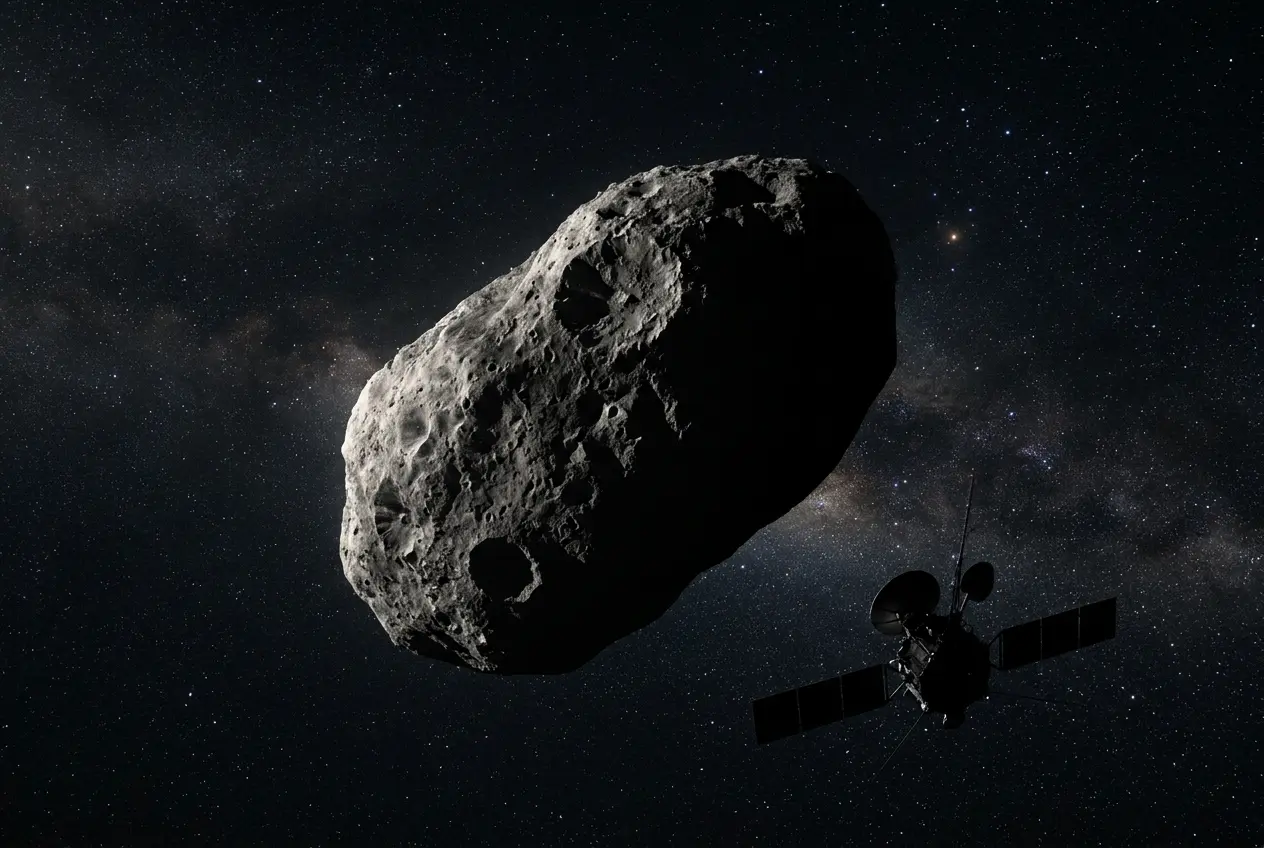
Around the size of a small office building and tucked into a one-to-one orbital resonance with Earth, Kamo’oalewa is one of seven quasi-moons of our planet catalogued to date. CNSA kept the close approach quiet while amateur satellite trackers at AMSAT-DL used Doppler data to confirm the rendezvous days before any agency statement. The 6 July announcement was China’s first official word on the arrival and included the probe’s first image of the rock, taken from about 20 kilometers on 2 July.
The 20-kilometer position is not a station-keeping orbit but a holding zone, with the spacecraft expected to dip in stages through 3 kilometers, 600 meters, and 300 meters above the asteroid as the science phase unfolds. Each stage adds precision to the surface map and tightens the sampling decision. No previous sample-return mission has orbited a body this small and this close to Earth. The arrival marks the first stop on a mission CNSA has framed as a decade-long tour of two small bodies.
The Asteroid Just Got Smaller
Tianwen-2’s first close-up suggests Kamo’oalewa is smaller than astronomers had thought, with the new image pointing to a diameter of just over 20 meters. Ground-based estimates had placed the asteroid somewhere between 40 and 100 meters across. The reading dovetails with a paper by Sharkey et al., posted to ArXiv on 1 July and still under peer review, which used the James Webb Space Telescope to estimate the diameter at around 18 meters.
So it seems that Kamo’oalewa is of asteroidal origin.
Mikael Granvik, an astronomer at the University of Helsinki and Luleå University of Technology in Sweden, told SpaceNews the Tianwen-2 image points to a high surface brightness for the asteroid, captured in the Tianwen-2 first image release and the diameter finding. That reading is incompatible with the Moon’s low-to-moderate albedo and supports an asteroidal origin. The alternate view holds that Kamo’oalewa was a chunk of the Moon’s far side, possibly blasted into space by the impact that carved the Giordano Bruno crater. The samples Tianwen-2 brings home will be the first material from any quasi-satellite of Earth to reach a terrestrial lab, and they should settle the question.
Three Ways to Grab a Sample
Engineers have not picked a single sampling method for Kamo’oalewa, because the surface itself is unknown. Tianwen-2 can pull regolith off the rock using any one of three different sampling techniques, with the choice driven by what close-up imaging and sounding radar reveal over the next year. The redundancy is deliberate: previous asteroid missions have arrived to find surfaces quite different from what was expected.
- Hover sampling: descend while matching the asteroid’s rapid rotation, a technique never before tested on an asteroid.
- Touch-and-go: the method Hayabusa2 used on Ryugu and OSIRIS-REx used on Bennu.
- Anchor and attach: use multiple arms to grip the rock before extraction, a first on an asteroid.
Kamo’oalewa rotates once every 28 minutes, a rate that argues against the rubble-pile structure common to larger asteroids and toward a single monolithic body. Anchoring would let the probe damp out that spin locally during contact, an option Hayabusa2 and OSIRIS-REx did not have at their target bodies, in an analysis of the Tianwen-2 sampling methods. Touch-and-go is the fallback if the surface turns out to be firmer than the radar suggests. Mission planners will pick between the three methods after the spacecraft finishes its close-up mapping at 3 kilometers, 600 meters, and 300 meters above the surface.
Site selection will draw on the next year of progressively closer passes, with the spacecraft dropping in three stages before any sample attempt. The departure window for the return leg opens on 24 April 2027, a date that doubles as China’s National Space Day. The return capsule is then expected to land on 29 November 2027, when Chinese space authorities will get their first look at the asteroid samples.
Where This Sits in the Asteroid Sample Race
Tianwen-2 is China’s first mission aimed at grabbing pieces of an asteroid and bringing them home, though it is not the first ever to try. NASA’s OSIRIS-REx returned material from Bennu on Sept. 24, 2023, the first U.S. asteroid sample to make it back. Japan’s Hayabusa2 dropped off regolith from Ryugu on Dec. 5, 2020. The original Hayabusa preceded it as the first spacecraft to return an asteroid sample at all.
| Mission | Country | Target | Sample return / status |
|---|---|---|---|
| Hayabusa | Japan | Itokawa | First asteroid sample return |
| Hayabusa2 | Japan | Ryugu | Dec. 5, 2020 |
| OSIRIS-REx | United States | Bennu | Sept. 24, 2023 |
| Tianwen-2 | China | Kamo’oalewa | Late Nov 2027 (planned) |
Each mission advanced a different technique: Hayabusa pioneered touch sampling, Hayabusa2 added subsurface retrieval through an artificial crater, and OSIRIS-REx used a much larger collection head to gather its sample. China’s mission enters this lineage with a different target class and a new set of sampling options. The asteroid work comes after Tianwen-1, China’s first interplanetary mission, which successfully landed a rover on Mars in 2021. The next step in the program is harder: Tianwen-3, a Mars sample-return mission scheduled for late 2028, will need to land, scoop material, and rocket it back off a planetary surface for the first time. Tianwen-2 is, in CNSA’s framing, the bridge between the lunar-sample-return experience and the harder Mars return.
A Decade of Targets Still Ahead
After sample collection, Tianwen-2 will not head home as one piece. The probe will release a return capsule carrying the asteroid material into Earth’s atmosphere on 29 November 2027. The main spacecraft fires engines for a gravity-assist slingshot past our planet on the same pass.
- Launch: 28 May 2025
- Arrival at 20 km station: 4 July 2026
- Departure from asteroid: 24 April 2027
- Capsule return to Earth: 29 November 2027
- Comet rendezvous (planned): 24 January 2035
From the gravity assist, the main probe points itself toward 311P/PANSTARRS, a main-belt comet that displays comet-like activity while orbiting the Sun between Mars and Jupiter. CNSA has scheduled the rendezvous for 24 January 2035, putting the spacecraft well past its tenth year in deep space by the time it arrives, per the Tianwen-2 mission profile and instrument timeline. The combined asteroid-and-comet tour is what makes Tianwen-2 a decade-class mission, with the science return only starting at Kamo’oalewa. None of the prior asteroid sample-return missions have continued on to a second small body after delivering their samples.
Tianwen-2 marks the first time Chinese deep-space engineering has been put to the test on a body smaller than a city block. The asteroid work reuses propulsion, imaging, and sampling hardware tested on earlier Chinese missions, including the Chang’e lunar sample returns. The full decade of the mission gives the program its longest sustained rehearsal before the next step.
Inside China’s Planetary Push
Tianwen-2 is the second of five planned missions in China’s Tianwen planetary program, a sequence sketched by researchers at the Chinese Academy of Sciences in 2018. The first, Tianwen-1, arrived at Mars in 2021 and landed the Zhurong rover, giving China’s deep-space program its first foothold beyond the Earth-Moon system. Tianwen-2 trades that single-body study for a tour of two small worlds.
Tianwen-3, a Mars sample-return mission scheduled for late 2028, is up next. The return capsule from Mars will hit Earth’s atmosphere at roughly 12 kilometers per second, a faster speed than the entries China’s Chang’e 5 and Chang’e 6 missions have flown. CNSA has framed Tianwen-2’s asteroid work as a rehearsal, with the anchor-and-attach technique and the high-speed entry designed to be tested under conditions similar to the Mars mission’s. Asteroid practice is, in that sense, the practice lap for the harder Mars return.
Tianwen-4, targeted for around 2030, is meant for the Jupiter system, with Callisto, the outermost of the planet’s four large moons, as the focus. None of the follow-on missions have launched yet. The deep-space program’s true test is whether it can sustain a cadence of one mission every few years through the early 2030s.
The Tianwen-2 mission has, by CNSA’s own framing, two jobs: collect the samples, and prove that China can run a decade-long robotic tour beyond the Moon. The first asteroid window closes when the probe departs on 24 April 2027. The second window opens when the main spacecraft reaches the comet 311P/PANSTARRS in January 2035. Everything in between is a sustained test of the country’s deep-space engineering, with cameras, sampling arms, and propulsion hardware working in sequence for the first time. The science from Kamo’oalewa lands first, in late 2027.
Frequently Asked Questions
What is asteroid Kamo’oalewa?
Kamo’oalewa, also catalogued as 2016 HO3, is a small near-Earth asteroid discovered in Hawaii in 2016. It is one of seven quasi-moons of Earth catalogued to date, bodies that circle the Sun in near-lockstep with our planet’s orbit and appear to drift around it over many years.
When will Tianwen-2 bring samples back to Earth?
Tianwen-2 is scheduled to depart Kamo’oalewa on 24 April 2027 and release its return capsule into Earth’s atmosphere on 29 November 2027. The full mission runs for about a decade, with the main probe continuing on to a comet in the main asteroid belt.
Is Kamo’oalewa a piece of the Moon?
For most of the past decade, the leading hypothesis held that Kamo’oalewa was a chunk of the Moon’s far side, possibly blasted off by the impact that formed the Giordano Bruno crater. Early images from Tianwen-2, combined with James Webb Space Telescope readings, point instead to an asteroidal origin, possibly a rare E-type silicate body from the inner main belt. The samples will be the next test.
How does Tianwen-2 compare to OSIRIS-REx and Hayabusa2?
China’s mission comes after NASA’s OSIRIS-REx, which returned asteroid material to Earth on Sept. 24, 2023, and Japan’s Hayabusa2, which returned Ryugu samples on Dec. 5, 2020. Hayabusa, the predecessor mission from Japan’s space agency, was the first ever to bring asteroid material back. Tianwen-2 is the first mission to target a quasi-satellite of Earth and the first to attempt anchor-and-attach sampling at an asteroid.






Spotify Running Mode hits Android and revives its old tempo experiment

Galaxy Tab S12 Ultra Renders Keep the Notch Fans Hate

Novato Spinning Round House Sells With Six Neighbors for $3.3 Million

Crop Tour Finds Indiana and Nebraska Corn Yields Lagging 2025

Best Buy 60th sale brings Android deals back to its roots

American Airlines reverses seatback screen bet years too late

Iran Hormuz Strikes Force Gulf Oil Onto Costlier Paths

Plague Tale Prequel Day One Joins Game Pass Wave 2 as Witcher Exits

NBA 2K27 opens The City to everyone and rewrites career eras

iOS 26.6.1 Patches 29 Flaws as AI Forces Faster Apple Updates

Double Fine Cuts 23 Jobs Weeks After Xbox Independence

Day-One Big Walk Lifts PS Plus August Beyond Recycled AAA

John Hight Exits Wizards After Digital Reckoning Hits

Curtis Mead’s Red Sox Debut Ends With Fractured Wrist

Moesch and Dressel Rewrite Night One at 2026 U.S. Nationals

Red Sox Squander Hot Streak Chance in 4-3 Loss to Athletics

Boutte’s Quiet Camp Takeover Forces Patriots Receiver Choices

Take-Two CEO Pushes Netflix Subs for GTA 6 Extended Look

Halo Campaign Evolved Skulls Meet Death Barriers That Kill the Hunt

Wildlands Free Update Hands Players the Tools They Already Invented
-

 TECHNOLOGY3 years ago
How to Adjust a Bulova Watch Band – An Easy Guide
-

 News3 years ago
Fred Pentland: Athletic Bilbao’s English mentor who changed the essence of Spanish football
-

 FINANCE3 years ago
Tax Planning for Every Season: Guide to Maximizing Your Tax Benefits
-

 Education3 years ago
African Ministers New Education Plan
-

 BUSINESS3 years ago
What is Entrepreneurial Operating System? A Comprehensive Guide to EOS
-

 Education3 years ago
Innovate Your Learning Journey with Technology and Enhance Education
-

 News3 years ago
Russians formally out of World Athletics Championships
-

 BUSINESS3 years ago
Top 9 Most Expensive American Cities to Rent an Apartment