
News
Neanderthals and Homo Sapiens Shared Culture at a Turkish Cave
Neanderthals and Homo sapiens hunted the same prey and curated the same seashells at a Turkish cave across roughly 20,000 years, a new PNAS study finds.

Neanderthals and Homo sapiens hunted the same prey, made the same stone tools and selectively collected the same seashells during separate occupations of a 56-square-metre cave on Turkey’s Mediterranean coast, according to a study published Monday in the journal PNAS.
The find, from Üçağızlı II Cave just north of the Syrian border, is the clearest evidence yet that the two closely related species shared more than biology when they crossed paths in the Levant. It also narrows the visible space between their lives, which makes the deeper question of what eventually separated them harder to answer, not easier.
The 56-Square-Metre Cave Layered in 20,000 Years of Toolkits
Üçağızlı II Cave sits on a narrow coastal strip just north of Syria, in a stretch of shoreline that acted as a prehistoric corridor between the Levant and Eurasia. The first full archaeological dig at the 56-square-metre site began in 2020, run by Naoki Morimoto, a paleoanthropologist at Kyoto University, and an international team from Türkiye, France and Japan. The cave itself, about the size of a city studio apartment, has now produced a continuous archaeological sequence that bridges the two species’ time on the ground.
Five years of study of cultural continuity at Üçağızlı II Cave relied on millimeter-by-millimeter excavation, pulling out teeth, a partial jawbone, stone tools, animal bones and seashells one layer at a time. The team dated the sediment using optically stimulated luminescence, a technique that reveals how long ago buried mineral grains last saw sunlight. Neanderthals inhabited the cave between approximately 77,000 and 59,000 years ago, and Homo sapiens moved in afterward, from approximately 59,000 to 47,000 years ago. Across the entire sequence, the stone-tool technology stayed “substantially uniform,” the researchers wrote, with both groups drawing flint from the same local sources.
Nearly 20,000 stone artifacts came out of the dig. Both groups hunted the same four prey species, identified from bones scattered through every layer of the cave:
- Wild goats (Capra aegagrus)
- Fallow deer (Dama mesopotamica)
- Roe deer (Capreolus capreolus)
- Wild boar (Sus scrofa)
That kind of stability, persisting through a biological handover from one human species to another, is what makes the find news. The team frames the continuity as cultural, grounded in what they found in the cave’s smallest and strangest layer. That same combination of sameness and symbolic choice runs through the rest of the deposit. It also matches work at other Levantine sites, where similar reads have been pulling the cultural gap narrower.
For much of the Late Pleistocene, the eastern Mediterranean shore was the narrow throat through which any expanding human population had to pass. Geography that size rewards groups who know the local flint sources and the seasonal movement of game. The Üçağızlı II record suggests both species did, and on the same schedule.
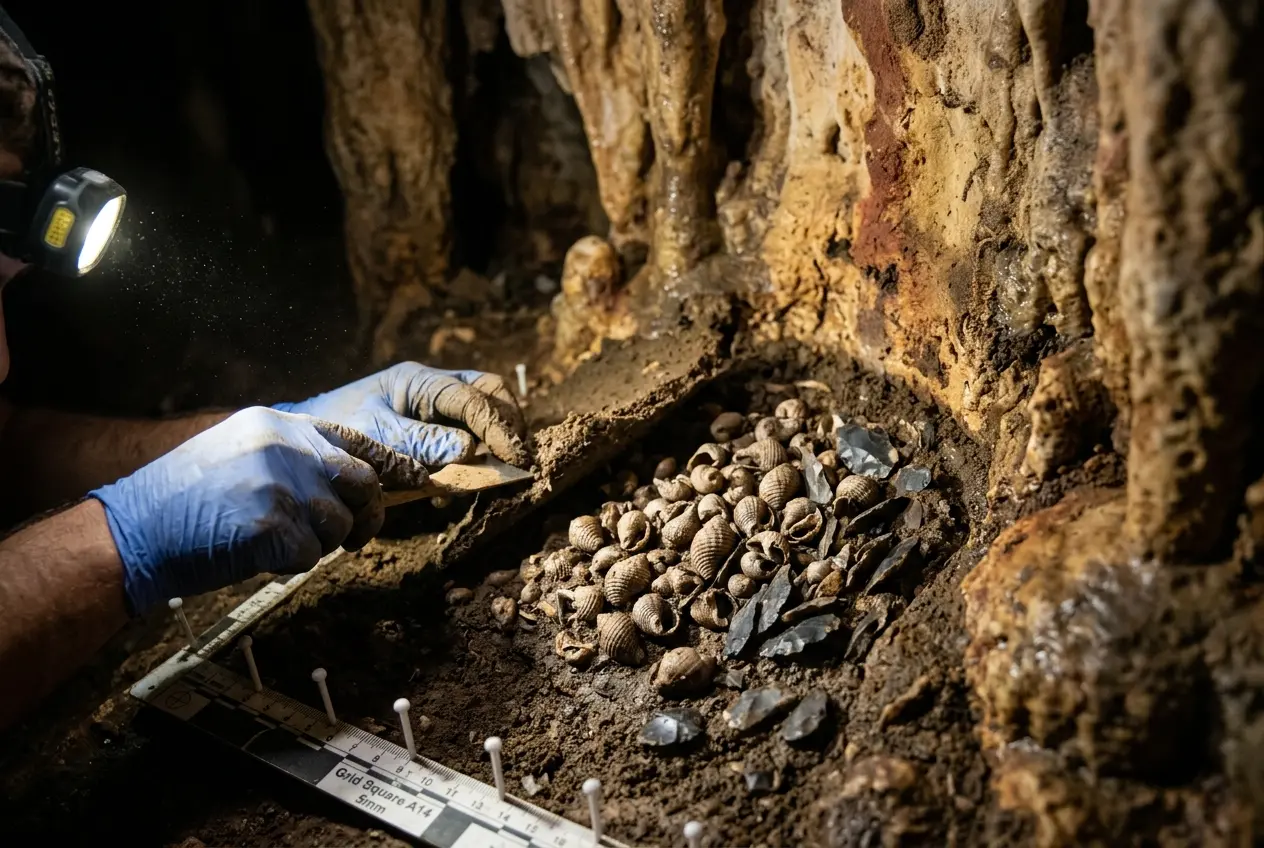
A Shell That Both Groups Chose to Carry
Layer after layer turned up 29 shells of Columbella rustica, a small marine snail with no food value to either species. Across every occupation phase, the shells outnumbered every other shell type in the cave.
Some of the shells were pierced as if meant to be strung, and one shell from the Neanderthal layer showed signs of deliberate heating that altered its color. Both species kept Columbella rustica intact most of the time, but in a few cases the shell tip was broken off or a small hole bored through it, behavior consistent with personal ornament. Columbella rustica appears in low numbers at other archaeological sites, and Morimoto’s team argues the density here is what makes the case.
Our findings indicate a deep level of cultural interaction. These two distinct but closely related human groups were not just adapting to the same environment: they were probably sharing symbolic preferences.
Morimoto, in a statement accompanying the study.
The shells sit in younger deposits than the recently dated 66,700-year-old Neanderthal hand paintings in Spain, evidence that Neanderthal symbolic behavior runs back well before any confirmed contact with Homo sapiens. Both species, in this paper, are selecting shells with no use as food or tool, the working definition of a symbolic choice in the archaeological record. The team’s preferred reading is regional contact and cultural exchange between two populations that occupied overlapping territory without directly sharing the cave. They are explicit that this is a hypothesis, not a proof.
The paper hedges that point clearly because it is the easiest claim to overreach on. Cultural continuity in tools and prey can be explained by independent adaptation to the same environment, a possibility the authors do not dismiss. The shell preference is the harder piece to explain that way, and the one the authors rest their case on.
Telling the Two Apart by Tooth Microstructure
Identifying which species left which layer is not a matter of large skeletons, because the cave yielded only teeth and a partial jawbone. The team distinguished Neanderthal from Homo sapiens remains by analyzing the internal structure of the fossilized teeth, a method used elsewhere to track dental development in other archaic humans.
Optically stimulated luminescence dated the surrounding sediment, which is how the team placed Neanderthals between approximately 77,000 and 59,000 years ago and Homo sapiens from approximately 59,000 to 47,000 years ago. Two independent methods of dating converging on the same sequence is what allows the cultural comparison to work in the first place. Millimeter-by-millimeter excavation meant each layer could be linked to a specific species, not lumped across both. The team also stress-tested the overlap using faunal and lithic data, and held up.
Three Caves, Three Different Pictures
Üçağızlı II is the newest data point in a wider mosaic of caves along and beyond the Neanderthal range. Comparing it against two well-studied sites turns the Turkish result into a regional argument.
The closest cousin sits in Israel, at Tinshemet Cave, where researchers reported in 2025 that Neanderthals and Homo sapiens left similar behavioral traces from approximately 130,000 to 80,000 years ago. That window is far earlier than Üçağızlı II, but the cultural pattern runs in the same direction, with behavioral uniformity between the two species. The two sites sit in the same Levantine corridor that runs north along the eastern Mediterranean, narrow enough that both species occupied the same coastal plain across tens of thousands of years. Researchers on the Tinshemet Cave study on shared Levantine behavior concluded that the cultural handoff at the species changeover was gradual.
On the other side of the comparison, Mandrin Cave in southern France looks like the opposite case. Neanderthals and modern humans there are thought to have alternated occupation in distinct pulses from about 56,800 to 41,500 years ago, and the layers they left behind do not show the same continuity in stone tools or symbolic objects. The Mandrin Cave findings on alternating Neanderthal occupation describe a sequence in which one species pushed the other out, and the material culture changed with it.
| Site | Location | Hominin dates | Cultural pattern |
|---|---|---|---|
| Üçağızlı II | Southern Türkiye, Mediterranean coast | Neanderthals ~77,000-59,000 ya; Homo sapiens ~59,000-47,000 ya | Same stone tools, same prey, same prized shells in every layer |
| Tinshemet | Central Israel | Neanderthals and Homo sapiens between ~130,000-80,000 ya | Burials and assemblages show behavioral uniformity between the two species |
| Mandrin | Southern France | Alternating Neanderthal and Homo sapiens pulses from ~56,800-41,500 ya | Distinct occupation pulses, no continuous shared culture |
Read together, the three sites describe a region in flux, with biological turnover happening in every case and cultural turnover tracked only sometimes. The Üçağızlı II sequence and the Tinshemet record both support the read that handover can be gradual. The Mandrin record shows it can also be sharp, with material culture changing in step with the species change. None of the three is a clean fit for a single model of how Neanderthals and Homo sapiens relate, and their differences are part of why the Turkish paper is generating discussion, not closure.
What Divided Them Now Looks Harder to Find
That compatibility raises a sharper question, since the two species did not end up sharing the planet. Neanderthals went extinct roughly 40,000 years ago, well after the final occupations at Üçağızlı II. Two species cannot occupy the same ecological niche indefinitely, and archaeologists are still working out which differences tipped the balance. Some of the candidate explanations rest on cognitive differences that the new evidence puts under heavier strain.
A long line of research has suggested Neanderthals were less cognitively flexible than modern humans, with a more limited capacity for language and a thinner self-awareness than H. sapiens. April Nowell, a Paleolithic archaeologist at the University of Victoria in Canada who was not involved in the new study, says the cultural sameness cuts against that picture. The finding does not erase the cognitive case, but it compresses the room available for cognitive differences in the archaeological record. Neanderthal craft, attested in pieces like the 200,000-year-old wooden hunting spears from Schöningen, Germany, shows the technical capability was there long before the Üçağızlı II window. The pushback against the cognitive-flexibility narrative is itself a research front, and the Üçağızlı II data lands inside that argument.
By demonstrating cultural continuity and elevated levels of interaction, sites such as Tinshemet and Üçağızlı II are changing what we thought we knew about Neandertals, Homo sapiens and other contemporary Homo groups … a fascinating region just got even more so!
Nowell, University of Victoria, in an email.
John Gowlett at the University of Liverpool said the puzzle of how the two species relate “has gone from 100 to 1000 pieces,” a sign that every well-dated site adds new complexity. Chris Stringer at the Natural History Museum in London tied the cultural continuity to the genetic record, noting that recent studies suggest Neanderthals and Homo sapiens interbred in the Levant around 100,000 years ago. The story of what separated them now has to fit inside a behavioral record that looks this close, and the differences that did the work may be ones the fossil record cannot show.
The Questions the Authors Leave Open
The authors themselves name the open questions. When and where the shared practices took shape is still unknown, and whether the similarities grew because the two species mated with each other remains a hypothesis the team’s data cannot test on its own.
Ongoing and future excavations at the site may help answer some of those questions. Stringer noted the Üçağızlı II samples are too small to show population-level variation. The team frames the work as building a more complete picture of human evolution and cultural development during the Late Pleistocene.






Spotify Running Mode hits Android and revives its old tempo experiment

Galaxy Tab S12 Ultra Renders Keep the Notch Fans Hate

Novato Spinning Round House Sells With Six Neighbors for $3.3 Million

Crop Tour Finds Indiana and Nebraska Corn Yields Lagging 2025

Best Buy 60th sale brings Android deals back to its roots

American Airlines reverses seatback screen bet years too late

Iran Hormuz Strikes Force Gulf Oil Onto Costlier Paths

Plague Tale Prequel Day One Joins Game Pass Wave 2 as Witcher Exits

NBA 2K27 opens The City to everyone and rewrites career eras

iOS 26.6.1 Patches 29 Flaws as AI Forces Faster Apple Updates

Caitlin Clark Skips the WNBA 3-Point Contest for a Third Straight Year

Rainout Gives Red Sox Two Shots at a Franchise-Record Win Streak

Double Fine Cuts 23 Jobs Weeks After Xbox Independence

John Hight Exits Wizards After Digital Reckoning Hits

Day-One Big Walk Lifts PS Plus August Beyond Recycled AAA

Curtis Mead’s Red Sox Debut Ends With Fractured Wrist

Red Sox Squander Hot Streak Chance in 4-3 Loss to Athletics

Moesch and Dressel Rewrite Night One at 2026 U.S. Nationals

Boutte’s Quiet Camp Takeover Forces Patriots Receiver Choices

Take-Two CEO Pushes Netflix Subs for GTA 6 Extended Look
-

 TECHNOLOGY3 years ago
How to Adjust a Bulova Watch Band – An Easy Guide
-

 News3 years ago
Fred Pentland: Athletic Bilbao’s English mentor who changed the essence of Spanish football
-

 FINANCE3 years ago
Tax Planning for Every Season: Guide to Maximizing Your Tax Benefits
-

 Education3 years ago
African Ministers New Education Plan
-

 BUSINESS3 years ago
What is Entrepreneurial Operating System? A Comprehensive Guide to EOS
-

 Education3 years ago
Innovate Your Learning Journey with Technology and Enhance Education
-

 News3 years ago
Russians formally out of World Athletics Championships
-

 BUSINESS3 years ago
Top 9 Most Expensive American Cities to Rent an Apartment