
Health
Superpotent Thyroid Lot Recall Flags Broader DTE Risks
One lot of Vitruvias 30 mg desiccated thyroid tablets is recalled as superpotent, spotlighting potency swings in unapproved animal-derived drugs used by 1.5.

Vitruvias Therapeutics is voluntarily recalling one lot of its Thyroid Tablets, USP 30 mg after testing confirmed the potential for superpotency, the FDA published Monday. Lot 504950 reached about 1,955 patients nationwide before the pull.
The batch is small. Yet it lands inside a longer pattern of potency swings in unapproved desiccated thyroid extract products that still reach an estimated 1.5 million Americans each year.
That pattern matters because thyroid replacement sits in a narrow therapeutic window. A tablet that delivers more hormone than labeled can push a stable patient into hyperthyroid symptoms. The reverse, too little hormone, leaves hypothyroidism untreated. Both failures have appeared in recent months across animal-derived and synthetic products alike.
The Lot Numbers That Matter
The company, based in Auburn, Alabama, announced the consumer-level recall on August 21. The FDA posted the notice on August 24. Testing showed the tablets could deliver more hormone than the label claims.
Only this lot is affected. Patients can match the identifiers on their bottle against the official list.
| Detail | Value |
|---|---|
| Product | Thyroid Tablets, USP 30 mg |
| NDC | 69680-166-00 |
| Lot | 504950 |
| Expiration | Sept. 30, 2026 |
| Units released | 3,655 |
| Units sold | 1,955 |
| Distribution window | Jan. 31, 2025 to Sept. 30, 2025 |
The tablets went to the company’s direct accounts across the United States. Vitruvias is telling wholesalers to stop shipping remaining stock and is arranging destruction. No adverse events linked to this lot have been reported to the firm so far.
- 3,655 units left the plant
- 1,955 reached patients
- Zero known adverse events tied to the lot
- Nationwide direct-account distribution only
Roughly half the released stock never reached a patient. The unsold balance is now under quarantine and destruction orders, which limits further exposure even if the sold units remain in home medicine cabinets.
Full details appear in the FDA company announcement for lot 504950.
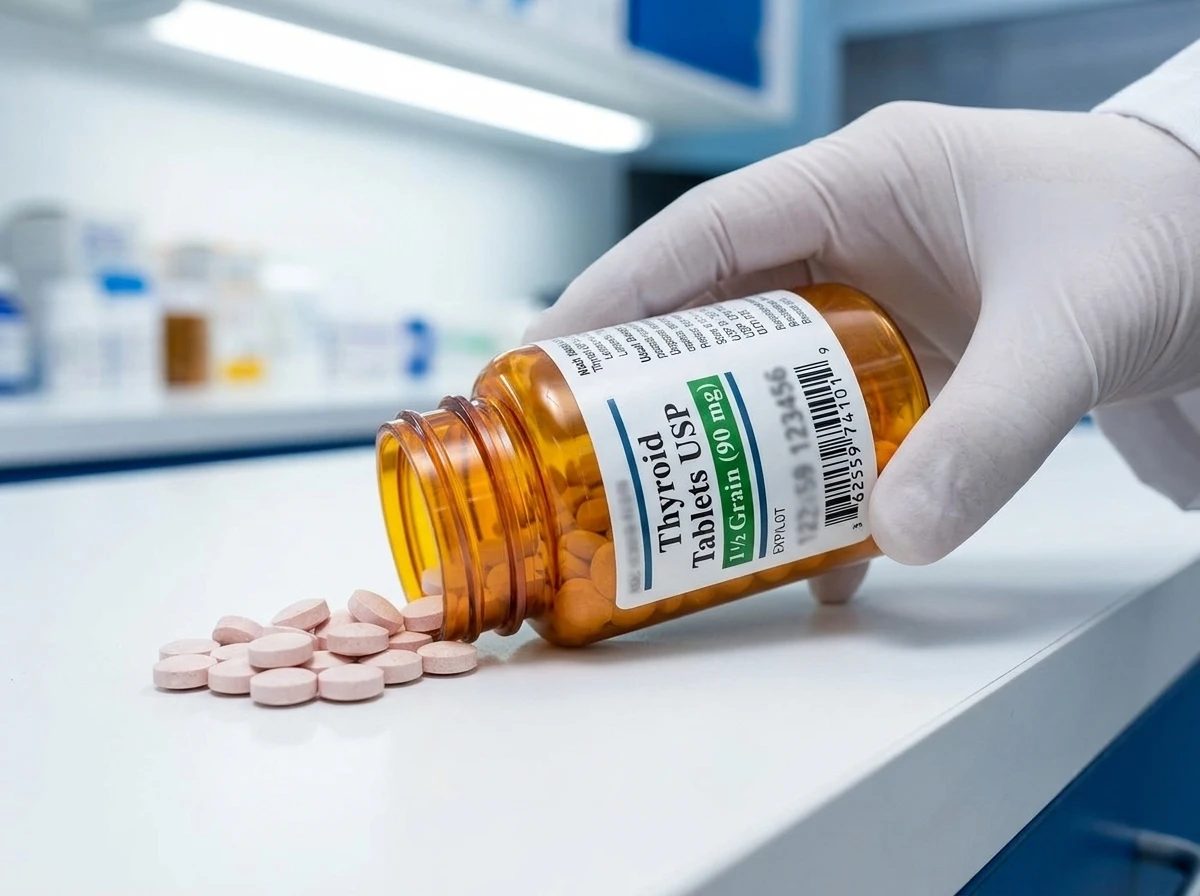
What Superpotent Thyroid Tablets Can Do
Thyroid, USP is a natural preparation made from porcine thyroid glands. It contains both levothyroxine (T4) and liothyronine (T3). Doctors prescribe it for hypothyroidism, an underactive thyroid.
Too much hormone flips the problem into hyperthyroidism. The company listed the possible effects clearly.
- Weight loss and heat intolerance
- Fatigue, nervousness and muscle weakness
- High blood pressure and chest pain
- Rapid heart rate or heart rhythm disturbances
Elderly patients face higher cardiac risk from excess hormone. Pregnant patients face higher rates of premature delivery and low birth weight with overtreatment. Infants can see negative effects on growth and development. The risk rises with longer exposure.
Because the same tablet is taken daily, a superpotent lot does not produce a one-time spike. It produces a sustained excess for as long as the bottle lasts. That is why the company and the FDA both stress contacting a clinician rather than simply discarding the medicine and waiting.
Patients who have the recalled lot should not stop the medicine on their own. Abrupt withdrawal of thyroid hormone can itself cause problems. Contact a healthcare provider first for guidance or a replacement prescription.
Why Animal-Derived Thyroid Keeps Showing Up in Recalls
Desiccated thyroid extract, or DTE, has been used for more than a century. It predates modern synthetic levothyroxine. None of the currently marketed DTE products has ever received full FDA approval as a new drug or biologic. They continue under historical marketing and risk-based enforcement.
Because the source material is ground animal glands, hormone content can vary from batch to batch and even within a batch. Synthetic levothyroxine is manufactured to exact molecular specifications and has been FDA-approved for decades. Professional guidelines from the American Thyroid Association and others name synthetic levothyroxine as the preferred first-line treatment.
The FDA has documented its concerns repeatedly. Tablets from the same manufacturing run of animal-derived material may not deliver consistent hormone levels. Too much or too little can produce real clinical consequences. Impurity risks from the animal source add another layer. The agency notes more than 500 adverse-event reports tied to these products from 1968 through early 2025, with a spike around earlier potency recalls.
- 2020, Multiple DTE lots pulled for subpotency, including Nature-Throid and WP Thyroid
- August 2025, FDA letters to manufacturers signal intent to tighten enforcement and require biologics license applications
- July 2026, Major Pharmaceuticals recalls multiple strengths of levothyroxine for subpotency
- August 2026, Vitruvias lot 504950 recalled for potential superpotency
Vitruvias itself entered the DTE market more recently, around early 2024, as one of several new suppliers after earlier compliance shifts. The FDA concerns on unapproved animal-derived thyroid page lays out the agency’s current stance and the roughly 1.5 million outpatient prescriptions for these products in 2024, against about 22 million for levothyroxine.
| Measure | Desiccated thyroid (DTE) | Synthetic levothyroxine |
|---|---|---|
| Source | Porcine thyroid glands | Manufactured T4 molecule |
| Hormone content | T4 and T3 plus glandular components | T4 only, exact specifications |
| FDA approval status | Never fully approved as new drug or biologic | Fully approved for decades |
| 2024 outpatient prescriptions | About 1.5 million | About 22 million |
| Batch consistency concern | Documented potency swings | Subject to ordinary manufacturing failures |
The prescription gap shows most clinicians already follow guideline preference for the synthetic. The remaining DTE volume is still large enough that a single superpotent lot can reach nearly two thousand patients before a recall catches it.
A Synthetic Recall Hit Weeks Earlier
The Vitruvias action followed a larger July recall of levothyroxine sodium tablets distributed by Major Pharmaceuticals. Those lots were found subpotent, meaning they delivered less hormone than labeled. Multiple strengths and lot numbers were involved. The FDA classified the action, and patients were told to return product and consult their doctors.
One week the problem is too little hormone. The next it is too much. Both hit the same narrow therapeutic window. Thyroid replacement requires precise dosing. Small swings can push patients out of the target range and into symptoms or, in vulnerable groups, more serious events.
Synthetic products are still subject to manufacturing failures, as the Major case shows. Yet they operate under full FDA approval, bioavailability standards and ongoing oversight that DTE products have never fully entered.
The contrast is procedural rather than absolute safety. When a synthetic lot fails, the firm and the agency work inside an established approval framework. When a DTE lot fails, the same recall tools apply, but the underlying product has never cleared the full application path the FDA now says it intends to require.
Who Still Chooses Desiccated Thyroid
Some patients report feeling better on DTE than on levothyroxine alone. The combination of T4 and T3, plus other glandular components, is the usual explanation offered by those who prefer it. The American Thyroid Association statement on DTE acknowledges that a subset of patients elect these products and supports personalized therapy while still naming levothyroxine as standard.
The same statement notes the FDA’s August 2025 letters signaling a move toward requiring proper marketing applications. Manufacturers have been told to prepare. Enforcement remains risk-based for now. Quality failures that put patients at clear risk, such as confirmed super- or subpotency, already trigger recalls.
On X, reaction to this specific lot was mostly straightforward news shares. One radiologist highlighted the hyperthyroidism risk. Longer-running conversation in thyroid communities treats brand and batch variability as a known fact of natural thyroid use. Patients already track symptoms and temperatures carefully. That lived experience of inconsistency is exactly what the FDA cites as a structural concern.
How Batch Variation Reaches the Patient
The mechanism behind repeated DTE recalls starts with the raw material. Ground porcine glands are not a uniform chemical feedstock. Hormone content can differ between animals, between processing runs, and even inside a single finished lot. Finished tablets therefore carry an inherent risk that labeled strength and actual delivered dose will diverge.
When testing later flags superpotency, the clinical pathway is straightforward. Daily dosing multiplies the excess. Patients who were stable on a prior bottle may notice heat intolerance, tremor, or palpitations only after several days or weeks on the new lot. Elderly patients and those with underlying heart disease sit at the upper end of that risk curve. Pregnant patients and infants face separate developmental stakes already listed by the company.
Subpotency travels the opposite path. Underdosed tablets leave TSH elevated and symptoms of hypothyroidism unresolved. The July Major Pharmaceuticals levothyroxine recall and the 2020 Nature-Throid and WP Thyroid actions both followed that pattern. Superpotency and subpotency are mirror failures of the same consistency problem.
- Source glands vary before any tablet is pressed
- Finished lots can drift above or below labeled strength
- Daily use turns a small drift into sustained over- or under-treatment
- Vulnerable groups absorb the clinical cost first
Synthetic levothyroxine avoids the glandular source problem by building a single molecule to specification. It can still fail in manufacturing, as the Major case showed. It cannot fail for the biologic reason that the starting material itself is inconsistent.
What the Enforcement Letters Signal Next
The FDA’s August 2025 letters told DTE manufacturers to prepare biologics license applications. That step would move the category out of historical marketing and into the same approval framework that governs other biologics. Until applications are filed and reviewed, enforcement stays risk-based. Confirmed potency failures already meet the bar for recall.
Vitruvias entered the market around early 2024, after earlier suppliers exited or faced compliance pressure. New entrants inherit the same unapproved status and the same batch-variability exposure. Lot 504950 is one illustration. The 2020 multi-lot subpotency recalls were another. The agency’s adverse-event tally, more than 500 reports from 1968 through early 2025, supplies the longer record behind the current posture.
For the estimated 1.5 million patients still filling DTE prescriptions, the practical near term is unchanged: check lot numbers, do not stop therapy abruptly, and treat any new hyperthyroid symptoms as a reason to call the prescriber. The longer term depends on whether manufacturers pursue the applications the agency has now requested and how quickly risk-based enforcement tightens around products that do not.
What Patients and Pharmacies Should Do Right Now
Check the bottle. Match NDC 69680-166-00 and lot 504950. If it matches, call the prescriber or pharmacist before making any change. If it does not match, no action is needed for this recall.
- Do not stop thyroid hormone suddenly
- Contact the healthcare provider for replacement options
- Report any suspected problems to a physician
- Consumers can reach Vitruvias at safety@vitruvias.com or 256-239-9373, Monday-Friday 9 a.m. to 5 p.m. CT
- Adverse events can also go to the FDA MedWatch adverse event reporting program
Pharmacies and wholesalers receiving the notice should quarantine remaining stock of the lot and follow the destruction instructions from the company. The recall is being conducted with FDA knowledge.
The lot itself is finite and already months into its distribution life. The larger question for the 1.5 million patients on DTE products is how long the current market of unapproved animal-derived tablets continues under the existing enforcement posture, and whether the next potency finding arrives as a subpotent or superpotent batch.
Frequently Asked Questions
How can I tell if my thyroid tablets are part of the Vitruvias recall?
Look for NDC 69680-166-00, lot number 504950 and expiration date Sept. 30, 2026 on the bottle or packaging of Thyroid Tablets, USP 30 mg. Only that combination is included; other lots and strengths from the same company are not affected by this action.
What are the main symptoms of taking superpotent thyroid medication?
Excess hormone can produce weight loss, heat intolerance, fatigue, nervousness, muscle weakness, elevated blood pressure, chest pain, rapid heartbeat or irregular heart rhythms. These effects can appear more quickly and severely in older adults, pregnant patients and infants.
Is desiccated thyroid the same as levothyroxine?
No. Levothyroxine is a synthetic T4 hormone made to exact specifications and fully FDA-approved. Desiccated thyroid extract is ground porcine thyroid gland containing both T4 and T3 plus other components; current products have never received full FDA approval as new drugs or biologics and can show greater batch-to-batch variability.
Should I stop taking my thyroid pills if they match the recalled lot?
No. The company and FDA both advise against stopping without first speaking to a healthcare provider. Sudden discontinuation of thyroid replacement can cause its own set of hypothyroid symptoms and risks; a doctor can arrange a safe switch or replacement.
How many patients use animal-derived thyroid products in the United States?
FDA figures show an estimated 1.5 million patients received prescriptions for unapproved animal-derived thyroid medications from outpatient retail and mail-order pharmacies in 2024, compared with roughly 22 million for synthetic levothyroxine.
Disclaimer: This article is news reporting and analysis based on FDA announcements and related public sources for informational purposes only. It does not constitute medical advice, diagnosis, or treatment recommendations of any kind. Readers who take thyroid medication or suspect they have the recalled lot should consult their own physician, endocrinologist, or pharmacist before making any change to their regimen. Figures, lot details, and guidance reflect the sources available as of August 26, 2026, and may be updated by regulators or the company.


Iowa Farmer Built Resilience for 16 Years Then Tariffs Hit Hard

HHS Adds FDA Tech and Drugs Deputies to Lock In AI and Review Power

Nvidia Earnings Carry a Built-In Sell-the-News Trap

HP Licenses Huawei Wi-Fi Patents Despite the Entity List

Poland Named in $131B F-15 Deal Echoes Apache Path

Sewer Scavengers Near Penn Station Repeat a Decades-Old NYC Pattern

Second Muni Fatigue Crash Exposes Surface Line Gaps

Chick-fil-A Chicken and Waffles Closes Its 80-Year Loop

Musk Data Centers Leave a Mississippi Family’s Historic Land Empty

OpenAI Data Center Chief Exits as Stargate Strategy Shifts

Double Fine Cuts 23 Jobs Weeks After Xbox Independence

Day-One Big Walk Lifts PS Plus August Beyond Recycled AAA

John Hight Exits Wizards After Digital Reckoning Hits

Curtis Mead’s Red Sox Debut Ends With Fractured Wrist

Moesch and Dressel Rewrite Night One at 2026 U.S. Nationals

Red Sox Squander Hot Streak Chance in 4-3 Loss to Athletics

Boutte’s Quiet Camp Takeover Forces Patriots Receiver Choices

Take-Two CEO Pushes Netflix Subs for GTA 6 Extended Look

Halo Campaign Evolved Skulls Meet Death Barriers That Kill the Hunt

Wildlands Free Update Hands Players the Tools They Already Invented
-

 TECHNOLOGY3 years ago
How to Adjust a Bulova Watch Band – An Easy Guide
-

 News3 years ago
Fred Pentland: Athletic Bilbao’s English mentor who changed the essence of Spanish football
-

 FINANCE3 years ago
Tax Planning for Every Season: Guide to Maximizing Your Tax Benefits
-

 Education3 years ago
African Ministers New Education Plan
-

 BUSINESS3 years ago
What is Entrepreneurial Operating System? A Comprehensive Guide to EOS
-

 Education3 years ago
Innovate Your Learning Journey with Technology and Enhance Education
-

 News3 years ago
Russians formally out of World Athletics Championships
-

 BUSINESS3 years ago
Top 9 Most Expensive American Cities to Rent an Apartment