
News
Android 17 Makes Domain Hiding an OS Default
Android 17 enables Encrypted Client Hello OS-wide with GREASE, local network locks, CT defaults and carrier 2G kill switches.

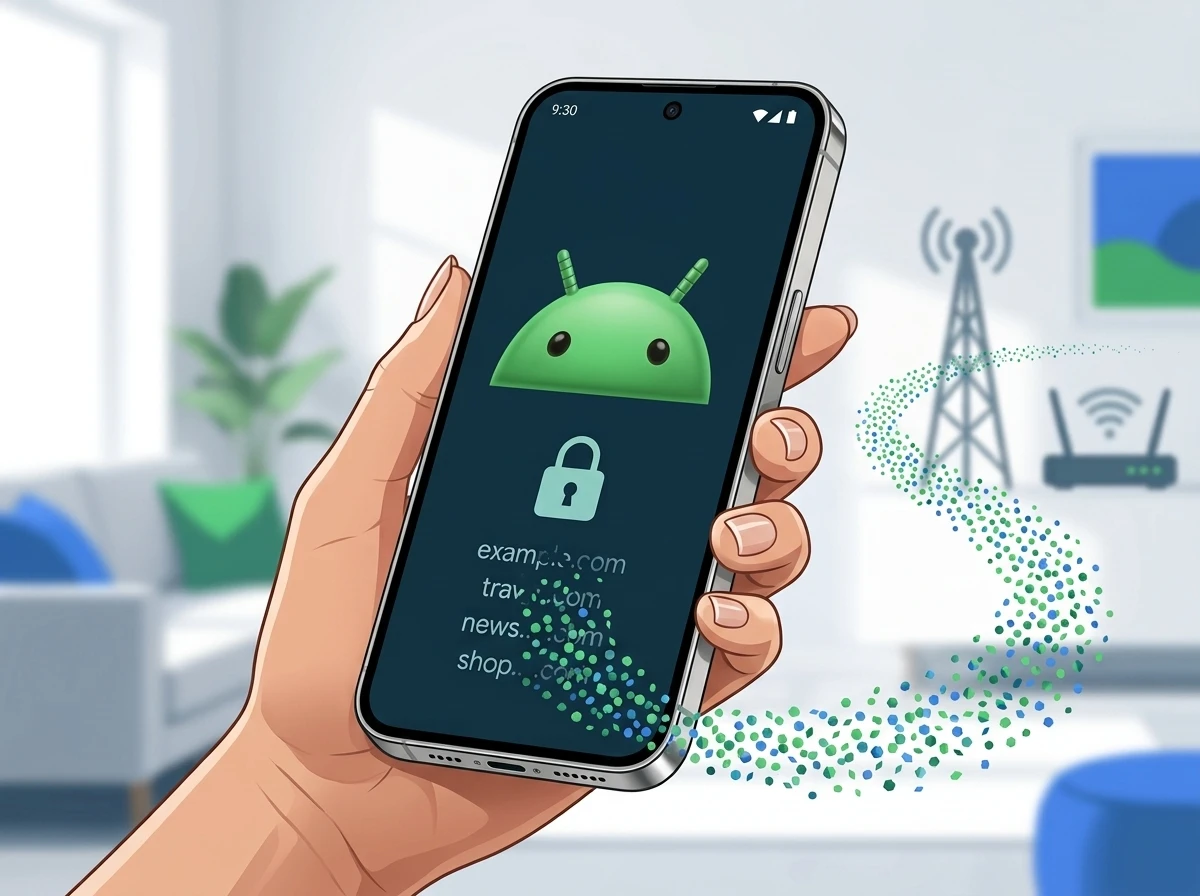
Android 17 turns on Encrypted Client Hello across the operating system, encrypting the domain name in the TLS handshake so that carriers, Wi-Fi operators and network snoopers can no longer read which sites or apps a phone is reaching for supported connections. Google announced the change on August 27, 2026, calling it the first broad rollout on a major mobile OS and pairing it with three other network defenses.
The move closes a long-standing metadata leak that sat beside HTTPS encryption itself. Domain names still spilled out in two places: the DNS lookup and the cleartext Server Name Indication inside the ClientHello. Private DNS already covered the first for many users. ECH now targets the second.
Together the pair forms a practical minimum. Without both, one of the two leaks remains open. Android 17 makes the second half of that minimum an operating-system default rather than an optional browser toggle.
How Encrypted Client Hello Seals the Handshake Leak
Even a fully encrypted HTTPS session begins with a ClientHello message that traditionally named the destination in plain text. Network observers could log every domain and stitch those logs into profiles for advertising, phishing or surveillance. ECH encrypts that name with a key only the destination server can open.
Android 17 enables ECH GREASE by default. When a server does not support the real protocol, the client still sends a randomized fake ECH extension so every connection looks identical from the outside. Google’s Jigsaw division measured the approach against the top 10,000 domains and found zero change in connection success rates. Tests across 202 countries and 740 ISPs, including heavily filtered networks, showed virtually no interference.
The protection works only when three conditions line up:
- The app targets Android 17 (API level 37) or higher.
- Its networking library supports ECH.
- The remote server offers it.
OkHttp 5.5.0 now includes the capability so developers can turn it on. Without private DNS the DNS step remains exposed, so users still need the private DNS setting on Android for full coverage.
GREASE is the quiet half of the design. It removes any special fingerprint that would mark a real ECH client as unusual. Observers see the same extension shape whether the destination can decrypt it or not. That uniformity is what lets the platform turn the feature on by default without risking reachability on the long tail of servers.
Four Protections Arrive Together
Google’s security post listed four new network security features that ship with the release. They address different layers of everyday connection risk.
| Feature | What it does | Who controls it |
|---|---|---|
| Encrypted Client Hello | Encrypts domain name in TLS handshake; GREASE keeps non-supporting sites looking the same | OS default for eligible apps; developer config via Network Security Config |
| Local Network Protection | Apps must request permission before scanning or connecting to other devices on the same Wi-Fi | User permission prompt; system device pickers for casting avoid the need |
| Certificate Transparency by default | All certificates must appear in public logs so rogue or compromised CAs are harder to hide | Enforced for apps targeting API 37 |
| Carrier 2G disable | Participating carriers can turn off 2G by default to block downgrade attacks from SMS blasters | Carrier zero-click setting; users already had a manual toggle since Android 12 |
Local Network Protection stops apps from quietly inventorying smart TVs, cameras and other household devices for fingerprinting. Certificate Transparency makes forged certificates far more visible. The 2G change targets portable “SMS blasters” that cost as little as $3,000 and force phones onto weak legacy networks so phishing texts can bypass modern filters. Android 12 gave users a manual hardware switch; Android 14 added enterprise controls; Android 17 hands carriers the ability to flip the switch for their entire subscriber base.
Each feature closes a different observation or attack path. ECH hides the destination name. Local Network Protection blocks silent device discovery on the same Wi-Fi. Certificate Transparency raises the cost of rogue certificates. Carrier 2G defaults shrink the pool of handsets that SMS blasters can force onto legacy radio. The package is coherent because the four surfaces are the ones scammers and trackers already exploit in the wild.
What Still Shows and What Does Not
ECH is not a VPN. Observers still see IP addresses, traffic volume and the CDN edge (often Cloudflare) that terminates many connections. Enterprise middleboxes and some managed networks can still apply policy through DNS controls that Android preserves for administrators. Apps that have not yet raised their target SDK or upgraded their HTTP client continue to leak SNI on Android 17 devices.
- What we know: Platform support and GREASE are on by default. Jigsaw’s tests found no breakage on top domains or across global ISPs. OkHttp and major browsers already ship the client side.
- What’s unconfirmed: Exact share of Android 17 traffic that will negotiate real ECH in the first months, how quickly non-Cloudflare servers enable it, and which carriers activate the 2G default first.
A paper published days before the announcement found roughly 1.1 million active ECH deployments, 99.99 percent of them on Cloudflare, covering about 8 percent of monitored domains. Firefox clients already initiate ECH-related handshakes for roughly one in five users. Android’s scale can change that ratio.
IP addresses and volume remain visible by design. The protocol goal was never to hide that a connection exists. It was to stop the domain name from traveling in cleartext beside the encrypted session. That narrower aim is what makes default enablement practical across an entire mobile OS.
Enabling ECH by default across Android and major network libraries is a crucial step forward for user protection. We’re excited to see Android take this step and encourage developers to drive adoption across the entire ecosystem.
Ehren Kret, CTO, Signal
Who Gains and Who Loses Visibility
Ordinary users gain the ability to keep everyday browsing and app traffic from feeding carrier or café-Wi-Fi profiles. Privacy-focused apps and messaging services get a cleaner transport path without custom workarounds. Developers who ship with OkHttp 5.5.0 and target the new API level inherit the protection for free once servers catch up.
Carriers and ISPs lose a free source of domain-level metadata they have used for advertising categories and network management. Some will adapt by relying more on IP and volume signals; others may accelerate their own encrypted-DNS and ECH support. SMS-blaster operators face a smaller pool of vulnerable handsets once carriers flip the 2G switch. App makers that previously scanned local networks for analytics or ads now need an explicit permission or a system picker.
| Party | Effect of the package |
|---|---|
| Everyday users | Domain names stop feeding carrier and public-Wi-Fi profiles on eligible connections |
| Messaging and privacy apps | Cleaner transport path without custom handshake workarounds |
| App developers on OkHttp 5.5.0 | Protection arrives with the API 37 target once servers support ECH |
| Carriers and ISPs | Domain-level metadata shrinks; IP and volume signals remain |
| SMS-blaster operators | Fewer handsets stay reachable on legacy 2G once carriers opt in |
| Local-network scanners | Explicit permission or system picker required |
Jigsaw’s Jigsaw global measurement of ECH GREASE and the accompanying open datasets give server operators concrete evidence that the change will not break reachability.
From Browser Toggle to Platform Default
Chrome added ECH support in version 117 and Firefox in 118-119. Those browser defaults already moved the needle for desktop and mobile web traffic. Android 9 introduced DNS-over-TLS; private DNS later became a user setting. The remaining hole was the TLS ClientHello itself. The IETF published the ECH standard as RFC 9849 earlier in 2026. Android 17 is the first time a major mobile operating system has made the client side an OS-wide default rather than a browser feature.
- 2018: Android 9 ships DNS-over-TLS support.
- Android 12: Manual user toggle to disable 2G at the radio level.
- Android 14: IT admins gain controls to disable 2G on managed devices.
- 2024-2025: Cloudflare enables ECH by default for many free-tier domains; browser clients begin GREASE and real ECH at scale.
- March 2026: ECH becomes RFC 9849.
- August 2026: Android 17 enables platform ECH, GREASE, local-network permission, CT-by-default and carrier 2G defaults.
The sequence shows a deliberate closing of successive metadata leaks rather than a single leap. Each step removed one cleartext surface while leaving the next one for later. Private DNS closed the lookup. Browser ECH closed the handshake for web traffic. Platform ECH now extends that handshake cover to apps that use the system stack and modern libraries.
What Developers and Carriers Need to Do Next
App teams that want the protection for users on Android 17 must target apps targeting Android 17 API level 37 and upgrade networking stacks. Network Security Config gains a new <domainEncryption> element so developers can force ECH on or off per domain if needed. Hosting providers and CDNs outside the current Cloudflare concentration will face rising pressure once billions of Android clients start sending ECH or GREASE on every connection.
Jigsaw released open-source ECH measurement tools and reports so operators can test their own domains. Carriers that want the 2G protection simply opt in; the change requires no user action. Enterprises keep DNS-level levers to manage ECH behavior on corporate networks.
On X, Jigsaw’s own account framed the release as infrastructure-level privacy: every app open previously revealed more than users assumed, and Android 17 closes that gap. Independent posts noted the same quiet shift: carrier domain logs grow emptier by default, yet the combination of ECH plus private DNS remains the practical minimum, and middleboxes still matter in managed settings.
For most consumer apps the path is short: raise the target SDK, ship a current OkHttp, and leave the defaults alone. Per-domain overrides exist for the edge cases. Carriers face an even lighter lift on 2G. The zero-click opt-in means the radio change can roll out at network scale without a user education campaign.
GREASE Removes the Holdout Fingerprint
Before GREASE, turning on real ECH could itself become a signal. A client that offered the extension only to supporting servers would look different from one that never offered it. Network filters could treat that difference as a classifier.
Android 17’s default GREASE closes that gap. Every eligible connection carries a randomized fake extension when the real protocol is unavailable. Jigsaw’s measurements against the top 10,000 domains and across 202 countries and 740 ISPs found that this uniform shape did not harm connection success, even on heavily filtered networks.
That result matters for server operators still outside the Cloudflare concentration. Refusing ECH no longer marks a client as special, because non-supporting destinations see the same GREASE traffic as everyone else. Enabling the real protocol is what delivers privacy; declining it merely leaves the name readable while the outside view stays identical.
Why Server Incentives Shift After Android 17
The paper’s snapshot of roughly 1.1 million active deployments, almost entirely on one CDN and covering about 8 percent of monitored domains, described a client-server imbalance. Firefox already drove ECH-related handshakes for roughly one in five of its users, yet most origin servers still had no key to open the encrypted name. Browser defaults alone left a large mobile gap.
Platform defaults change the arithmetic. Once apps target API 37 and ship OkHttp 5.5.0, the volume of GREASE and real ECH offers rises with ordinary Android updates rather than with individual site migrations. Operators who enable the extension gain genuine cover for their users. Operators who wait keep serving cleartext names into a crowd that no longer looks unusual for offering the extension.
The open measurement tools and datasets from Jigsaw give those operators a concrete way to verify reachability on their own domains before they flip the switch. The pressure is gradual, not a hard cutover, but the direction is set by client mass.
The Client Mass That Changes Server Incentives
Browser support alone left a large mobile gap. By putting ECH and GREASE into the platform and the most common HTTP client library, Android 17 raises the cost of remaining an ECH hold-out. Servers that refuse the extension will still see the same GREASE traffic as everyone else, removing any special fingerprint, while those that enable it gain genuine privacy for their users. That asymmetry is what finally moves adoption beyond a single CDN.
The other three features close adjacent attack surfaces that scammers and trackers already exploit today. Together they form a coherent package: hide the destination, lock down the local network, make certificates auditable, and remove the 2G downgrade path. Users who update will notice almost nothing. The networks watching them will notice the difference.


Walmart’s $50 Million Opioid Settlement Closes Case Without Admission

California Sues Over $120 Million Morro Bay Wind Lease Buyout

Gilead Bixlenvo FDA Nod Opens Single Pill Path for Complex HIV Cases

Meta’s $18B Kids Deal Forever Shields Data Used to Spot Under-13s

Lettuce Outbreak Drove Record Cyclospora Spike Across 20 States

Amazon Shaves $20 Off M6 Mac Mini Before It Even Ships

SpaceX Louisiana Port Tests Debt Markets on Orbital AI Scale

Microsoft High Lifts Indexes as Small Caps Crack Support

Apple Replays 2015 Saturday Midnight Preorder for iPhone 18 Pro

Updated COVID Shots Clear FDA but Access Friction Hits High-Risk Groups

Take-Two CEO Pushes Netflix Subs for GTA 6 Extended Look

Halo Campaign Evolved Skulls Meet Death Barriers That Kill the Hunt

Wildlands Free Update Hands Players the Tools They Already Invented

Destiny 2 Fans Unlock Vaulted Maps After Live Service Ends

Quake Gets 19 Free Maps From MachineGames Quake Club

Quordle Monday Delivers Gavel Crush Speed Ethos Cleanly

Stripe Bid Shows PayPal Moat Cracked After Years of Slide

Tyson’s Five-Year Utah Plant Falls to Cattle Shortage Reckoning

Silver Lake Workday Talks Signal Private Floor for Software

Kennedy Lewis Takes Majority Control of The Greenbrier in $500M Deal
-

 TECHNOLOGY3 years ago
How to Adjust a Bulova Watch Band – An Easy Guide
-

 News3 years ago
Fred Pentland: Athletic Bilbao’s English mentor who changed the essence of Spanish football
-

 FINANCE3 years ago
Tax Planning for Every Season: Guide to Maximizing Your Tax Benefits
-

 Education3 years ago
African Ministers New Education Plan
-

 BUSINESS3 years ago
What is Entrepreneurial Operating System? A Comprehensive Guide to EOS
-

 Education3 years ago
Innovate Your Learning Journey with Technology and Enhance Education
-

 News3 years ago
Russians formally out of World Athletics Championships
-

 BUSINESS3 years ago
Top 9 Most Expensive American Cities to Rent an Apartment