
News
Archer’s Military Pivot Takes Flight With Anduril’s Thunder Aircraft
Archer Aviation’s cash-burning air taxi business found a defense lifeline in Anduril’s Thunder aircraft, the latest strike at legacy military contractors.

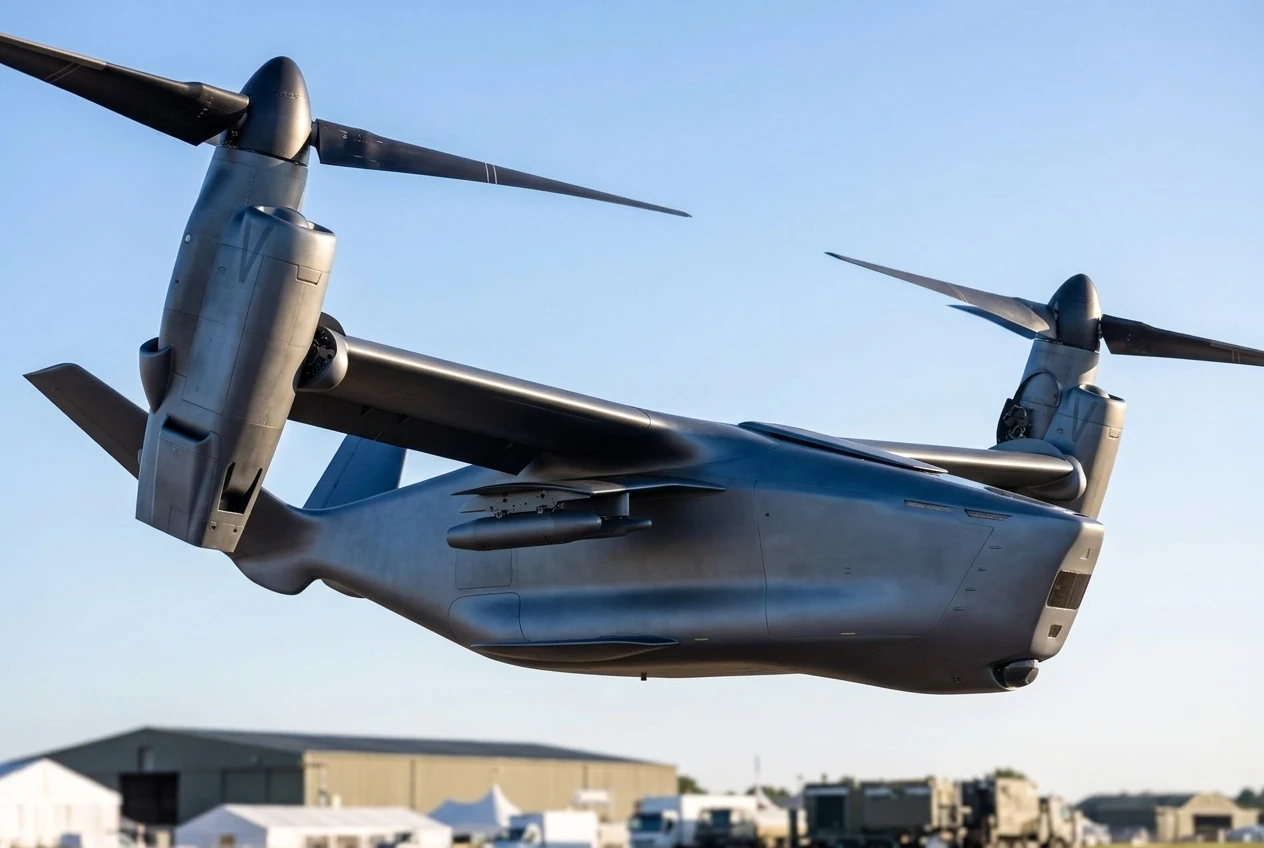
Archer Aviation and Anduril Industries unveiled Thunder on Monday, a pilotless attack rotorcraft built to carry up to 10 Hellfire missiles into combat. The reveal happened at the Farnborough International Airshow in England. Archer’s stock jumped as much as 20% on the news.
The rally said more about Archer’s balance sheet than about the aircraft itself. The air taxi maker lost $217.7 million in the first three months of 2026 on just $1.6 million of revenue, and its commercial service in the United States still has no confirmed launch date. Anduril, meanwhile, has already beaten Boeing, Lockheed Martin and Northrop Grumman for a separate multibillion-dollar Air Force contract, running the same playbook it just pointed at attack helicopters.
Ten Hellfires, No Pilot
Anduril showed off Thunder as a Group 5 autonomous attack rotorcraft, the Pentagon’s heaviest classification for unmanned aircraft and the same weight tier as major program-of-record platforms. It’s meant to fly alongside crewed helicopters like Boeing’s Apache, taking the riskiest runs so human pilots don’t have to.
This has the range of a Cheyenne, has the speed of a Cheyenne, but the payload equivalency of the Apache.
Shane Arnott, an Anduril senior vice president, said that to reporters at the airshow. He also used a military aviation term, nap-of-the-earth, to describe how Thunder is meant to fly low and fast enough to hug the terrain for most of its working life.
A joint release from the two companies put the strategic logic bluntly: “The proliferation of drones in land warfare has brought maneuver to a stalemate, extracting a significant toll in terms of both man and machine.”
Here is what Anduril and Archer say the aircraft can actually do:
- Payload: up to 10 AGM-114 Hellfire missiles, 16 air-launched effects or 75 guided rockets, reconfigurable by mission
- Propulsion: series hybrid-electric power feeding dual tiltrotors for vertical takeoff and efficient forward flight
- Benchmarks: range and speed matching the Cheyenne, payload matching an Apache gunship, according to Anduril
- Transport: sized to fit inside a standard shipping container for deployment
- Timeline: in development for about three years, with the production aircraft’s first flight planned for 2027
Anduril and Archer say they have already flown full-scale surrogate aircraft to prove out the underlying technology. The companies describe the shared platform as a new class of autonomous aircraft built for the speed, range, payload and cost that both defense and commercial missions demand.
Archer Is Burning Through $2.4 Million a Day
Archer’s enthusiasm for military contracts looks different next to its own numbers. The company posted a $217.7 million net loss for the first quarter of 2026, compared with $93.4 million in the same quarter of 2025. Revenue reached $1.6 million, up from nothing a year earlier.
Spread across the quarter, that works out to roughly $2.4 million a day, most of it research and development spending tied to certifying the Midnight air taxi and building out the Anduril program.
The trend has been moving in one direction:
| Metric | Q1 2025 | Q4 2025 | Q1 2026 |
|---|---|---|---|
| Revenue | $0 | $0.3 million | $1.6 million |
| Net loss | $93.4 million | $188.9 million | $217.7 million |
| R&D spending | $103.7 million | $147.1 million | $171.7 million |
Archer ended March with roughly $1.8 billion in cash and short-term investments, so it isn’t close to running dry. It also spent $127.1 million late last year buying rights to Hawthorne Airport in Los Angeles, a bet on its own commercial hub even as losses keep widening. Guidance for the second quarter points to an even wider adjusted operating loss, as much as $200 million, before any meaningful commercial revenue shows up.
Archer Aviation CEO Adam Goldstein isn’t backing off the company’s commercial ambitions either. He told CNBC’s Phil LeBeau at Farnborough that the goal remains getting air taxis certified in time for the 2028 Olympics in Los Angeles. “It’s always been an ambitious goal,” he said. “It’s still an ambitious goal, but we’re certainly going to try our hardest to get there.”
Archer has said its commercial service could still launch as soon as this year, with Abu Dhabi as the likely first market since that doesn’t require FAA sign-off. The FAA path is slower. Archer became the first eVTOL company to close Phase 3 of the agency’s four-phase Type Certification process this spring, but certification for US passenger flights has taken longer than the industry once expected.
How Anduril Already Beat Boeing at This Game
This isn’t Anduril’s first attempt at unseating the legacy defense industry, and its record explains why investors reacted the way they did on Monday.
- January 2024: The Air Force selects Anduril as one of five companies to design a Collaborative Combat Aircraft (CCA) prototype, an autonomous fighter drone meant to fly alongside crewed jets.
- April 2024: Anduril and General Atomics advance to build flight prototypes. Boeing, Lockheed Martin and Northrop Grumman do not make the cut.
- October 2025: Anduril’s Fury drone completes its first flight.
- November 2025: Archer agrees to supply its Midnight eVTOL powertrain to Anduril’s Omen drone program.
- March 2026: Anduril opens production at its Ohio factory months ahead of schedule, without a production contract in hand yet.
- June 17, 2026: The Air Force orders the Fury and General Atomics’ rival drone into production together, the first time it has committed to two competing autonomous fighter designs at once.
- July 20, 2026: Anduril and Archer unveil Thunder at the Farnborough Airshow.
Anduril has said that run, from prototype selection to a production contract, was the fastest path from prototype to production for a fighter-type aircraft in more than 50 years.
Is This the Beginning of the End for Legacy Rotorcraft?
Not immediately, but the pressure is real. Boeing still builds the Army’s Apache gunships, and Bell is developing the service’s next troop transport, the MV-75, under the Future Long Range Assault Aircraft program. Both are exactly the kind of decades-long, single-source programs Anduril just showed it can beat on speed and cost.
Timing the reveal for a UK airshow was itself a signal. Thunder’s design lines up with Project NYX, a British program hunting for a robotic wingman to fly alongside the UK’s Boeing-made Apache helicopters, and Anduril made the shortlist of four companies in May. The US Army is running a parallel search of its own, looking to replace its aging MQ-1C Gray Eagle drones with an armed VTOL or short-takeoff aircraft, a competition where General Atomics is expected to offer a modified Gray Eagle called Mojave.
Chris Brose, Anduril’s chief strategy officer, made no secret of the audience he wanted. “It’s a global airshow,” he told reporters. “We’ll have the eyes of pretty much everybody that we’re interested in discussing this system with.” He wouldn’t give a price tag but said Thunder costs a “fraction” of the cost of traditional manned assets.
The Collaborative Combat Aircraft program broke with decades of procurement habit along a similar line. Instead of picking one winner and canceling the loser, as fighter competitions traditionally do, the Air Force ordered both the Fury and General Atomics’ rival drone into production at once. Defence Insight, a military spending research service, figures the program as an $8.9 billion procurement and development effort once both drones reach full production. Thunder points that same math at rotorcraft, betting the Pentagon and its allies will pay for something faster and cheaper than a new Apache or MV-75 variant.
The Archer-Anduril Relationship Didn’t Start at Farnborough
Monday’s reveal was the public payoff of a relationship that began quietly. Archer and Anduril first joined forces in 2024, and the air taxi company later agreed to license its electric vertical takeoff and landing (eVTOL) technology to the defense company.
That included supplying Archer’s electric powertrain to Anduril’s Omen tail-sitting drone program, developed alongside the UAE’s EDGE Group and announced in November 2025. Archer has also delivered one of its Midnight aircraft to the US Air Force as part of an ongoing evaluation program, giving the military hands-on time with the same hardware base Thunder builds on.
Anduril itself was founded by Palmer Luckey, the entrepreneur better known for building Oculus before turning to defense technology. Since then the company has leaned on outside partners rather than building every piece of hardware itself, which is exactly the role Archer now plays in the rotorcraft program.
A Commercial Cousin Called Halo Is Coming This Week
Archer says the same underlying platform will also come in a civilian form, called Halo, sharing a common development baseline with Thunder. The company plans to name its first commercial customers for that aircraft later this week, following up on Monday’s defense-focused reveal.
For now, Thunder is the more concrete program. Full-scale surrogate test flights are already done, and the production aircraft’s first flight is scheduled for 2027. Whatever Archer announces this week, Thunder already has a production timeline, a weapons list and a customer with a defense budget. Halo still needs all three.


Walmart’s $50 Million Opioid Settlement Closes Case Without Admission

California Sues Over $120 Million Morro Bay Wind Lease Buyout

Gilead Bixlenvo FDA Nod Opens Single Pill Path for Complex HIV Cases

Meta’s $18B Kids Deal Forever Shields Data Used to Spot Under-13s

Lettuce Outbreak Drove Record Cyclospora Spike Across 20 States

Amazon Shaves $20 Off M6 Mac Mini Before It Even Ships

SpaceX Louisiana Port Tests Debt Markets on Orbital AI Scale

Microsoft High Lifts Indexes as Small Caps Crack Support

Apple Replays 2015 Saturday Midnight Preorder for iPhone 18 Pro

Updated COVID Shots Clear FDA but Access Friction Hits High-Risk Groups

Take-Two CEO Pushes Netflix Subs for GTA 6 Extended Look

Destiny 2 Fans Unlock Vaulted Maps After Live Service Ends

Wildlands Free Update Hands Players the Tools They Already Invented

Quake Gets 19 Free Maps From MachineGames Quake Club

Quordle Monday Delivers Gavel Crush Speed Ethos Cleanly

Stripe Bid Shows PayPal Moat Cracked After Years of Slide

Tyson’s Five-Year Utah Plant Falls to Cattle Shortage Reckoning

Silver Lake Workday Talks Signal Private Floor for Software

Kennedy Lewis Takes Majority Control of The Greenbrier in $500M Deal

Best Buy Marks 60 Years With Sale That Echoes Its Audio Shop Roots
-

 TECHNOLOGY3 years ago
How to Adjust a Bulova Watch Band – An Easy Guide
-

 News3 years ago
Fred Pentland: Athletic Bilbao’s English mentor who changed the essence of Spanish football
-

 FINANCE3 years ago
Tax Planning for Every Season: Guide to Maximizing Your Tax Benefits
-

 Education3 years ago
African Ministers New Education Plan
-
 BUSINESS3 years ago
What is Entrepreneurial Operating System? A Comprehensive Guide to EOS
-

 Education3 years ago
Innovate Your Learning Journey with Technology and Enhance Education
-

 News3 years ago
Russians formally out of World Athletics Championships
-

 BUSINESS3 years ago
Top 9 Most Expensive American Cities to Rent an Apartment