
FINANCE
AutoZone Beats Estimates and Has Its Worst Day Since 2022

AutoZone beat the Street on Tuesday and was punished for it. Shares of the Memphis-based auto-parts retailer closed down roughly 9% on May 26, the stock’s worst trading day since a 9.5% fall on May 18, 2022, and kept sliding in after-hours trade after management took the analyst call. The quarterly print itself was clean: earnings of $38.07 a share on $4.84 billion in revenue, both above the consensus stitched together by LSEG.
The problem was everything around the headline. International same-store sales decelerated again, gross margin compressed for the second straight quarter, and management spent a chunk of the call fielding questions about cool weather, Mexico and Brazil, and whether a brewing motor-oil shortage at Toyota and Nissan dealers will eventually wash into the aisles of America’s largest aftermarket retailer.
The Beat That Didn’t Hold
AutoZone reported $38.07 in diluted earnings per share for the quarter ended May 9, comfortably ahead of the $36.28 average estimate compiled by LSEG. Revenue of $4.84 billion came in essentially in line with the $4.83 billion consensus, up 8.4% from the year-ago period. Net income for the quarter was $641.5 million.
Total company same-store sales rose 3.9%. Domestic comps lifted 4.1%, with do-it-yourself transactions up 2.2% and the commercial book, the segment AutoZone has chased hardest for three years, up 10.4%. By the math any sell-side model would run, this was the strongest commercial quarter the company has printed in over a year.
Then the stock opened, and traders sold it through every support line on the chart. By the closing bell AutoZone had erased roughly four months of gains, a move large enough to drag peer aftermarket filings on EDGAR back into focus for buyside analysts re-stress-testing their models.
What the tape said was simple. The print was good. The forward read was not.
Where the Numbers Tightened
Strip the headlines off the earnings release and three softer lines do the work of explaining the 9% close. Gross margin slipped, international comps slowed in constant currency, and the commercial mix that drove the top-line beat brought a margin tax with it.
Gross Margin Slipped 57 Basis Points
Gross profit landed at 52.2% of sales, a 57-basis-point decline versus the prior year. AutoZone attributed 77 basis points of the move to a non-cash LIFO accounting impact, partially offset by 42 basis points of other gross-margin improvements that themselves were softened by a 22-basis-point drag from the commercial mix shift. Chief Financial Officer Jamir Jackson laid out the bridge on the call.
The Print Versus Expectations
| Metric | Q3 FY2026 actual | LSEG / Street estimate | YoY change |
|---|---|---|---|
| Diluted EPS | $38.07 | $36.28 | Up |
| Net sales | $4.84 billion | $4.83 billion | +8.4% |
| Total company same-store sales | +3.9% | +3.4% (Visible Alpha) | Higher |
| Domestic same-store sales | +4.1% | Mixed | Higher |
| International same-store sales (constant currency) | +1.6% | Above 2% sought | Slower |
| Gross margin | 52.2% | Roughly 52.8% modeled | Minus 57 bps |
Commercial Mix Is a Two-Edged Win
Commercial revenue grew 10.4% on a comparable basis, the segment’s strongest quarter in more than a year. That growth came with structurally lower gross-margin rates than the DIY counter, so the faster commercial grows relative to retail, the more rate compression flows through. Buyside notes circulating Tuesday afternoon flagged that dynamic as the most durable concern of the three.
Mexico and Brazil Lose Their Tailwind
AutoZone has spent four years selling international expansion as the offset to a maturing US footprint. The quarterly numbers gave that thesis a wobble. International same-store sales rose 16.6% on an unadjusted basis but only 1.6% on a constant-currency reading, meaning a soft peso and weaker real did most of the lifting.
The store-count math reads better. AutoZone opened 20 new stores in Mexico and 5 in Brazil during the quarter, finishing with 933 locations south of the Rio Grande and 157 in Brazil. Total company store count crossed 7,856, with the company still tracking toward 355 to 365 net new openings for the fiscal year. Capital expenditure for the year is pacing toward roughly $1.6 billion.
What slowed was the comp engine, not the build. Mexican GDP growth has cooled through 2026 on softer consumer demand and tighter credit, and Brazil’s recovery has been uneven. AutoZone CEO Philip Daniele framed the international read as a deferred reacceleration rather than a structural break.
While these economies have slowed, we are continuing to grow share. When these economies improve, we expect our sales to reaccelerate.
That is a reasonable thing for a CEO to say. It is also exactly the kind of “wait for the cycle to turn” framing that the buyside has stopped paying full multiples for, especially when domestic comps are also decelerating off the spring weather print.
The Motor Oil Question Hangs Over the Aisles
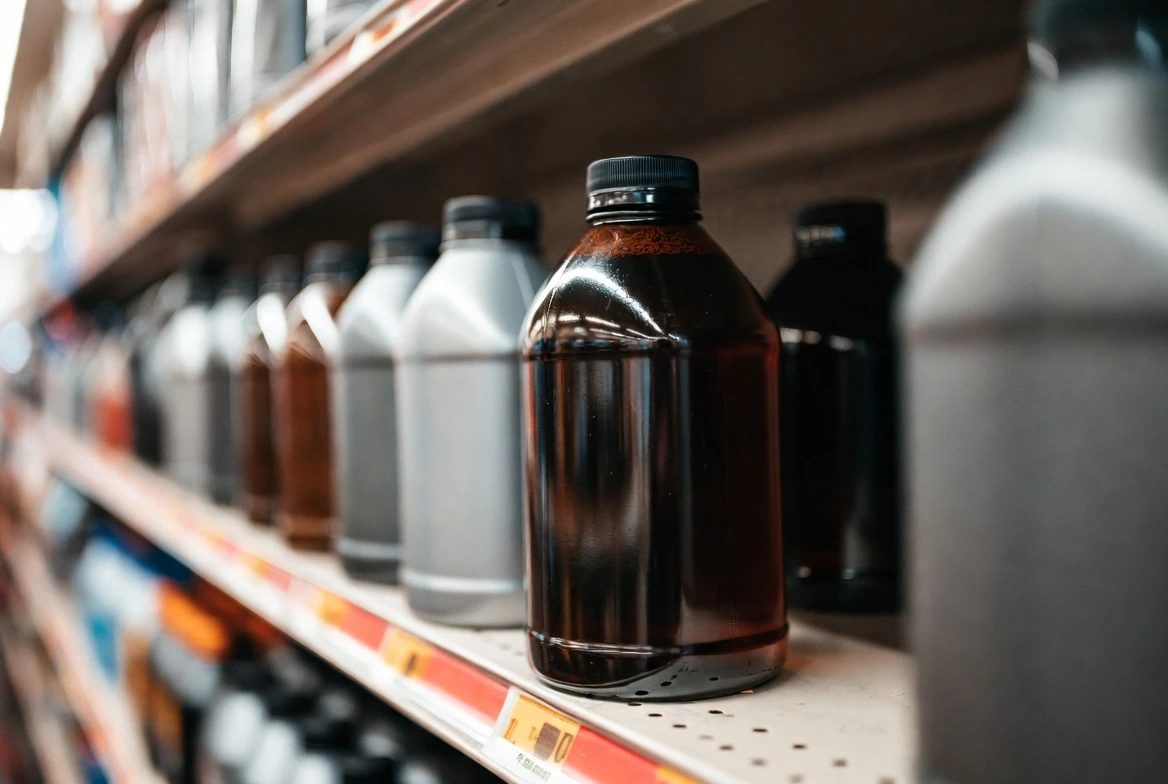
Half a dozen analyst questions on the call circled back to one topic the earnings release did not mention: the motor-oil supply squeeze working through Toyota and Nissan service bays. AutoZone management told the call they have not yet seen meaningful disruption on their own shelves. The reason analysts kept pushing is that motor oil and additives sit in the highest-velocity, highest-margin lanes of the aftermarket retail mix.
What the Service Bulletins Say
An internal Toyota dealer bulletin dated April 30 advised service managers that 0W-8 and 0W-16 viscosities could become difficult to maintain, citing “production and logistics constraints within the global petrochemical supply chain.” Nissan followed with allocations capped at 55% of prior-year purchase levels starting May 1, telling dealers to prioritize warranty, recall, and prepaid maintenance work. Both bulletins were first surfaced by The Drive’s reporting on the Toyota memo; Toyota and Nissan have confirmed the broad outlines without disputing the substance.
The Industry’s Own Read
The Independent Lubricant Manufacturers Association (ILMA, the US trade body for blenders and distributors) has told members it expects domestic supply of Group III base oils sourced from the Gulf region to tighten through June, with the shortage running into mid-2027 in a base case. The underlying cause is a mix of refinery downtime and shipping disruption tied to the conflict around the Strait of Hormuz, which moves roughly a fifth of the world’s petroleum products.
Daniele was asked twice, and he was careful. The exchange that mattered:
- Position: AutoZone is not the price-setter on lubricants; its suppliers are.
- Outlook: Constraints are likely, but the company does not expect the impact on its own P&L to be material.
- Hedge: If branded-oil supply pinches, AutoZone’s private-label and bulk programs could absorb some demand transfer from the dealer channel.
The hedge is the part the bulls are clinging to. Aftermarket retailers historically gain share when dealer service bays ration or upcharge maintenance work. If the shortage persists through summer, AutoZone could end up an unexpected beneficiary. The bears note the same supply chain that pressures dealers will eventually price every quart on the AutoZone shelf, too, and the second-derivative gross margin damage may show up before the share-gain benefit does.
How AutoZone Stacks Up Against O’Reilly and Advance
The aftermarket retail trio is the cleanest comp set in US specialty retail, and the spring 2026 read across the three is uneven enough to deserve a side-by-side look. O’Reilly Automotive posted record first-quarter revenue and a 16% diluted EPS jump, with double-digit professional growth and mid-single-digit DIY. Advance Auto Parts printed its strongest comp in five years, helped by 410 basis points of adjusted operating-margin expansion off a low base.
| Company | Latest reported quarter | Same-store sales | EPS trajectory | Margin direction |
|---|---|---|---|---|
| AutoZone | Q3 FY2026 (ended May 9) | +3.9% total, +4.1% domestic | $38.07, beat by $1.79 | Gross margin down 57 bps |
| O’Reilly Automotive | Q1 2026 (ended March 31) | Mid-to-high single digits (record) | +16% diluted EPS | Expanding |
| Advance Auto Parts | Q1 2026 (ended April 19) | +3.5% (five-year best) | Adjusted op margin +410 bps | Recovering off a low base |
The peer view sharpens the Tuesday move. O’Reilly is widening margin. Advance is rebuilding it. AutoZone is the only one of the three giving margin back. With the same macro and the same weather backdrop, that delta is what the tape was repricing.
Weather, Margin, and the Patience Question
Daniele attributed two soft weeks inside the quarter, with comps of only 1.3% during that span, to cooler-than-usual spring weather pushing heat-related categories such as batteries, A/C parts, and coolant out of their normal seasonal ramp. That explanation is plausible. Last year’s third quarter benefited from an early heatwave across the southern US, and a flat year-on-year compare on hot-weather SKUs is a real headwind.
It is also exactly the explanation a Wall Street analyst has the least patience for when it lands alongside slowing international comps and a margin step-down. “Weather” reads as a tolerable explanation once. It reads as a tell the second time a quarter in a row.
The company guided to a fourth-quarter average ticket in the mid-4% range as it laps last year’s inflation ramp, suggesting management still expects pricing power to hold even as the year-over-year compares tighten. The implied message: gross-margin pressure should ease into fiscal Q4 if commercial-mix drag normalizes and the LIFO charge does not repeat at its current size.
If that arithmetic holds when AutoZone reports its September fiscal-year-end print, Tuesday’s selloff will look like a buyable overreaction. If gross margin slips again and international stays under 2% in constant currency, the recession-proof premium that has sat on this stock since 2020 will need to be marked down further, and the May 26 close at down 9% will be the start of a longer reset rather than its bottom.
Disclaimer: This article is for informational purposes only and does not constitute investment, financial, or trading advice. Equity markets carry risk including loss of principal; readers should consult a qualified financial advisor before acting on any information here. Figures cited are accurate as of publication on May 27, 2026.


Applied Digital Breaks Ground on $3.6B Delta Forge 1 in Louisiana

Nasal Spray Reverses Brain Aging in Aged Mice, Texas A&M Study Finds

Nvidia Retires Its 20-Year Control Panel as 610.47 Driver Ships

PS Plus June 2026 Free Games Lean on Two Xbox-Born Co-Ops

Logitech’s Signature Comfort Plus Adds Cushioned Mice and Keyboard From $40

KeySmart SmartCard Pro Doubles Find Hub Wallet Tracker Battery Life

Apple Builds an iPhone Snatch Lock as Android’s Lead Hits 19 Months

Dodge Bets the Copperhead SRT Can Refill Its Halo White Space by 2030

Lilly Drops $3.83B on Vaccines Targeting Roots of Chronic Disease

GoPro Mission 1 Pro Review: A $699 Bet on 8K Video Quality

Mitchell Matches Kobe in Game 7 Rout, Cavaliers Reach East Finals

Shai Gilgeous-Alexander Wins Second Straight MVP With 83 of 100 First-Place Votes

Colt Emerson Debuts, Mariners Get Swept by Padres in Vedder Cup

Brent at $111 Hides the Hormuz Damage Hitting Fed and Asia

Jaylen Brown Calls Stephen A. Smith the Face of Clickbait Media

Samsung Strike Looms May 21 as Union Eyes SK Hynix Bonus Formula

Xperia 1 VIII Holds Price, Xiaomi 17 Max Loads Up: Week 20 Phone News

Rousey Finishes Carano in 17 Seconds and Hands Netflix Its MMA Opening

LIRR Strike Hits Third Day as 250,000 Commuters Face a Tougher Manhattan Run

Santa Marta’s Fossil Fuel Exit Plan Puts Scotland’s Drilling U-Turn on the Clock
-

 TECHNOLOGY3 years ago
How to Adjust a Bulova Watch Band – An Easy Guide
-

 FINANCE3 years ago
Tax Planning for Every Season: Guide to Maximizing Your Tax Benefits
-

 News3 years ago
Fred Pentland: Athletic Bilbao’s English mentor who changed the essence of Spanish football
-

 Education3 years ago
African Ministers New Education Plan
-

 BUSINESS3 years ago
What is Entrepreneurial Operating System? A Comprehensive Guide to EOS
-

 Education3 years ago
Innovate Your Learning Journey with Technology and Enhance Education
-

 News3 years ago
Russians formally out of World Athletics Championships
-

 BUSINESS3 years ago
Top 9 Most Expensive American Cities to Rent an Apartment