
News
Delta Flight 1076 Hit by Firework on Midway Final Approach
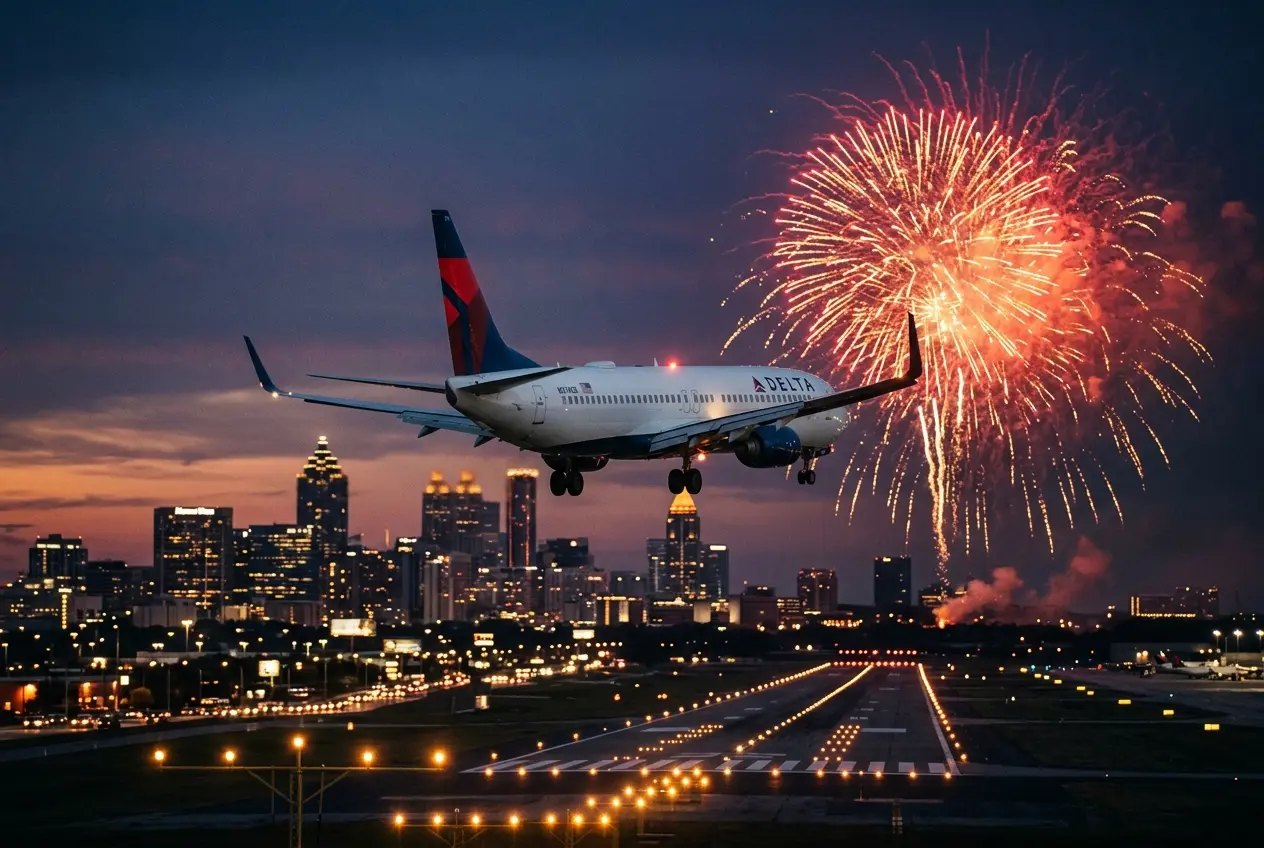
Delta Flight 1076, an Airbus A319, was reportedly struck by a firework on final approach to Chicago Midway on July 4, 2026. The pilot told controllers he felt a big bang.

Delta Flight 1076 was reportedly struck by a firework on final approach to Chicago Midway International Airport around 8:30 p.m. local time on Saturday, July 4, according to the Federal Aviation Administration. The pilot told air traffic control the Airbus A319 felt a big bang at about 200 feet of altitude on the descent from Atlanta. The aircraft, carrying 52 passengers and six crew members, landed safely and taxied to the gate, and the FAA said it is investigating.
The incident came on the night the United States marked its 250th anniversary with fireworks from coast to coast. An air traffic controller, after fielding “multiple reports” of consumer fireworks being set off in residential yards near the approach path, welcomed the next arriving plane with two words: “Welcome to the war zone.“
The Pilot’s Report From 200 Feet
Delta Flight 1076 pushed back from Hartsfield-Jackson Atlanta International Airport and touched down at Midway about 41 minutes later, by the clock in the full picture of what happened on descent. The pilot keyed the microphone over Midway just before touchdown, and what came out is now the centerpiece of the FAA investigation.
“Tower, we just had a firework hit our plane, Delta 1076, we’re continuing,” the pilot said, according to air traffic control audio. “We just heard a bang on the plane, so we’ll have to look at it when we get to the gate. We’re just hoping it was just a mortar that went off underneath, but definitely felt a big bang.” The crew never declared an emergency. The jet taxied to the gate, where Delta pulled it from service for a full inspection.
The aircraft is an Airbus A319, a workhorse of the Delta narrowbody fleet. The source of the firework, the altitude it reached, and whether it was a stray professional mortar or a consumer device are all still under investigation.
- Flight: Delta 1076
- Route: Hartsfield-Jackson Atlanta International Airport to Chicago Midway International Airport
- Landing time: Around 8:30 p.m. local time on Saturday, July 4, 2026
- Aircraft: Airbus A319
- Aboard: 52 passengers and six crew members
- Reported strike altitude: About 200 feet above the ground
What the Controllers Were Telling Pilots
By the time Delta 1076 reached the final approach, the tower had already been working the problem from the other side. “Delta 1076… use caution, there are multiple homes near the approach end shooting off fireworks,” a controller warned, according to the air traffic control audio from the approach. “There have been multiple reports as you can imagine.” Controllers added that the city was aware and would be notifying the Chicago Police Department.
Moments after Delta 1076 landed, a Southwest Airlines flight was cleared to descend. The controller’s greeting was unusually blunt. “Welcome to the war zone,” the controller said, per audio reported by KETV 7. “That’s reassuring,” Southwest 223 replied.
Welcome to the war zone. That’s reassuring.
The exchange has circulated widely because it captures the operating environment controllers were juggling in the minutes around the strike. Neither plane was damaged by fire according to official statements, but the runway was, in the literal sense, a corridor of falling pyrotechnics.
Two Different Damage Reports
Delta and the Chicago Police Department have described the aftermath in two different ways.
Delta told reporters on Sunday that its post-flight inspection, as the no-damage finding from the post-flight inspection, showed no damage to the aircraft. The Chicago Police Department told local media the firework caused minor paint damage. The accounts are not necessarily contradictory, a post-flight inspection can focus on structural and systems integrity while police document exterior marks, but they describe the same plane differently. The Airbus A319 was taken out of service for the full inspection Delta promised.
Where Fireworks and Flight Paths Overlap
The strike happened at an altitude where consumer fireworks legally go. The Federal Aviation Administration regulates airspace, not backyard pyrotechnics, and the two collide in residential neighborhoods that ring urban airports like Midway. On a clear July 4, the geometry of a fireworks mortar and an aircraft on a 3-degree glideslope can briefly share the same patch of sky.
Professional displays can climb far higher. The vertical reach of common firework types, per industry figures cited in coverage of the incident:
- Consumer fireworks: Typically 50 to 200 feet above the ground.
- Professional displays: Can reach as high as 1,200 feet.
The Delta pilot’s 200-foot figure sits at the ceiling of the consumer range and well below the professional one, which is consistent with a neighborhood-mortar strike rather than a citywide show.
Why a 40-Minute Show Stopped Reagan National
Elsewhere in the country on July 4, the calculus looked very different. The semiquincentennial, the 250th birthday, was marked in Washington by a 40-minute fireworks display put on by the National Park Service at the National Mall, anchored by military flyovers and a pyrotechnic show that began at midnight local time.
To make room for that, Reagan National Airport suspended flights from noon on Saturday until after the show wrapped. Other large displays in major cities routinely trigger temporary flight restrictions. The pre-emptive shutdowns work because the professionals and the FAA plan the airspace together.
At Midway, the holiday met the runway through backyards, not briefings. The two approaches to the same national celebration, a city planned for and a neighborhood improvised, ended with a different result on the same evening: a runway closed for a choreographed spectacle in one place, and an Airbus A319 on inspection in another.
The FAA Statement and the Open Investigation
The agency’s official statement, included on the official statement on the July 4 strike, is short and confirmed the basics. The flight “landed safely at Chicago Midway International Airport around 8:30 p.m. local time on Saturday, July 4, after the pilot reported that a fireworks mortar struck the aircraft just before landing.” The agency said it would investigate and pointed further questions to the airline and to local authorities.
What the FAA has not yet said is just as telling. The agency has not named the type of firework involved, the neighborhood it came from, the extent of any structural examination of the airframe, or whether enforcement action is contemplated. The investigation is preliminary and the agency’s incident pages are updated as facts are confirmed.
What the Investigation Is Likely to Examine
Investigators will start with the airframe. Maintenance crews will inspect the leading edges, the radome, the cockpit windows, and any surface the pilot could plausibly have felt a strike on. The aircraft was taken out of service for exactly this work.
Then the airspace. The FAA will reconstruct the flight’s final approach, the 200-foot altitude the crew reported, and the local firework activity in the neighborhoods that border the runway. Tower audio already documents controllers warning of “multiple homes” setting off fireworks, which gives the investigation a starting point for the geographic question of where the device originated.
The harder question, the one no preliminary statement can answer, is regulatory. Midway, like many urban airports, sits inside a city where consumer fireworks are legal in some form for a few days each year. The FAA regulates aircraft and the airspace around them, and local authorities regulate when and where fireworks can be set off. The Delta strike is, among other things, a stress test of how those two jurisdictions meet on the country’s birthday. Chicago police told local media they were contacted about the activity; whether any enforcement followed is not yet clear. Delta declined to comment beyond its Sunday statement.
Frequently Asked Questions
Was anyone hurt on Delta Flight 1076?
No. Delta said the 52 passengers and six crew members on the Airbus A319 all disembarked without injury. The plane taxied to the gate under its own power after the strike.
What did the FAA say about the firework strike?
The FAA confirmed Delta Flight 1076 “landed safely” at Midway around 8:30 p.m. local time on Saturday, July 4, and said the agency “will investigate.” It directed other questions to local authorities and the airline.
Did the fireworks cause any damage to the plane?
The accounts differ. Delta told reporters its post-flight inspection “showed no damage to the aircraft.” The Chicago Police Department told local media the firework caused “minor paint damage.” The plane was taken out of service for a full inspection.
Why did a controller warn of a “war zone” at Midway?
By the time a Southwest Airlines flight 223 descended behind the Delta strike, controllers had fielded “multiple reports” of consumer fireworks being set off in residential yards near the approach path. The Delta pilot had already told the tower his plane “felt a big bang.”
How high do consumer fireworks actually fly?
Consumer fireworks typically reach 50 to 200 feet above the ground. Professional displays can reach as high as 1,200 feet. The Delta pilot said the strike occurred at about 200 feet of altitude, the top of the consumer range.





MapLight Stock Plunges After Schizophrenia Trial Splits on Dosage

Starship Survives Its Splashdown, Clearing SpaceX’s Path to a Historic Catch

Red Cross Declares Second-Ever Blood Crisis as Donors Age Out

FDA Advisers Back Six Peptides but Gray Market Endures

Sandisk and ASML Shares Sink as China Ships Chip Tools

Maple Leaf Bacon Recall Exposes a Border Checkpoint Pattern

Mamdani’s 30% Grocery Discount Plan Alarms NYC’s Bodega Owners

Levothyroxine Recall Leaves Millions to Catch the Risk Themselves

Cyclospora Fears Push Americans Toward the Processed Foods RFK Jr. Opposes

Ford’s Custom Garage Push Bets Big on Owning the Aftermarket

Pokémon GO Developer Niantic Rebrands as Scopely Explore

Persona 4 Revival Hands All Anime Cutscenes to Studio MAPPA

Doom Studio id Software Cuts Half Its Staff in Xbox Layoffs

Jaylen Brown Traded to 76ers for Paul George and Four Draft Picks

Nintendo Switch Online Adds Four Classics and One Japan-Only Title

Jordan Henderson Hospitalized After Wrist Injury at the Azteca

Mexico’s World Cup Run Ends at Azteca as England Hold On 3-2

Meta’s Muse Image Lets Anyone Use Your Instagram Photos in AI

Louis Vuitton Beats Molly Tea in China, Triggers Cultural Backlash

Pink Bearista Cup Returns July 13 as Starbucks Pink Vibes Drops
-

 TECHNOLOGY3 years ago
How to Adjust a Bulova Watch Band – An Easy Guide
-

 News3 years ago
Fred Pentland: Athletic Bilbao’s English mentor who changed the essence of Spanish football
-

 FINANCE3 years ago
Tax Planning for Every Season: Guide to Maximizing Your Tax Benefits
-

 Education3 years ago
African Ministers New Education Plan
-

 BUSINESS3 years ago
What is Entrepreneurial Operating System? A Comprehensive Guide to EOS
-

 Education3 years ago
Innovate Your Learning Journey with Technology and Enhance Education
-

 News3 years ago
Russians formally out of World Athletics Championships
-

 BUSINESS3 years ago
Top 9 Most Expensive American Cities to Rent an Apartment