
BUSINESS
Domino’s Posts Higher Profit as Its Franchisees Feel the Squeeze
Domino’s Q2 profit beat estimates on buybacks and supply-chain sales, but a same-store sales stall exposes strain on the franchisees running its stores.

Domino’s Pizza reported a $135.8 million second-quarter profit on Monday, up from $131.1 million a year earlier, with revenue climbing 4.3% to $1.19 billion and beating Wall Street’s forecast. But U.S. same-store sales, the number franchisees track most closely, slowed to just 0.1% from 3.4% a year ago, the weakest showing in more than a year.
Analysts had penciled in more on nearly every line: earnings of $4.17 a share and comparable sales growth near 0.6%. Domino’s missed both, its second straight quarterly shortfall, even as shares jumped about 7% in premarket trading. The distance between that profit headline and the pressure now showing up in the company’s own store-opening plans lands squarely on the franchisees who run nearly all of its restaurants.
Buybacks Carry the EPS Beat
Diluted earnings per share rose 6.8%, to $4.07 from $3.81, outpacing the 3.6% rise in net income. The gap came from a smaller share count. Domino’s repurchased and retired 443,917 shares of its own stock for $156.2 million during the quarter, bringing its year-to-date buyback total to 632,221 shares for $231.3 million.
The company still has $1.23 billion left on a repurchase authorization that the board topped up with an additional $1 billion approved in the first quarter. It also declared a quarterly dividend of $1.99 a share, payable September 30 to shareholders of record September 15.
Operating income rose 3.1%, to $232.0 million from $225.1 million, or 2.6% once currency swings and refranchising gains are stripped out.
Supply-chain revenue, the unit that sells dough, cheese, boxes and equipment to franchised and company-owned stores, climbed 6.5% to $731.7 million. Higher store ordering volume and a 2.2% increase in food-basket pricing both helped. That business collects payment on volume whether or not the store selling the pizza actually turns a profit.
| Metric | Q2 2026 | Year-Over-Year Change |
|---|---|---|
| Revenue | $1.19 billion | +4.3% |
| Net income | $135.8 million | +3.6% |
| Diluted EPS | $4.07 | +6.8% |
| Operating income | $232.0 million | +3.1% |
| Supply-chain revenue | $731.7 million | +6.5% |
| U.S. same-store sales | +0.1% | vs. +3.4% a year ago |
| International same-store sales (ex-FX) | -0.1% | vs. +2.4% a year ago |
Every one of those lines beat or matched what Domino’s reported a year ago. The one line that barely moved is the one that determines whether a franchisee’s store is worth running.
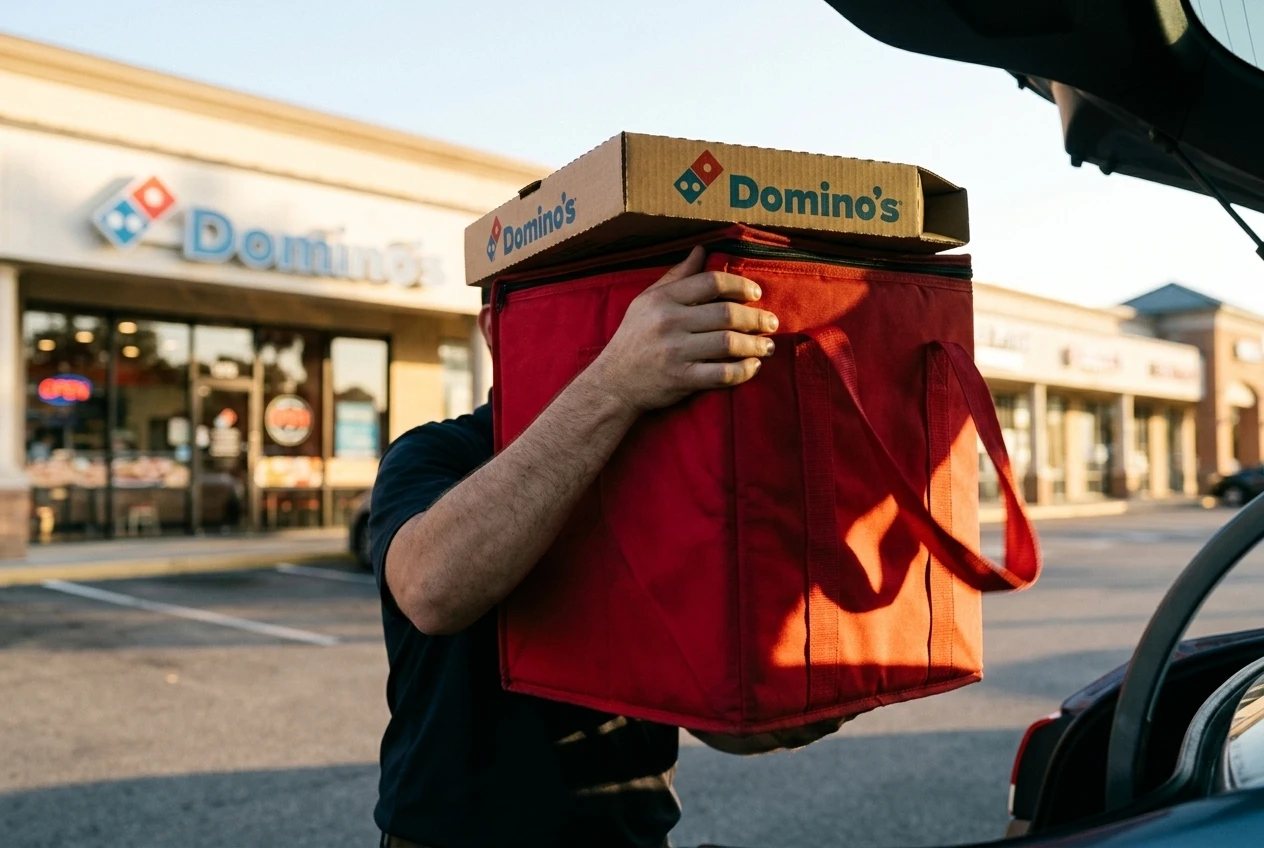
Same-Store Sales Nearly Grind to a Halt
The U.S. comparable sales figure undershot the 0.62% gain analysts polled by LSEG had expected. It is the weakest U.S. same-store sales quarter Domino’s has posted in more than a year, down sharply from the 3.4% growth logged in the same period of 2025.
Three months earlier, U.S. comparable sales were still climbing 0.9%, according to Domino’s first-quarter results. The slide to 0.1% shows a slowdown that built through the year rather than one bad month.
Executives blamed the ticket, not the customer count. Order counts grew meaningfully across delivery and carryout, chief executive officer Russell Weiner said, even as the company lapped last year’s Stuffed Crust Pizza launch, a promotion that had inflated the prior-year comparison.
We had a one-quarter blip on ticket. We’re not going to have another blip.
Chief Financial Officer Sandeep Reddy made that case on the earnings call, framing the weak average check as tied to one product cycle rather than a lasting shift in demand.
Morningstar analyst Ari Felhandler offered a more measured read on the same data. “Positive transaction counts across both carryout and delivery are a bright spot, indicating the firm is still winning with consumers, albeit at lower check sizes,” Felhandler said.
Internationally, same-store sales fell 0.1% on a currency-neutral basis, compared with growth of 2.4% a year ago and short of the 0.5% gain analysts expected. Domino’s Pizza Enterprises, the company’s largest international master franchisee, dragged on that number because it deliberately cut lower-margin transactions, executives said on the call, while China and India stayed bright spots.
What the Balance Sheet Doesn’t Show
Domino’s is built almost entirely on franchising. Independent operators run about 99% of its roughly 22,500 locations worldwide, and the company added a net 209 stores this quarter, 26 in the U.S. and 183 abroad, lifting its global footprint to 22,531 restaurants.
That structure means Domino’s own income statement barely touches store-level economics. Its second-quarter financial filing spells out that retail sales at franchised stores are reported to Domino’s but never counted as its own revenue, even though the company says franchisee sales directly affect its profitability.
Domino’s earns instead through royalties, advertising fees, and the supply chain arm that sells food and equipment into every store, company owned or not.
That is why the 2.2% rise in food-basket pricing this quarter cuts differently depending on which side of the counter someone stands. Domino’s corporate books it as extra supply-chain revenue. The franchisee paying that bill, while also covering labor and delivery costs, just sees a higher cost of doing business.
Domino’s argues its own model still beats the alternative. Executives said on the first-quarter call that when rival chains try to match Domino’s value pricing, it puts outsized pressure on those competitors’ franchisees, since they lack Domino’s advertising scale and supply-chain leverage. That argument does not fully explain why Domino’s own store-growth pipeline is now the one showing strain.
A Trimmed Store Target Spells Out the Real Cost
Domino’s cut its 2026 U.S. net store growth target to about 175 locations, down from a prior goal of 175-plus. Executives tied the reduction directly to the development pipeline, citing pressure from macro conditions and what they called a challenging start to the year that affected franchisee profitability.
That is a reversal from the picture Domino’s painted two quarters ago. On its fourth-quarter call in February, the company said U.S. franchisee store profitability grew about 3% in 2025, with the average store clearing roughly $166,000 and multi-store operators’ enterprise profits approaching $1.5 million. Weiner pointed to those figures as proof the model was working before this year’s slowdown began.
Store growth targets are ultimately a franchisee decision. Operators sign leases, borrow money, and commit capital based on what a new store is expected to earn. A trimmed target is Domino’s admitting, in guidance form, that fewer of its franchisees currently see that math working in their favor.
Internationally, the company still expects roughly 800 net new stores this year and mid-single-digit global retail sales growth, a pace it credits partly to China and India even as other markets soften.
Who Is Taking Over as Domino’s CEO?
Joe Jordan, currently Domino’s chief operating officer and president of its U.S. business, becomes chief executive officer on October 1, succeeding Russell Weiner, who is retiring after serving as CEO since 2022. Weiner moves into a newly created Executive Chairman Designate role and formally becomes executive chairman after the company’s 2027 annual shareholder meeting.
The succession plan, announced in June, also sends longtime executive chairman David Brandon into retirement from the board in 2027, closing out 28 years with the company that include a stint as CEO from 1999 to 2010 and the 2004 initial public offering.
Weiner joined Domino’s in 2008. During his tenure as CEO, the company added more than 3,200 net stores globally, grew worldwide retail sales by nearly $3 billion, and increased operating income by almost 30%.
Jordan has spent close to 15 years at Domino’s across marketing, U.S. and international operations, technology, and franchisee support. He most recently led the relaunch of the company’s loyalty and e-commerce platforms as chief operating officer.
Weiner delivered Monday’s results as, in effect, a retiring chief executive. Jordan takes over the year Domino’s own guidance admits franchisee profitability is under real pressure, not the year it was still climbing 3% annually.
Guidance Holds Anyway
Domino’s kept its full-year targets largely intact on the call, even after two straight quarters of weaker-than-expected comparable sales:
- U.S. same-store sales: low single digit growth for 2026, excluding the extra week in the fiscal calendar
- International same-store sales: low single digit growth, including a lift from the recently completed World Cup
- U.S. net new stores: approximately 175, down from the prior 175-plus goal
- International net new stores: approximately 800
- Operating income growth: mid to high single digits, excluding currency effects, refranchising gains, and the gain from selling the corporate aircraft
The number looks softer next to where the year started. At the February call, Domino’s had guided to 3% U.S. comparable sales growth for 2026. Two quarters in, actual U.S. comps have decelerated every quarter, well under that original mark. Wall Street’s own full-year model has already adjusted lower: analysts expect just 1.28% U.S. and 0.95% international sales growth for 2026, both below what low single digits typically implies.
Where the Bulls and the Skeptics Split
- Domino’s management calls the ticket miss a one-quarter blip tied to lapping last year’s Stuffed Crust promotion, and points to order growth as evidence the underlying model still works.
- Morningstar’s Ari Felhandler credits the order counts as a genuine bright spot while flagging that customers are trading down to smaller tickets.
- TheStreet’s analysis is more cautious, noting first-half free cash flow fell 5.5% to $313.6 million even as headline profit rose, and warning that value promotions can pay Domino’s corporate before they pay the franchisee absorbing the food, labor, and delivery costs behind them.
The stock’s roughly 7% premarket jump Monday came after shares had fallen about 23% so far in 2026, a decline steep enough that a smaller-than-feared miss still read as relief.
Jordan takes over as CEO on October 1. He inherits a same-store sales line stuck at 0.1% and a store-opening target already cut once this year for the franchisees now waiting to see if his math works better than his predecessor’s.


Walmart’s $50 Million Opioid Settlement Closes Case Without Admission

California Sues Over $120 Million Morro Bay Wind Lease Buyout

Gilead Bixlenvo FDA Nod Opens Single Pill Path for Complex HIV Cases

Meta’s $18B Kids Deal Forever Shields Data Used to Spot Under-13s

Lettuce Outbreak Drove Record Cyclospora Spike Across 20 States

Amazon Shaves $20 Off M6 Mac Mini Before It Even Ships

SpaceX Louisiana Port Tests Debt Markets on Orbital AI Scale

Microsoft High Lifts Indexes as Small Caps Crack Support

Apple Replays 2015 Saturday Midnight Preorder for iPhone 18 Pro

Updated COVID Shots Clear FDA but Access Friction Hits High-Risk Groups

Take-Two CEO Pushes Netflix Subs for GTA 6 Extended Look

Destiny 2 Fans Unlock Vaulted Maps After Live Service Ends

Wildlands Free Update Hands Players the Tools They Already Invented

Quake Gets 19 Free Maps From MachineGames Quake Club

Quordle Monday Delivers Gavel Crush Speed Ethos Cleanly

Stripe Bid Shows PayPal Moat Cracked After Years of Slide

Tyson’s Five-Year Utah Plant Falls to Cattle Shortage Reckoning

Silver Lake Workday Talks Signal Private Floor for Software

Kennedy Lewis Takes Majority Control of The Greenbrier in $500M Deal

Best Buy Marks 60 Years With Sale That Echoes Its Audio Shop Roots
-

 TECHNOLOGY3 years ago
How to Adjust a Bulova Watch Band – An Easy Guide
-

 News3 years ago
Fred Pentland: Athletic Bilbao’s English mentor who changed the essence of Spanish football
-

 FINANCE3 years ago
Tax Planning for Every Season: Guide to Maximizing Your Tax Benefits
-

 Education3 years ago
African Ministers New Education Plan
-

 BUSINESS3 years ago
What is Entrepreneurial Operating System? A Comprehensive Guide to EOS
-

 Education3 years ago
Innovate Your Learning Journey with Technology and Enhance Education
-

 News3 years ago
Russians formally out of World Athletics Championships
-

 BUSINESS3 years ago
Top 9 Most Expensive American Cities to Rent an Apartment