
FINANCE
ECB Hikes Rates to Fight Iran War Inflation, Warsh’s Fed Votes Next
ECB lifted its main rate to 2.25% Thursday, the first major central bank to hike against Iran-war inflation. Fed, BOJ and BOE all decide in eight days.

The European Central Bank raised its benchmark deposit rate to 2.25% from 2% on Thursday, becoming the first major central bank to raise borrowing costs in response to the energy shock from the Iran war. The 25-basis-point move, the ECB’s first rate hike since September 2023, lands a week before decisions at the U.S. Federal Reserve, the Bank of Japan, and the Bank of England.
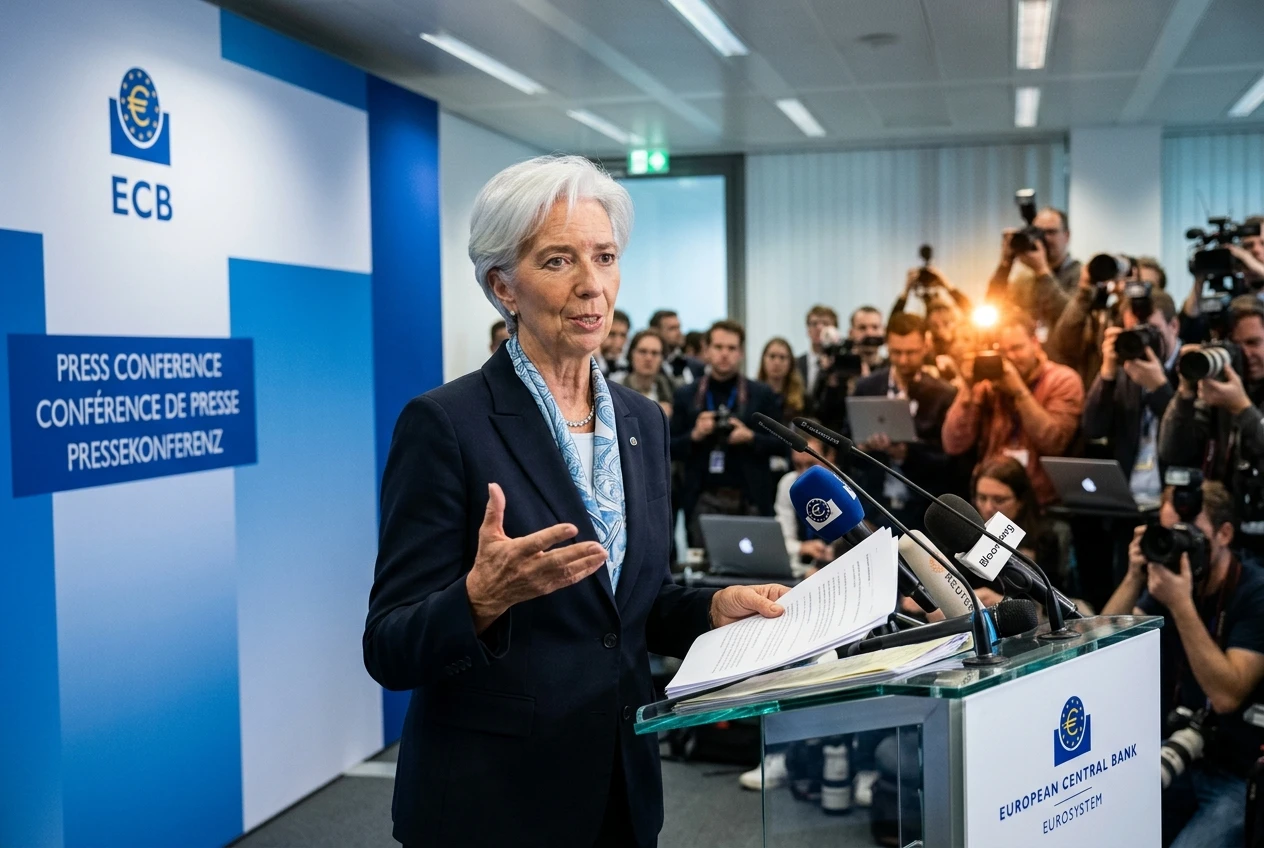
ECB President Christine Lagarde, speaking in Frankfurt after the unanimous decision, framed the increase as insurance against a price shock that the bank expects to keep inflation above its 2% target into the first half of 2027. Financial markets now price two more ECB hikes over the coming year, with September seen as the next likely step, according to the RTÉ account of the decision.
ECB Goes First
The ECB’s Governing Council raised all three of its key policy rates by 25 basis points, taking the main deposit rate to 2.25% from 2%, the level it had held for a year. The decision, set out in a monetary policy statement from Frankfurt, was unanimous.
It was the first rate increase by any of the world’s major central banks since the war began, and the ECB’s first move in either direction since September 2023. With the Federal Reserve, the Bank of Japan, and the Bank of England all due to set policy within eight days, the Frankfurt decision is now the working template for the global rate debate.
Eurozone inflation rose to 3.2% in May from 3.0% in April, well above the 2% target. Energy price inflation, the channel most exposed to the war, climbed to 10.9% in May from 10.8% in April, even as food price inflation eased to 2.0% from 2.4%.
- ECB deposit rate: 2.25% (up from 2%)
- Eurozone inflation, May 2026: 3.2% (target: 2%)
- Eurozone energy inflation, May 2026: 10.9%
- Strait of Hormuz closure: 103 days
- Brent crude, June 11, 2026: about $93 per barrel
Underlying inflation is also drifting higher. Core inflation, which strips out the most volatile energy and food prices, has climbed to 2.5% in May from 2.2% in April, and services inflation rose to 3.5% from 3.0% in the same period. The pattern matches the one the ECB spent the years after 2022 trying to avoid: an external energy shock feeding into wages and the prices of other goods.
The Energy Bill Driving the Hike
Brent crude, the international benchmark, was trading at about $93 a barrel on Thursday, up from roughly $73 on the eve of the war. The jump reflects the closure of the Strait of Hormuz to most commercial shipping for 103 days, choking off the sea passage that, in normal times, carries a fifth of the world’s oil and fuel products.
The ECB’s own staff revised their growth forecast down for 2026 and 2027, in part because higher energy costs are eroding real incomes. They now see the eurozone economy expanding 0.8% this year and 1.2% next year, with the 2028 figure nudged up to 1.5%. The war in the Middle East is weighing on activity, and surveys point to a slowdown, especially in services, Lagarde said in the bank’s statement.
Higher energy prices have already passed through to other parts of the price index. Energy price inflation ticked up to 10.9% in May, food price inflation eased to 2.0%, and core inflation, the measure the ECB watches most closely for domestic pressure, jumped to 2.5% from 2.2% in April. Services inflation, the stickiest component, rose to 3.5% from 3.0%, the kind of move that historically forces a central bank’s hand.
Lagarde’s Data-Dependent Pitch
Lagarde rejected the insurance hike label that many economists had applied to the move in advance. It’s not at all how we had our discussion, she told reporters at the press conference, according to the RTÉ account. The ECB will be monitoring attentively any further consequences of this major energy shock, she added.
She was clear that the bank is not signalling a series of pre-ordained increases. We are not pre-committing to a particular rate path, Lagarde said. The bank’s future decisions depend to a great extent on how long energy prices remain elevated and how high they go, and the ECB will follow a data-dependent and meeting-by-meeting approach.
The war in the Middle East is generating inflation pressures, and the decision to raise rates is robust across a range of scenarios mapping out how the shock might evolve and affect the medium-term outlook for the euro area.
The bank is well positioned to navigate the uncertainty caused by the war, Lagarde said. But she warned that the energy-driven inflation is expected to lift inflation further over the summer and to remain well above target into the first half of next year. Longer-term inflation expectations, the level the ECB watches most closely, are still around 2%, leaving room to react rather than to chase.
Critics Call It a Policy Mistake
Not everyone is convinced. Holger Schmieding, chief economist at Berenberg, called the hike a policy mistake in a note to clients, citing what he described as a stagnant labour market and weak consumer demand. Amid the ongoing destruction of demand, the inevitable temporary surge in prices seems unlikely to turn into a protracted inflation problem that would need to be addressed by higher rates, he wrote.
Paul Donovan, chief economist at UBS Global Wealth Management, went further, calling the move an error rooted in an unhelpful 2022 mindset, a reference to the inflation rebound that followed the lifting of COVID-19 lockdowns. A Reuters analysis of earnings call transcripts found that just 40% of eurozone companies outside the financial sector had raised prices or planned to, roughly half the share seen in 2022. Carsten Brzeski, global head of macro at ING, took a middle view: the ECB may be able to get by with only one or two increases because consumers, burned by the post-pandemic price spike, are unwilling to pay more, leaving businesses to absorb higher energy costs. ECB chief economist Philip Lane, usually seen as a dove, has argued that the Iran-related shock may be broader in scope than the Ukraine crisis because it affects global, not just European, energy markets.
Will Warsh’s Fed Hike First?
The Federal Reserve’s next decision lands on June 16 and 17. It will be the first Federal Open Market Committee meeting chaired by Kevin Warsh, who was confirmed by the Senate on May 13 and sworn in on May 22.
President Donald Trump, in an interview with NBC’s Meet the Press that aired Sunday, said a rate increase would be the wrong thing to do. There’s no reason to raise interest rates, Trump said. We should actually lower interest rates. His comment, recorded Friday, followed a May jobs report that topped all forecasts, with nonfarm payrolls rising 172,000 and the unemployment rate steady at 4.3%.
Goldman Sachs economists scrapped their forecast for a Fed cut in December 2026 on the same day as the jobs release. They continue to expect two quarter-point cuts, but have moved the timing into 2027, in June and December. The CME FedWatch tool now assesses one or two hikes as relatively likely in 2026, even though holding rates steady remains possible.
Fed Governor Christopher Waller said at a May 22 speech in Frankfurt that he would support removing the easing bias language in the Fed’s policy statement to make it clear that a rate cut is no more likely in the future than a rate increase. That would clear the way for a hike later in the year if inflation does not cool. The Fed’s preferred inflation gauge, the April Consumer Price Index, ran at 3.8% headline and 2.8% core, both above the 2% target.
The Fed under Warsh now faces cross-currents: a White House pushing for cuts, a bond market that has started to price a possible hike, and a labour market that has not weakened enough to force the central bank’s hand in either direction.
Four Banks, One Question
The Bank of Japan meets on June 16, the same day as the Fed, with a Reuters poll of economists forecasting a quarter-point increase that would take the policy rate to 1.0%, followed by another move to 1.25% by year-end. The Bank of England announces on June 18, with its Bank Rate currently held at 3.75% and markets no longer fully pricing a cut in 2026, according to the central bank’s current Bank Rate and decision date.
The four central banks now face the same arithmetic: an energy-driven inflation pulse running into economies that, in the eurozone’s case at least, are growing well below trend. Whether to act pre-emptively, as the ECB has, or to wait for clearer data, is the question that will define the next eight days.
| Central bank | Current policy rate | Status | Market expectation |
|---|---|---|---|
| European Central Bank | 2.25% (deposit) | Hiked 25 bps on June 11 | Two more hikes; September next |
| U.S. Federal Reserve | Unchanged | Meets June 16 to 17 under new chair Warsh | Hike possible by year-end |
| Bank of Japan | 0.75% | Meets June 16 | Hike to 1.0% expected |
| Bank of England | 3.75% | Meets June 18 | Hold; 2026 cuts no longer priced |
Mark Wall, chief European economist at Deutsche Bank, expects the ECB to deliver one more hike in September and then stop. There is upside risk to inflation, but there is also downside risk to growth, Wall said. Most private-sector forecasts land in the same place: one or two more moves, contingent on Brent and on whether the Strait of Hormuz reopens. Goldman Sachs has moved its Fed rate cuts from December 2026 into 2027. The ECB says it is well positioned to navigate the uncertainty. Whether that confidence holds depends, in Lagarde’s words, on how long energy prices remain elevated and how high they go.
Frequently Asked Questions
Why did the ECB raise rates?
The ECB raised its benchmark deposit rate by 25 basis points to 2.25% on June 11, 2026, citing inflation pressures from the Iran war and higher energy prices. Eurozone inflation rose to 3.2% in May, with energy inflation at 10.9%, both well above the bank’s 2% target. Lagarde said the decision was robust across a range of scenarios for the war’s evolution.
Will the Federal Reserve raise rates too?
Markets now see a possible Fed rate hike by the end of 2026 after a strong May jobs report, with Goldman Sachs having scrapped its December 2026 cut forecast. Fed Governor Christopher Waller has said he would support removing language that pointed to future cuts. President Trump has publicly opposed a hike, calling it the wrong thing to do.
What does the ECB rate hike mean for eurozone borrowers and savers?
Higher ECB rates feed into bank lending rates across the eurozone, raising the cost of new mortgages and corporate borrowing. The move lifted tracker mortgage costs immediately for Ireland’s 110,000 tracker customers, with a 0.25% ECB increase adding about €37 a month to a typical €300,000, 25-year mortgage, according to the RTÉ report. Savers may see better deposit rates, though eurozone savings rates have historically lagged central bank moves.
How long has the Strait of Hormuz been closed?
The Strait of Hormuz, the sea passage that in normal times carries about a fifth of the world’s oil and fuel products, has been closed to most commercial ship traffic for 103 days as of June 11, 2026. The closure is the supply shock that has pushed Brent crude to about $93 a barrel, up from roughly $73 on the eve of the war.
Is this the start of a new global rate-hike cycle?
It is too early to call it a cycle. The ECB acted as the first major central bank to hike against the war-driven inflation, and most economists expect one or two more ECB moves rather than a sustained tightening path. Lagarde said the bank is not pre-committing to a particular rate path. The Fed, BOJ, and BOE will each set their own course over the next eight days.
Disclaimer: This article is for informational purposes only and does not constitute financial advice. Rate decisions and inflation figures are accurate as of publication. Consult a qualified financial professional before making investment or borrowing decisions.





Walmart’s $50 Million Opioid Settlement Closes Case Without Admission

California Sues Over $120 Million Morro Bay Wind Lease Buyout

Gilead Bixlenvo FDA Nod Opens Single Pill Path for Complex HIV Cases

Meta’s $18B Kids Deal Forever Shields Data Used to Spot Under-13s

Lettuce Outbreak Drove Record Cyclospora Spike Across 20 States

Amazon Shaves $20 Off M6 Mac Mini Before It Even Ships

SpaceX Louisiana Port Tests Debt Markets on Orbital AI Scale

Microsoft High Lifts Indexes as Small Caps Crack Support

Apple Replays 2015 Saturday Midnight Preorder for iPhone 18 Pro

Updated COVID Shots Clear FDA but Access Friction Hits High-Risk Groups

Take-Two CEO Pushes Netflix Subs for GTA 6 Extended Look

Quake Gets 19 Free Maps From MachineGames Quake Club

Destiny 2 Fans Unlock Vaulted Maps After Live Service Ends

Wildlands Free Update Hands Players the Tools They Already Invented

Quordle Monday Delivers Gavel Crush Speed Ethos Cleanly

Stripe Bid Shows PayPal Moat Cracked After Years of Slide

Tyson’s Five-Year Utah Plant Falls to Cattle Shortage Reckoning

Silver Lake Workday Talks Signal Private Floor for Software

Kennedy Lewis Takes Majority Control of The Greenbrier in $500M Deal

Best Buy Marks 60 Years With Sale That Echoes Its Audio Shop Roots
-

 TECHNOLOGY3 years ago
How to Adjust a Bulova Watch Band – An Easy Guide
-

 News3 years ago
Fred Pentland: Athletic Bilbao’s English mentor who changed the essence of Spanish football
-

 FINANCE3 years ago
Tax Planning for Every Season: Guide to Maximizing Your Tax Benefits
-

 Education3 years ago
African Ministers New Education Plan
-

 BUSINESS3 years ago
What is Entrepreneurial Operating System? A Comprehensive Guide to EOS
-

 Education3 years ago
Innovate Your Learning Journey with Technology and Enhance Education
-

 News3 years ago
Russians formally out of World Athletics Championships
-

 BUSINESS3 years ago
Top 9 Most Expensive American Cities to Rent an Apartment