
News
Adobe Resets ARR Target for Freemium AI as CFO Heads to Marvell
Adobe reset its ARR growth target to 10.2% on a Q2 beat, absorbing a ~$500M freemium hit, the same day it confirmed CFO Dan Durn’s June 15 exit to Marvell.

Adobe reported record second-quarter revenue of $6.62 billion on June 11, 2026, then used the same announcement to reset its full-year annualized recurring revenue growth target to 10.2%, absorbing a roughly $500 million second-half hit in exchange for an aggressive freemium push across Acrobat, Express and Firefly. The bet comes with a price: management is also deferring previously planned Creative Cloud price increases and confirming that Chief Financial Officer Dan Durn will leave on June 15, 2026 to take the top finance job at Marvell Technology.
Hours after the print, Adobe’s Q2 revenue and EPS beat recap showed non-GAAP earnings of $5.96 per share, ahead of the $5.83 consensus, and remaining performance obligations of $22.27 billion, beating $22.11 billion forecasts. Adobe raised its third-quarter revenue guide to $6.67 billion to $6.72 billion, well above the $6.51 billion analysts had projected. The market reaction to the print was not the beat, but the reset and the exit. Adobe shares closed down 6.25% on June 11 and slid another 5.6% in after-hours trading, leaving the stock down 47% over the past year.
The Q2 Print, and the Reset Hidden Inside It
Revenue of $6.62 billion grew 11% year-over-year in both reported and constant currency, and adjusted earnings per share of $5.96 came in 18% above the prior year, beating consensus of $5.83. GAAP EPS of $4.25 grew 8% and absorbed a $70 million non-cash goodwill impairment charge tied to Adobe’s legacy Publishing and Advertising unit. Total annualized recurring revenue exiting the quarter stood at $27.10 billion, including roughly $480 million from the SEMrush acquisition that closed in April 2026, and AI-first annual recurring revenue crossed $500 million after more than tripling year-over-year.
Behind the beat, Adobe also reset its full-year total ARR growth target to 10.2%, a step down from the 12.5% exit rate posted in the quarter itself. Management framed the cut as a deliberate trade, citing the SEMrush contribution, the freemium expansion, and a decision to defer previously planned Creative Cloud line optimizations, and the three pieces together account for the gap between the exit pace and the new full-year guide.
| Metric | Q2 FY2026 | Year-over-year change |
|---|---|---|
| Total revenue | $6.62 billion | +11% |
| Non-GAAP EPS | $5.96 | +18% |
| GAAP EPS | $4.25 | +8% |
| Total ARR (exit) | $27.10 billion | +12.5% |
| AI-first ARR (exit) | more than $500 million | more than tripled |
| RPO | $22.27 billion | +13% |
| Cash from operations | $2.17 billion | n/a in release |
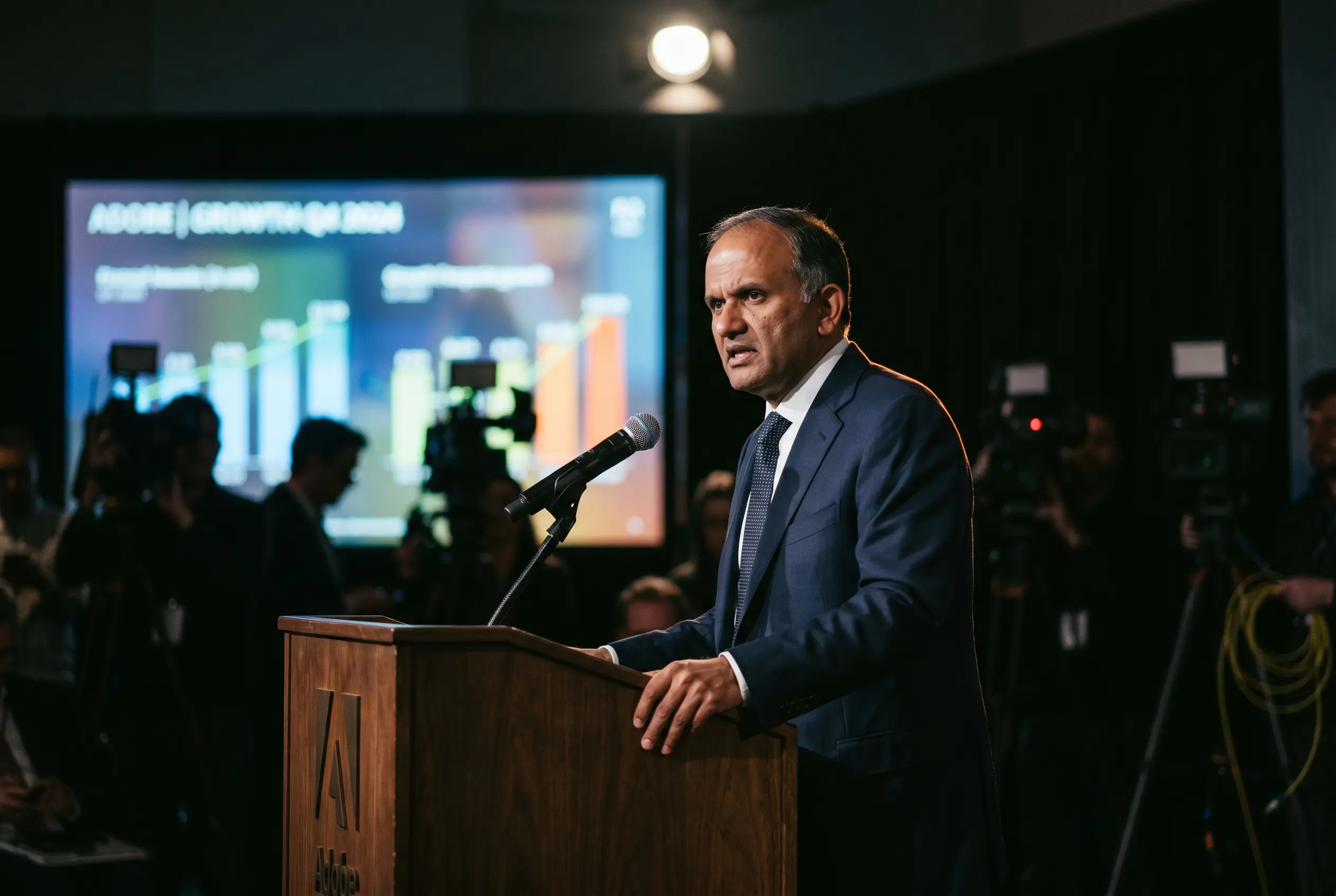
Freemium First, ARR Second
Adobe will widen free onboarding across its three flagship products, Acrobat, Express, and Firefly, as the central lever for monetizing generative AI, per the Adobe Q2 2026 earnings call highlights. The mechanics are built on a traffic shift Adobe’s leadership described in unusually candid terms on the call, with users arriving through large-language-model-driven queries like “summarize this PDF” or “generate pixel art for social media” rather than through traditional product discovery.
Adobe’s digital media president David Wadhwani told analysts that the company is seeing more of that intent traffic, and argued that sending it directly to a paid flow would leave the long-term opportunity on the table. He framed the bet this way: sending paid-only visitors to a download flow would produce less long-term upside for Adobe, because the LLM-arrived users convert differently. The thesis is that engagement compounds at the free layer, even if the first invoice is delayed.
We are at a transformative moment. The opportunity is to serve billions of business professionals and consumers through a comprehensive freemium funnel.
Adobe said traffic to adobe.com grew more than 40% year-over-year, with business professional and consumer traffic up 35% and creative and marketing professional traffic up more than 50%. Monthly active users across business and consumer products passed 850 million, up about 20% year-over-year, and Creative Freemium monthly active users jumped from 50 million to 90 million, a 70% increase. The numbers were the central evidence management used to justify trading near-term ARR growth for user-base scale.
The $500 Million Second-Half Trade-Off
The new full-year ARR growth target of 10.2% is roughly $500 million lower than the trajectory implied by the 12.5% Q2 exit rate, and management told analysts the gap splits roughly evenly between the freemium expansion and the deferred Creative Cloud line optimizations, as laid out in Adobe’s freemium-driven ARR target reset. Chief Executive Officer Shantanu Narayen said the deferral is not permanent. He framed the choice as one of focus, telling analysts the company is going after the entire creative opportunity right now and that any distraction from that message would detract from the prize.
Analysts pressed for the payback math on the call. Alex Zukin of Wolfe Research asked about the return period on the roughly $500 million ARR investment. Kirk Materne of Evercore asked about lifetime-value economics for users arriving through intent-based search. Wadhwani’s response was that those users tend to have much higher engagement and usage patterns than those that go directly into paid, which translates to long-term lifetime value. Brent Thill of Jefferies asked whether Adobe should be investing even more aggressively, and Narayen pushed back, saying the company is already spending the money on models, marketing, and product.
On the price-increase deferral, Narayen added: “That one, we can defer. It’s not going away.” The full-year revenue guide rose to $26.5 billion to $26.6 billion from $25.9 billion to $26.1 billion, and the non-GAAP EPS guide climbed to $24.35 to $24.45 from $23.30 to $23.50. The raised top-line guide coexists with the lower ARR growth target because revenue and ARR measure different things: revenue flows from existing contracts, while ARR reflects the rate of new paid commitments and the trade-off management just chose.
A CFO Exit Hours After the Call
The earnings call ended with a second personnel surprise. Adobe said Dan Durn, its executive vice president and CFO, is departing the company on June 15, 2026 to pursue a new professional opportunity. The release named Steve Day, senior vice president of corporate finance and CFO of Adobe’s Customer Experience Orchestration business unit, as interim CFO effective the same day, reporting directly to Narayen.
Hours later, Marvell’s new CFO appointment announcement named Durn as the chipmaker’s new finance chief, succeeding Willem Meintjes, who will stay at Marvell in an advisory role through April 2027. Durn had resigned from Marvell’s board on June 10, 2026, one day before the appointment was announced, and his prior finance chief roles span Applied Materials, NXP Semiconductors, Freescale Semiconductor and GlobalFoundries.
Durn said he is excited to join at a ‘dynamic moment’ for the company and that he looks forward to supporting Marvell’s artificial-intelligence and data-infrastructure strategy.
Marvell Chief Executive Matt Murphy said Durn’s industry experience and familiarity with the company’s strategy make him well-suited to help lead the company through its next phase, and Marvell reaffirmed its own second-quarter fiscal 2027 outlook in the announcement. Adobe’s interim choice is a familiar face: Day brings 20 years of financial leadership experience at Adobe to the role, and Marvell shares were off 2.4% after the bell on the news, with Adobe losing 5.3% in extended trade at the same point. The wire report on the dual moves was timestamped June 11, 2026 at 17:02 ET.
How Wall Street Read It
Three notable analyst moves hit the tape on the same day, all leaning bearish even as the headline numbers topped estimates, and the price target reductions on Adobe shares framed the reset as a structural concern about the company’s growth algorithm, not a one-quarter issue. Citi analyst Tyler Radke noted Adobe’s earnings beat, but the slight slowdown in annualized recurring revenue raised concerns. Argus Research analyst Joseph Bonner downgraded Adobe from Buy to Hold after the earlier news of the CEO transition.
- Citigroup maintained a Neutral rating on Adobe and cut its price target from $315 to $278, citing concerns about the slight slowdown in annualized recurring revenue growth.
- Goldman Sachs kept a Sell rating and lowered its price target from $290 to $220, with analyst Gabriela Borges cited as reflecting a cautious outlook for the company’s prospects.
- Argus Research downgraded Adobe from Buy to Hold following the CEO transition announcement, with analyst Joseph Bonner naming leadership uncertainty as the trigger.
Adobe shares fell 6.25% during the regular session on June 11, 2026 and another 5.6% in after-hours trading, per the post-print analysis. The stock is now down 47% over the past year, a drawdown analysts and observers are increasingly tying to the broader “AI is eating software” rotation, with Adobe singled out as a high-profile casualty of the trade. The consensus analyst price target stood at $339.32 across 37 covering analysts, with 15 Strong Buys, two Moderate Buys, 16 Holds, and four Strong Sells.
Two Seats Empty at the Top
The CFO change is the second senior departure Adobe has disclosed this year. On March 12, 2026, the company announced that Narayen, who has served as CEO for 18 years, has decided to transition from his position as CEO after a successor has been appointed, and that he will remain as chair of the board once the handoff happens. The first-quarter print that day, also a record at $6.40 billion in revenue, gave the announcement some cover, but the market reaction told the rest of the story: the stock has not reclaimed the levels it held before that March disclosure.
On the Q2 call, Narayen said the CEO search is “progressing well” with the goal of having a successor in place to shape fiscal 2027 planning. He also defended the finance bench, saying “The leadership team that exists in the finance organization is absolutely seasoned and top-notch. I am confident that we will not miss a beat,” a line that lands differently the same day a 20-year veteran is named interim CFO to replace a sitting CFO who is leaving for a peer chief role.
For investors, the combined picture is a company with two open seats at the top, a quarter that beat on the metrics Wall Street watches most, and a multi-year growth algorithm the company itself just lowered to defend a longer-dated bet on AI distribution. The next test is whether the deferred Creative Cloud price increases come back online, and whether the freemium funnel converts the 90 million creative monthly active users into the recurring revenue management says will follow.
What the Numbers Hide in the Mix
Beneath the headline beat, the freemium story shows up in product-level growth that is uneven and, in some places, very fast. Firefly ARR grew roughly 50% quarter-over-quarter, approaching $300 million exiting Q2, and the product is now accessible through ChatGPT and Claude, with Microsoft Copilot and Google Gemini integrations on the way. Adobe also announced a strategic partnership with NVIDIA to accelerate AI-driven creation, production, and personalization, including the rollout of advanced Adobe Firefly models and agentic workflows.
Acrobat AI Assistant ARR tripled year-over-year, GenStudio ARR grew more than 25%, and Adobe Experience Platform with native apps grew more than 30%, with Adobe now processing more than 70 billion profile activations per day. Business Professionals and Consumers subscription revenue reached $1.85 billion, up 15% in constant currency, and Creative and Marketing Professionals subscription revenue hit $4.54 billion, up 11% in constant currency. Customers with more than $10 million in ARR grew more than 20% year-over-year, the segment the company leans on for the deferred price increases to land without denting the largest accounts.
- Firefly ARR exiting Q2 FY2026: approaching $300 million
- Firefly ARR growth: roughly 50% quarter-over-quarter
- Acrobat AI Assistant ARR: tripled year-over-year
- Adobe Experience Platform app growth: more than 30% year-over-year
- Customers with $10M+ ARR: more than 20% growth year-over-year
Frequently Asked Questions
Why did Adobe reset its full-year ARR growth target to 10.2%?
Adobe’s Q2 FY2026 release attributes the reset to three drivers: the addition of the SEMrush book of business, a strategic choice to accelerate monthly active user freemium growth, and a decision to defer previously planned Creative Cloud line optimizations. The combined impact is roughly $500 million of second-half ARR, split about evenly between the freemium expansion and the deferred price increases, per Adobe’s prepared remarks.
Who is replacing Dan Durn as Adobe’s CFO?
Steve Day, Adobe’s senior vice president of corporate finance and CFO of the Customer Experience Orchestration business unit, is serving as interim CFO effective June 15, 2026, reporting to CEO Shantanu Narayen. Day has 20 years of financial leadership experience at Adobe, and Adobe has not yet named a permanent successor.
Where is Dan Durn going after Adobe?
Marvell Technology announced on June 11, 2026 that Durn will join the chipmaker as its new CFO, succeeding Willem Meintjes, who will remain at Marvell in an advisory role through April 2027. Durn had resigned from Marvell’s board on June 10, 2026 in connection with the appointment, and his prior finance chief roles include Applied Materials, NXP Semiconductors, Freescale Semiconductor and GlobalFoundries.
What is the freemium strategy Adobe is pursuing?
Adobe is widening free, no-paywall onboarding across Acrobat, Express, and Firefly to convert more of the LLM-driven intent traffic the company is seeing on adobe.com into active users, with the bet that higher engagement and lifetime value over time will offset the near-term ARR cost. Adobe says it will revisit the deferred Creative Cloud price increases once the freemium funnel is in place.
When does Dan Durn officially leave Adobe?
Adobe said in its June 11, 2026 release that Dan Durn is departing the company on June 15, 2026, with Steve Day taking over as interim CFO effective the same day. Marvell announced the appointment separately on the same evening.
Disclaimer: This article is for informational purposes only and is not investment, financial, or legal advice. Figures are accurate as of publication and may change. Statements about future performance are the named maker’s, not the publication’s. Consult a qualified professional before acting on any information in this piece.






Spotify Running Mode hits Android and revives its old tempo experiment

Galaxy Tab S12 Ultra Renders Keep the Notch Fans Hate

Novato Spinning Round House Sells With Six Neighbors for $3.3 Million

Crop Tour Finds Indiana and Nebraska Corn Yields Lagging 2025

Best Buy 60th sale brings Android deals back to its roots

American Airlines reverses seatback screen bet years too late

Iran Hormuz Strikes Force Gulf Oil Onto Costlier Paths

Plague Tale Prequel Day One Joins Game Pass Wave 2 as Witcher Exits

NBA 2K27 opens The City to everyone and rewrites career eras

iOS 26.6.1 Patches 29 Flaws as AI Forces Faster Apple Updates

Double Fine Cuts 23 Jobs Weeks After Xbox Independence

Day-One Big Walk Lifts PS Plus August Beyond Recycled AAA

John Hight Exits Wizards After Digital Reckoning Hits

Curtis Mead’s Red Sox Debut Ends With Fractured Wrist

Red Sox Squander Hot Streak Chance in 4-3 Loss to Athletics

Moesch and Dressel Rewrite Night One at 2026 U.S. Nationals

Boutte’s Quiet Camp Takeover Forces Patriots Receiver Choices

Take-Two CEO Pushes Netflix Subs for GTA 6 Extended Look

Halo Campaign Evolved Skulls Meet Death Barriers That Kill the Hunt

Wildlands Free Update Hands Players the Tools They Already Invented
-

 TECHNOLOGY3 years ago
How to Adjust a Bulova Watch Band – An Easy Guide
-

 News3 years ago
Fred Pentland: Athletic Bilbao’s English mentor who changed the essence of Spanish football
-

 FINANCE3 years ago
Tax Planning for Every Season: Guide to Maximizing Your Tax Benefits
-

 Education3 years ago
African Ministers New Education Plan
-

 BUSINESS3 years ago
What is Entrepreneurial Operating System? A Comprehensive Guide to EOS
-

 Education3 years ago
Innovate Your Learning Journey with Technology and Enhance Education
-

 News3 years ago
Russians formally out of World Athletics Championships
-

 BUSINESS3 years ago
Top 9 Most Expensive American Cities to Rent an Apartment