
Health
FDA Approves Bemotrizinol, the First New Sunscreen Filter in 25 Years
On June 9, 2026, the FDA approved bemotrizinol, the first new sunscreen filter in 25 years. U.S. products deliver on average only 24% of labeled UVA protection.

On June 9, 2026, the FDA approved bemotrizinol, the first new sunscreen active ingredient added to the U.S. over-the-counter monograph in more than 25 years. The decision puts an ingredient sold across Europe and much of Asia since 1999 on American shelves, and it directly addresses a gap that has quietly left U.S. consumers with weak protection against the ultraviolet A rays most responsible for skin cancer and premature aging.
The filter, also called BEMT, will arrive in U.S. stores later this year as Parsol Shield, a proprietary formulation from Dutch manufacturer DSM Nutritional Products. After 18 months of exclusive marketing, other manufacturers will be free to blend it into their own lines, the federal sunscreen monograph update confirms.
The 25-Year Wait Ends on June 9
The U.S. Food and Drug Administration added bemotrizinol to the list of permitted over-the-counter sunscreen active ingredients on June 9, 2026. It is the first new active ingredient added to the sunscreen monograph since the late 1990s, and the first approved under a streamlined review process Congress created in the CARES Act of 2020.
Health and Human Services Secretary Robert F. Kennedy Jr. tied the approval to the Trump administration’s Make America Healthy Again strategy. “As promised in the Trump Administration’s MAHA Strategy Report, HHS is advancing innovation by bringing a new sunscreen ingredient to the U.S. market for the first time in 20 years,” Kennedy said in the agency’s release. He added that bemotrizinol “has been used safely in Europe for decades, and FDA’s action will increase competition and consumer confidence in sunscreen products.” The new ingredient has been marketed as a sunscreen filter in Europe and many other countries for years, the FDA noted.
Dr. Mike Davis, acting director of the FDA’s Center for Drug Evaluation and Research, called the decision a model for faster reviews. “This is exactly the kind of progress we can achieve when we modernize our processes and apply sound science to regulatory decisions,” Davis said. The FDA finalized the addition within seven months of issuing its proposed order in December 2025.
What Bemotrizinol Does That Other Filters Do Not
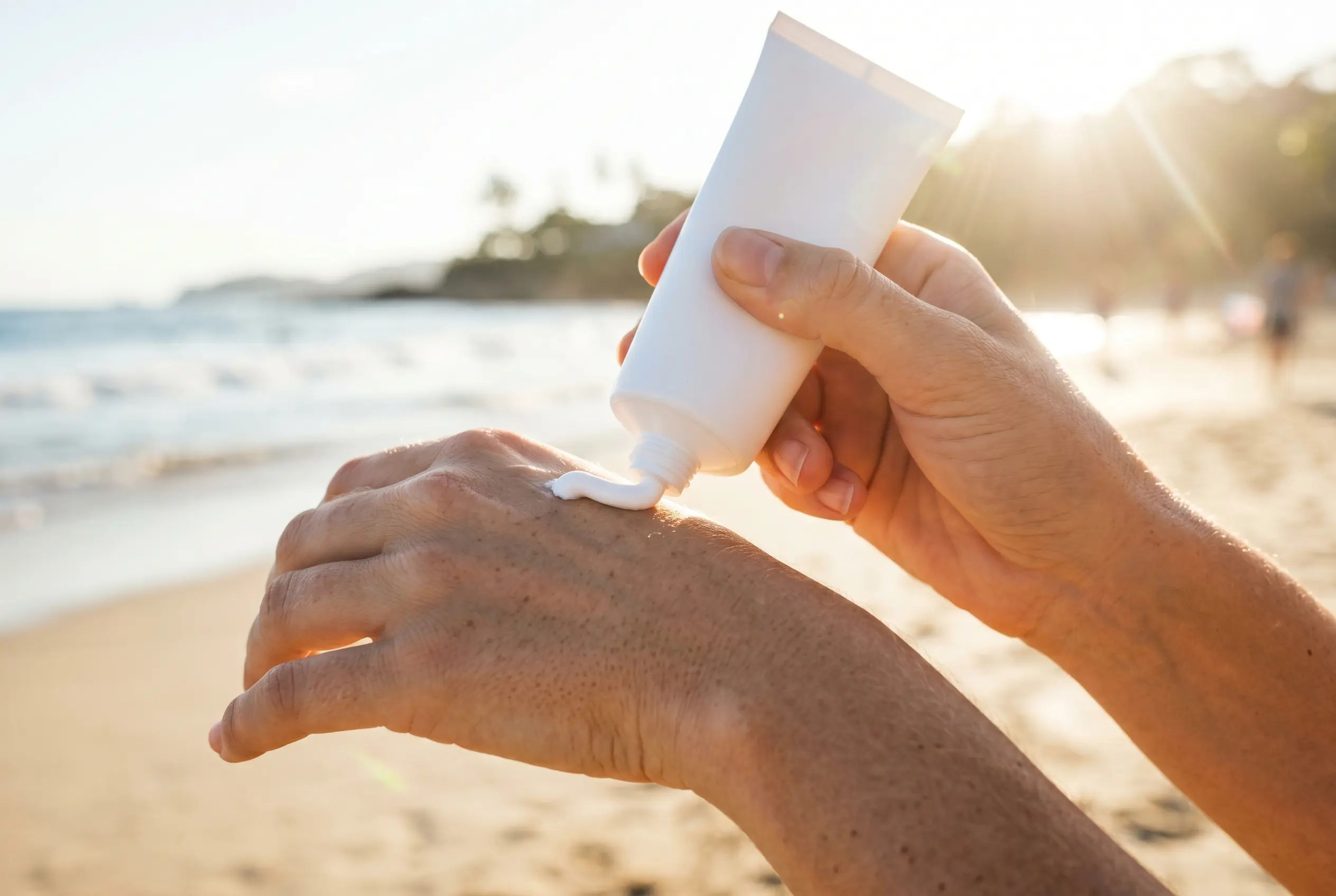
Bemotrizinol protects against both ultraviolet A and ultraviolet B radiation, the two bands the FDA requires a “broad spectrum” sunscreen to cover. The agency determined that at concentrations up to 6%, the ingredient is generally recognized as safe and effective for adults and for children 6 months of age and older. It produces low skin absorption into the body, and the FDA’s review found no meaningful entry into the bloodstream at permitted concentrations. The new filter does not break down under sunlight, a quality called photostability that older chemical filters, including avobenzone, lack. Bemotrizinol’s 27-year safety record abroad, reviewed by the FDA, includes no signals of cancer or reproductive harm.
The Environmental Working Group, which has pressed the FDA to approve the filter for more than a decade, says the new ingredient is also a better partner for mineral sunscreens. It can be combined with zinc oxide to provide strong broad spectrum protection with less white cast than a zinc-only formula. That combination matters for darker skin tones, where the chalky residue of pure mineral formulas has long been a barrier to consistent sunscreen use.
The UVA Gap U.S. Shoppers Have Been Missing
U.S. sunscreens do a credible job blocking the UVB rays that cause visible sunburn. They do far less well against UVA, the longer wavelength that penetrates deeper into skin, drives photoaging, suppresses immune function, and is a leading contributor to melanoma.
A peer-reviewed EWG study, published in Photodermatology, Photoimmunology & Photomedicine, tested 51 U.S. sunscreens and found that products delivered on average just 59% of their labeled UVB protection and only 24% of the UVA protection their SPF labels implied. Most Americans reaching for high-SPF products get a fraction of the protection they believe they are buying. The EWG’s annual review of the sunscreen market, summarized in its 20th annual sunscreen market review, has tracked that gap for two decades.
The chemical filters currently allowed in U.S. sunscreens are built to handle one band or the other, and brands combine them to claim broad spectrum coverage. Avobenzone is the only non-mineral filter that delivers meaningful UVA protection, but it is chemically unstable in sunlight, and its breakdown products have been linked to allergic reactions. A 2019 FDA randomized clinical trial, published in JAMA in 2020, found that six common chemical UV filters were absorbed into the bloodstream above the threshold the FDA uses to require additional safety studies. The EWG’s release on the approval reported that oxybenzone, by comparison, was detected in blood at 515 times the FDA’s threshold of concern after a single weekend of application.
For too long, American consumers have been applying sunscreen and believing they were fully protected, not knowing that their product was delivering far less UVA protection than the label implied.
Alexa Friedman, senior scientist at the Environmental Working Group, points to mineral sunscreens built on zinc oxide and titanium dioxide as the alternative that reflects both kinds of radiation without breaking down. She noted that the group’s top daily-use recommendation still points to zinc oxide, though its drawback is the white cast, a real barrier for many people, especially those with darker skin, who have had to choose between protection and a product that does not look like a mask.
Why It Took a Generation to Reach U.S. Shelves
Bemotrizinol was first submitted to the FDA in 2005, under a regulatory process that has since been discontinued. The ingredient had already been used in Europe and across Asia for six years by that point, sold by BASF as Tinosorb S and by DSM as Parsol Shield. It had racked up a 27-year safety record abroad before American shelves got access to it, according to the consumer advocacy response to the approval.
Congress tried to break the bottleneck in 2020 with the CARES Act, which gave the FDA a streamlined administrative order process for over-the-counter monograph ingredients. DSM submitted its most recent request in 2024 under that new pathway, and the agency issued a proposed order on December 12, 2025, with public comments open until January 26, 2026.
The final order arrived seven months after the proposal, a faster turnaround than the decades-long reviews bemotrizinol had previously seen. The decision aligns with the Make America Healthy Again Strategy Report, which named sunscreen reform as a priority. The MAHA directive said the FDA will “promote innovation in the sunscreen market, and improve regulatory processes for over-the-counter sunscreen, which has fallen behind other countries.” That pressure, combined with the new CARES Act pathway, finally pushed the long-stalled approval through.
Parsol Shield Arrives First, With an 18-Month Head Start
Bemotrizinol will reach U.S. shelves first as Parsol Shield, a proprietary formulation from Dutch manufacturer DSM Nutritional Products. The launch is expected later in 2026, and DSM will hold 18 months of exclusive marketing rights before other formulators can use the ingredient, the FDA’s release confirms. Shoppers will recognize the ingredient on the label as “bemotrizinol,” “BEMT,” “Parsol Shield,” or its standardized name, bis-ethylhexyloxyphenol methoxyphenyl triazine.
International shoppers have been buying products with the same molecule for years. Tinosorb S, the BASF brand, has stocked shelves in France, South Korea, Japan, and Israel for decades, and Israeli consumers have been using it without necessarily knowing its name.
The Reforms Still Sitting on the FDA’s Desk
Bemotrizinol is a single addition to a list the EWG says is still 14 ingredients behind Europe. Even with the new filter, U.S. sunscreen formulators will have access to 16 approved UV filters, while European formulators have access to approximately 30. The FDA proposed meaningful reforms in 2019 and again in 2021. Those reforms covered stronger UVA standards, SPF value caps, better labeling, and updated safety data requirements. None of those reforms has been finalized.
The gap shows up on the high end of the SPF scale. In perfect laboratory conditions, an SPF 50 product blocks 98% of UVB rays, and SPF 100 blocks 99%, a difference the EWG calls negligible. Manufacturers continue to push SPF 70, 80, and 100+ products using chemical boosters that inflate the number without improving UVA protection.
Independent testing has exposed the marketing problem in starker terms. In Australia, a regulator’s tests found that one product labeled SPF 50+ measured at just SPF 4, a scandal that triggered investigations and mass recalls. The U.S. still uses the same in vivo testing method, in which technicians visually judge skin redness on human subjects. That method is so inconsistent that the EWG reports the same formula can produce SPF 51 at one lab and SPF 28 at another.
This approval is a triumph of consumer advocacy, but it also shines a harsh spotlight on a federal system stuck in neutral. American families have waited long enough.
Melanie Benesh, the EWG’s vice president for government affairs, said in the group’s June 2026 statement on the approval that Congress has to set binding deadlines for chemical testing and give the FDA the power to pull noncompliant products from shelves. “Meanwhile, sunscreen manufacturers are refusing to provide the FDA with safety data for other UV filters, prioritizing corporate secrecy over public health,” Benesh said.
What Shoppers Should Do This Summer
For now, the EWG says zinc oxide sunscreens remain the most stable, balanced broad spectrum option on U.S. shelves. Mineral formulas with zinc oxide are the group’s top daily recommendation, while products built on titanium dioxide are also acceptable for daily use. For consumers willing to wait for the new wave, the label to look for is “bemotrizinol,” “BEMT,” or “Parsol Shield.” The EWG’s 2026 Guide to Sunscreens evaluated 2,784 SPF products and found 550 that met its safety and balanced UV protection criteria.
Of those, 62 sunscreens carry the EWG Verified mark, which requires products to exceed both U.S. and European UVA protection standards. The group’s 20th annual guide also evaluated 130 SPF products, including moisturizers and lip balms, that meet its standards. Shoppers can search the guide, scan products with the EWG Healthy Living app, and look for the Verified mark to find the right sunscreen this summer.
- Choose mineral sunscreens with zinc oxide for daily use.
- Stick with SPF 50 or lower, since higher numbers do not reliably improve UVA protection.
- Avoid oxybenzone and octinoxate, both linked to hormone disruption.
- Look for “bemotrizinol” or “BEMT” on new products entering shelves later in 2026.
Frequently Asked Questions
What is bemotrizinol?
Bemotrizinol, also labeled BEMT or sold as Parsol Shield, is a chemical UV filter that protects against both UVA and UVB radiation. The FDA added it to the U.S. over-the-counter sunscreen monograph on June 9, 2026, ending a 25-year drought of new active ingredients, with use permitted at concentrations up to 6%.
Is bemotrizinol safe?
Bemotrizinol is classified by the FDA as generally recognized as safe and effective for adults and children 6 months of age and older, the same standard applied to other approved OTC sunscreen active ingredients. A two-year animal study and a multigenerational reproductive study, both reviewed by the FDA, found no evidence of cancer-causing effects or reproductive harm, according to the EWG’s summary of the FDA’s review documents.
When will bemotrizinol sunscreens be available in the U.S.?
Parsol Shield, made by Dutch manufacturer DSM Nutritional Products, is the first U.S. product expected to reach stores, with a launch later in 2026. DSM will hold 18 months of exclusive rights before rival manufacturers can blend the same filter into their own products.
Why did it take 25 years for the FDA to approve a new sunscreen ingredient?
The molecule’s first FDA submission dates to 2005, filed under a regulatory process that has since been retired. Congress rewrote the rules for over-the-counter drug reviews in the 2020 CARES Act, and DSM’s 2024 submission under that new framework moved the application from a December 2025 proposed order to the final June 2026 approval, a multi-decade review by the time American shelves get access.
Will bemotrizinol replace mineral sunscreens?
Not exactly. Bemotrizinol is a strong option for shoppers who prefer non-mineral formulas, but the EWG still rates mineral sunscreens with zinc oxide as the top daily-use pick because zinc oxide is the most photostable broad spectrum filter on U.S. shelves. The two can also be combined in hybrid formulas for users who want both.
Disclaimer: This article summarizes the FDA’s June 9, 2026 approval of bemotrizinol and the broader sunscreen regulatory landscape. It is informational and not medical advice. For skin conditions or sunscreen selection tailored to your health, consult a dermatologist. Figures and quotes are accurate as of the FDA’s June 9, 2026 release.





Guardians Rout Twins With Seven Homers, Leave Joe Ryan One Shy of Record

Jersey Mike’s IPO Pays Blackstone More Than It Raises for the Chain

Archer’s Military Pivot Takes Flight With Anduril’s Thunder Aircraft

Dan Ives Sticks With His $350 IBM Target While HPE Banks the Fallout

Bristol Myers Squibb Joins Nvidia’s Pharma AI Supercomputer Arms Race

Starter Homes Are Rebounding in the South, Yet Sales Keep Falling

Domino’s Posts Higher Profit as Its Franchisees Feel the Squeeze

AMC’s Record Quarter Lifts the Stock 20%, but Dilution Caps the Rebound

Space Force’s Rocket Contracts Balloon to $30 Billion for Golden Dome

Nvidia Is Quietly Betting Against OpenAI’s Push to Ban Kimi K3

Halo Studios Reverses PS Plus for Halo: Campaign Evolved on PS5

Black Ops 1 and 2 PS5 Ports: $40 Price Tag Has Fans Uneasy

Star Wars: Galactic Racer Is a Roguelite Racer With a Podracing Skin

Matt Brown Dismisses Rousey and Paul’s MVP MMA Ratings Win Over UFC

Julius Randle Traded to Nets as Wolves Reclaim Cap Space for Dosunmu

Sega’s $49.99 Sonic Classic and Modern Bundles Hit Switch in October

Colombia Edge DR Congo as Muñoz Books World Cup Knockout Place

Warriors Take Yaxel Lendeborg, the Oldest Pick in the 2026 NBA Draft

Douze Dixièmes Closes Five Months After MIO: Memories in Orbit

Warhammer Horus Heresy Super-Heavy Tanks Share a Plastic Chassis
-

 TECHNOLOGY3 years ago
How to Adjust a Bulova Watch Band – An Easy Guide
-

 News3 years ago
Fred Pentland: Athletic Bilbao’s English mentor who changed the essence of Spanish football
-

 FINANCE3 years ago
Tax Planning for Every Season: Guide to Maximizing Your Tax Benefits
-

 Education3 years ago
African Ministers New Education Plan
-

 BUSINESS3 years ago
What is Entrepreneurial Operating System? A Comprehensive Guide to EOS
-

 Education3 years ago
Innovate Your Learning Journey with Technology and Enhance Education
-

 BUSINESS3 years ago
Top 9 Most Expensive American Cities to Rent an Apartment
-

 News3 years ago
Russians formally out of World Athletics Championships