
AUTOMOBILE
Ferrari’s $640,000 Luce EV Lands With an 8% Stock Slide and a Soprano Meme

Ferrari priced its first electric car at €550,000 (about $640,000) on Monday in Rome and watched its Milan-listed shares close down 8.4% the next session, the steepest single-day drop since October. The four-door, five-seat Luce was co-designed by Sir Jony Ive’s San Francisco studio LoveFrom over a five-year collaboration. By Wednesday, the loudest critic was not an analyst. It was Luca di Montezemolo, Ferrari’s chairman from 1991 to 2014, asking publicly that the prancing horse be removed from the bodywork.
The market is not telling Ferrari its electric car is bad. It is telling Ferrari its electric car looks too much like the design firm it hired. That is a different problem, and a more expensive one to fix.
The Car Ferrari Built With LoveFrom
The Luce uses four electric motors producing up to 1,035 horsepower, a 122 kilowatt-hour battery, and a claimed 0-to-62 mph time of 2.5 seconds. Production starts in late 2026. United States deliveries begin in the second quarter of 2027. Ferrari has confirmed pricing in euros and described the dollar equivalent at current rates.
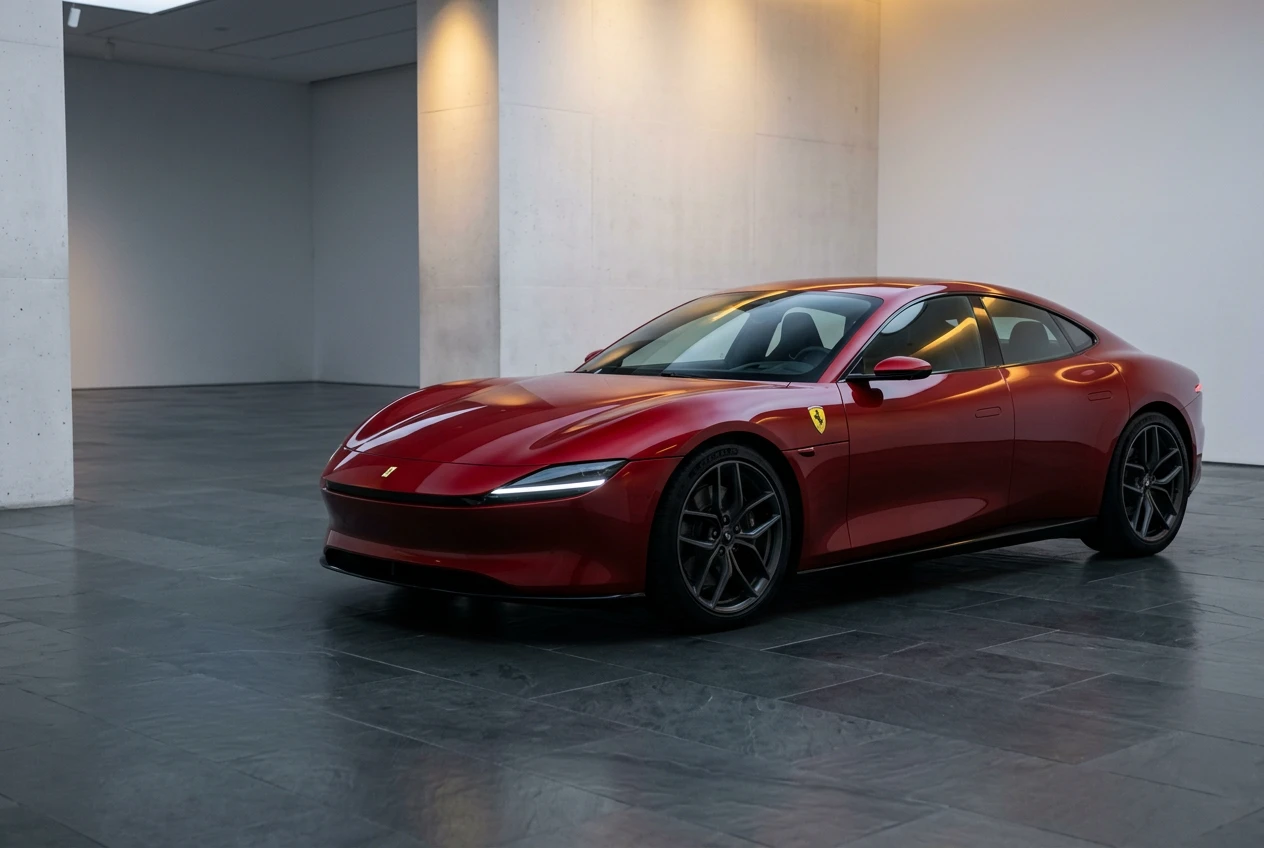
The exterior is a smooth, continuous shell rather than the angular wedge that defined the F40, the Enzo and the SF90. Inside, the cabin rejects the giant touchscreen most luxury EV (electric vehicle, battery-powered passenger car) makers have standardized. Ive and design partner Marc Newson built the controls around precision-engineered mechanical buttons, dials and toggles in glass and anodised aluminium. The steering wheel is made from 100% recycled aluminium.
The result reads as a deliberate split from the racing-bred shapes that defined the brand for six decades. The table below puts the Luce alongside the two combustion halo cars it shares a showroom with.
| Model | Powertrain | Peak Output | Starting Price |
|---|---|---|---|
| Luce (2026) | 4 electric motors, 122 kWh battery | 1,035 hp | €550,000 |
| SF90 Stradale | V8 plug-in hybrid | 986 hp | €430,000 |
| F80 | V6 hybrid | 1,184 hp | €3.6 million |
On raw numbers, the Luce slots cleanly into the lineup. On silhouette, it does not. That is the gap the backlash is filling.
Why Ferrari Hired Apple’s Designer
Ive left Apple in 2019 after running industrial design for the iPhone, the iPod and every Mac that mattered for two decades. He founded LoveFrom in San Francisco with Newson and a roster of former Apple hardware leads. Ferrari brought the studio in to translate two decades of consumer-electronics thinking onto a vehicle architecture where batteries take floor space and a quiet motor takes the place of a V12.
Benedetto Vigna, Ferrari’s chief executive, has spent his tenure arguing that the electric car must extend the brand rather than replace it. He has capped fully electric models at 20% of Ferrari’s 2030 lineup, with combustion and hybrid taking the rest. Bringing Ive in was the part of that strategy meant to signal that the EV would be a serious, separate product, not a battery retrofit of an existing platform.
Flavio Manzoni, Ferrari’s chief design officer, described the work in the launch video as a bridge between San Francisco and Maranello, the northern Italian town where Ferrari has built cars since 1947. The bridge is real. So is the cost of standing on it.
The Backlash, From Memes to Maranello Veterans
The reaction broke in three distinct registers within 48 hours of the Rome unveiling. Each one targets a different audience, and each one is harder to dismiss than the one before it.
- Social media meme cycle. One widely circulated post on X read: “Legend has it that if you pull the Ferrari badge off the side of the new Luce you see an Apple logo underneath.” Other memes photoshopped iPhone home-screen icons onto the roof and showed the Luce upside down, plugged into an iPhone charger. A Tony Soprano reaction image carried the caption, “I don’t want any California bulls-.”
- Political intervention. Matteo Salvini, Italy’s transport minister, told his 1.5 million X followers the prancing horse should come off the bodywork. A sitting cabinet minister publicly attacking a Ferrari design is unusual. Coverage of the Salvini broadside and the Rome unveiling backlash ran on Italian wires within hours.
- Veteran repudiation. Montezemolo, who chaired the company for 23 years, told Italian news agency askanews this week the Luce risks destroying a legend and asked that the badge be removed. He also added a barbed line, saying the car is “certainly one that at least the Chinese won’t copy.”
If I were to say what I really think, I’d be doing Ferrari a disservice. We risk destroying a legend, and I’m truly sorry about that. I hope they at least remove the prancing horse from that car.
That is Montezemolo, on the record, three days after the launch. The quote landed in Italian press cycles on Wednesday and Thursday. It is rare for a former Ferrari chairman to attack a current product by name. Pairing the attack with a request to strip the logo escalates the rare to the unprecedented.
What Wall Street Saw
The selloff started before Montezemolo spoke. Milan trading opened with the stock down as much as 7.8% on Tuesday morning and closed at minus 8.4%. The New York-listed RACE ticker finished down 5.1% the same session. Ferrari shares are now off roughly 31% over the past 12 months, weighed down by softer global luxury demand on top of the Luce reaction.
Two named-analyst reads bracketed the trading day. Pierre-Olivier Essig at AIR Capital called the design “a mix between a Honda Accord EV and Tesla 3” and said Ferrari’s electric strategy looked “lost in translation.” Stephen Reitman’s team at Bernstein took the gentler view, arguing enough of the Ferrari client base may absorb the Luce to make the program work, but conceded that investors would want more proof the car is recognizably Ferrari before re-rating the stock.
- 8.4% Milan close on May 26, the steepest single-session drop since October
- 5.1% New York close the same session
- 31% 12-month decline in RACE shares heading into the launch week
- 20% ceiling Vigna has set for fully electric models in the 2030 lineup
Bernstein’s caveat is the one to watch. A luxury brand’s stock can absorb a bad week. It struggles to absorb a multi-quarter doubt cycle from the same client base that pays the deposits.
Launching Into the EV Headwind
The Luce arrives at the worst possible moment for premium battery-electric programs in the United States, the second-largest market Ferrari plans to ship into. President Trump has cut federal EV purchase incentives and unwound manufacturer credits, prompting Ford, General Motors and Stellantis to pare back electric programs and lean back into combustion. The Sony-Honda joint venture Afeela, a high-tech luxury EV that had spent years on the auto-show circuit, was shut down before reaching showrooms after Honda trimmed its electric ambitions.
Legacy automakers carrying combustion-era heritage have the hardest version of the problem. Their core buyers are attached to the exact engineering choices that an EV erases. Stellantis is working through the same calculus across Maserati, Alfa Romeo and Dodge, and the turnaround plan chief executive Antonio Filosa laid out for investors emphasizes brand-by-brand product pacing rather than a uniform electric push.
Ferrari’s own ceiling, 20% electric by 2030, is more conservative than almost any peer. The Luce is the proof of concept, not the volume bet. If the reception holds where it is now, the company has time to recalibrate before the next plug-in flagship.
The Mustang Mach-E Question
One historical parallel is worth holding alongside the share-price chart. When Ford put the Mustang badge on a four-door electric crossover in 2019, the launch drew sustained ridicule from the same kind of brand purists now writing Luce memes. The Mach-E was called a betrayal of the original Mustang shape, marketing and engineering philosophy. The car has since become a regular fixture of Ford’s electric lineup and one of the few non-Tesla battery vehicles to find consistent United States sales.
The Mach-E precedent argues that aggressive design departures absorb noise and then pull through on volume. The Afeela precedent argues that some halo electric programs never recover from a poor first impression. The Luce sits between those two outcomes, and which one it bends toward will depend less on Ive’s interior than on whether Ferrari can keep its combustion lineup healthy long enough for the EV reaction to cool.
Montezemolo’s request to remove the badge is the strongest signal in either direction. A former chairman publicly disowning a product changes the conversation from “does this car sell” to “does this car stay Ferrari.” Vigna’s answer to that question, in the next two earnings calls, is what investors are now waiting on.
Frequently Asked Questions
How Much Does the Ferrari Luce Cost?
Pricing starts at €550,000 in Europe, about $640,000 at current exchange rates. Final United States pricing has not been confirmed and will depend on the exchange rate at order time, options and any applicable duties or incentives in effect at Q2 2027 delivery.
When Can You Actually Buy One?
Production starts in late 2026 in Maranello. European deliveries begin first. The United States launch is scheduled for the second quarter of 2027. Order books opened on launch day; Ferrari has not disclosed how many units have been reserved.
Who Designed the Ferrari Luce?
The car was co-designed by Ferrari’s in-house team led by chief design officer Flavio Manzoni and LoveFrom, the San Francisco studio Sir Jony Ive founded after leaving Apple in 2019. Marc Newson, Ive’s longtime collaborator, was a named partner on the project. The work spanned five years.
How Powerful Is the Luce?
Ferrari quotes up to 1,035 horsepower from four electric motors, a 122 kilowatt-hour battery, and a 0 to 62 mph time of 2.5 seconds. Range and charging-speed figures have not been published.
Will There Be More Electric Ferraris?
Yes, but capped. CEO Benedetto Vigna has set 20% of Ferrari’s 2030 lineup as fully electric. The remaining 80% will be combustion and hybrid, including V12 and V6 platforms already in development. The Luce is positioned as an addition to the range rather than a replacement for combustion models.
If the meme cycle fades by the Paris and Monaco summer events and Ferrari posts a clean second-quarter combustion order book, the Luce gets the long runway it needs to find its audience. If the order book softens and a second former executive joins Montezemolo on the record, the company will be defending the program rather than selling it through the United States launch window.
Disclaimer: This article is for informational purposes only and does not constitute investment advice. Share price movements in luxury automakers carry significant risk and can be driven by short-term sentiment as well as fundamentals. Readers considering an investment in Ferrari or any other listed automaker should consult a qualified financial professional. Figures cited reflect publicly reported data accurate as of publication.


Bariatric Surgery Delivers 5x the Weight Loss of Ozempic in NYU Study

Olive Oil and Lemon Shot Every Morning: What Science Actually Shows

Wisconsin Confirms Five Mpox Cases as US Total Climbs to 535

Six Questions Sleep Researchers Use to Tell If You’re Getting Enough

ACS Adds Shield Blood Test to Colorectal Cancer Screening Guideline

New York, New Jersey Subpoena FIFA Over World Cup Ticket Pricing

Lamar Jackson Calls Ravens Coaching Change a ‘Breath of Fresh Air’

Hurricanes Shut Out Canadiens 4-0, One Win From Stanley Cup Final

Naomi Osaka’s Eiffel Tower Dress Hands Kevin Germanier a Roland Garros Runway

Donkey Kong 64 Joins Switch Online June 4 After 26-Year Wait

Mitchell Matches Kobe in Game 7 Rout, Cavaliers Reach East Finals

Shai Gilgeous-Alexander Wins Second Straight MVP With 83 of 100 First-Place Votes

Xperia 1 VIII Holds Price, Xiaomi 17 Max Loads Up: Week 20 Phone News

Colt Emerson Debuts, Mariners Get Swept by Padres in Vedder Cup

Brent at $111 Hides the Hormuz Damage Hitting Fed and Asia

Jaylen Brown Calls Stephen A. Smith the Face of Clickbait Media

Rousey Finishes Carano in 17 Seconds and Hands Netflix Its MMA Opening

LIRR Strike Hits Third Day as 250,000 Commuters Face a Tougher Manhattan Run

Nebraska Softball Tops GCU, Lands Program’s First Home Super Regional

Santa Marta’s Fossil Fuel Exit Plan Puts Scotland’s Drilling U-Turn on the Clock
-

 TECHNOLOGY3 years ago
How to Adjust a Bulova Watch Band – An Easy Guide
-

 FINANCE3 years ago
Tax Planning for Every Season: Guide to Maximizing Your Tax Benefits
-

 Education3 years ago
African Ministers New Education Plan
-

 News3 years ago
Fred Pentland: Athletic Bilbao’s English mentor who changed the essence of Spanish football
-

 BUSINESS3 years ago
What is Entrepreneurial Operating System? A Comprehensive Guide to EOS
-

 Education3 years ago
Innovate Your Learning Journey with Technology and Enhance Education
-

 News3 years ago
Russians formally out of World Athletics Championships
-

 BUSINESS3 years ago
Top 9 Most Expensive American Cities to Rent an Apartment