
News
What the Google Home Display Should Look Like After the Speaker
The Google Home Speaker hit shelves June 25, 2026. The next consequential product is a Google Home Display. The strongest case is a modern Nest Hub Max.

The Google Home Speaker arrived on shelves on June 25, 2026, the first new entry in Google’s smart home lineup since 2021. The next consequential product is almost certainly a Google Home Display, a smart display the company has not officially announced but has been signaling since fall 2025. The question for Google’s hardware roadmap is no longer whether a Display is coming, but what form factor it should take.
That question sits in a small pile of Google smart displays, three attempts across the past decade, none a clean winner. The Google Home Speaker at $99.99 clears room for a Display priced above it. Gemini for Home gives Google a reason to ship a real hub again. And the third-party smart speaker market, led by Walmart’s upcoming Onn device, is willing to fill the smaller gaps Google leaves behind.
The Speaker Just Reset the Smart Home Lineup
The Google Home Speaker ended a stretch of quiet in Google’s smart home hardware lineup when it went on sale June 25, 2026, a date first hinted at in a Google Home Speaker launch date leak weeks earlier. Google’s last first-party smart speaker was the Nest Audio in 2020. Its last first-party smart display was the second-generation Nest Hub in 2021. The Speaker is the first audio device Google has built for Gemini for Home, the assistant that replaces Google Assistant across the company’s smart home hardware.
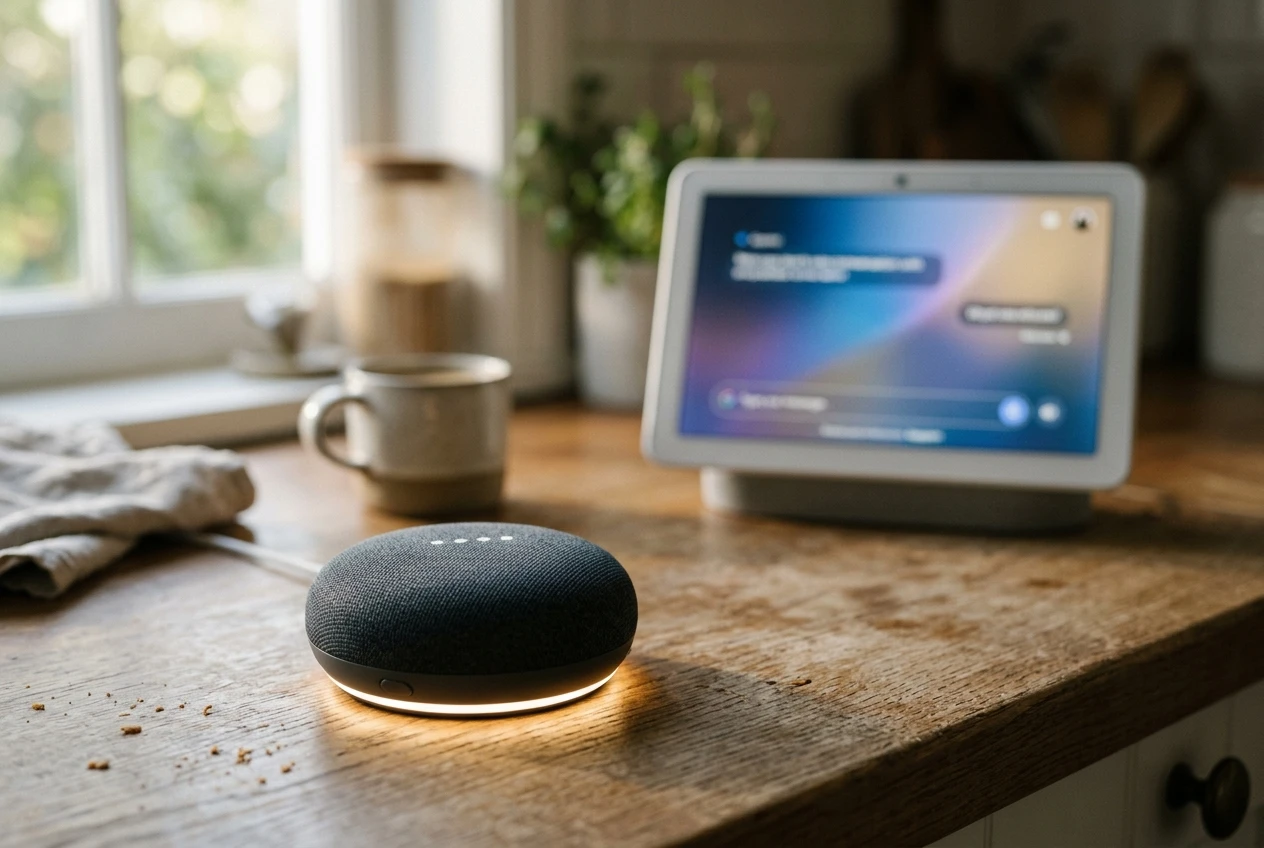
The Speaker’s official launch details and Gemini features list the device at $99.99 with retail on June 25, 2026, in Hazel, Porcelain, and US-exclusive Jade and Berry. The Speaker ships with 10 new natural-sounding voices, a balanced 360° sound profile, and a custom 3D-knit textile wrap. A hardware microphone toggle pairs with a new light ring underglow for privacy, and Gemini Live plus Continued Conversation make it the first Google speaker that handles free-flowing back-and-forth. Pairs of Speakers can also link to a Google TV Streamer for spatial surround sound in the living room, and the piece that fits below the Speaker in the lineup is the Display.
Why a Google Home Display Is Almost Certainly Next
Three converging signals make the next device almost inevitable. Google Home chief Anish Kattukaran said on The Vergecast in October 2025 that Google is “definitely committed to smart displays” and that buyers “should definitely expect that we’ll have news to share there.” He described the category as “an incredible form factor to interact with something like Gemini for Home” and went further, calling smart displays “almost the ultimate form factor to be able to deliver a really great home experience.” The comments came before the Speaker’s launch but pointed at what Google was preparing next.
A microphone, which means audio in, a speaker, so audio out. It’s got a screen, which complements a voice modality, you can interact with it and visualize information.
Kattukaran, Google’s head of Home, made the comments on The Vergecast in October 2025. The name then showed up in code, spotted by @aaronp613 on Twitter/X, a MacRumors analyst. A device labeled “Google Home Display” appeared in the Google Home app for iOS, in the same device list that already includes Chromecasts, Nest Cams, and every prior Google smart speaker and display. The branding matches the Speaker’s stripped-down naming.
The Display has not been officially announced. Google has not given a release date, a price, or a spec sheet. The Speaker’s rollout is the most useful guide: a fall 2025 tease, a spring announcement, a late-June retail launch. If the Display follows the same cadence, a fall 2026 tease and a 2027 launch is the obvious read, though Google has not confirmed any timeline. What is confirmed is that smart displays are no longer a sidelined category inside Google Home.
Three Smart Display Forms Google Has Already Shipped
Google has shipped three distinct smart display concepts across the past decade. Each approached the problem differently, and each came with a different tradeoff. The strongest argument for what the Google Home Display should be starts with how the prior three worked.
| Display | Form factor | What set it apart |
|---|---|---|
| Home Hub / Nest Hub | Compact, $99 | Speaker with visual feedback and casting |
| Nest Hub Max | Larger display | Built-in Nest Cam, upgraded speakers, hub hardware |
| Pixel Tablet | Detachable tablet with dock | Tried to be both tablet and smart display, failed in execution |
The Home Hub, later rebranded as the Nest Hub, debuted in 2018, with a second generation in 2021. It is a compact display that was, in practice, a speaker with a small screen for visual feedback. The $99 price point made it the cheap, useful option in the lineup. Casting and visual feedback gave it a role in the kitchen or on a nightstand. The Home Hub did not have a camera.
The Nest Hub Max launched in 2019 with a larger display, a built-in camera that doubled as a Nest Cam, and upgraded speakers. The Max was where Google actually tried to live up to the “hub” part of the name. It added more smart home radios and processing power under the hood, and it is also where Google stopped shipping smart displays, leaving the Hub Max without a true successor for five years.
The Pixel Tablet tried to bridge a smart display and an Android tablet. The product was clearly meant to be a Nest device first, but it tried to do both jobs at once and ended up doing neither cleanly. It is still useful on a desk, but as a smart display it is a jack of all trades and master of none. The Pixel Tablet is the strongest argument against trying to do too much in one device.
The Nest Hub Max Form Factor Still Fits Best
Of the three, the Nest Hub Max is the best model for what comes next. The size is not as universal as the smaller Nest Hub, but a modernized version fits naturally above the Speaker in the lineup. The Speaker already sits at the smaller Nest Hub’s $99 price point, so the Display belongs in the Hub Max’s tier.
The Max form factor wins on substance. Smart displays need room for a real display, real speakers, and a real camera. The Home Hub form factor was cramped by comparison, and the Pixel Tablet’s portable-first design fought the kitchen-counter use case. A larger display also gives Gemini for Home room to visualize what the voice is doing, which is the central point Kattukaran made about smart displays in the first place.
The Home Hub form is also redundant with the Speaker. A $99 Speaker and a $99 Nest Hub compete for the same shelf space and roughly the same use case. Google does not need two devices at the same price with overlapping feature sets. The Display has to sit above the Speaker in the lineup, both physically and in capability, and the Max form factor is the cleanest answer to that pricing problem.
What a Modernized Display Would Need to Ship
A built-in Nest Cam is at the top of the wishlist. The Hub Max had one, but the implementation left room for improvement, including the absence of night vision. With Camera History Search now a Gemini for Home feature that lets users ask a speaker to describe recent Nest cam activity, the new Display needs a camera that matches the new assistant. A camera that doubles as a security camera also justifies the price difference above the Speaker.
The Gemini for Home experience has to be on par with the Speaker. Continued Conversation, Gemini Live, Home Briefs, and Camera History Search should all be there from day one. The Display becomes the device on the kitchen counter where a family asks the most questions.
- A built-in Nest Cam with night vision, the obvious upgrade over the Hub Max.
- A larger display running the same Gemini for Home experience as the Speaker.
- Stereo speakers tuned for room-filling audio, not just near-field listening.
- Thread and Matter radios to act as a true smart home hub.
- A redesigned base or dock that fits kitchen counters and bedside tables.
A single Display replacing the existing roster is also the cleaner lineup. The Home Hub line ends. The Hub Max gets a direct successor. The Pixel Tablet stops competing for the smart display slot and goes back to being a tablet. The result is two first-party devices, the Speaker at $99 and the Display above it, plus whatever third parties like Walmart ship under their own brands. That is the lineup Google’s restraint can support.
The Display also has to differentiate from the Speaker in ways that justify a higher price. A bigger screen, a better camera, room-filling stereo audio, and hub-grade smart home hardware are the four obvious upgrades. A Display that costs the same as the Speaker and sits next to it is a confusing lineup. The price gap is the easiest signal that the two devices do different jobs.
Google’s Smart Home Hardware Stops at Two Devices
Google’s hardware restraint is one of the most consistent signals in the smart home category. On a recent episode of the 9to5Google Pixelated podcast, Abner Li argued that Google’s smart home hardware future does not extend far beyond the Speaker and a Display for the foreseeable future. The argument is straightforward: Google set the template with the Nest Hub and the Nest Hub Max, and it lost interest in the category after 2021 because the products were not differentiated enough. Two clean devices, one cheap and one premium, is a more disciplined bet than the old multi-device roster.
Third-party brands are picking up the slack. Walmart’s Onn Smart Speaker, listed on the Connectivity Standards Alliance (CSA) Matter website in May 2026, runs Gemini voice controls, has a 10W speaker, a far-field microphone array, and Bluetooth and Google Cast support. The last memorable third-party Google Assistant speaker was the JBL Authentics lineup in 2023. The Onn listing signals that third-party Gemini hardware is back, which gives Google room to stay disciplined on its own catalog.
The bet is that the Google Home Speaker and a future Google Home Display carry the first-party smart home lineup. Walmart, JBL, and other brands fill the gaps in size, price, and audio profile. The Display’s job is to be the best version of the smart display Google can build, not to be five different products at once.
Frequently Asked Questions
Has Google officially announced the Google Home Display?
No. As of July 2026, Google has not officially announced the Google Home Display. The name “Google Home Display” appeared in code inside the Google Home app for iOS in May 2026, spotted by MacRumors analyst @aaronp613. Google Home chief Anish Kattukaran confirmed in October 2025 that the company is “definitely committed to smart displays” and that buyers “should definitely expect that we’ll have news to share there,” without giving a release date.
How much will the Google Home Display cost?
Google has not announced pricing. The Nest Hub Max launched at $229.99 and the smaller Nest Hub (2nd gen) launched at $99.99, the same price as the Google Home Speaker. A Display above the Speaker in the lineup would most likely sit closer to the Hub Max’s tier rather than the smaller Hub’s price point.
Will the Google Home Display have a camera?
Google has not confirmed specifications. If the Display follows the Nest Hub Max form factor, a built-in Nest Cam is the strongest expectation. The Hub Max had a camera that doubled as a Nest Cam but lacked night vision, which is the most obvious first upgrade for a new device.
When will the Google Home Display launch?
Google has not given a release date. The Google Home Speaker was teased in October 2025 and hit retail on June 25, 2026. If the Display follows the same cadence, a fall 2026 tease and a 2027 launch is plausible, but Google has not confirmed any timeline.
Will the Google Home Display work with the Google Home Speaker?
Almost certainly. Both are part of Google’s smart home lineup and run Gemini for Home. The Speaker already pairs with the Google TV Streamer for spatial audio. The Display would likely act as the visual hub for the Speaker, the TV Streamer, Nest Cams, and any Matter or Thread smart home devices on the network.






Spotify Running Mode hits Android and revives its old tempo experiment

Galaxy Tab S12 Ultra Renders Keep the Notch Fans Hate

Novato Spinning Round House Sells With Six Neighbors for $3.3 Million

Crop Tour Finds Indiana and Nebraska Corn Yields Lagging 2025

Best Buy 60th sale brings Android deals back to its roots

American Airlines reverses seatback screen bet years too late

Iran Hormuz Strikes Force Gulf Oil Onto Costlier Paths

Plague Tale Prequel Day One Joins Game Pass Wave 2 as Witcher Exits

NBA 2K27 opens The City to everyone and rewrites career eras

iOS 26.6.1 Patches 29 Flaws as AI Forces Faster Apple Updates

Caitlin Clark Skips the WNBA 3-Point Contest for a Third Straight Year

Rainout Gives Red Sox Two Shots at a Franchise-Record Win Streak

Double Fine Cuts 23 Jobs Weeks After Xbox Independence

Day-One Big Walk Lifts PS Plus August Beyond Recycled AAA

John Hight Exits Wizards After Digital Reckoning Hits

Curtis Mead’s Red Sox Debut Ends With Fractured Wrist

Moesch and Dressel Rewrite Night One at 2026 U.S. Nationals

Red Sox Squander Hot Streak Chance in 4-3 Loss to Athletics

Boutte’s Quiet Camp Takeover Forces Patriots Receiver Choices

Take-Two CEO Pushes Netflix Subs for GTA 6 Extended Look
-

 TECHNOLOGY3 years ago
How to Adjust a Bulova Watch Band – An Easy Guide
-

 News3 years ago
Fred Pentland: Athletic Bilbao’s English mentor who changed the essence of Spanish football
-

 FINANCE3 years ago
Tax Planning for Every Season: Guide to Maximizing Your Tax Benefits
-

 Education3 years ago
African Ministers New Education Plan
-

 BUSINESS3 years ago
What is Entrepreneurial Operating System? A Comprehensive Guide to EOS
-

 Education3 years ago
Innovate Your Learning Journey with Technology and Enhance Education
-

 News3 years ago
Russians formally out of World Athletics Championships
-

 BUSINESS3 years ago
Top 9 Most Expensive American Cities to Rent an Apartment