
FINANCE
IBM Stock Suffers Its Worst Trading Day Since the 1987 Crash
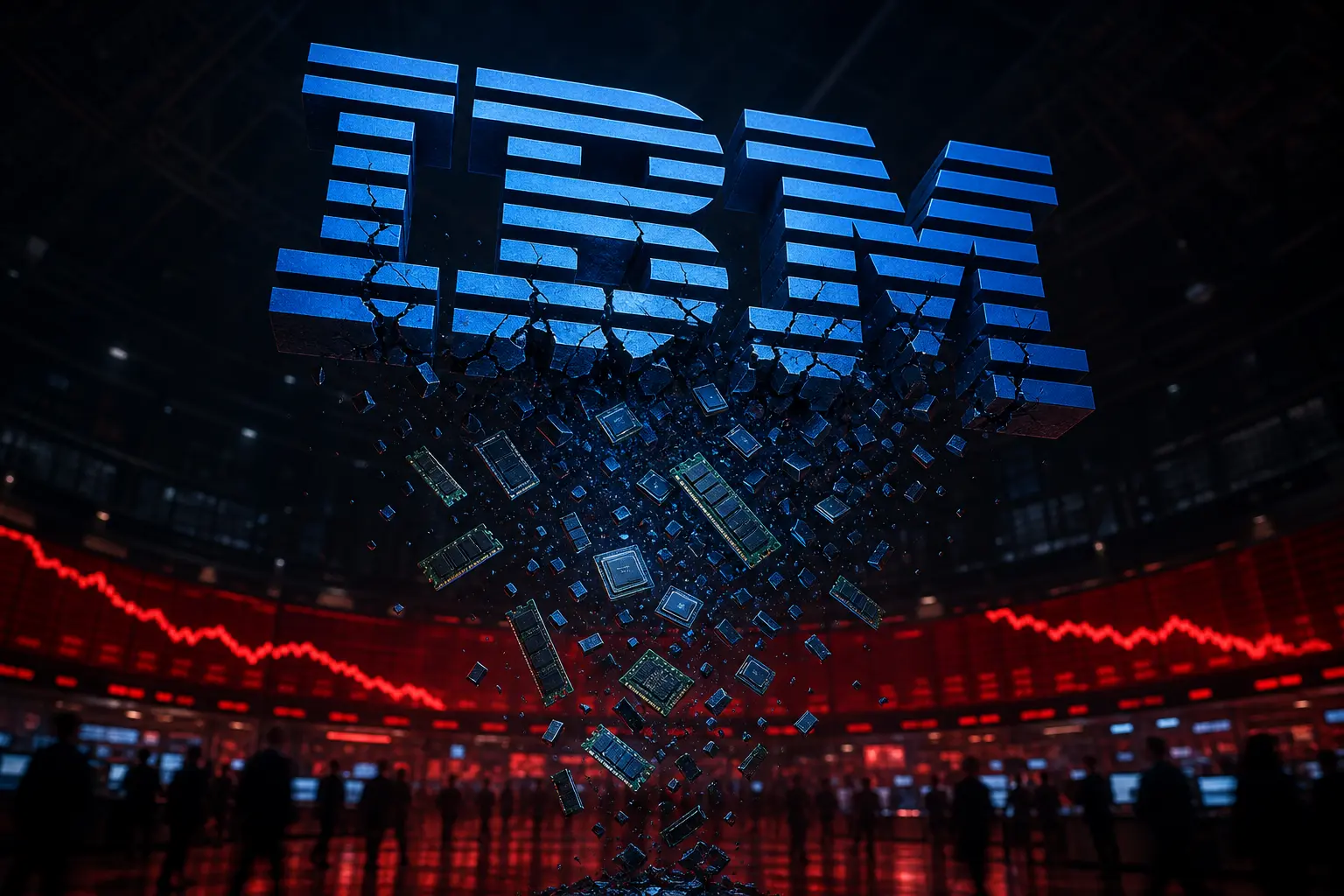
IBM stock plunged 25% Tuesday, its worst day since 1987, after warning that clients are shifting budgets from software to AI-driven hardware.

IBM shares closed down 25.21% at $217.05 on Tuesday, the steepest single-session drop for the stock in roughly six decades. The rout erased an estimated $67 billion to $70 billion in market value after the company warned that customers are steering technology budgets toward AI-hungry hardware instead of software.
Shares were still stuck near those levels Wednesday, Barron’s reported, unable to mount much of a recovery as investors weighed whether the selloff had gone too far or captured a real, lasting shift in how companies spend their technology budgets.
IBM’s Worst Trading Day in Almost 60 Years
Tuesday’s decline surpassed the 23.7% plunge IBM suffered on Black Monday, October 19, 1987, according to CNBC, making it the worst single session in the stock’s modern history. Bloomberg framed it in similar terms, reporting that IBM shares fell by the most since the 1960s.
The trigger was a preliminary earnings warning issued Monday evening, as the artificial intelligence (AI) buildout squeezes global supply of chips and servers. IBM said second-quarter revenue would land around $17.2 billion, short of the $17.86 billion Wall Street expected, with adjusted earnings per share near $2.93 against a consensus close to $3.01.
| Q2 2026 Metric | IBM’s Preliminary Figure | Wall Street Estimate |
|---|---|---|
| Total revenue | $17.2 billion | $17.86 billion |
| Adjusted earnings per share | $2.93 | $3.01 |
| Infrastructure segment revenue | Down 7% year over year | Growth had been expected |
| Consulting segment revenue | Up 1% in constant currency | Slower than prior quarters |
Two segments told most of the story. Infrastructure, the unit housing IBM’s mainframe business, dropped 7% from a year earlier. Consulting, roughly a third of total revenue, grew just 1% in constant currency, far slower than in recent quarters. Even after Tuesday’s drop, IBM remains a $68.9 billion-revenue company; over the trailing 12 months it booked $10.75 billion in profit, or $11.31 a share.
Krishna Blames a Capex Pivot to Chips
Chief executive Arvind Krishna laid out the shift in a letter to shareholders late Monday, pointing to enterprise customers who reprioritized their capital expenditure, or capex, budgets in the final weeks of the quarter.
In the last few weeks of June, we saw clients shift their quarterly capex spend toward servers, storage, and memory purchases to secure supply-constrained infrastructure ahead of expected price increases.
Krishna, IBM’s chairman and chief executive, added that the company had expected some disruption but not its scale: “While we anticipated some supply chain related impact in our expectations, we did not anticipate the magnitude of the capex reprioritization.” He also pointed to execution problems beyond the budget shift, saying current conditions demand near-flawless delivery and that a number of large deals failed to close on their expected timelines this quarter.
Micron’s own stock recently swung into a bear market on the same AI memory dynamics, proof the chip-versus-software tug-of-war Krishna described is already playing out elsewhere in the market.
Software Stocks Fall in Sympathy
IBM’s warning did not stay contained to one stock. Traders sold shares of other enterprise software companies within minutes of the open, worried the same capex squeeze could show up in results still to come.
Adam Crisafulli, founder of the markets research firm Vital Knowledge, said IBM’s results “will deliver a devastating blow to software/services stocks as investors will worry about the capex pivot negatively impacting the whole industry.”
By the closing bell, four of the biggest enterprise software names had all finished lower:
- Salesforce fell 2.1%
- Workday fell 3.5%
- Adobe fell 4.3%
- ServiceNow fell 5.8%
All four had dropped more than 5% within the first few minutes of trading before paring some of those losses into the close.
Echoes of Black Monday
Tuesday’s rout invites a comparison to October 1987, when IBM’s 23.7% single-day loss came amid a market-wide crash that had little to do with the company’s own numbers. Tuesday’s drop traces to a single earnings warning from IBM itself.
IBM survived 1987 to become one of the steadier dividend payers on Wall Street, raising its payout for 31 straight years. What Tuesday’s drop becomes next depends largely on what clients do with their budgets over the next few quarters.
Is IBM Stock a Buy After the Crash?
Wall Street is split. Most analysts still rate IBM a buy, with average price targets well above where the stock trades now, betting the software slowdown proves temporary. A smaller group, including Bank of America, has trimmed expectations, warning clients may keep favoring chips over subscriptions longer than bulls expect.
Yahoo Finance puts the average analyst price target near $321. TipRanks has it higher, at $334, implying more than 50% upside from Tuesday’s close. Among the 23 analysts TipRanks tracks, ratings skew heavily bullish: three rate it a strong buy, 12 a buy, seven a hold, and one a strong sell.
- Bulls: CNBC’s Jim Cramer has urged investors to buy the stock, arguing Krishna has left it undervalued, while Morningstar analysts expect most clients to eventually complete mainframe upgrades on a delayed timeline rather than scrap them.
- Bears: Bank of America trimmed its price target on the stock, citing the revenue miss and software weakness that could carry into future quarters.
- Skeptics: Some analysts warn that AI coding tools are starting to automate the legacy code maintenance work that has long supported a large share, about 29%, of IBM’s software sales tied to its mainframe installed base, Motley Fool analysts noted.
Even after the crash, IBM shares traded at roughly 22 times estimated 2027 earnings, according to Simply Wall St, above the broader software sector’s median of about 17 times. That gap is why bears argue the stock still has room to fall.
IBM’s generative AI business kept growing through the turmoil: AI-related bookings passed $12.5 billion on an inception-to-date basis by the end of 2025, a figure bulls point to as evidence the company’s core AI strategy remains intact. Retail sentiment on Stocktwits flipped to “extremely bullish” by early Wednesday, a sign individual investors were already treating the drop as a buying opportunity even as the stock struggled to bounce.
IBM’s Next Test Comes July 22
IBM is scheduled to report full second-quarter results on July 22 after markets close, when analysts get their first detailed look at how deep the software slowdown ran and whether it spread into other business lines.
The company’s longer-term pitch still leans heavily on quantum computing. IBM’s roadmap points to a large-scale, fault-tolerant quantum computer by 2029, a year behind the federal government’s own marker: an executive action from President Trump set a 2028 target for quantum computing earlier this year and left quantum stocks broadly mixed.
A second straight disappointment on July 22 would confirm the bears’ case that the capex shift is structural, the more consequential risk given how much of Wall Street’s bullish thesis assumes a quick rebound.
Until that report lands, Tuesday’s 25.21% plunge stands as the number every software earnings call this season will be measured against.
Disclaimer: This article is for informational purposes only and does not constitute investment advice. Stock prices are volatile and past performance does not guarantee future results. Consult a licensed financial advisor before making investment decisions. Figures are accurate as of publication on July 15, 2026.


Iowa Farmer Built Resilience for 16 Years Then Tariffs Hit Hard

HHS Adds FDA Tech and Drugs Deputies to Lock In AI and Review Power

Nvidia Earnings Carry a Built-In Sell-the-News Trap

HP Licenses Huawei Wi-Fi Patents Despite the Entity List

Poland Named in $131B F-15 Deal Echoes Apache Path

Sewer Scavengers Near Penn Station Repeat a Decades-Old NYC Pattern

Second Muni Fatigue Crash Exposes Surface Line Gaps

Chick-fil-A Chicken and Waffles Closes Its 80-Year Loop

Musk Data Centers Leave a Mississippi Family’s Historic Land Empty

OpenAI Data Center Chief Exits as Stargate Strategy Shifts

Double Fine Cuts 23 Jobs Weeks After Xbox Independence

Day-One Big Walk Lifts PS Plus August Beyond Recycled AAA

Curtis Mead’s Red Sox Debut Ends With Fractured Wrist

John Hight Exits Wizards After Digital Reckoning Hits

Red Sox Squander Hot Streak Chance in 4-3 Loss to Athletics

Moesch and Dressel Rewrite Night One at 2026 U.S. Nationals

Boutte’s Quiet Camp Takeover Forces Patriots Receiver Choices

Take-Two CEO Pushes Netflix Subs for GTA 6 Extended Look

Halo Campaign Evolved Skulls Meet Death Barriers That Kill the Hunt

Wildlands Free Update Hands Players the Tools They Already Invented
-

 TECHNOLOGY3 years ago
How to Adjust a Bulova Watch Band – An Easy Guide
-

 News3 years ago
Fred Pentland: Athletic Bilbao’s English mentor who changed the essence of Spanish football
-

 FINANCE3 years ago
Tax Planning for Every Season: Guide to Maximizing Your Tax Benefits
-

 Education3 years ago
African Ministers New Education Plan
-

 BUSINESS3 years ago
What is Entrepreneurial Operating System? A Comprehensive Guide to EOS
-

 Education3 years ago
Innovate Your Learning Journey with Technology and Enhance Education
-

 News3 years ago
Russians formally out of World Athletics Championships
-

 BUSINESS3 years ago
Top 9 Most Expensive American Cities to Rent an Apartment