
AUTOMOBILE
Lucid’s Bankruptcy Denial Can’t Quiet Wall Street’s Doubts
Lucid Motors denies a bankruptcy report after shares crashed as much as 57%, but deep losses and missed delivery targets keep investors on edge.

Lucid Motors denied a bankruptcy report on Tuesday, hours after the claim wiped out more than half the electric vehicle (EV) maker’s stock value in a single session. Shares fell as much as 57% before paring losses to close at $4.62, down 16% on the day, after a blog reported the company was weighing Chapter 11 protection or going private.
Lucid’s cash position backs up the denial. Still, it took one report built on two unnamed sources to erase billions in market value, drag rival Rivian down with it, and leave options traders hedged for distress even after the company called the story false.
The Hour Lucid Lost Half Its Value
Exchanges halted trading in Lucid Group shares multiple times Tuesday as the stock swung wildly. At its worst point, shares were down as much as 57%, Bloomberg News reported, the biggest intraday drop since the company went public.
The stock clawed back through the afternoon and closed at $4.62, still down 16% on the day, according to CNBC. That close capped a brutal stretch. Lucid priced its 2021 special purpose acquisition company (SPAC) debut near $58 a share, and shares are now down more than 90% from that peak, per the Motley Fool.
The report landed the same month Lucid eliminated a second production shift at its Casa Grande, Arizona factory and cut more than 2,000 jobs, moves the company has described as aligning output with demand. It also arrived during a stretch of executive turnover, including a chief financial officer change and a newly installed chief executive, that had already put investors on edge.
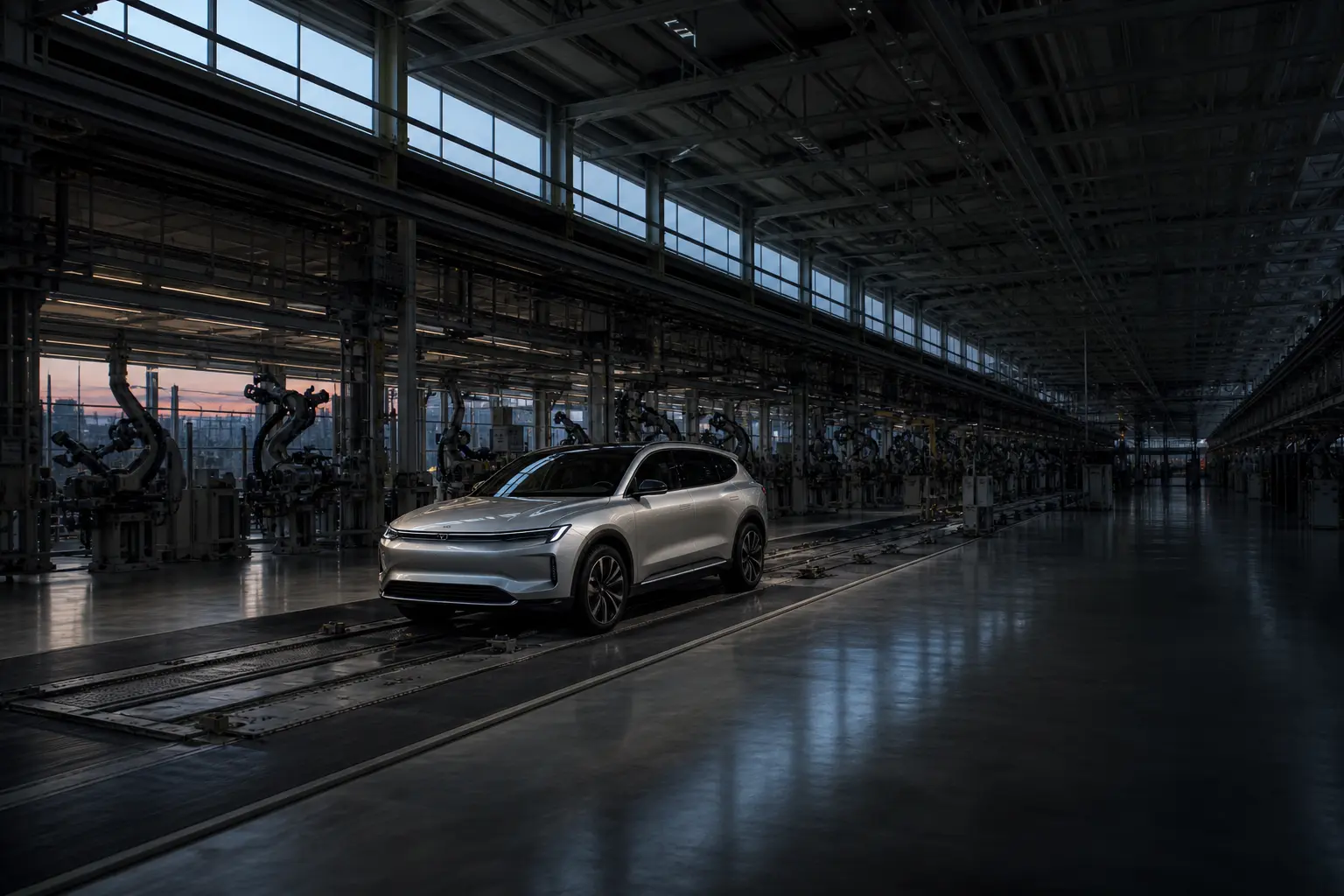
Twork Calls the Bankruptcy Claim Fabricated
The rumors are completely false.
Nick Twork, Lucid’s chief communications officer, gave that statement to TechCrunch hours after shares began sliding. He said the company has sufficient liquidity to carry its operations well into next year, as reflected in its most recent quarterly filings, and that no special board committee had been formed to weigh bankruptcy or a sale.
Twork also addressed the specific claim driving the sell-off: that AlixPartners, a turnaround and restructuring consultancy, had recommended bankruptcy to Lucid’s board. He said AlixPartners “is assisting us in that and nothing else and has not recommended bankruptcy to management or the Board,” describing its mandate as limited to strengthening operations.
The claim originated with eletric-vehicles.com, a little-known outlet citing two unnamed sources who said Lucid asked AlixPartners to weigh a Chapter 11 filing or a move to take the company private, with a recommendation due to the board. Torque News, reviewing the report, said the site lacked a track record for sourcing and had conflated a routine restructuring engagement with an active board decision on bankruptcy.
Why Did Wall Street Believe It?
Lucid’s own numbers explain why traders were primed to believe the worst. The company has posted mounting losses, missed its own delivery targets and burned through billions of dollars in cash over the past year. Its gross margin ranks among the weakest of any public automaker.
- $1.03 billion net loss in the first quarter of 2026, nearly three times the loss from the same period a year earlier.
- $3.8 billion in free cash flow burned during 2025 on just 15,800 vehicle deliveries for the full year.
- A gross margin of roughly negative 93%, meaning the cost of building each car still exceeds what Lucid collects selling it.
- Second-quarter 2026 deliveries of 3,953 vehicles, only slightly above the same quarter last year and below Wall Street’s forecast near 4,618.
Lucid has long struggled to find buyers for its luxury EVs despite widely praised technology, and it is now facing multiple class-action lawsuits alleging it hid a supplier quality problem that disrupted Gravity SUV production. An unauthorized supplier change tied to defective seatbelt welds triggered a 4,476-vehicle recall and a 29-day halt in Gravity deliveries earlier this year.
Rivian Slides in Sympathy as Traders Hedge for Distress
Rivian, the other major U.S. EV startup still working toward sustained profitability, saw its own shares dip Tuesday even though nothing in the report concerned the company. The sympathy move showed how thin investor patience has grown for the broader EV startup class.
Prediction markets moved too. Contracts on Polymarket pricing the odds of a Lucid bankruptcy announcement before 2027 jumped to 19%, far above the odds priced for its closest peers.
| Company (Ticker) | Polymarket-Implied Odds of Bankruptcy by 2027 |
|---|---|
| Lucid Group (LCID) | 19% |
| Rivian Automotive (RIVN) | 9% |
| Carvana (CVNA) | 6% |
Options traders showed similar skepticism. Lucid’s options chain skewed heavily toward puts for the July 31 expiry even after the denial, a sign some investors are still hedging against a worse outcome than management describes.
Lucid’s robotaxi partners have the most riding on that outcome. Uber has pledged to buy at least 35,000 Nuro-equipped vehicles from Lucid over the next several years, a commitment that only pays off if Lucid keeps building cars on schedule.
The AlixPartners Pattern
Lucid’s denial rests partly on drawing a line between hiring a restructuring adviser and planning to file for bankruptcy. AlixPartners’ own client history makes that line harder for some investors to see.
- 2021: Lordstown Motors brought in AlixPartners after its CEO and CFO resigned. The startup later partnered with Foxconn, but that relationship soured and Lordstown went out of business.
- 2022: Faraday Future retained AlixPartners to implement recommendations from its board following an internal probe.
- 2026: Lucid retained AlixPartners for what it describes as an operational restructuring focused on execution, not a bankruptcy review.
None of that history proves Lucid is heading toward the same outcome as Lordstown. AlixPartners works across distressed and healthy companies alike, and Twork’s description of its mandate matches how the firm is often used well before any bankruptcy filing. That pattern still gave a single report naming the firm enough weight to trigger a stock-halting sell-off.
Uber and Nuro Have 35,000 Vehicles Riding on Lucid
Lucid’s survival matters most right now to Uber and Nuro, the partners behind a robotaxi program built almost entirely around Lucid’s factory output. The three companies plan to put more than 20,000 Level 4 autonomous Lucid Gravity robotaxis on the road, unveiled at CES alongside plans for autonomous on-road testing, with Nuro supplying the self-driving system and Uber the dispatch network.
Uber’s order splits into 10,000 Gravity SUVs and 25,000 vehicles built on Lucid’s upcoming midsize EV platform, the smaller and more affordable model the company is counting on to widen its buyer base beyond luxury sedan shoppers. Lucid’s own account of the partnership describes robotaxis configured to seat up to six passengers with extra luggage space for group rides.
The bet arrives as regulators scrutinize robotaxis more broadly. The National Highway Traffic Safety Administration has pushed the robotaxi industry over vehicles blocking first responders, adding regulatory pressure onto a timeline Lucid cannot afford to miss.
Nuro began supervised autonomous testing in the Bay Area in December, with commercial rides in a major U.S. city targeted before the end of 2026 and expansion to dozens of markets planned over the following six years.
Disclaimer: This article is for informational purposes only and does not constitute investment advice. Lucid Group shares are volatile and speculative; consult a licensed financial professional before making investment decisions. Figures are accurate as of publication on July 15, 2026.


Iowa Farmer Built Resilience for 16 Years Then Tariffs Hit Hard

HHS Adds FDA Tech and Drugs Deputies to Lock In AI and Review Power

Nvidia Earnings Carry a Built-In Sell-the-News Trap

HP Licenses Huawei Wi-Fi Patents Despite the Entity List

Poland Named in $131B F-15 Deal Echoes Apache Path

Sewer Scavengers Near Penn Station Repeat a Decades-Old NYC Pattern

Second Muni Fatigue Crash Exposes Surface Line Gaps

Chick-fil-A Chicken and Waffles Closes Its 80-Year Loop

Musk Data Centers Leave a Mississippi Family’s Historic Land Empty

OpenAI Data Center Chief Exits as Stargate Strategy Shifts

Double Fine Cuts 23 Jobs Weeks After Xbox Independence

Day-One Big Walk Lifts PS Plus August Beyond Recycled AAA

Curtis Mead’s Red Sox Debut Ends With Fractured Wrist

John Hight Exits Wizards After Digital Reckoning Hits

Red Sox Squander Hot Streak Chance in 4-3 Loss to Athletics

Moesch and Dressel Rewrite Night One at 2026 U.S. Nationals

Boutte’s Quiet Camp Takeover Forces Patriots Receiver Choices

Take-Two CEO Pushes Netflix Subs for GTA 6 Extended Look

Halo Campaign Evolved Skulls Meet Death Barriers That Kill the Hunt

Wildlands Free Update Hands Players the Tools They Already Invented
-

 TECHNOLOGY3 years ago
How to Adjust a Bulova Watch Band – An Easy Guide
-

 News3 years ago
Fred Pentland: Athletic Bilbao’s English mentor who changed the essence of Spanish football
-

 FINANCE3 years ago
Tax Planning for Every Season: Guide to Maximizing Your Tax Benefits
-

 Education3 years ago
African Ministers New Education Plan
-

 BUSINESS3 years ago
What is Entrepreneurial Operating System? A Comprehensive Guide to EOS
-

 Education3 years ago
Innovate Your Learning Journey with Technology and Enhance Education
-

 News3 years ago
Russians formally out of World Athletics Championships
-

 BUSINESS3 years ago
Top 9 Most Expensive American Cities to Rent an Apartment