
News
JUNO Neutrino Detector Releases First Results, Validates 20-Year Plan
China’s JUNO neutrino detector released first results: 1.6x better precision on key parameters. The mass ordering answer is still about six years out.

The Jiangmen Underground Neutrino Observatory (JUNO), a 20,000-ton liquid-scintillator detector buried 700 meters beneath a hill in southern China, released its first major physics results on Wednesday as a cover article in Nature. The data, gathered over 59.1 days starting in August 2025, gives the most precise measurements yet of two fundamental parameters that govern how the universe’s most abundant particles change identity as they travel through space.
The bigger prize, a definitive answer to the neutrino mass ordering question, is still about six years away. The early numbers show JUNO can deliver on a project plan first laid out in 2008, when Chinese physicists sketched a way to resolve one of particle physics’ longest-standing puzzles with a single, exquisitely calibrated detector.
First Results Land a 1.6x Precision Jump
The cover article in Nature, published June 10, draws on data from August 26 to November 2, 2025, the first 59.1 days after JUNO began operations. The detector recorded electron antineutrinos streaming in from two nearby nuclear power plants. JUNO used the data to measure the "solar parameters" θ12 and Δm²2₁ with 1.6 times better precision than every previous experiment combined.
That improvement pulls the smaller mass-squared difference down from 2.5% to 1.6% accuracy, the published first-physics-result paper from JUNO reports. The peer review called the result a key step in "the emerging precision era of neutrino oscillation physics," per the institute announcement of the cover article. The same release noted that 2015 Nobel laureate Arthur McDonald said JUNO "has successfully met its design objectives, achieving exceptional radiopurity, energy resolution, and detector stability." The experiment is "fully operational and ready to pursue its ambitious physics goals," McDonald added.
Reaction outside the collaboration was warm. The cover article status marked the moment JUNO moved from a decade-long construction project to a working precision instrument.
Achieving such precision within only two months of operation shows that JUNO is performing exactly as designed. With this level of accuracy, JUNO will soon determine the neutrino mass ordering, test the three-flavor oscillation framework, and search for new physics beyond it.
That comment came from Yifang Wang, JUNO’s project manager and spokesperson.
A 20-Year Project Hinges on One Number
Neutrinos come in three flavors (electron, muon, tau) and oscillate between them as they travel, a behavior that only makes sense if they have mass. Physicists know the relative differences between those masses, but they do not know which arrangement nature chose. In the "normal" ordering, the smallest mass-squared gap separates the two lightest neutrinos; in the "inverted" ordering, the same gap separates the two heaviest.
JUNO was conceived to answer that question with a single, dedicated detector. The concept was proposed in 2008 by Chinese physicists including Wang, Liang Zhan, Jun Cao, and Liangjian Wen, while the earlier Daya Bay experiment was still running. Approval and funding came in 2013, civil construction began in 2015, and detector installation ran from 2021 to December 2024. More than 700 scientists from 74 institutions across 17 countries now work on the project, per the press release describing the first 59 days of detector data.
700 Meters Down, 52.5 Kilometers From Eight Reactors
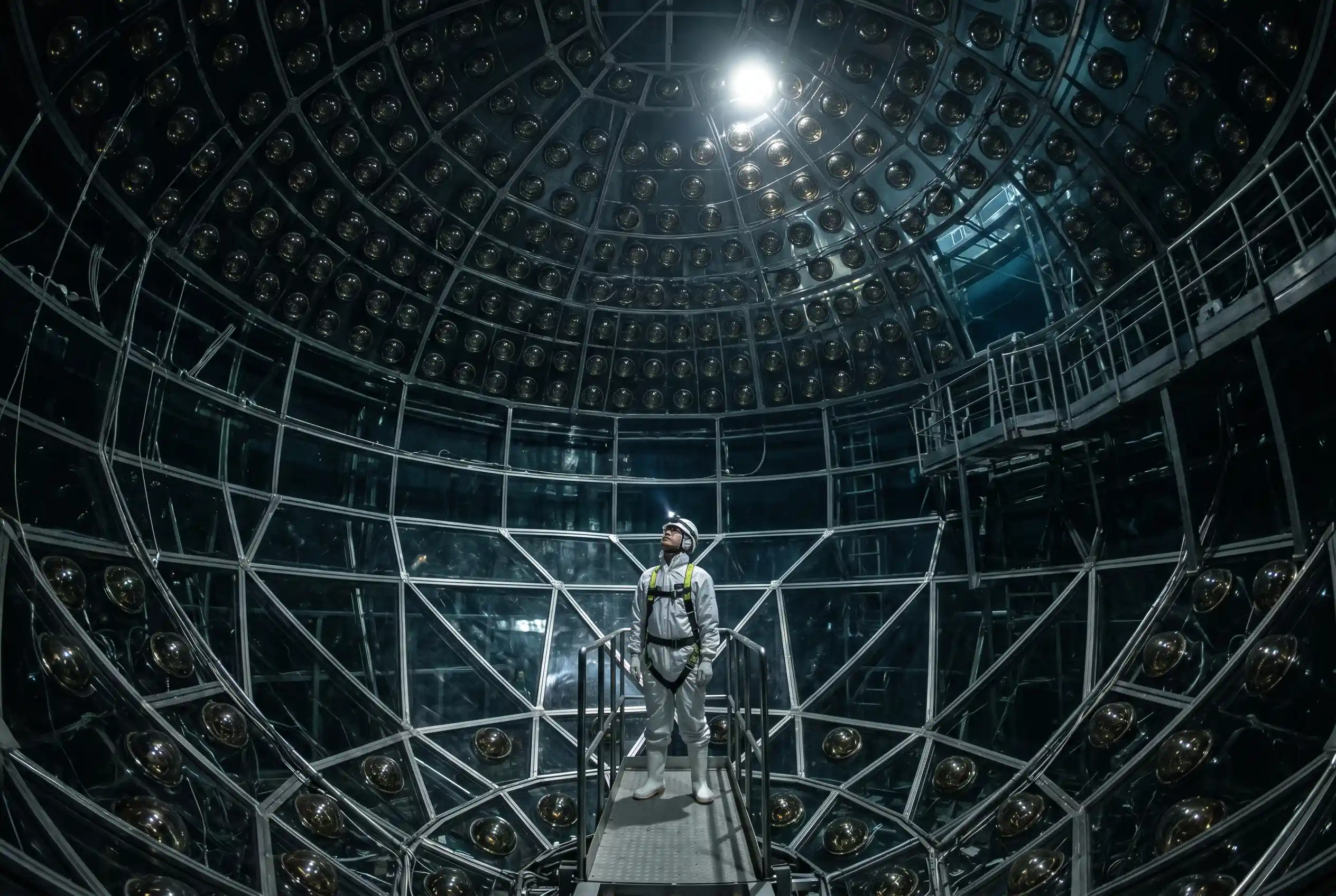
The detector is built around a 17.7-meter-radius acrylic sphere holding 20,000 tons of liquid scintillator, a light-emitting fluid that flashes when an antineutrino interacts inside it. That sphere sits inside a 44-meter-deep water pool, surrounded by photomultiplier tubes that record the light.
The full array includes 17,596 large photomultiplier tubes and 25,587 small ones, giving 78% geometric coverage. The whole assembly is parked 700 meters underground, beneath 650 meters of rock that screens out cosmic rays. The location sits exactly 52.5 kilometers from the eight reactor cores of the Yangjiang and Taishan Nuclear Power Plants.
That distance is the heart of the design. It places JUNO at the first maximum of the "solar" oscillation, where the slow wave driven by Δm²2₁ and the fast ripple driven by Δm²3₁ interfere most strongly, so the mass ordering imprints a small phase shift in the antineutrino energy spectrum. To read that shift, JUNO must hit 3% energy resolution at 1 MeV, an unprecedented figure for a detector of this scale. The detector is designed to run for about 30 years, with the option of an upgrade to one of the world’s most sensitive searches for neutrinoless double-beta decay.
- 20,000 tons of liquid scintillator
- 700 meters underground beneath Dashi Hill
- 52.5 km from eight reactor cores
- 3% energy resolution at 1 MeV
- 17,596 large and 25,587 small photomultiplier tubes
A 1.5-Sigma Hint of Something New
The first 59.1 days also sharpened a quieter puzzle. Earlier experiments had found a 1.5-sigma discrepancy between θ12 and Δm²2₁ values inferred from solar neutrinos and those inferred from reactor antineutrinos, a mismatch some researchers call the "solar neutrino tension."
JUNO’s new reactor measurement confirms the discrepancy. If the gap persists, it would point to physics the Standard Model does not describe. Spokesperson Yifang Wang framed the goal in narrower terms: testing "the three-flavor oscillation framework, and search for new physics beyond it."
A 1.5-sigma gap is far from the 5-sigma threshold physicists treat as a discovery. The new measurement confirms the discrepancy at high precision. JUNO is the experiment positioned to either confirm or close the gap in the coming years. The same data also tests the three-flavor mixing framework directly.
The combined solar-and-reactor test is what will prove or disprove the difference, the press release on the first 59 days of detector data explains. The combined analysis will also provide a sharper test of the three-flavor framework as a whole. JUNO is the first measurement designed for that test.
Six More Years to the Mass Ordering
The mass ordering determination is the headline goal, and it is still ahead. "Current projections suggest that JUNO will require about six years of data collection to distinguish between the two possible mass orderings," the commentary on the JUNO paper states.
The reason is the resolution of the fine ripple. The two possible orderings shift the ripple’s phase by a small amount, detectable only with a long, stable dataset, a calibrated detector, and a system that holds background and detector-systematic noise far below the signal. The first 59.1 days did not yet resolve the shift, but they validated the tools. The energy-scale uncertainty stood at 0.5% across the detector’s 16.5-meter fiducial volume, the published paper reports.
As the data accumulates, "numerous new results will be released sequentially starting from this summer," the institute announcement states. The mass ordering result will need about six years of data collection to come into focus, per the commentary on the JUNO paper. The first round of atmospheric, solar, supernova, and geoneutrino measurements is queued up behind it.
- 2008: JUNO concept proposed by Wang, Zhan, Cao, and Wen
- 2013: Approval and funding from the Chinese Academy of Sciences and Guangdong Provincial Government
- 2015: Civil construction of the underground laboratory begins
- 2021: Detector installation starts
- December 2024: Detector installation completes
- August 26, 2025: JUNO begins physics data taking
- June 10, 2026: First results published as a Nature cover article
- After about 6 years of data: Projected first mass ordering determination
Three Decades of Physics Underground
JUNO is designed to run for about 30 years, Hans Steiger, who heads the Technical University of Munich’s contributions to JUNO, said in the press release on the first 59 days of detector data. The detector can be upgraded over its lifetime into "one of the world’s most sensitive detectors for neutrinoless double-beta decay." That upgrade would probe the absolute neutrino-mass scale and test whether neutrinos are Majorana particles, meaning particles that are their own antiparticles. The neutrinoless double-beta decay search would be a direct test of that idea.
Two peer experiments are coming online on similar but different tracks. Japan’s Hyper-Kamiokande, the successor to Super-Kamiokande, plans to begin data taking in 2028, per its project schedule, while the U.S.-based Deep Underground Neutrino Experiment (DUNE) is on a longer schedule. The two water-based detectors use different baselines and matter effects to probe the mass ordering and CP violation, and their independent cross-checks will be what turns a JUNO measurement into a settled result.
Hyper-K and DUNE will independently verify any JUNO mass-ordering result. Most neutrino experiments are designed to measure only one mass-squared difference; JUNO is sensitive to both, the News & Views piece notes.
The next decade of neutrino physics will be defined by the cross-checks between these three flagship experiments. Each one tests the same underlying physics with a different detector technology. The convergence of the three approaches is what will turn hints into answers.
This first result from JUNO marks the dawn of the next era of precise neutrino oscillation measurements, and it promises fresh insights into the properties of these mysterious fundamental particles.





Spotify Running Mode hits Android and revives its old tempo experiment

Galaxy Tab S12 Ultra Renders Keep the Notch Fans Hate

Novato Spinning Round House Sells With Six Neighbors for $3.3 Million

Crop Tour Finds Indiana and Nebraska Corn Yields Lagging 2025

Best Buy 60th sale brings Android deals back to its roots

American Airlines reverses seatback screen bet years too late

Iran Hormuz Strikes Force Gulf Oil Onto Costlier Paths

Plague Tale Prequel Day One Joins Game Pass Wave 2 as Witcher Exits

NBA 2K27 opens The City to everyone and rewrites career eras

iOS 26.6.1 Patches 29 Flaws as AI Forces Faster Apple Updates

Guardians Rout Twins With Seven Homers, Leave Joe Ryan One Shy of Record

Caitlin Clark Skips the WNBA 3-Point Contest for a Third Straight Year

Rainout Gives Red Sox Two Shots at a Franchise-Record Win Streak

Double Fine Cuts 23 Jobs Weeks After Xbox Independence

John Hight Exits Wizards After Digital Reckoning Hits

Day-One Big Walk Lifts PS Plus August Beyond Recycled AAA

Curtis Mead’s Red Sox Debut Ends With Fractured Wrist

Moesch and Dressel Rewrite Night One at 2026 U.S. Nationals

Red Sox Squander Hot Streak Chance in 4-3 Loss to Athletics

Boutte’s Quiet Camp Takeover Forces Patriots Receiver Choices
-

 TECHNOLOGY3 years ago
How to Adjust a Bulova Watch Band – An Easy Guide
-

 News3 years ago
Fred Pentland: Athletic Bilbao’s English mentor who changed the essence of Spanish football
-

 FINANCE3 years ago
Tax Planning for Every Season: Guide to Maximizing Your Tax Benefits
-

 Education3 years ago
African Ministers New Education Plan
-

 BUSINESS3 years ago
What is Entrepreneurial Operating System? A Comprehensive Guide to EOS
-

 Education3 years ago
Innovate Your Learning Journey with Technology and Enhance Education
-

 BUSINESS3 years ago
Top 9 Most Expensive American Cities to Rent an Apartment
-

 News3 years ago
Russians formally out of World Athletics Championships