
News
Mars’s Lost Water and Air Are Locked Underground, Studies Find
Mars’s missing water sits 11 to 20 km underground and its missing atmosphere is trapped in clay as methane, two 2024 studies and a 2026 rover finding argue.

Mars’s missing water and vanished atmosphere are still on the planet. Two 2024 studies, one drawing on NASA’s retired InSight lander and the other on laboratory measurements of clay chemistry at MIT, argue that the bulk of both is locked away beneath the Martian surface, in water trapped in the mid-crust and in methane stored inside iron-rich clay. A 2026 announcement from NASA’s Curiosity rover added a fresh piece of supporting evidence: the largest, most chemically diverse cache of organic molecules ever identified on Mars, including seven molecules never seen before on the planet or in Martian meteorites. Together, the three findings are narrowing the search for an answer to a question planetary scientists have chased for decades.
The water, if the InSight reading holds, sits 11.5 to 20 kilometres underground, far deeper than any drill bit has ever reached on Mars. The methane, if the MIT chemistry is right, is bound up in iron-rich clays close enough to the surface that, in principle, it could be mined. The Curiosity organics, in turn, show that the rocks the rovers have been grinding through for years were once bathed in the kind of chemistry that, on Earth, leads to biology.
How Mars Became a Desert
For most of human history, observers could only guess what lay on Mars. Ground-based astronomers in earlier centuries speculated about a wet, possibly jungle-covered planet, with some imagining alien civilisations on the surface. NASA’s Mariner 4 put those ideas to bed in 1964, when it flew past Mars and returned the first close-up images, which showed a cold, dead world.
Later missions sharpened the picture. The 1997 Pathfinder landing touched down in a boulder field that looked as if a flood had carried the rocks into place. In the early 2000s, the Spirit and Opportunity rovers found sedimentary rocks and minerals, including tiny spheres of hematite, that can only form in the presence of liquid water. By the time the last of those missions went silent, the case for an ancient, water-soaked Mars was no longer in serious doubt.
Orbital measurements told the same story from above. The thin atmosphere that wraps Mars today carries an overabundance of heavy isotopes, the fingerprint of an atmosphere that was once much thicker, because lighter isotopes are more likely to escape into space. When researchers compared the ratio of carbon to krypton, an unreactive gas that has changed little across Mars’s 4.6-billion-year history, they found that Mars holds about a tenth of the carbon that Earth or Venus does, and that almost all of the missing carbon disappeared around 3.5 billion years ago.
The ‘Lost to Space’ Theory and Its Limits
For decades, the default explanation was that Mars’s air and water were stripped away by the solar wind. Earth’s magnetic field deflects most of that wind, and our planet’s plate tectonics recycle gases through the crust. Mars has neither. Its magnetic field is a weak remnant, and it has no plate tectonics to refresh its atmosphere, leaving a thin, mostly carbon dioxide envelope that sits at less than 1 per cent of Earth’s surface pressure. Less atmosphere means lower surface pressure, which lets water evaporate more easily, which lets the solar wind strip even more of it away, a feedback loop that should have left the planet dry and cold long before now.
When researchers modelled Mars’s climate evolution, however, atmospheric escape could only account for a fraction of the missing water. It couldn’t explain why the carbon budget had fallen so dramatically. The numbers did not add up, and the missing material had to be somewhere.
An Ocean’s Worth of Water, Hidden in the Mid-Crust
An August 2024 paper in the Proceedings of the National Academy of Sciences, led by Vashan Wright of the University of California, San Diego’s Scripps Institution of Oceanography, drew on four years of seismic data from NASA’s InSight lander, whose full mission arc is documented on the InSight lander’s four-year mission timeline. InSight operated from 2018 to 2022 and detected more than 1,300 marsquakes, the vibrations of which travelled at different speeds depending on the rock and what filled its cracks. Wright’s team fed those speeds into a mathematical model of rock physics, the same kind used on Earth to map underground oil fields and aquifers. The model that best fit InSight’s readings was a deep layer of igneous rock saturated with liquid water.
The reservoir sits between 11.5 and 20 kilometres below the Martian surface, in tiny cracks and pores in the middle of the crust. If the crust is similar across the planet, the team wrote, the water in that mid-crust layer would fill oceans on the surface to a depth of 1.6 kilometres. The InSight data also showed no evidence of a layer of frozen groundwater above it, a result the team said they didn’t expect.
Speaking about the implications for habitability, study co-author Michael Manga of the University of California, Berkeley, told reporters the find should in principle make the deep crust a place life could survive. Bruce Banerdt, the principal investigator for InSight, called the result “exactly the kind of thing I hoped we would get out of InSight.” Alberto Fairén, a planetary scientist and astrobiologist at Cornell University who was not involved in the study, said the water was likely “a kind of deep underground mud.” Banerdt added that the interpretation was strongly supported but still “somewhat speculative” and that the seismic data almost always admits more than one explanation. The team’s finding is the first time a Mars mission has returned data capable of confirming the long-standing speculation that liquid water exists deep beneath the surface.
Establishing that there is a big reservoir of liquid water provides some window into what the climate was like or could be like. And water is necessary for life as we know it. I don’t see why (the underground reservoir) is not a habitable environment.
Michael Manga, geophysicist at the University of California, Berkeley, in a 2024 statement on the InSight study.
Methane-Bearing Clay May Hold the Missing Air
Just over a month later, on 25 September 2024, an MIT team led by Joshua Murray, with Oliver Jagoutz of MIT’s Department of Earth, Atmospheric and Planetary Sciences, published the 2024 paper on Martian smectite and methane in Science Advances. Their focus was a clay mineral called smectite, the accordion-folded grains of which are well known on Earth as long-term traps for carbon dioxide and methane. Jagoutz had been studying terrestrial smectites for years when, the MIT release says, he happened to look at a map of Mars and noticed that much of the surface was covered in the same mineral.
The question for the team was how the Martian smectites could have formed without the plate tectonics that produce the clays on Earth. The answer they proposed is water: liquid water trickling through the iron-rich igneous rock of the Martian crust and reacting with a mineral called olivine. Oxygen in the water would have bound to the iron, releasing hydrogen and giving Mars its characteristic red colour as a byproduct. That hydrogen, in turn, would have combined with carbon dioxide dissolved in the water to form methane, slowly transforming the olivine first into serpentine and then into smectite that locked the carbon away for billions of years.
| Finding | What was found | Where it sits | How much |
|---|---|---|---|
| InSight seismic study, August 2024 | Liquid water in mid-crust rock | 11.5 to 20 kilometres underground | Enough to cover Mars in a 1.6-kilometre ocean |
| MIT clay study, September 2024 | Methane trapped in iron-rich smectite clay | A 1,100-metre-deep layer across the crust | 1.7 bar of carbon dioxide, around 80% of the early atmosphere |
| Curiosity rover, 2026 | Organic molecules in a clay-rich rock | Surface outcrop on Mount Sharp, Gale Crater | 21 carbon-containing molecules, 7 detected for the first time on Mars |
The team calculated that a 1,100-metre-deep layer of smectite covering Mars could hold the equivalent of 1.7 bar of carbon dioxide, around 80 per cent of the planet’s early atmosphere. Bruce Jakosky of the University of Colorado, the principal investigator on NASA’s MAVEN orbiter, said the chemistry “could be a major process in removing CO2 from Mars’ early atmosphere,” though he was not involved in the study. Jagoutz noted that the trapped methane “could still be present and maybe even used as an energy source on Mars in the future.” The team is careful to point out that the estimate depends on how much smectite actually exists in the crust, a number the available remote sensing can only loosely constrain. Even so, the paper’s framing is striking: where Mars’s carbon went may not be a mystery of escape, but a question of storage.
In some ways, Mars’ missing atmosphere could be hiding in plain sight.
Joshua Murray, lead author of the 2024 MIT clay study, in a statement released by MIT News.
A 2026 Confirmation From Curiosity on the Ground
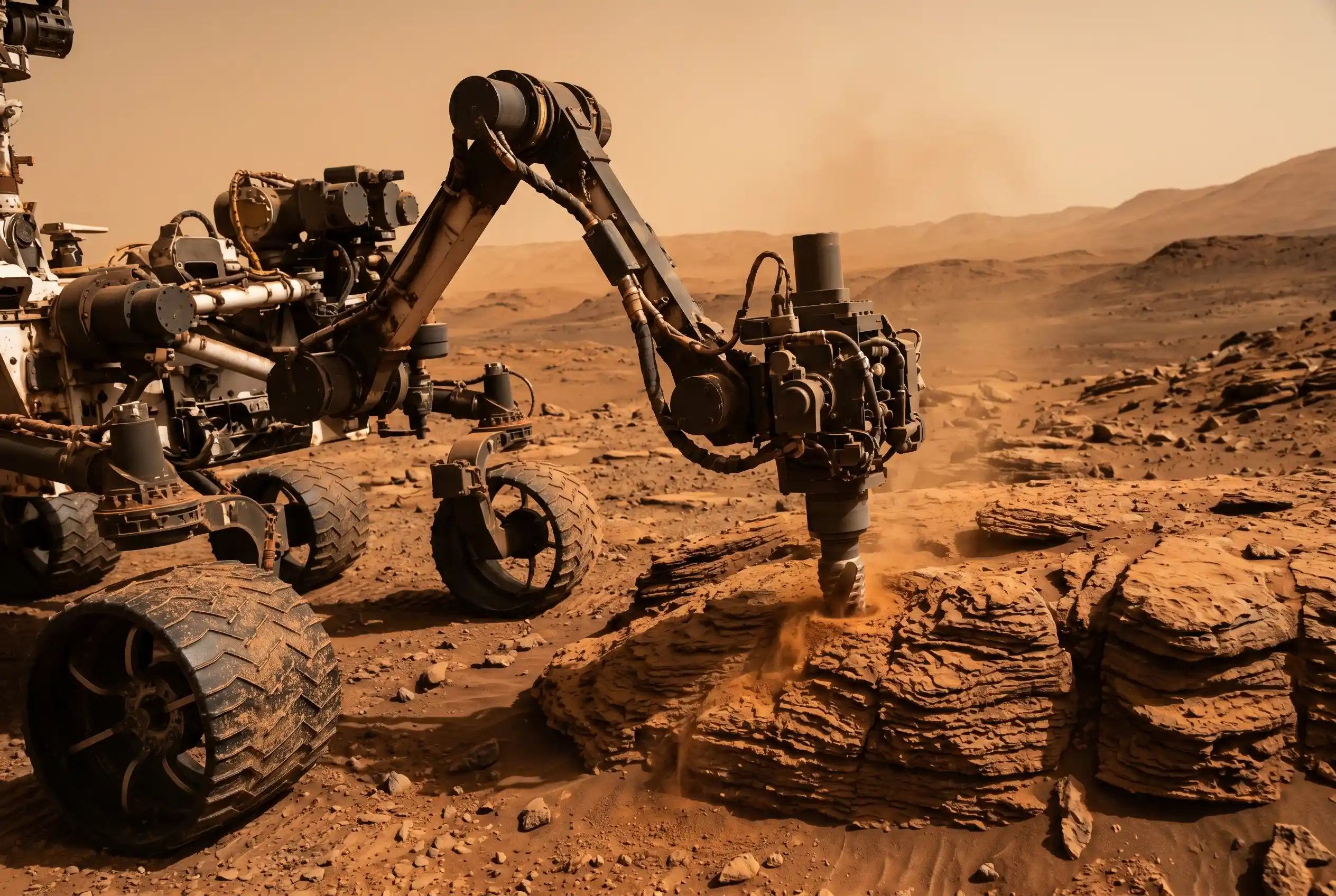
The third piece of the picture came in 2026, when a paper in Nature Communications, led by Amy Williams of the University of Florida and reported in the 2026 paper on Martian organic molecules from NASA, described the most chemically diverse cache of organic molecules ever identified on Mars. The source was the Mary Anning 3 sample, drilled by NASA’s Curiosity rover in 2020 from a clay-rich outcrop on Mount Sharp inside Gale Crater. Of the 21 carbon-containing molecules identified in the rock, seven had never been detected on Mars or in Martian meteorites before. Among the new arrivals were nitrogen heterocycles, ring-shaped molecules considered chemical precursors to RNA and DNA, the nucleic acids that carry genetic information in life as we know it. The team also identified benzothiophene, a carbon- and sulfur-bearing molecule common in meteorites and thought by some scientists to have seeded prebiotic chemistry across the early solar system. Curiosity’s project scientist at NASA’s Jet Propulsion Laboratory, Ashwin Vasavada, called the find evidence that “Mars offered a home for life in the ancient past.”
The fact that the molecules survived billions of years of surface radiation, the team noted, suggests that the clay minerals in the rock were especially good at preserving them. It’s the same kind of preservation, in a different mineral, that the MIT team argues is now locking up the planet’s missing carbon. Taken together, the three studies describe a Mars whose missing water and air aren’t lost but stored, and whose rocks still carry the chemistry needed to study both.
Can Future Astronauts Reach Mars’s Hidden Reserves?
Both NASA and the China National Space Administration have publicly stated ambitions to land astronauts on Mars in the coming decades. If the InSight and MIT readings hold up, the planet would already be carrying two of the most useful resources any human mission could ask for: water and a carbon-rich fuel. Underground water could be used for drinking, for cooling equipment, or split into hydrogen and oxygen for rocket propellant. Methane bound up in the surface clays could, in principle, be released and used as fuel in its own right.
The water, however, is the harder of the two to reach, sitting between 11.5 and 20 kilometres below the surface. Vashan Wright, the lead author of the InSight study, noted that even drilling holes half a kilometre deep on Earth is a challenge that requires serious energy and infrastructure. Bringing that capability to Mars, he added, would require a massive number of resources to be shipped from Earth.
Three practical challenges stand between a future Mars crew and the underground water Wright’s team has mapped:
- Depth: the water sits between 11.5 and 20 kilometres below the surface, well beyond the reach of any current Earth drilling rig.
- Energy: a drill that deep on Earth already requires serious infrastructure; replicating it on Mars would mean shipping the equipment and the power supply from Earth.
- Time: even reaching the shallower clay layer to test for trapped methane would likely take a dedicated mission of its own, Wright’s team noted.
The methane in the surface clays, by contrast, is far closer to where any landing would happen, and Murray’s team has already flagged the possibility that it could one day be recovered. Whether the trapped carbon and the trapped water end up shaping a real mission depends on decisions made well before any rocket lifts off.
Frequently Asked Questions
How much water is underground on Mars?
An August 2024 study used seismic data from NASA’s InSight lander to estimate that there is enough liquid water in the mid-crust to cover the planet in a 1.6-kilometre-deep ocean. The water sits 11.5 to 20 kilometres below the surface, in tiny cracks and pores in the rock, and is the first direct confirmation of long-standing speculation about deep groundwater on Mars.
Where did Mars’s missing atmosphere go?
A September 2024 study from MIT argues that much of the missing carbon was trapped as methane inside iron-rich smectite clay. The team calculated that a 1,100-metre layer of the mineral across the crust could hold 1.7 bar of carbon dioxide, around 80 per cent of the planet’s early atmosphere, locked away in the same rocks the rovers have been driving over.
What did NASA’s Curiosity rover find on Mars in 2026?
A paper in Nature Communications, based on the Mary Anning 3 sample drilled by Curiosity in 2020, identified 21 carbon-containing molecules in a clay-rich rock on Mount Sharp, including seven detected for the first time on Mars or in Martian meteorites. Among the new finds were nitrogen heterocycles, chemical precursors to RNA and DNA, and benzothiophene, a sulfur-bearing molecule common in meteorites.
Could astronauts one day use the underground water or methane?
In principle, yes, the water for drinking, cooling, or rocket propellant, and the methane as a fuel in its own right. In practice, the water at 11.5 to 20 kilometres depth would be a major engineering challenge, and InSight lead author Vashan Wright has said a massive number of resources would need to be shipped from Earth. The methane bound in the surface clays sits far closer to where a landing would happen.
Could the underground water on Mars host life?
Researchers say the conditions are right in principle. Michael Manga of UC Berkeley compared the deep crust to deep Earth mines and ocean floors, both of which host microbial life, and Alberto Fairén of Cornell said the subsurface biosphere on Earth is “truly vast.” No evidence of Martian life has yet been found, but the InSight team has identified a place that should, in principle, be able to sustain it.






Shelby’s $42.9 million Daytona Coupe cashes the bet that beat Ferrari

AI forces Apple into third security drop in three weeks

Lamborghini banks 2027 revenue with sold-out Revuelto SV

Apple’s Labor Day Habit Locks iPhone 18 Pro September Dates

Frogwares Ships Sinking City 2 After Years of Air Raids

AirTag 2 Hits Near Lows Just as Travel Season Peaks

McLaren Pop Art F1 GTR Hits $34.6 Million and Resets the Tier

Spotify Playlist Notes Bring Back Liner Notes for Streaming

AirPods Max 2 hit $429 and finally close the value gap

Star Citizen private demo of Siege of Orison still wiped the devs

Guardians Rout Twins With Seven Homers, Leave Joe Ryan One Shy of Record

Rainout Gives Red Sox Two Shots at a Franchise-Record Win Streak

Caitlin Clark Skips the WNBA 3-Point Contest for a Third Straight Year

Double Fine Cuts 23 Jobs Weeks After Xbox Independence

John Hight Exits Wizards After Digital Reckoning Hits

Day-One Big Walk Lifts PS Plus August Beyond Recycled AAA

Curtis Mead’s Red Sox Debut Ends With Fractured Wrist

Moesch and Dressel Rewrite Night One at 2026 U.S. Nationals

Red Sox Squander Hot Streak Chance in 4-3 Loss to Athletics

Boutte’s Quiet Camp Takeover Forces Patriots Receiver Choices
-

 TECHNOLOGY3 years ago
How to Adjust a Bulova Watch Band – An Easy Guide
-

 News3 years ago
Fred Pentland: Athletic Bilbao’s English mentor who changed the essence of Spanish football
-

 FINANCE3 years ago
Tax Planning for Every Season: Guide to Maximizing Your Tax Benefits
-

 Education3 years ago
African Ministers New Education Plan
-

 BUSINESS3 years ago
What is Entrepreneurial Operating System? A Comprehensive Guide to EOS
-

 Education3 years ago
Innovate Your Learning Journey with Technology and Enhance Education
-

 News3 years ago
Russians formally out of World Athletics Championships
-

 BUSINESS3 years ago
Top 9 Most Expensive American Cities to Rent an Apartment