
News
JWST Catches a ‘Galaxy-Killing’ Wind in a Galactic Crash
JWST and ALMA caught a ‘galaxy-killing’ wind in CRISTAL-02 1 billion years after the Big Bang, a simpler answer to the early-universe dead-galaxy puzzle.

Astronomers using the James Webb Space Telescope and the Atacama Large Millimeter/submillimeter Array have caught a “galaxy-killing” wind tearing through a system of merging galaxies 1 billion years after the Big Bang. The discovery could solve one of the field’s biggest puzzles: why so many massive galaxies in the early universe already appear dead.
The galaxy system, known as CRISTAL-02, is forming stars at twice the rate of similar galaxies from the same era. Its wind is ejecting material at twice the rate stars are forming, according to a study published today in Monthly Notices of the Royal Astronomical Society: Letters. If the blowout continues, the system could be dead in less than 50 million years.
What the JWST and ALMA Saw
CRISTAL-02 sits at a lookback time of 1 billion years after the Big Bang. That is deep inside the era when the first large galaxies were still supposed to be building themselves up. The Royal Astronomical Society statement on the CRISTAL-02 discovery describes the system as caught “in the midst of a rapid growth spurt,” with star formation running at twice the pace of similar-sized galaxies from the same epoch.
Joint JWST imaging and ALMA radio observations revealed the telltale signature of the kill: a huge plume of cold gas stretching far from the galaxy, almost as long as the galaxy itself. The plume is gas that should have fed future stars, now being driven out into intergalactic space.
- Cosmic time observed: 1 billion years after the Big Bang
- Star formation rate: twice that of similar galaxies from the same era
- Outflow rate: twice the galaxy’s star formation rate
- Projected time to quiescence: less than 50 million years
- Early massive galaxies interacting with companions: nearly half
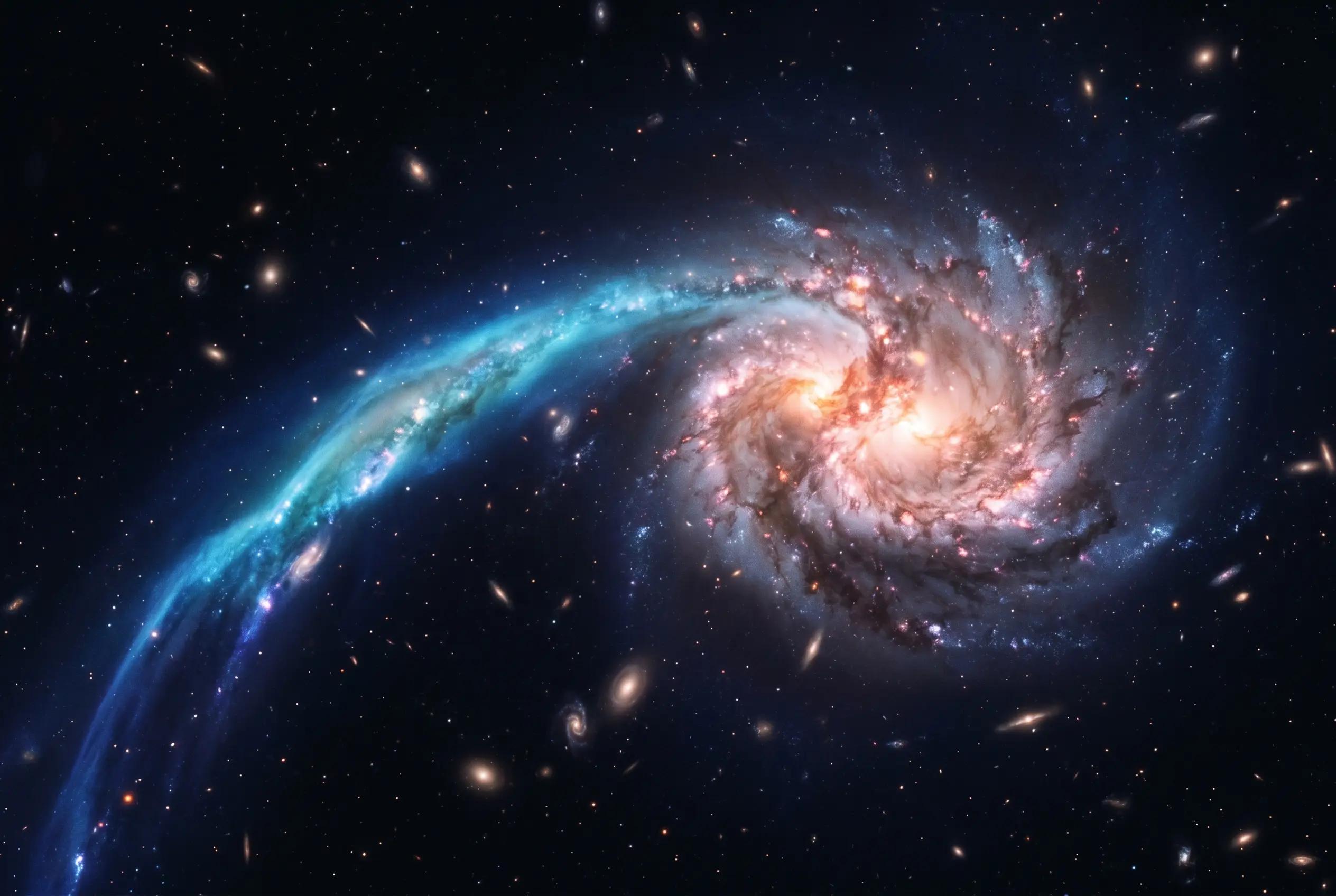
How a Merging Pair Builds Its Own Funeral Pyre
The wind is not pulled in from outside. CRISTAL-02 is the engine that builds and then fuels its own destruction. The sequence begins with the collision that triggered it.
During the merger, gas funnels toward the centers of the colliding galaxies and ignites a burst of star formation. The most massive of those new stars burn through their fuel quickly and end their lives as supernovae, each one launching a wind of its own into the surrounding gas.
Dense regions of the universe are like very active cities. Galaxies collide and undergo frenzied bursts of star formation. But when the biggest stars burn out, they explode as supernovas, launching powerful winds that blast away the very gas galaxies need to keep forming stars.
Lead author Dr Rebecca Davies, of the Swinburne University of Technology in Melbourne, gave that description in the Royal Astronomical Society statement on the CRISTAL-02 discovery.
The combined blast of supernova-driven winds is what the team imaged streaming away from CRISTAL-02. The wind moves outward at twice the rate the galaxy converts gas into stars, a mismatch that drains the system faster than the merger can refill it.
An Unusually Common Kind of Death
CRISTAL-02 is a set of galaxies caught in the final stages of a cosmic collision. The collision is also why its star formation rate is so high. Gas compressed during the merger is what is feeding the burst.
That detail matters because the same picture is likely playing out across the early universe. Almost half of early massive galaxies are interacting with other nearby galaxies, Davies said in the statement, a pattern that suggests the CRISTAL-02 mechanism is not a quirk but a widespread cosmic phenomenon. The merged, gas-rich environment the team caught in CRISTAL-02 was closer to the norm than the exception in the first billion years, when galaxies were smaller, denser, and far more likely to collide. If a large share of the universe’s first giant galaxies ran through the same merger-then-blowout cycle, the population of massive dead galaxies JWST has been cataloging since 2022 would no longer be a paradox. They would be a predictable outcome of a process the telescopes had not yet caught in the act.
A Simpler Answer to a 2022 Puzzle
Since JWST began returning sharp images of the early universe in 2022, astronomers have been wrestling with the same problem: red, quiescent, “dead” galaxies showing up at cosmic times when every model said they should still be growing. The space telescope kept finding massive, already-formed galaxies that should not yet have had time to age. Among the candidate explanations floated in the years since was that dark energy may have been stronger in the early universe than current theories predict, briefly accelerating galaxy growth and death.
The wind now observed in CRISTAL-02 offers a more conventional solution, according to the Multiphase images paper in MNRAS Letters. The same starbursts that build a massive galaxy can also be the engine that empties it of fuel. The Royal Astronomical Society statement on the CRISTAL-02 discovery calls the wind mechanism “much simpler than some of the other explanations” put forward since 2022.
CRISTAL-02 offers a natural solution to the mystery of why these massive galaxies live fast and die young.
Davies gave that line in the Royal Astronomical Society statement on the CRISTAL-02 discovery. The wind mechanism does not require exotic early-universe physics, only the routine violence of galaxy mergers, which were far more common when the universe was smaller and denser.
The Survey That Will Test the Theory
CRISTAL-02 is one of 18 main-sequence galaxies in the ALPINE-CRISTAL-JWST survey, a program that combines high-resolution imaging and spectroscopy from the Hubble Space Telescope, JWST, and ALMA, according to the survey description.
Further JWST and ALMA observations of more galaxies in the same field will tell the team whether the CRISTAL-02 outflow is typical, the authors write, and how often this merger-driven blowout explains the early population of massive, quiescent systems. The work is published as the paper “Multiphase images of a powerful supernova-driven wind in the early Universe,” by Davies and a multi-institution team that includes co-author Deanne Fisher of Swinburne. Separate JWST work on a black hole that formed before its host galaxy has added to the same tension between observations and models of the first billion years.
Frequently Asked Questions
What is a galaxy-killing wind?
A galaxy-killing wind is a high-speed outflow of gas powerful enough to strip a galaxy of the raw material it needs to form new stars. Without that cold gas reservoir, a galaxy can no longer grow and is classified as quiescent, or “dead.” The wind around CRISTAL-02 is ejecting material at twice the rate the galaxy forms stars, according to the Royal Astronomical Society.
How far back in cosmic time does CRISTAL-02 sit?
CRISTAL-02 is observed as it appeared roughly 1 billion years after the Big Bang, deep in the era when the first large galaxies were still expected to be growing.
Will CRISTAL-02 really die?
At the current outflow rate, the team projects the system could be dead in less than 50 million years. Davies noted in the statement that the prediction depends on the blowout continuing at the present rate.
Why are dead massive galaxies a puzzle?
Astronomers have cataloged large numbers of massive, quiescent galaxies in the early universe, when models predicted galaxies should still be rapidly building stars. The tension between observation and theory was sharpened in 2022, when JWST began returning clear images of that era.
What comes next from the survey?
CRISTAL-02 sits inside the ALPINE-CRISTAL-JWST survey of 18 main-sequence galaxies. Further JWST and ALMA observations of the rest of the sample will tell the team whether the merger-driven wind is a routine feature of massive early galaxies or a rare case.
Who led the study?
Dr Rebecca Davies of the Swinburne University of Technology in Melbourne led the work alongside Associate Professor Deanne Fisher. The full author list is in the published paper “Multiphase images of a powerful supernova-driven wind in the early Universe.”





Spotify Running Mode hits Android and revives its old tempo experiment

Galaxy Tab S12 Ultra Renders Keep the Notch Fans Hate

Novato Spinning Round House Sells With Six Neighbors for $3.3 Million

Crop Tour Finds Indiana and Nebraska Corn Yields Lagging 2025

Best Buy 60th sale brings Android deals back to its roots

American Airlines reverses seatback screen bet years too late

Iran Hormuz Strikes Force Gulf Oil Onto Costlier Paths

Plague Tale Prequel Day One Joins Game Pass Wave 2 as Witcher Exits

NBA 2K27 opens The City to everyone and rewrites career eras

iOS 26.6.1 Patches 29 Flaws as AI Forces Faster Apple Updates

Caitlin Clark Skips the WNBA 3-Point Contest for a Third Straight Year

Rainout Gives Red Sox Two Shots at a Franchise-Record Win Streak

Double Fine Cuts 23 Jobs Weeks After Xbox Independence

Day-One Big Walk Lifts PS Plus August Beyond Recycled AAA

John Hight Exits Wizards After Digital Reckoning Hits

Curtis Mead’s Red Sox Debut Ends With Fractured Wrist

Moesch and Dressel Rewrite Night One at 2026 U.S. Nationals

Red Sox Squander Hot Streak Chance in 4-3 Loss to Athletics

Boutte’s Quiet Camp Takeover Forces Patriots Receiver Choices

Take-Two CEO Pushes Netflix Subs for GTA 6 Extended Look
-

 TECHNOLOGY3 years ago
How to Adjust a Bulova Watch Band – An Easy Guide
-

 News3 years ago
Fred Pentland: Athletic Bilbao’s English mentor who changed the essence of Spanish football
-

 FINANCE3 years ago
Tax Planning for Every Season: Guide to Maximizing Your Tax Benefits
-

 Education3 years ago
African Ministers New Education Plan
-

 BUSINESS3 years ago
What is Entrepreneurial Operating System? A Comprehensive Guide to EOS
-

 Education3 years ago
Innovate Your Learning Journey with Technology and Enhance Education
-

 News3 years ago
Russians formally out of World Athletics Championships
-

 BUSINESS3 years ago
Top 9 Most Expensive American Cities to Rent an Apartment