
AUTOMOBILE
McLaren Pop Art F1 GTR Hits $34.6 Million and Resets the Tier
Chassis 10R, the Pop Art short-tail prototype once owned by Nick Mason, set McLaren and British auction records at RM Sotheby’s Monterey and prices a new.

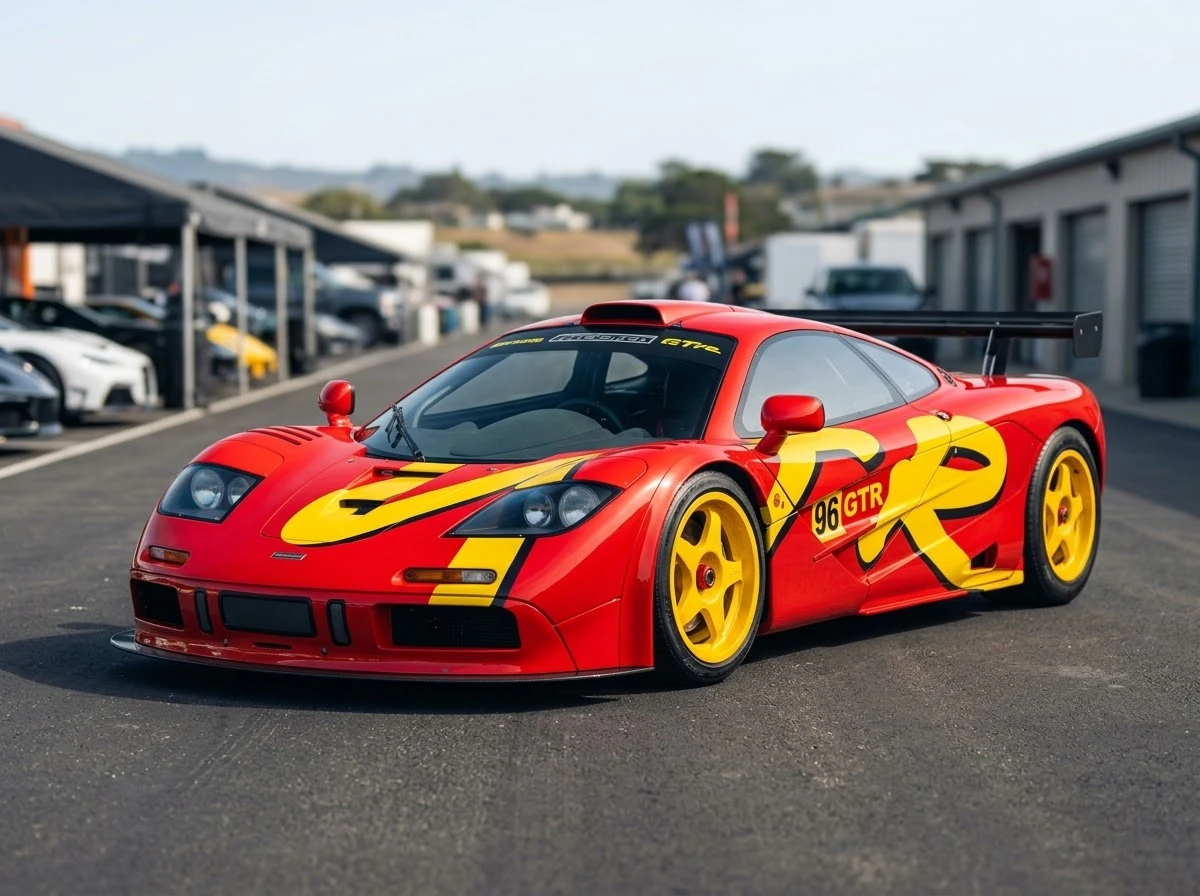
Chassis 10R, the 1996 McLaren F1 GTR finished in factory scarlet and yellow Pop Art graphics, sold for $34,655,000 at RM Sotheby’s Monterey on 15 August 2026. The result made it the most expensive McLaren and the most expensive British-built car ever sold at public auction.
The hammer price sat just under the “in excess of $35 million” estimate yet still jumped nearly $10 million past the prior McLaren public record. Collectors watched a short-tail factory prototype with Le Mans test history, road conversion papers and 25 years of Nick Mason ownership reset the public benchmark for the entire marque.
That combination of factory origin, period use and continuous specialist care is what separated the lot from other high-value F1 sales. The car did not rely on a single headline attribute. It stacked several, and the bidding reflected every layer.
$34.655 Million Resets Two Auction Benchmarks
RM Sotheby’s confirmed the sold price at $34,655,000 for Lot 328. The RM Sotheby’s auction history note called it the most expensive British car and most expensive McLaren at public auction in one stroke.
Monterey week totals reached roughly $376 million across the house’s three nights. A first-production Ferrari Luce electric car led overall at $40 million for charity. The McLaren took second and became the clear statement result for historic machinery.
- $34,655,000 final price for chassis 10R
- Most expensive McLaren at public auction, clear of the previous $25.3 million mark
- Most expensive British-built car sold publicly
- One of roughly the top ten cars ever at public auction
Private McLaren F1 transactions have long been rumored higher. Public records now have a new floor that every future GTR or XP car must clear or explain.
The gap to the prior McLaren public high is wide enough to reframe the whole ladder. A jump of nearly $10 million past $25.3 million is not a routine increment. It is a new reference band for anything that can match 10R’s paper trail.
One of Two Short-Tail Prototypes
Only nine McLaren F1 GTRs were built to the 1996 specification. Chassis 10R was the first of them, completed at Woking in December 1995 and kept by the factory as its development and promotional car.
It stands as one of just two short-tail GTR prototypes. The other is chassis 01R, the car that won the 1995 24 Hours of Le Mans outright. The 1996 cars answered the arrival of purpose-built GT1 rivals such as the Porsche 911 GT1. McLaren extended the bodywork, fitted a more aggressive splitter, switched to a magnesium gearbox casing and strengthened internals. The package cut 38 kilograms and produced the fastest F1 GTR variant, quicker even than the later long-tail cars.
Key facts that separate 10R:
- Factory-retained XP prototype status alongside the Le Mans winner
- First of the nine 1996-spec cars
- Only F1 GTR to leave the factory in the scarlet-and-yellow Pop Art livery
- Le Mans pre-qualifying and test duty in 1996 with David Brabham
- Converted for road use by McLaren itself, later refined by Lanzante
- Single private ownership by Nick Mason from 1999 until a 2024 private sale
The full RM Sotheby’s lot description lays out the paper trail in detail. That stack of attributes has no exact twin.
Factory retention mattered as much as the specification itself. Because McLaren kept 10R in house, the car carried development duty and promotional work that customer cars never saw. That early life is part of why the prototype label still carries weight with collectors.
Gordon Murray Wanted Spectators to Notice
Customer GTRs wore sponsor liveries. Because McLaren kept 10R, the design team could treat it differently. Gordon Murray described the choice as deliberate.
It was a conscious decision to do something that wasn’t just choosing a color-something that the spectator would appreciate that was very different, not just a nice color.
Murray later added there is only a handful of these GTRs, “but there’s only one like that.” The Blood Red base with oversized yellow “96 GTR” graphics earned the car its Pop Art nickname at BPR events and test days. It remains the sole F1 GTR finished in a factory-created design rather than team or commercial colours.
The same car ran winter testing at Magny-Cours with 1995 Le Mans winner JJ Lehto, completed a 12-hour endurance run, then travelled to La Sarthe for pre-qualifying. It finished eighth in class and 20th overall in those sessions. Sister chassis 11R contested the race itself.
Visual identity and period duty reinforced each other. Spectators who saw the Pop Art graphics at test days were looking at the factory’s own development car, not a customer entry in borrowed colours. That link between appearance and role is rare even inside a nine-car run.
Twenty-Five Years With Pink Floyd’s Drummer
McLaren sold 10R directly to Nick Mason in 1999. The Pink Floyd drummer already owned a Ferrari 250 GTO, Maserati 250F, Bugatti Type 35 and other competition icons. The F1 GTR fitted the collection perfectly.
McLaren converted the car for road use and registered it K40 MCL. Further work came from Paul Lanzante, the man who had prepared the 1995 Le Mans winner, and later from his son Dean at Lanzante Limited. Mason kept an open-checkbook policy. The car returned to the workshop after every significant outing.
A short timeline of the car’s public life under Mason and after:
- 1999 – Direct factory sale to Nick Mason; road conversion and K40 MCL registration follow
- 2009 – Autocar test ends in a wheat field and triggers a full restoration
- 2017 – Mason hits a tire wall at the Goodwood Members’ Meeting; Lanzante rebuilds the car again
- Later outings – Rétromobile, multiple Goodwood events, the 106 Drivers Club’s 750-kilometer anniversary tour, and a Tuscany rally with five other F1 GTRs
- Spring 2024 – Private change of hands before the August 2026 public return
The pattern is consistent. Damage or hard use never left the car idle for long. Specialist rebuilds kept it on the road and on the event calendar, which is why the continuous-care claim still holds when buyers inspect the file today.
How McLaren F1 Prices Climbed to This Point
Public auction results for McLaren F1 cars show a steep ladder. The compiled McLaren F1 auction price table places the new result at the top.
| Rank | Year / Model | Price (USD) | Auction |
|---|---|---|---|
| 1 | 1996 F1 GTR #10R | 34,655,000 | RM Sotheby’s Monterey 2026 |
| 2 | 1994 McLaren F1 | 25,317,500 | RM Sotheby’s Abu Dhabi 2025 |
| 3 | 1995 McLaren F1 | 20,465,000 | Gooding Pebble Beach 2021 |
| 4 | 1994 F1 LM-Spec | 19,805,000 | RM Sotheby’s Monterey 2019 |
| 5 | 1995 McLaren F1 | 15,620,000 | Bonhams Quail 2017 |
| 8 | 1997 F1 GTR Longtail | 5,280,000 | Gooding Scottsdale 2014 |
The last GTR to appear publicly more than a decade ago brought just over $5 million. Road cars in exceptional condition had already pushed past $20 million. Chassis 10R’s combination of prototype status, unique livery and continuous high-level maintenance produced a step-change rather than another incremental rise.
Market observers noted the same week that ordinary consignments struggled while unrepeatable cars separated cleanly. That split now has a fresh data point at the top of the McLaren column.
Read down the table and the shape is plain. Road cars filled the middle ranks for years. A longtail GTR from 2014 still sits far below. The 2026 result pulls a racing prototype with road papers into territory that ordinary road cars had only recently entered, then clears them by a wide margin.
The Stack Collectors Will Chase Next
The sale does not merely crown one car. It assigns a clear public value to the precise convergence of factory prototype, one-off factory art livery, period competition use, factory-backed road conversion and multi-decade single celebrity ownership with perfect specialist care.
Remaining short-tail 1996 GTRs, other early road-converted examples and any McLaren with comparable documentation now sit in a higher reference band. British icons that can claim similar cultural weight gain a new comparable. The F1 GTR was already the last Le Mans overall winner developed directly from a road hypercar. Chassis 10R turned that historical full stop into a priced cultural object.
Similar record-seeking lots appear across categories, from hypercars to the kind of another record-seeking auction lot that tests how far uniqueness can stretch. For McLaren collectors the message is simpler: the cars that can prove every layer of the 10R stack will keep finding new money.
The 1996 Spec Made the Fastest GTR
The 1996 package was McLaren’s answer to a changing GT1 field. Purpose-built rivals had arrived, and the factory responded with extended bodywork, a more aggressive splitter, a magnesium gearbox casing and strengthened internals.
The work cut 38 kilograms from the car. The result was the fastest F1 GTR variant, quicker even than the later long-tail cars that followed. Chassis 10R was the first of the nine cars built to that lighter specification and one of only two short-tail prototypes, sharing that narrow group with 01R, the 1995 Le Mans winner.
Factory development use put those changes through real miles before customer cars saw them. Winter testing at Magny-Cours with JJ Lehto, a 12-hour endurance run and La Sarthe pre-qualifying with David Brabham all happened on this chassis. Eighth in class and 20th overall in those sessions gave the factory data; sister chassis 11R took the race entry.
Buyers who study the 1996 cars now have a clear mechanical story to go with the headline price. Weight down, gearcase lighter, bodywork sharper, and the factory’s own prototype proving the package in period.
What Public Records Now Force Rivals to Prove
Private McLaren F1 deals have long been rumored above public highs. Until Monterey, the open record still topped out at $25,317,500 for a 1994 road car in Abu Dhabi. Chassis 10R moves the floor to $34,655,000 and does so with a racing prototype, not another road example.
That shift changes the burden of proof. Future GTR or XP consignments must either clear the new mark or explain, in documentation, why they fall short of 10R’s stack. Prototype status alone may not be enough. Neither may a clean road conversion or a famous name on the logbook.
- Factory prototype and first of the 1996 nine
- Sole factory Pop Art livery
- Period test and pre-qualifying history at Le Mans
- Factory road conversion later refined by Lanzante
- Twenty-five years with Nick Mason and open-checkbook specialist care
Roughly sixteen racing GTRs have been adapted for street legality over the years. Chassis 10R was among the earliest, converted by McLaren itself. Early factory work plus later Lanzante attention is part of the file that supported the hammer price.
The Monterey week itself underlined the same split. Ordinary consignments struggled while unrepeatable cars separated cleanly. A charity Ferrari Luce led the house at $40 million; the McLaren took second at $34,655,000 and became the statement result for historic machinery inside a roughly $376 million three-night total.
Frequently Asked Questions
How many 1996-specification McLaren F1 GTRs were built?
Exactly nine cars were completed to the lighter, faster 1996 GTR specification that followed the 1995 Le Mans win. Chassis 10R was the first of those nine and one of only two short-tail factory prototypes.
What engine does the McLaren F1 GTR use?
It carries the 6.1-litre BMW Motorsport S70/2 naturally aspirated V12, the same basic engine family as the road-going F1 but prepared for endurance racing demands.
Was chassis 10R ever raced at the 24 Hours of Le Mans?
It took part in pre-qualifying and official testing for the 1996 race, finishing eighth in class in those sessions with David Brabham driving, but the race entry went to sister chassis 11R.
How many McLaren F1 GTRs have been converted for road use?
Auction specialists estimate roughly sixteen racing GTRs have been adapted for street legality over the years. Chassis 10R was among the earliest, converted by the McLaren factory itself before further work by Lanzante.
What was the previous public auction record for a McLaren F1?
A 1994 McLaren F1 sold for $25,317,500 at RM Sotheby’s Abu Dhabi in 2025. Earlier high-water marks included a low-mileage 1995 car at $20.465 million in 2021.


Shelby’s $42.9 million Daytona Coupe cashes the bet that beat Ferrari

AI forces Apple into third security drop in three weeks

Lamborghini banks 2027 revenue with sold-out Revuelto SV

Apple’s Labor Day Habit Locks iPhone 18 Pro September Dates

Frogwares Ships Sinking City 2 After Years of Air Raids

AirTag 2 Hits Near Lows Just as Travel Season Peaks

McLaren Pop Art F1 GTR Hits $34.6 Million and Resets the Tier

Spotify Playlist Notes Bring Back Liner Notes for Streaming

AirPods Max 2 hit $429 and finally close the value gap

Star Citizen private demo of Siege of Orison still wiped the devs

Spain’s Diaspora-Rooted Squad Wins Over New York Ahead of the Final

Guardians Rout Twins With Seven Homers, Leave Joe Ryan One Shy of Record

Rainout Gives Red Sox Two Shots at a Franchise-Record Win Streak

Caitlin Clark Skips the WNBA 3-Point Contest for a Third Straight Year

Double Fine Cuts 23 Jobs Weeks After Xbox Independence

John Hight Exits Wizards After Digital Reckoning Hits

Day-One Big Walk Lifts PS Plus August Beyond Recycled AAA

Red Sox Squander Hot Streak Chance in 4-3 Loss to Athletics

Curtis Mead’s Red Sox Debut Ends With Fractured Wrist

Moesch and Dressel Rewrite Night One at 2026 U.S. Nationals
-

 TECHNOLOGY3 years ago
How to Adjust a Bulova Watch Band – An Easy Guide
-

 News3 years ago
Fred Pentland: Athletic Bilbao’s English mentor who changed the essence of Spanish football
-

 FINANCE3 years ago
Tax Planning for Every Season: Guide to Maximizing Your Tax Benefits
-

 Education3 years ago
African Ministers New Education Plan
-

 BUSINESS3 years ago
What is Entrepreneurial Operating System? A Comprehensive Guide to EOS
-

 Education3 years ago
Innovate Your Learning Journey with Technology and Enhance Education
-

 News3 years ago
Russians formally out of World Athletics Championships
-

 BUSINESS3 years ago
Top 9 Most Expensive American Cities to Rent an Apartment