
AUTOMOBILE
Shelby’s $42.9 million Daytona Coupe cashes the bet that beat Ferrari
The 1964 Shelby Cobra Daytona Coupe CSX2300 brought $42.9 million at Gooding Christie’s, nearly doubling the prior American auction mark and closing Shelby’s.

A 1964 Shelby Cobra Daytona Coupe chassis CSX2300 sold for $42,905,000 at Gooding Christie’s Pebble Beach Auctions on August 14, becoming the most expensive American car ever sold at public auction. The price nearly doubled the prior American mark of $22 million set by a 1935 Duesenberg SSJ in 2018.
The result closed a bet Carroll Shelby placed more than sixty years earlier: that a small California operation could build a car capable of defeating Ferrari’s 250 GTO on the world stage.
The sale did more than reset a ledger line. It confirmed that a short factory program, a longer privateer life, and personal ownership by the man whose name the car carried could outweigh sheer age or pure coachbuilt rarity in the American market.
The hammer price and what it bought
Bidding reached a hammer of about $39 million before buyer’s premium and fees pushed the total to $42,905,000. Pre-sale guidance from Gooding Christie’s had been “in excess of $25,000,000.” The car was Lot 39 at the firm’s flagship Monterey sale during Car Week.
- $42,905,000 final price including fees
- $39 million approximate hammer
- More than $25 million official estimate
- $22 million previous American auction record (1935 Duesenberg SSJ, 2018)
David Gooding, president of Gooding Christie’s, called the consignment “a truly generational opportunity” and “the pinnacle of American automotive achievement” in the firm’s Gooding Christie’s catalogue launch.
The gap between the published estimate and the final figure showed how far bidding climbed once the room accepted the car as a category of its own. Fees on top of the hammer accounted for the last stretch past $40 million, a threshold collectors on X had treated as the psychological line for the night.
Lot 39 also carried the weight of Monterey week itself. Flagship sales there set tone for the rest of the American collector calendar, and a record of this size reframes what consignors may ask for other blue-chip Cobras and period Ford GT racers in seasons ahead.
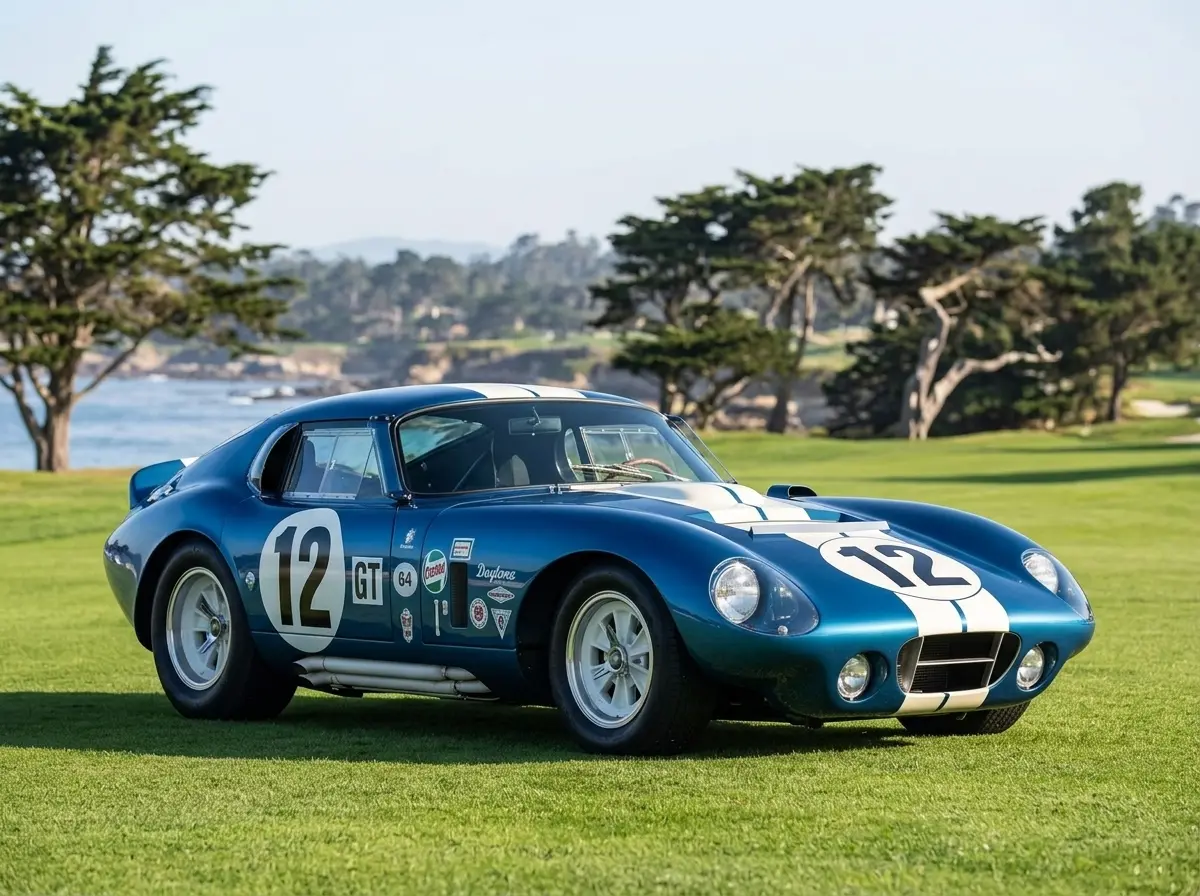
Only six were built, and this one kept racing
Shelby American constructed exactly six Cobra Daytona Coupes between 1964 and 1965. Peter Brock designed the closed body to give the Cobra the high-speed stability the open roadster lacked against Ferrari. CSX2300 was the third completed. After the factory program ended, it alone continued a serious competition career as a privateer entry in Japan through 1968.
That extended racing life, plus later ownership by Shelby himself, separated this chassis from the other five. Collectors on X and in the trade repeatedly pointed to the privateer chapter and Shelby provenance as the factors that justified clearing $40 million so cleanly.
| Attribute | CSX2300 | Typical other Daytona |
|---|---|---|
| Factory racing | 1964-65 FIA GT season | 1964-65 FIA GT season |
| Post-factory racing | Japan privateer to 1968 | None of note |
| Owned by Carroll Shelby | 1975-1998 | None |
| Street use in period | Yes, Tokyo roads | No |
The combination of championship participation, unique privateer results, and personal Shelby ownership created a one-of-one story among an already tiny production run.
Six cars is a small enough population that any single chassis can redefine the group. When one of those six keeps racing, takes public roads in period, and later returns to the builder’s own garage, the market stops treating the run as interchangeable. CSX2300 became the reference point against which the quieter five are now measured.
Peter Brock’s strange shape that cut the air
Brock, then a young ArtCenter graduate and Shelby’s first employee, drew a long-roof fastback with a Kamm tail. He later recalled the car looked “so strange” at the time. Wind-cheating form let the 289-cubic-inch Ford V-8 keep pace on the long straights where the roadster ran out of breath.
Bodies for the later cars, including CSX2300, were built in aluminum by Carrozzeria Grandsport in Modena, Italy, steps from the Ferrari factory the cars were built to beat. Shelby said the goal was blunt: “The reason I built the cars was to kick Corvette’s ass and Ferrari’s ass.”
The closed roof was not a styling flourish. It was a stability fix. Open Cobras lost composure as speeds rose; Brock’s fastback and truncated tail kept the car planted so the Ford engine could do its work on the longest circuits of the FIA calendar.
Building those bodies in Modena added a further twist. Italian hands shaped the aluminum that would challenge Italian GT cars on the same weekends, a geographic irony Shelby never bothered to soften in public.
How the 1965 championship paid the original bet
CSX2300 debuted at the 1964 Tour de France Automobile with Bob Bondurant and Jochen Neerpasch. It won early stages before retiring with a broken crankshaft. Ferrari took the 1964 title by a narrow margin. Shelby’s response was direct: “Next year Ferrari’s ass is mine.”
In 1965 the car, now in Guardsman Blue and driven by Allen Grant and others, scored solid class finishes at Daytona, Sebring, the Nürburgring and Reims. At Sebring it survived an early collision and still finished third in class; Grant set a GT lap record. At Reims, with a connecting-rod failure improvised away by the crew, it finished second in class. Those results helped Shelby American clinch the FIA International Championship for GT Manufacturers, the first time an American constructor won the title.
- 1964 Tour de France: early stage wins, retirement with broken crankshaft
- 1965 Daytona and Nürburgring: solid class finishes in Guardsman Blue
- 1965 Sebring: third in class after early collision; Grant’s GT lap record
- 1965 Reims: second in class after crew improvised past a connecting-rod failure
I don’t believe that anything in my own racing career, including winning Le Mans, was more gratifying than winning that championship.
Carroll Shelby said that years later. The championship mattered more to him than his 1959 Le Mans win with Aston Martin.
The 1964 near-miss set the tone for the following season. A narrow Ferrari title left Shelby with a clear target and a car already proven on the Tour de France stages. The 1965 finishes were not always wins, yet they were consistent enough, and hard enough earned, to tip the manufacturers’ standings.
That title converted Shelby’s wager from bravado into record. Without it, the Daytona Coupes would still be rare period tools. With it, they became the cars that first put an American constructor on top of the FIA GT world.
The Japan years that no other Daytona shared
After the 1965 season the FIA rules shifted and Shelby turned to the Ford GT40 program. CSX2300 went through a 1966 garage sale to Oscar Koveleski, then Don Nichols, who took it to Japan. There Tadashi Sakai and later owners raced it successfully at Suzuka, Fuji and the Japan Grand Prix into 1968. It scored overall wins in Japanese national events while the other five Daytonas sat retired.
Later it even served as a street car in Tokyo with a milder engine before historian Michael Shoen arranged its return to the United States. Shelby bought it in 1975 and kept it until 1998, the only Daytona Coupe he ever personally owned. He had Mike McCluskey restore it to 1965 specification.
Those Japanese seasons matter because they were not ceremonial. Overall wins at national level kept the chassis in genuine competition long after the factory lights went out. Street use in Tokyo added another layer few competition cars of the era ever received.
When the car finally came home, Shelby’s decision to buy it and restore it to 1965 form closed a personal circle. The builder who had sold the racer off in a garage sale chose, years later, to live with that one chassis and no other Daytona.
From Shelby’s garage to the auction block
After Shelby the car passed through Prova International, Jim Spiro and Larry Bowman before entering current ownership in 2005. It appeared at Goodwood Festival of Speed (including 2026), Goodwood Revival three times, Tour Auto and other historic events. The car remained dual-purpose eligible for concours and vintage racing.
- 1963-65 Shelby American factory car, third Daytona completed
- 1966 Garage sale to Oscar Koveleski, then Don Nichols
- 1966-74 Japanese privateer racing and street use
- 1975-98 Carroll Shelby personal ownership and restoration
- 1998-2005 Subsequent U.S. collectors, further restoration
- 2005-2026 Current owner, active historic racing and display
- August 14, 2026 Gooding Christie’s Pebble Beach sale
That unbroken chain of documented use and the personal Shelby chapter turned a championship tool into a blue-chip collectible.
Continuity of use also kept the car visible. Goodwood, Tour Auto, and similar grids put CSX2300 in front of the same enthusiasts and trade figures who later watch Monterey bidding. A chassis that still turns a wheel in anger is easier to value than one that has spent decades under a cover.
American records and the gap that remains
The $42.9 million figure rewrites the American auction hierarchy. It sits well clear of the old Duesenberg mark and any prior Cobra or Ford GT40 result. Yet the absolute world auction list is still led by a 1955 Mercedes-Benz 300 SLR Uhlenhaut Coupe at roughly $142 million and several Ferrari 250 GTOs above $40 million. The Daytona now occupies the top American slot and ranks among the most expensive cars of any nationality sold in 2026.
| Car | Result context |
|---|---|
| 1964 Shelby Cobra Daytona Coupe CSX2300 | $42,905,000; top American auction result |
| 1935 Duesenberg SSJ | $22 million; prior American record, 2018 |
| Ferrari 250 GTOs | Several above $40 million |
| 1955 Mercedes-Benz 300 SLR Uhlenhaut Coupe | Roughly $142 million; world auction leader |
For Shelby enthusiasts the sale also lands beside newer interpretations such as the modern fixed-roof Cobra coupe that keep the Daytona silhouette alive for drivers who will never own an original.
Clearing the Duesenberg mark by such a wide margin resets expectations inside the United States. Crossing into the same bracket as top 250 GTOs places an American GT car in a conversation long dominated by Maranello. The Uhlenhaut Coupe remains in another tier entirely, a reminder that global absolute records still run through European factory legends.
Why the Privateer Chapter Still Matters
Factory championship cars often share similar season sheets. CSX2300’s edge came after the works effort ended. Japan gave the chassis years of racing the other five never saw, plus street miles in Tokyo that no sister car can claim.
That stretch turned a team tool into a car with a second life. Privateer wins at Suzuka, Fuji, and the Japan Grand Prix, followed by milder-engine road use, produced a paper trail collectors read as proof of durability and character rather than mere survival.
Shelby’s later purchase sealed the argument. When the man who built the six chose only this one for his own garage, from 1975 to 1998, he handed the market a simple signal. Provenance does not get cleaner than the founder’s keys.
Trade talk before and after the sale kept returning to those same points: extended competition, period street use, and Shelby ownership. The hammer answered that talk in full.
How Monterey Bidding Reframes the Field
A result near $43 million does not only crown one chassis. It moves the reference points for every related car that might cross a block in the next cycle of Car Week sales.
Other Daytonas remain extraordinary objects, yet they now compare against a sibling that raced longer, lived on public roads, and spent more than two decades with Shelby. Prior Cobra and Ford GT40 auction marks, already behind this figure, look smaller still when consignors and advisors set reserves.
The sale also tests how far American GT history can climb while European icons hold the absolute peaks. Matching or exceeding several 250 GTO results without touching the Uhlenhaut Coupe’s realm suggests a ceiling that has risen, not vanished.
For the wider hobby, dual-purpose eligibility still counts. A car that can take a concours lawn and a historic grid gives its owner more ways to use the asset, and that flexibility supported the price as surely as the 1965 title did.
Frequently Asked Questions
How many Shelby Cobra Daytona Coupes were originally built?
Exactly six were completed in 1964-65 for the FIA GT effort. No more original competition cars were made; later continuation models are separate modern productions.
Who designed the Daytona Coupe body?
Peter Brock, Shelby American’s first employee and an ArtCenter-trained designer who had earlier worked on the Corvette Sting Ray project at General Motors, created the fastback shape with its distinctive Kamm tail.
What championship did the Daytona Coupes win?
Shelby American won the 1965 FIA International Championship for GT Manufacturers, the first world GT title for an American constructor, defeating Ferrari’s 250 GTO program.
What was the previous most expensive American car at auction?
A 1935 Duesenberg SSJ once owned by Gary Cooper sold for $22 million at Gooding & Company in 2018, holding the American record until the Daytona Coupe sale.
Why was CSX2300 considered the rarest of the six?
It was the only Daytona Coupe that continued privateer racing after the factory program ended, the only one regularly driven on public roads in period, and the only example Carroll Shelby ever personally owned.
The new owner now holds the car that turned Shelby’s improbable wager into the most valuable American automobile ever to cross a public auction block.


Shelby’s $42.9 million Daytona Coupe cashes the bet that beat Ferrari

AI forces Apple into third security drop in three weeks

Lamborghini banks 2027 revenue with sold-out Revuelto SV

Apple’s Labor Day Habit Locks iPhone 18 Pro September Dates

Frogwares Ships Sinking City 2 After Years of Air Raids

AirTag 2 Hits Near Lows Just as Travel Season Peaks

McLaren Pop Art F1 GTR Hits $34.6 Million and Resets the Tier

Spotify Playlist Notes Bring Back Liner Notes for Streaming

AirPods Max 2 hit $429 and finally close the value gap

Star Citizen private demo of Siege of Orison still wiped the devs

Spain’s Diaspora-Rooted Squad Wins Over New York Ahead of the Final

Guardians Rout Twins With Seven Homers, Leave Joe Ryan One Shy of Record

Rainout Gives Red Sox Two Shots at a Franchise-Record Win Streak

Caitlin Clark Skips the WNBA 3-Point Contest for a Third Straight Year

Double Fine Cuts 23 Jobs Weeks After Xbox Independence

John Hight Exits Wizards After Digital Reckoning Hits

Day-One Big Walk Lifts PS Plus August Beyond Recycled AAA

Red Sox Squander Hot Streak Chance in 4-3 Loss to Athletics

Curtis Mead’s Red Sox Debut Ends With Fractured Wrist

Moesch and Dressel Rewrite Night One at 2026 U.S. Nationals
-

 TECHNOLOGY3 years ago
How to Adjust a Bulova Watch Band – An Easy Guide
-

 News3 years ago
Fred Pentland: Athletic Bilbao’s English mentor who changed the essence of Spanish football
-

 FINANCE3 years ago
Tax Planning for Every Season: Guide to Maximizing Your Tax Benefits
-

 Education3 years ago
African Ministers New Education Plan
-

 BUSINESS3 years ago
What is Entrepreneurial Operating System? A Comprehensive Guide to EOS
-

 Education3 years ago
Innovate Your Learning Journey with Technology and Enhance Education
-

 News3 years ago
Russians formally out of World Athletics Championships
-

 BUSINESS3 years ago
Top 9 Most Expensive American Cities to Rent an Apartment