
BUSINESS
SpaceX IPO Selling Scare Missed the Real Unlock Wave
Boutle flagged $50 billion of selling to fund the SpaceX IPO. Space funds fell on listing day. Lock-up shares now swamp the index bid.

SpaceX listed as SPCX on June 12 at $135, and BNP Paribas warned buyers might dump $50 billion of other stocks to fund it. The sale valued the company at $1.77 trillion, the largest IPO on record.
The S&P 500 still rose 0.5% that Friday. The pressure that lasted sat inside SpaceX, where lock-up stock has kept meeting a float-capped index bid.
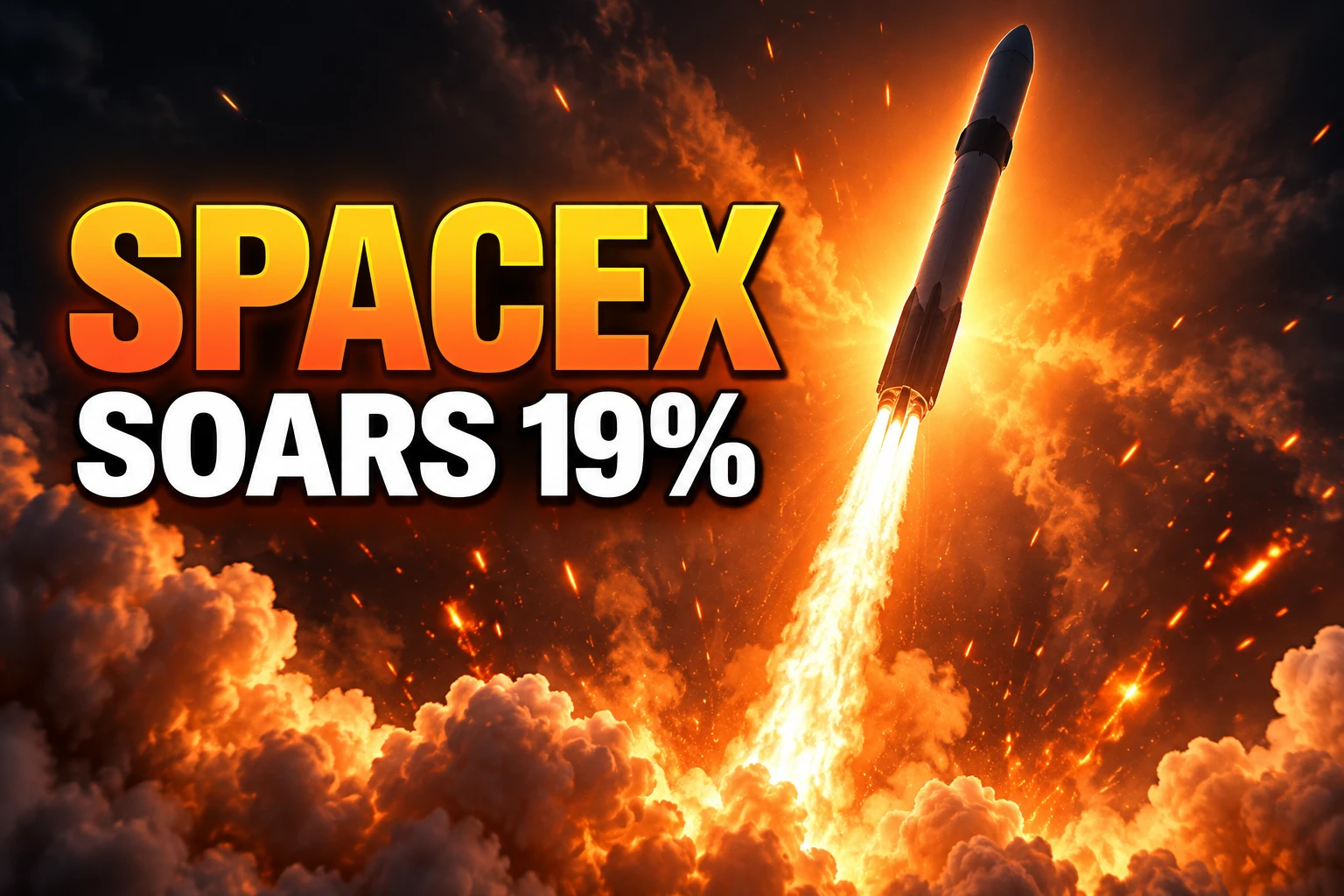
SpaceX Closed 19% Higher as Space Stocks Sold Off
Greg Boutle, head of U.S. equity derivative strategy at BNP Paribas, had sent that $50 billion figure to clients days before the book closed. SpaceX priced 555,555,555 shares at $135 on June 11, a $75 billion base deal that broke Saudi Aramco’s $29.4 billion record from 2019. Shares opened trading on Nasdaq at $150 and finished at $160.95, up 19.2%.
IPO TERMS IN BRIEF
- Share price: $135, with an 11% jump at the open.
- Base size: 555,555,555 shares that raised $75 billion.
- Overallotment: 83,333,333 extra shares taken by the banks.
- Completed net proceeds: about $85.7 billion after fees.
Underwriters Goldman Sachs, Morgan Stanley, BofA Securities, Citigroup, J.P. Morgan, and Deutsche Bank exercised that option on June 15, bringing the completed offering to 638,888,888 Class A shares. SpaceX said it would put the cash into AI compute, launch gear, and more satellites. Last year’s sales were $18.67 billion, and Gwynne Shotwell, the chief operating officer, told the Times Square bell crowd the firm was about 22,000 strong after 24 years as a private company founded in 2002.
The rest of the space tape did not get a party. By 10 a.m. Eastern, funds that had run up 65% to 78% on the listing were giving it back, and Maurits Pot, chief executive of Tema, said investors were selling other space stocks to buy SpaceX.
SPACE NAMES ON LISTING DAY
- Global X Space Tech (ORBX): Down nearly 8% by mid-morning.
- VanEck Space (WARP): Down 6.8%.
- Tema Space Innovators (NASA): Down 6.5%.
- Rocket Lab (RKLB): Closed down 10.8%.
- Intuitive Machines (LUNR): Closed down 13.1%.
- Planet Labs (PL): Closed down 8.8%.
- AST SpaceMobile (ASTS): Down more than 12%.
- EchoStar (SATS): Down 11%.
Talley Léger, chief market strategist at The Wealth Consulting Group, called it capital recycling, with institutions trimming smaller pure-play peers to free cash for the new giant. The Dow still gained 0.70% to 51,202.26, the S&P 500 gained 0.50% to 7,431.46, and the Nasdaq Composite gained 0.31% to 25,888.84. SPCX itself ran to $225.64 on June 16, then spent the summer giving that spike back.
Boutle’s $50 Billion Warning Hit a Thin Slice
Boutle’s June 5 note was never really about whether SpaceX would find buyers. He thought stand-alone SpaceX flows might be digestible, and he worried that passive funds, retail chase, and levered ETFs would all lean the same way against a thin float.
With the SpaceX free float reported to be close to $75bn on IPO, it’s easy to see how $30bn of passive buying, a retail investor chase, and levered ETF and option flows collectively could quickly become challenging for the stock’s liquidity.
Greg Boutle, Head of U.S. Equity Derivative Strategy, BNP Paribas
He put the combined dump of other stocks by retail and passive buyers at $50 billion, and said that number could rise if the IPO popped. He also stacked the listing against more than $100 billion of unrelated stock sales already queued near quarter-end, including an $85 billion Alphabet share issue that week, and warned that the danger was the cumulative effect. A chip-led selloff the Friday before the roadshow, he said, looked like an early tell, with recent winners and levered products the obvious cash source for a FOMO-style chase.
On the listing tape, that chase showed up in the space complex and in a few crowded tech names at midday, then faded. Nvidia, Apple, Microsoft, and Broadcom slipped in the morning and the indexes still finished higher. The $50 billion figure never printed as a broad-market air pocket. It printed as a rotation out of the proxies people had used when they could not buy SpaceX itself.
How Much Passive Money Bought SpaceX
Boutle’s $30 billion passive bid assumed index funds would have to swallow a trillion-dollar weight. They did not. S&P Dow Jones Indices refused a fast-entry exception on June 4, so the roughly $13 trillion tied to the S&P 500 stays on the sideline until mid-2027 at the earliest, and only if SpaceX clears GAAP profit and a year of seasoning. Nasdaq went the other way on May 1, letting a new listing that ranks in the top 40 by full market value into the Nasdaq-100 after 15 trading days and dropping the old 10% float test.
That rule got SPCX into the index on July 7. It did not get SPCX a full-size weight. When free float sits below one-third of the company, Nasdaq counts three times the float, not the whole firm. Brian Liew’s flow study for The Intrinsic Investor sized the first-month mechanical bid at about $11 billion of forced buying, roughly $8.4 billion from Nasdaq-100 trackers and about $3 billion from total-market funds, against a tradable slice he put near $45 billion to $70 billion. Eleven billion dollars is about 20% of that float, which is tight, and it is not $30 billion.
Elon Musk still holds about 42% of the equity and 85% of the votes. After the overallotment, only about 639 million shares were trading, around 5% of a company with about 13.57 billion shares outstanding. The S-1 path for the cash, Starlink service in 164 countries, and a dual listing on Nasdaq Texas did not change that math. Index weight follows shares the public can actually buy.
Who Paid for the SpaceX Bid
An index fund does not print new money to buy a new member. It trims what it already owns. Nasdaq’s fast-entry rule also kept every old member in the index, so the first SpaceX purchase was a straight rotation, heaviest in the megacaps that dominate the Nasdaq-100. Liew’s desk put Nvidia’s share of that first cut near $0.80 billion, with Microsoft and Apple close behind, and the largest eight names taking about half of the $8.4 billion Nasdaq-100 ticket. Total-market funds spread their $3 billion across thousands of holdings, so the per-name dent there was small.
THE BOUTLE CALL VERSUS WHAT TRADED
| Measure | Boutle, June 5 note | What printed |
|---|---|---|
| Passive buying of SpaceX | $30 billion | About $11 billion in the first month |
| Selling of other stocks | $50 billion from retail and passive | Space ETFs fell 2% to 8% on June 12; the S&P 500 rose 0.5% |
| SpaceX free float at IPO | Close to $75 billion | About 639 million shares after the overallotment, around 5% of the company |
Retail still mattered, which is the part Boutle got right. Up to 30% of some IPO allocations went to individuals in early tallies, far above the usual 5% to 10%, and the first-day pop rewarded that chase. The cash for those tickets came out of the names people already owned, which is why Rocket Lab and the space ETFs, not the S&P 500, took the punch. Michael Field, Morningstar’s chief equity market strategist, said at the July inclusion that skeptics, his firm included, thought the stock was overvalued even as the fast-track made the demand obvious.
Lock-Ups Turned the Company Into a Supply Event
The listing-day squeeze was a float story. The next three months have been a supply story. SpaceX did not use a single 180-day cliff. The lock-up terms in the IPO prospectus release stock in slices tied to earnings and to the calendar, and those slices are now larger than the index bid that was supposed to catch them.
THE SPACEX LOCK-UP CALENDAR
- June 12, 2026: SPCX lists; about 639 million shares trade after the overallotment, around 5% of the company.
- June 15, 2026: Banks complete the 83,333,333-share overallotment; net proceeds reach about $85.7 billion.
- July 7, 2026: SpaceX joins the Nasdaq-100 at about 1.28% weight.
- August 6, 2026: Up to 911.5 million shares unlock after the first public earnings.
- August 20, 2026: Up to 319 million more shares unlock.
- September 9-10, 2026: 319.0 million shares plus a 59.1 million affiliate block unlock.
- September 21, 2026: Nasdaq-100 weight rises to 2.82%.
- September 24, 2026: Up to 328.4 million shares unlock.
After the August tests, insiders largely held their stakes and the stock held up, which is the bull case for every date that follows. The other read, and the one that keeps showing up around each window, is that employees with almost all their net worth in one name still sell a slice once the price sits above $135, while short-term holders use the date as a reason to get out. Earlier unlocks that did little do not cancel the next block; they only show that the selling rate is a choice, not a formula.
A 2.82% Weight Met 328 Million New Shares
The September rebalance is the cleanest test of Boutle’s original liquidity worry, and it ran in reverse. Nasdaq reset SpaceX’s weight to 2.82% from about 1.28%, using the float as of August 31: the IPO shares plus the August 6 and August 20 releases, about 1.87 billion shares, or 13.8% of the company. More than 200 products with over $800 billion in assets track that index, including the $482 billion Invesco QQQ Trust.
On that $800 billion base, a 1.54 point weight increase is about $12.3 billion, or roughly 81 million shares at the Sept. 18 close of $152.71. QQQ alone accounts for about $7.4 billion of that. JPMorgan’s earlier model of a smaller weight move had implied about $15.5 billion, and scaling it to the final 1.54 points gets near $23.9 billion. Even the high end of that range is a fraction of the stock that became eligible the same month.
SPCX traded 335.7 million shares on Sept. 18, about 3.5 times its three-month average, and still closed down 1.4% at $152.71. It closed Sept. 21 at $151.85 on 82.3 million shares. The Sept. 24 tranche of up to 328.4 million shares is about four times that ~81 million-share index buy. The same 328.4 million size is due again on Oct. 9 and Oct. 24. After Sept. 24 the cumulative float sits near 2.58 billion shares, or 19.0% of the company, still under the one-third line where Nasdaq would drop the three-times-float cap.
Edward Yoon at Macquarie cautioned against reading index days in isolation, pointing to Iran headlines, inflation, tariffs, rates, and the usual swings in AI stocks. That is a fair hedge. It does not change the share count. The forced buyers are known, the unlock sizes are in the prospectus, and the September tape did not lift when the bid arrived.
December’s 797.6 Million Shares Arrive Without an Index Bid
The three-times-float rule stops once free float passes 33.3%, because three times one-third is the whole company. That crossing is tied to a block of about 1.3 billion shares two trading days after third-quarter results, which would take the float to about 4.53 billion shares, or 33.4%, and a full-value Nasdaq-100 weight near 6.6% if the rest of the index is unchanged. From 2.82% to 6.6% on an $800 billion base is about $30 billion of buying, or about $58 billion if the JPMorgan scaling is used instead. From Oct. 9 through Dec. 8, about 3.08 billion shares are scheduled to unlock, worth around $471 billion at $152.71. That bid covers 6% to 12% of the new stock. The rest depends on holders sitting tight, which is what happened in August and is not a mechanical fact.
The 797.6 million shares due on Dec. 8, day 180, add nothing to the index weight once the cap is already off. They are supply with no forced buyer attached. Musk’s own stock stays locked until June 12, 2027. The S&P 500 bid Boutle folded into his $30 billion remains a 2027 question, and the listing-day fear that SPCX would drain the whole market has already had its test: space funds paid, the S&P 500 did not, and the company that was supposed to starve the tape is now the one feeding it shares.
Disclaimer: This article is news reporting and analysis of SpaceX’s IPO, index inclusion, and lock-up calendar, and it is for information only. It is not investment advice, a recommendation to buy or sell SPCX or any other security, or a forecast of future prices or index weights. Readers should consult a licensed financial adviser or broker who can review their own holdings, time horizon, and risk limits before acting on any figure in this piece. Share counts, prices, weights, and proceeds reflect the company filings, exchange notices, and desk estimates cited above as of the dates given, and those figures can change with later filings, rebalances, or trading.

The Salary Cap Fight That Can Freeze Baseball’s TV Payday

The 2027 Mercedes GLE and GLS Keep Alabama Busy

Margaret Hamilton Dies at 90 With a Harder Fight Unfinished

Unity Parks Its Engine Inside Google’s Prompt Games

The Hidden Vendor Cut in 403(b) vs 401(k) Plans

Microsoft 365 Auth Fault Took Down Exchange and Teams

IFA 2026’s Weird Gadgets Are Building a Sensor Home

Xbox Caps Game Pass Cloud Gaming at 15 Hours

Squishy Dumpling Toys Recalled After Hiding Illegal Water Beads

Tesla Puts Its Wheel-Free Cybercab on Austin Streets
-
 NEWS2 months ago
Microsoft 365 Auth Fault Took Down Exchange and Teams
-
 GAMING1 month ago
Xbox Caps Game Pass Cloud Gaming at 15 Hours
-
 NEWS1 month ago
IFA 2026’s Weird Gadgets Are Building a Sensor Home
-
 NEWS1 month ago
OpenAI Unveils GPT-6 Astra With a Critical Cyber Label
-
 AUTO1 month ago
Tesla Puts Its Wheel-Free Cybercab on Austin Streets
-
 NEWS2 months ago
OpenClaw 2.0 Ships a Team Workplace With Host-Trust Defaults
-

 NEWS1 month ago
Sony and Warner Sue Anthropic Over Torrented Song Lyrics
-
 LIFESTYLE1 month ago
Squishy Dumpling Toys Recalled After Hiding Illegal Water Beads