
BUSINESS
UPS Beat and Raised Guidance Then Watched Shares Slide
UPS posted $22.8 billion revenue and raised 2026 outlook after finishing its Amazon exit, yet shares dropped hard on volume optics and a flat Q3 domestic call.

UPS reported second-quarter revenue of $22.8 billion, up 7.6% year over year, and adjusted diluted EPS of $1.76 that beat estimates by a dime. The company also raised full-year revenue outlook to approximately $91.2 billion. Shares still closed down about 6.5% on Tuesday.
The growth arrived exactly as planned after an 18-month Amazon volume exit and network reset. That same reset left volume numbers looking soft and a flat domestic third-quarter call that traders punished.
The Quarter That Cleared the Bar
Consolidated operating profit on a non-GAAP adjusted basis reached $2.1 billion, up 12%. Adjusted operating margin expanded 40 basis points to 9.2%. GAAP diluted EPS was $0.71 after after-tax transformation charges of $891 million, or $1.05 per share, mostly employee separation costs from the completed Driver Choice Program.
| Metric | Q2 2026 | Change / Note |
|---|---|---|
| Consolidated revenue | $22.8B | +7.6% YoY |
| Adj. operating profit | $2.1B | +12% YoY |
| Adj. diluted EPS | $1.76 | Beat $1.66 consensus |
| U.S. Domestic revenue | $14.93B | +6.0% |
| International revenue | $5.04B | +12.5% |
| Supply Chain Solutions | $2.86B | +7.8% |
CEO Carol Tomé called it the fourth straight quarter of results that exceeded internal expectations. Full-year non-GAAP adjusted operating profit is now targeted near $8.65 billion and adjusted diluted EPS near $7.22. Capital spending stays near $3.0 billion and dividends near $5.4 billion.
The beat landed across every major line. Revenue, adjusted profit, and adjusted EPS all cleared the bar management had set for itself. That consistency over four quarters now underpins the raised full-year targets and the claim that the transformation bumps are behind the company.
The Amazon Glide Ends After 18 Months
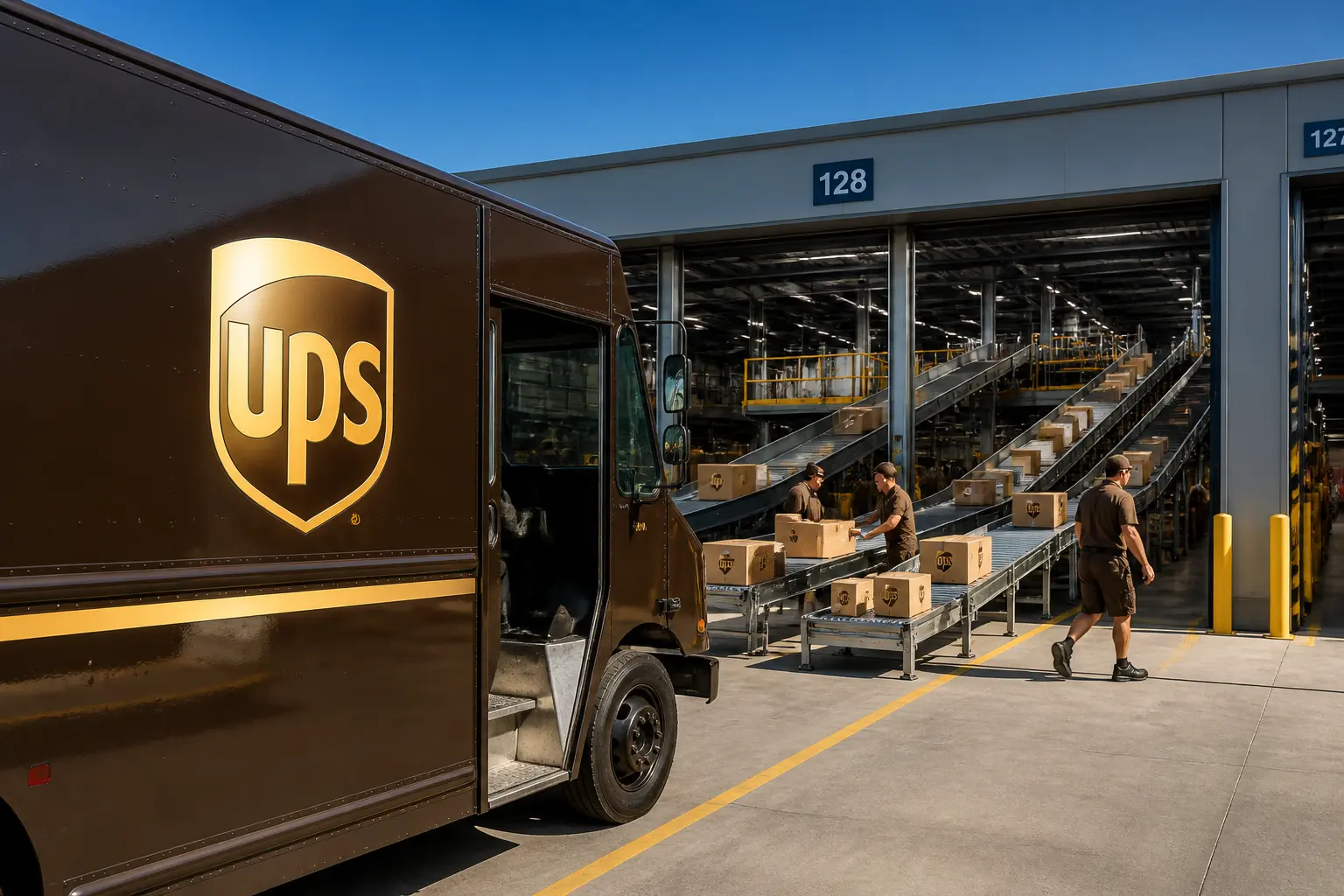
Tomé thanked employees for finishing the Amazon glide-down and related network reconfiguration “as designed.” The company removed roughly 2 million pieces per day of lower-quality Amazon volume and cut about $4.5 billion of related expenses.
- U.S. average daily volume fell 3.3% year over year, almost entirely from the planned Amazon reduction.
- Excluding that intentional release of volume, UPS says it grew non-Amazon volume in the quarter.
- Network reconfiguration and Efficiency Reimagined initiatives have already delivered about $1.2 billion of benefits year to date, on track for roughly $3 billion for full-year 2026.
- Further non-GAAP operating expense exclusions of $1.3 billion to $1.5 billion are still expected this year, largely tied to the Driver Choice Program.
The leaner network is now more automated and agile. Tomé said it will deliver operating leverage as higher-quality volume returns. RFID and AI investments are improving package visibility, described as the biggest advance in a decade.
The glide-down was never meant to look good on a volume chart. It was meant to strip out low-yield work, shrink the related cost base, and leave a network that can expand margins when better freight returns. On that narrower scorecard the quarter matched the plan.
Why Shares Still Dropped Hard
Coming into the report, UPS stock was up roughly 14% for the year. It rose initially on the beat, then faded to a close near $105.50, down 6.57%. Premarket trading already showed pressure. BofA raised its price target to $115 from $108 but kept a Neutral rating.
Investors focused on two lingering shadows. First, the volume optics remain negative even though revenue and profit grew. Second, management guided third-quarter U.S. domestic revenue flat year over year, with average daily volume down mid-single digits from seasonality plus residual Amazon effects. That bridge quarter sits between the completed reset and the expected leverage.
Fuel costs also rose sharply and clipped international profit. International operating profit fell $59 million despite strong revenue per piece gains. The market has seen this movie before with parcel carriers: good quality metrics arrive, yet the stock waits for cleaner volume growth before it re-rates.
The selloff therefore tracked the optics more than the income statement. Revenue and adjusted profit rose. Margins expanded. Guidance moved higher. The tape still punished the soft volume print and the flat domestic bridge still ahead.
Revenue Per Piece Carried the Day
U.S. Domestic revenue rose 6% even as volume declined, thanks to a 9.3% jump in revenue per piece. Adjusted operating margin for the segment reached 8.0%. International revenue climbed 12.5% on an 18.9% rise in revenue per piece, holding a 12.4% operating margin. Supply Chain Solutions margin sat at 10.2%.
| Segment | Revenue Change | Rev. per Piece | Adj. Op. Margin |
|---|---|---|---|
| U.S. Domestic | +6.0% | +9.3% | 8.0% |
| International | +12.5% | +18.9% | 12.4% |
| Supply Chain Solutions | +7.8% | – | 10.2% |
These figures show the quality pivot working. UPS deliberately chose higher-yielding packages over raw scale. The same choice created the temporary volume hole that still rattles some holders. On X, one observer noted that everyone had called UPS a structural-decline story six months earlier; the beat and raised outlook suggested that story forgot to arrive. Another framed the Amazon shrink as the long-term move of a company planning to still be here in 20 years.
Comparisons to peers are imperfect but useful. FedEx reported strong fourth-quarter and full-year results in June, also navigating trade and cost pressures while spinning off freight. UPS investors can weigh that against FedEx’s own Q4 beat and freight spin-off for a clearer read on how the two giants are reshaping their networks.
Revenue per piece did the heavy lifting in both major package segments. Volume could fall and revenue still rise because each remaining package paid more. That is the mechanical heart of the quality strategy, and it is already visible in the segment margins.
Healthcare and the New Mix
Healthcare logistics generated more than $3 billion in revenue for the second straight quarter. Tomé highlighted end-to-end cold-chain control with more than 20 million square feet of dedicated capacity across more than 36 countries. “Amazon’s not offering that,” she told CNBC.
Forwarding and logistics growth inside Supply Chain Solutions offset softer spots elsewhere. China-to-U.S. volume returned to year-over-year growth in May. The company is pushing automation and higher-value verticals while the domestic network absorbs the post-Amazon reality.
We launched a major transformation of our company that was transformative and came with some bumps, but we’re through those bumps, and we have returned our company to revenue and profit growth.
Carol Tomé said that on CNBC after the release. She added that when the company grows, the stock should follow.
Healthcare is one concrete example of the mix shift. Cold-chain capacity of that scale is hard to replicate quickly, and it sits outside the pure parcel volume debate that still dominates the stock reaction. Forwarding strength inside Supply Chain Solutions plays a similar role: it adds revenue and margin without needing the domestic network to refill every lost Amazon piece at once.
A Flat Domestic Third Quarter Is the Bridge
Management expects third-quarter domestic average daily volume down mid-single digits and revenue roughly flat. Seasonal patterns plus the final Amazon effects explain most of it. After that, the raised full-year targets imply stronger sequential leverage in the fourth quarter and beyond.
Cash flow from operations year to date stood at $3.1 billion. Free cash flow was solid. The balance sheet carried $4.7 billion in cash at quarter-end. The effective tax rate outlook remains about 23%.
What we know
- Amazon glide-down and Driver Choice Program are complete as designed.
- Full-year 2026 revenue, adjusted operating profit and adjusted EPS targets were all raised.
- Network benefits are tracking to $3 billion for the year.
What’s still in motion
- Third-quarter domestic volume and revenue will look soft by design.
- Further transformation costs of $1.3-1.5 billion will still be excluded from non-GAAP results this year.
- Fuel volatility and trade policy remain external variables.
The irony sits in plain sight. UPS did the hard, multi-year work of shedding low-quality volume and rightsizing the network. The numbers finally show revenue and profit growth with higher revenue per piece and expanding margins. The stock sold off anyway because the volume chart still looks ugly and the next quarter will not look pretty either. Investors who wanted the quality pivot got it. They just have to wait through one more soft print before the leverage they were promised becomes visible in the share price.
How the Leaner Network Is Built to Flex
The completed Amazon exit and the Driver Choice Program leave UPS with a smaller, more automated domestic network. Management’s stated aim is operating leverage: when higher-quality volume returns, a larger share of each incremental dollar should fall to profit because the cost base has already been cut.
Year-to-date network benefits of about $1.2 billion, on a path to roughly $3 billion for 2026, are the early proof point. RFID and AI tools that improve package visibility are meant to tighten that same loop, reducing handling waste and giving customers clearer tracking without adding headcount in proportion to volume.
- 18-month glide-down: roughly 2 million lower-quality Amazon pieces per day removed and about $4.5 billion of related expenses cut.
- Q2 2026: non-Amazon volume growth, revenue per piece jumps of 9.3% domestic and 18.9% international, adjusted margin up 40 basis points.
- Q3 2026 bridge: domestic revenue guided flat, average daily volume still down mid-single digits from seasonality and residual Amazon effects.
- Full-year 2026 targets: revenue near $91.2 billion, adjusted operating profit near $8.65 billion, adjusted EPS near $7.22.
The sequence matters. The cost exit came first. The volume optics stay messy through the third quarter by design. The raised full-year numbers assume the leverage arrives once that bridge is crossed. Capital spending near $3.0 billion and dividends near $5.4 billion remain intact through the transition, so the company is not starving the network or the shareholder while it waits.
What the Stock Is Still Waiting to See
The 6.57% drop to a close near $105.50, after a 14% year-to-date gain going into the print, shows how tightly the market is still tied to the volume line. BofA’s move to a $115 target with a Neutral rating captures the same tension: the fundamental path looks cleaner, yet conviction waits for a cleaner chart.
International profit already showed one external drag. Fuel costs rose sharply enough to cut operating profit by $59 million even while revenue per piece climbed 18.9%. Trade policy remains another variable outside management’s control. Those pressures do not erase the domestic quality gains, but they keep a ceiling on how fast the multiple can expand.
Tomé’s CNBC message was direct: the bumps are through, revenue and profit growth have returned, and the stock should follow when the company grows. The raised outlook to roughly $91.2 billion in revenue and $7.22 in adjusted EPS is the numerical version of that claim. The market’s reply was to mark the bridge quarter first and the full-year raise second.
Until domestic average daily volume stops declining and the fourth-quarter leverage shows up in the reported numbers, the quality story and the tape are likely to keep talking past each other. The ingredients for a re-rating are on the page. The catalyst the stock still wants is a volume print that no longer needs an asterisk.
Frequently Asked Questions
What were UPS’s exact Q2 2026 revenue and adjusted EPS figures?
Consolidated revenue was $22.8 billion, up 7.6% from the prior-year quarter. Non-GAAP adjusted diluted EPS came in at $1.76, beating the $1.66 analyst consensus by $0.10. GAAP diluted EPS was $0.71 after transformation charges.
How much full-year 2026 guidance did UPS raise?
The company now targets approximately $91.2 billion in consolidated revenue, roughly $8.65 billion in non-GAAP adjusted operating profit, and about $7.22 in non-GAAP adjusted diluted EPS. Earlier targets had been lower on both revenue and profit.
What did the Amazon glide-down remove from the UPS network?
UPS eliminated about 2 million pieces per day of lower-quality Amazon volume and removed roughly $4.5 billion of related expenses. The company states the glide-down and related network reconfiguration finished as designed after 18 months.
How large are the network reconfiguration savings UPS expects in 2026?
Year-to-date benefits already reached about $1.2 billion. Management expects approximately $3 billion of full-year 2026 benefits from Network Reconfiguration and Efficiency Reimagined initiatives.


Shelby’s $42.9 million Daytona Coupe cashes the bet that beat Ferrari

AI forces Apple into third security drop in three weeks

Lamborghini banks 2027 revenue with sold-out Revuelto SV

Apple’s Labor Day Habit Locks iPhone 18 Pro September Dates

Frogwares Ships Sinking City 2 After Years of Air Raids

AirTag 2 Hits Near Lows Just as Travel Season Peaks

McLaren Pop Art F1 GTR Hits $34.6 Million and Resets the Tier

Spotify Playlist Notes Bring Back Liner Notes for Streaming

AirPods Max 2 hit $429 and finally close the value gap

Star Citizen private demo of Siege of Orison still wiped the devs

Guardians Rout Twins With Seven Homers, Leave Joe Ryan One Shy of Record

Rainout Gives Red Sox Two Shots at a Franchise-Record Win Streak

Caitlin Clark Skips the WNBA 3-Point Contest for a Third Straight Year

Double Fine Cuts 23 Jobs Weeks After Xbox Independence

John Hight Exits Wizards After Digital Reckoning Hits

Day-One Big Walk Lifts PS Plus August Beyond Recycled AAA

Curtis Mead’s Red Sox Debut Ends With Fractured Wrist

Red Sox Squander Hot Streak Chance in 4-3 Loss to Athletics

Moesch and Dressel Rewrite Night One at 2026 U.S. Nationals

Boutte’s Quiet Camp Takeover Forces Patriots Receiver Choices
-

 TECHNOLOGY3 years ago
How to Adjust a Bulova Watch Band – An Easy Guide
-

 News3 years ago
Fred Pentland: Athletic Bilbao’s English mentor who changed the essence of Spanish football
-

 FINANCE3 years ago
Tax Planning for Every Season: Guide to Maximizing Your Tax Benefits
-

 Education3 years ago
African Ministers New Education Plan
-

 BUSINESS3 years ago
What is Entrepreneurial Operating System? A Comprehensive Guide to EOS
-

 Education3 years ago
Innovate Your Learning Journey with Technology and Enhance Education
-

 News3 years ago
Russians formally out of World Athletics Championships
-

 BUSINESS3 years ago
Top 9 Most Expensive American Cities to Rent an Apartment