
News
Marantz Cinema Series 2 Puts Dirac and FreeSync on Midrange Boxes
Marantz Cinema Series 2 brings a 32-bit eight-channel DAC, Dirac Live Ready on mid and slim models, FreeSync gaming and Web Control 2.0, with prices from £950.

Marantz unveiled four Cinema Series 2 AV receivers on August 6, 2026, stretching a new 32-bit eight-channel DAC, Dirac Live Ready room correction and AMD FreeSync gaming support from a £950 slimline box up to a £1,850 nine-channel flagship. Ship dates start August 12 for most models, with the compact Cinema 70s Series 2 following on September 15.
The headline upgrades sit on every chassis. The second-order shift is who can now buy them, license them later, and install them without living inside a TV menu.
Four Boxes for Every Room Size
The range keeps the familiar Cinema ladder. Cinema 50 Series 2 sits at the top with nine channels of amplification and 11.4 channels of processing. Cinema 60 Series 2 and the Europe-only Cinema 60 DAB Series 2 run seven channels at higher power. Cinema 70s Series 2 stays slimline at seven channels and half the wattage.
| Model | Amp channels / power | Processing | Dirac path | Price (key markets) | Availability |
|---|---|---|---|---|---|
| Cinema 50 Series 2 | 9 ch / 110W (8 Ω) | 11.4 | Full ecosystem (RC, Bass Control, ART) | $3,000 / €2,100 / £1,850 | Aug 12, 2026 |
| Cinema 60 Series 2 | 7 ch / 100W | 7.x class | Dirac Live Ready | $2,000 (Americas, APAC) | Aug 12, 2026 |
| Cinema 60 DAB Series 2 | 7 ch / 100W | 7.x class | Dirac Live Ready | €1,450 / £1,250 (Europe) | Aug 12, 2026 |
| Cinema 70s Series 2 | 7 ch / 50W | 7.x class | Dirac Live Ready | $1,500 / €1,100 / £950 | Sep 15, 2026 |
All four keep full-channel preamp outputs for external amps. Finishes are Black and Silver-Gold globally, Black only in North America. Packaging cuts plastic and shifts to recyclable paper protection.
According to HARMAN’s full Series 2 announcement, every model was tuned by the Marantz Sound Master for the brand’s warm, spacious signature.
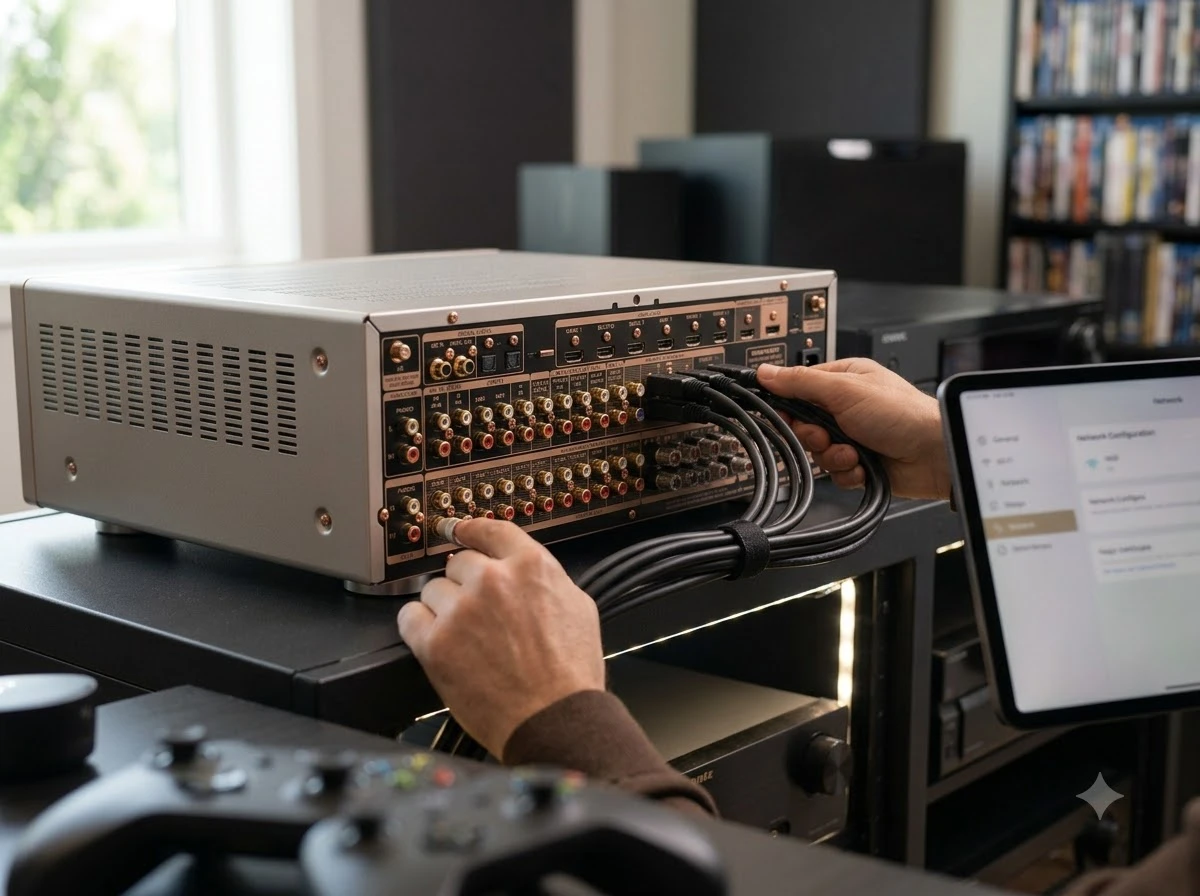
Eight Channels Convert at Once
The shared heart is a new 32-bit, eight-channel DAC. Marantz says it performs dedicated simultaneous high-resolution conversion on every channel. That design cuts timing errors between channels and shortens the signal path.
Claimed results are tighter imaging, better dynamic expression and more coherent surrounds. The architecture is identical from the 50-watt slimline to the flagship, so the sonic platform is no longer a top-model exclusive.
The Cinema 50 Series 2 pairs that converter with Hyper Dynamic Amplifier Modules (HDAM SA2), current-feedback topology and 110 watts per channel on the flagship into 8 ohms (20 Hz-20 kHz, 0.08%, two channels driven). It also lists 150W into 6 ohms under a 1 kHz, 0.7% two-channel rating. Four independent subwoofer outputs sit on the rear panel.
Flagship-only tricks include Dolby Atmos Channel Expander, which can press every available speaker into service on channel-based Atmos mixes, and Center Bi-Amp Mode for clearer dialogue when a second compatible centre run is wired alongside the fronts.
Dirac Drops Into the Midrange
Room correction is where the purchase math changes. Cinema 50 Series 2 still carries the full Dirac path: Room Correction, Bass Control and Active Room Treatment (ART). The bigger move is that Cinema 60, 60 DAB and 70s Series 2 are now Dirac Live Ready.
Buyers can run the included Audyssey MultEQ (XT32 on the 50, MultEQ on the lower pair) on day one, then decide later whether to pay Dirac for a larger sweet spot and tighter bass. Marantz describes the paid upgrade as delivering “tighter bass,” improved timing and a “significantly larger listening sweet spot.”
- Base layer: Audyssey MultEQ or MultEQ XT32 ships in the box on every model.
- Dirac Live Ready (60 / 60 DAB / 70s): license Room Correction after purchase.
- Full Dirac on Cinema 50 Series 2: Room Correction plus Bass Control and ART availability.
- Mic note: Dirac does not use the bundled Audyssey microphone; a separate calibrated mic is required.
Established Dirac Live options for Marantz models have historically split Limited Bandwidth and Full Bandwidth Room Correction, with Bass Control priced as a further tier. Series 2 SKUs were not yet listed on Dirac’s Marantz page at launch, so exact new license prices should be confirmed at purchase. The strategic point is already clear: correction quality is now modular across the whole line instead of locked to the expensive chassis.
That invites a different decision. A buyer who once stretched for a higher model only to unlock better EQ can now take the slimline or mid box and fund Dirac later if the room needs it.
1440p and FreeSync Join the HDMI Stack
Gaming features land on every Series 2 unit. The receivers add 1440p video passthrough and AMD FreeSync compatibility for tear-free frames from PCs and consoles that support variable refresh. Existing HDMI 2.1 strengths stay: 8K/60 and 4K/120 passthrough, VRR, ALLM and QFT on the supported inputs.
On the Cinema 50 Series 2, detailed specs list six 8K HDMI inputs and three HDMI outputs (main plus zone), with FreeSync called out on HDMI inputs 4-6. Lower models keep six inputs, though fewer of them are full 8K class, and the 70s runs a single eARC HDMI output in the comparison charts Marantz published at launch.
HDR formats cover HDR10, HLG, Dolby Vision, HDR10+ and Dynamic HDR. A future firmware drop will add low-latency Bluetooth LE Audio, aimed at cutting wireless delay to compatible headphones and phones.
The practical effect is one less box for mixed movie-and-PC rooms. Console and GPU owners who already park an AVR under the TV no longer need a separate FreeSync path for 1440p high-refresh play.
Web Control 2.0 Speaks Installer
Custom install is the quiet stakeholder in this refresh. Series 2 introduces Web Control 2.0 so the entire system can be configured from a phone, tablet or laptop without the TV on-screen menu. HDMI Diagnostics 2.0 inside CI Mode automates HDMI verification and troubleshooting. Channel Level Monitoring draws real-time activity across every channel so a tech can see which speakers are alive without crawling the rack.
- Web Control 2.0: full setup and daily control from any browser device.
- HDMI Diagnostics 2.0 (CI Mode): automated link checks for faster rack commissioning.
- Channel Level Monitoring: live visualisation of channel activity on all models.
- Legacy CI hooks: IP control, RS-232, IR flasher in, DC trigger, Marantz remote bus remain.
Streaming still rides the upgraded HEOS multi-room streaming platform, with AirPlay 2, Bluetooth headphone retransmit, Roon Ready on the flagship class, and major services including TIDAL, Qobuz, Spotify Connect and Amazon Music HD. Two-zone audio remains available.
Trade coverage immediately highlighted installation flexibility. Enthusiast reaction on X was thinner and more price-focused; one Japanese owner simply posted the $3,000 Cinema 50 Series 2 tag with a grimace emoji. Volume in this category often moves through custom channels. Giving those channels faster diagnostics and browser setup is a second-order bet on who actually racks the product.
Regional Stickers and the Midrange Fight
Pricing is sharply regional.
- Cinema 50 Series 2: $3,000, €2,100, £1,850
- Cinema 60 Series 2: $2,000 in the Americas and APAC only
- Cinema 60 DAB Series 2: €1,450 / £1,250, Europe only with DAB radio
- Cinema 70s Series 2: $1,500, €1,100, £950
What Hi-Fi? notes the flagship will sit against the Arcam AVR5 in the mid-premium bracket, where the Arcam has earned strong rhythmic praise. Marantz counters with nine amp channels, 11.4 processing, the exclusive Atmos expander and centre bi-amp mode, plus the new DAC and Dirac depth. Reviews will settle the sound contest. On paper the Series 2 50 is built to contest that shelf rather than cede it.
Below that fight, the 60 and 70s Series 2 matter more for market shape. Dirac Ready at £950-£1,250 and $1,500-$2,000 pulls advanced correction into rooms that never budgeted a flagship. FreeSync and 1440p make the same boxes more useful beside a gaming PC. Web Control 2.0 shortens the installer’s visit. None of those moves needs a nine-channel faceplate.
Availability is August 12, 2026 for the 50 and 60 family, September 15 for the 70s Series 2, through Marantz.com and authorised dealers. The boxes look like a standard generation bump. The options ladder underneath them is the part that will still be reshaping shopping lists three months from now.
Frequently Asked Questions
How many HDMI inputs does the Cinema 50 Series 2 provide?
The Cinema 50 Series 2 lists six HDMI inputs, all specified for 8K, plus three HDMI outputs including eARC on the main path and a zone output, according to Marantz’s detailed product specifications published at launch.
Can I bi-amp the centre channel on every Series 2 model?
No. Center Bi-Amp Mode is exclusive to the Cinema 50 Series 2. Lower models retain assignable bi-amp options for compatible front left and right speakers but do not get the dedicated centre bi-amp feature called out for dialogue clarity on the flagship.
Does the Cinema 70s Series 2 include a phono input?
The Cinema 50 Series 2 includes a moving-magnet phono stage. Buyers eyeing the slimline 70s should confirm the final I/O sheet for that chassis at order time, because the compact layout has historically traded some analogue flexibility for height; Marantz’s Series 2 comparison charts emphasise HDMI count and power first.
Will Bluetooth LE Audio work on day one?
No. Marantz says low-latency Bluetooth LE Audio arrives via a future firmware update. Day-one wireless covers classic Bluetooth, including retransmission to headphones with volume control on supported models, plus Wi-Fi and Ethernet for HEOS and AirPlay 2.
Is Auro-3D supported on the new Cinema 50 Series 2?
Yes. Marantz’s Cinema 50 Series 2 specification sheet lists Auro-3D alongside Dolby Atmos, DTS:X, IMAX Enhanced, 360 Reality Audio and MPEG-H, so immersive format coverage on the flagship extends beyond the two dominant object codecs.


iPhone 18 Pro Price Hike Hands Wins to Memory Makers

Apple Lifts Trade-In Credits Ahead of Costly iPhone 18 Cycle

Hisense Ships Dolby Vision 2 First and the Brightness Catch

Quake Gets 19 Free Maps From MachineGames Quake Club

SpaceX Moon Factories Aim to Break Earth’s AI Limits

OpenAI Bets $300 Donut Speaker Can Beat Smart Home Economics

Marantz Cinema Series 2 Puts Dirac and FreeSync on Midrange Boxes

AirPods Pro 3 Hit $190 as Camera Models Loom Pricier

Ford Places Its $30K Fathom Bet on a New Production Era

Seiko Wraps Its Speedtimer in Edo Purple for 145 Years

Doom Studio id Software Cuts Half Its Staff in Xbox Layoffs

Nintendo Switch Online Adds Four Classics and One Japan-Only Title

Meta’s Muse Image Lets Anyone Use Your Instagram Photos in AI

Pink Bearista Cup Returns July 13 as Starbucks Pink Vibes Drops

Samsung Sets Galaxy Unpacked for July 22 in London With a Wider Fold

Marine Cloud Brightening Could Weaken Super El Niños, Study Says

US Trade Deficit Jumps to 14-Month High as AI Spending Lifts Imports

Micron Stock Just Entered a Bear Market. Is It Time to Buy?

Samsung’s $1,230 Galaxy Unpacked Deal: How It Stacks Up

Meta Tests ‘Super Sensing’ AI Glasses That Record Every Moment
-

 TECHNOLOGY3 years ago
How to Adjust a Bulova Watch Band – An Easy Guide
-

 News3 years ago
Fred Pentland: Athletic Bilbao’s English mentor who changed the essence of Spanish football
-

 FINANCE3 years ago
Tax Planning for Every Season: Guide to Maximizing Your Tax Benefits
-

 Education3 years ago
African Ministers New Education Plan
-

 BUSINESS3 years ago
What is Entrepreneurial Operating System? A Comprehensive Guide to EOS
-

 Education3 years ago
Innovate Your Learning Journey with Technology and Enhance Education
-

 News3 years ago
Russians formally out of World Athletics Championships
-

 BUSINESS3 years ago
Top 9 Most Expensive American Cities to Rent an Apartment