
News
SpaceX Moon Factories Aim to Break Earth’s AI Limits
Musk’s lunar mass driver and robot plants would mine regolith for AI satellites Earth factories cannot match, turning Starship tonnage into self-scaling compute.

Elon Musk told investors on SpaceX’s first earnings call as a public company that the firm will land heavy tonnage on the moon, build factories there with robots, and fire finished AI compute satellites into space with a mass driver. “I know this sounds totally nuts,” he said, before sketching a path that could scale intelligence launched to space a thousand times, maybe a million times, beyond Earth’s economy.
The plan sits in the company’s SEC filings and roadshow materials from its June IPO. It is less a sci-fi flourish than the second-order move that turns Starship’s promised cargo flood into self-reinforcing manufacturing capacity Earth physics cannot match.
Musk Spelled Out the Lunar Factory Sequence
SpaceX currently puts roughly 2,500 tons a year into orbit on Falcon rockets, about 80 to 90 percent of the global total. With Starship, Musk said the company is working toward 1 million tons per year and ultimately 10 million. That volume is the precondition for everything else.
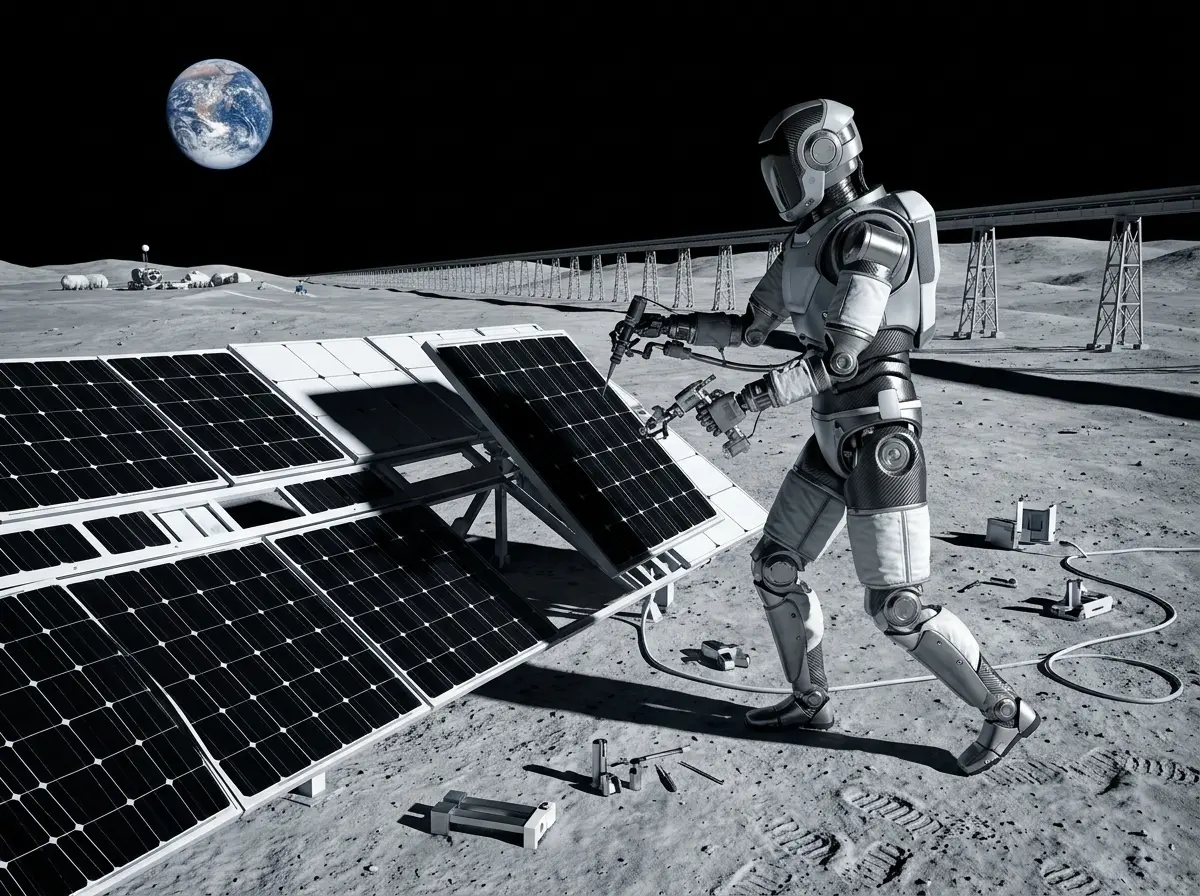
“We are going to land a lot of tonnage on the moon,” Musk said. “We’re going to build the factories on the moon. The robots will be helpful with that.” Components ship from Earth. Robots assemble plants that mine the dusty regolith for aluminum, titanium and silicon. Chips and specialty parts still come from Earth, but the bulk structure of large-scale AI compute satellites is produced locally.
Finished satellites then ride a lunar mass driver, an electromagnetic launcher that flings payloads off the surface without rockets. The lunar mass driver electromagnetic launcher definition in the S-1 is plain: a system built on the Moon’s surface that uses electromagnetic acceleration to propel payloads into space. Roadshow slides put it next to solar power and the goal of growing AI compute to terawatts annually.
Q2 revenue hit $7.8 billion, up 92 percent year over year, with adjusted EBITDA of $3.5 billion. The space segment that covers launch, Starship and the lunar ambitions posted $962 million in revenue and a $205 million adjusted EBITDA loss tied to Starship investment. Musk still projected $1 trillion in company revenue by 2030 if the trajectory holds.
Why Moon Dirt Beats Earth Factories for AI Sats
Earth data centers already fight for power, land and cooling water. Orbital AI compute satellites sidestep those limits with free solar power and radiative cooling in vacuum. SpaceX expects to begin deploying those satellites as early as 2028. The constraint is launch mass and the cost of lifting solar arrays, radiators and structure.
The moon supplies the bulk materials. Launching from the lunar surface takes roughly one-twentieth the energy of launching from Earth because of lower gravity and no atmosphere. A high-speed train analogy is common among the people who have worked the problem: you accelerate mass and let it go. Propellant stays on the ground.
| Factor | Earth launch | Moon surface |
|---|---|---|
| Gravity | 1 g | 1/6 g |
| Atmosphere | Thick drag and heating | None |
| Energy to orbit | Baseline | ~1/20th |
| Day-night cycle | 24 hours | 14 Earth days each |
| Local minerals | Mined and refined on planet | Aluminum, titanium, silicon in regolith |
Jaret Matthews, CEO of Astrolab and a former SpaceX engineer, notes the moon’s surface area is roughly that of Africa. Gaining reliable access is like opening a new continent with no ecological bill for mining. “You can huck mass off the moon without burning propellant,” he said. Greg Martin of Rainmaker Securities calls the two-day trip and frequent windows far more palatable for investors than the 26-month Mars cycle and six-month transit.
Robots, Power and the Sequence That Has to Work
No one serious imagines human crews wrenching bolts on the surface for industrial output. Cost and danger rule that out. Tesla Optimus-class humanoids or similar systems need electricity, solar power and lubrication. Jim Cantrell, Arizona space commissioner and early SpaceX executive, has watched the idea move from pipe dream in the 1980s to engineering possibility.
“Robots just need electricity, solar power, and a little bit of lubrication in the joints,” Cantrell said. The catch is the two-week lunar night. Solar alone leaves long blackouts. Nuclear power becomes necessary for continuous operations, a point several veterans raise without hesitation.
- Land cargo and first robots with Starship.
- Extract and process regolith into structural metals and glass.
- Assemble solar arrays, radiators and factory modules on site.
- Build and commission the mass driver track.
- Produce AI compute satellites and launch them electromagnetically.
- Use the same playbook later for Mars.
Ryan Westerdahl, a former SpaceX engineer now running Turion Space, said Musk’s timelines usually run a few years optimistic. The method is familiar: state the goal and wait for engineers to prove it impossible. They rarely can. NASA has put $20 billion over seven years behind a phased lunar base near the south pole with habitats, rovers and nuclear systems, giving commercial operators a parallel customer and infrastructure track. The NASA phased lunar base and CLPS cadence shifts toward frequent commercial landings and surface infrastructure.
Dust, Temperature and the Physics That Still Kill Projects
Matthews spent nine years at JPL and seven at SpaceX. He calls lunar dust everyone’s favorite boogeyman: abrasive, jagged at microscopic scale, electrostatically charged. It leaps onto solar arrays and degrades them. Temperature swings from minus 300 degrees Fahrenheit to above boiling can hit the same piece of hardware at once. “Everything is trying to kill you on the moon,” he said. “The moon is a harsh mistress and a pretty tough place to operate.”
Factories would launch in pieces and assemble robotically. Mass drivers themselves are old concepts updated for modern magnets and control. Casey Handmer’s detailed engineering walk-through shows that a track only a couple hundred meters long can work if rocks tolerate high acceleration. Power demand for multi-megaton annual throughput runs into the hundreds of megawatts, pointing again at nuclear or beamed energy. His first-principles mass driver power and track math makes clear the system only pays when Earth launch cadence itself becomes the bottleneck.
At extreme Starship rates, Handmer notes, the world already flies far more commercial aircraft daily than the number of Starship launches needed to loft a terawatt of solar capacity. The mass driver is insurance against that ceiling and against rising launch costs once the easy gains are harvested.
What the Numbers Say About Investor Appetite
SpaceX’s S-1 lists establishing the lunar economy, including cargo transport, manufacturing and energy production on the Moon, among its growth strategies. Future markets include passenger and cargo transport to the Moon and Mars, energy production and manufacturing capabilities there, and asteroid mining. The filing is frank that many of these involve unproven technologies and may never reach commercial viability on the hoped-for timeline.
Martin frames the investment case simply. Getting to Mars is a multi-year wait. The moon is two days. Start with ships, extract resources, scale manufacturing. “He is building the building blocks to pull it off,” Martin said. Cantrell goes further: Musk is not building a company so much as a nation-state, and no other nation-state is competing at this level. All the pillars, Starlink, AI data centers, Optimus, tunnels, fit the multiplanetary resettlement idea Musk first pitched him 25 years ago.
It’s pure insanity. But he’s going to do it, because that’s what Elon does.
That was Cantrell’s verdict. He still remembers the 2001 flight when Musk’s plan to build rockets from scratch sounded deranged. Twenty-five years later the same voice is not betting against him.
Public markets now share the ride after the SpaceX IPO that put the lunar plan in public filings. The real question Martin poses is whether shareholders trust the trajectory. Musk has made more investors more money than any entrepreneur in history. They still have to go along with the ride.
Starship Cadence Decides Whether Any of This Starts
Every step depends on Starship flying often, cheaply and reliably. Recent flights have cleared major technical hurdles, including heat shield performance and the Starship splashdown clearing the path to cadence. Musk has said he sees no remaining technical obstacles to full and rapid reusability.
Crowd reaction on X tracked the earnings clips closely. High-engagement posts amplified the “path to petawatts is mass drivers on the Moon” line and the robot factory language. Sharper observers noted the complete absence of schedule, budget, site or milestones. Near-term focus stays on capital expenditure, lockups and quarterly numbers. The lunar vision is the long-term thesis that only compounds once the first heavy cargo landings become routine.
Westerdahl expects that by the time serious Mars work begins, Optimus robots will already handle most surface labor and Starships will deposit cargo autonomously. The moon is the faster iteration loop: launches every couple of weeks instead of once every 26 months, communication delays of minutes instead of half an hour, and the chance to break equipment and learn in a vacuum that is still only a few days from home.
The Compute Ceiling Earth Cannot Raise
Earth can build more data centers. It cannot create more land next to cheap power or more rivers for cooling without political and physical limits. Orbital AI compute changes the resource equation. Lunar manufacturing multiplies the change by making the solar arrays and radiators themselves cheap enough to throw by the megaton.
If the factories and the mass driver work, the second-order result is not merely a stepping stone to a million-person Mars city. It is an industrial base that grows intelligence capacity faster than terrestrial constraints allow, financed by the same launch and connectivity business that already throws off billions. Failure modes remain plentiful: nuclear power delays, dust that ruins optics and seals, timelines that slip by half a decade, capital markets that lose patience.
SpaceX has already shown it can turn “totally nuts” into operational hardware. The filings, the earnings call and the parallel NASA money now put the next layer of the bet in plain view. The moon is no longer a destination. It is the factory floor that decides how large the AI economy can actually get.


iPhone 18 Pro Price Hike Hands Wins to Memory Makers

Apple Lifts Trade-In Credits Ahead of Costly iPhone 18 Cycle

Hisense Ships Dolby Vision 2 First and the Brightness Catch

Quake Gets 19 Free Maps From MachineGames Quake Club

SpaceX Moon Factories Aim to Break Earth’s AI Limits

OpenAI Bets $300 Donut Speaker Can Beat Smart Home Economics

Marantz Cinema Series 2 Puts Dirac and FreeSync on Midrange Boxes

AirPods Pro 3 Hit $190 as Camera Models Loom Pricier

Ford Places Its $30K Fathom Bet on a New Production Era

Seiko Wraps Its Speedtimer in Edo Purple for 145 Years

Doom Studio id Software Cuts Half Its Staff in Xbox Layoffs

Nintendo Switch Online Adds Four Classics and One Japan-Only Title

Meta’s Muse Image Lets Anyone Use Your Instagram Photos in AI

Pink Bearista Cup Returns July 13 as Starbucks Pink Vibes Drops

Samsung Sets Galaxy Unpacked for July 22 in London With a Wider Fold

Marine Cloud Brightening Could Weaken Super El Niños, Study Says

US Trade Deficit Jumps to 14-Month High as AI Spending Lifts Imports

Micron Stock Just Entered a Bear Market. Is It Time to Buy?

Samsung’s $1,230 Galaxy Unpacked Deal: How It Stacks Up

Meta Tests ‘Super Sensing’ AI Glasses That Record Every Moment
-

 TECHNOLOGY3 years ago
How to Adjust a Bulova Watch Band – An Easy Guide
-

 News3 years ago
Fred Pentland: Athletic Bilbao’s English mentor who changed the essence of Spanish football
-

 FINANCE3 years ago
Tax Planning for Every Season: Guide to Maximizing Your Tax Benefits
-

 Education3 years ago
African Ministers New Education Plan
-

 BUSINESS3 years ago
What is Entrepreneurial Operating System? A Comprehensive Guide to EOS
-

 Education3 years ago
Innovate Your Learning Journey with Technology and Enhance Education
-

 News3 years ago
Russians formally out of World Athletics Championships
-

 BUSINESS3 years ago
Top 9 Most Expensive American Cities to Rent an Apartment