
AUTOMOBILE
Ford Places Its $30K Fathom Bet on a New Production Era
Ford’s Fathom midsize EV pickup opens at $29,945 as the first Universal EV platform vehicle, testing a radical assembly bet against Chinese competition.

Ford put a hard number on its next big EV wager Thursday: the Fathom midsize electric pickup will start at $29,945 including destination when customer deliveries begin in 2027. That figure undercuts the average new vehicle and most EVs by a wide margin and marks the first product off an entirely new platform and plant process the company has called a Model T moment.
CEO Jim Farley is betting the combination can finally deliver affordable American EVs that stand up to Chinese competition. Whether the Fathom itself becomes a volume star is secondary to proving the system works.
Farley’s Model T Moment Lands on a Compact Truck
Ford has lived or died by breakout products for a century. The Model T, Taurus, F-150 and Explorer each reset the company’s trajectory. Recent introductions have not repeated that pattern. U.S. sales rose 6% to 2.204 million vehicles in 2025, still less than half the 2000 peak. Electric models have been mixed: the Mustang Mach-E holds steady near 50,000 units while the F-150 Lightning is being reworked into a range-extender hybrid.
Farley has framed the Universal EV platform and its Louisville Assembly Plant overhaul as the most radical change in how Ford designs and builds vehicles since the Model T. The Fathom is the opening vehicle. Pre-orders open early 2027. The base truck uses a standard-range LFP battery, rear-wheel drive with a Ford-designed permanent-magnet motor, and seating for five. An extended-range pack and all-wheel drive will cost more.
The price itself is the clearest signal of intent. A starting MSRP of $28,350 with standard-range battery plus the $1,595 destination fee lands just under the long-promised $30,000 target. That undercuts the roughly $50,000 new-vehicle average and the still-higher EV average, and sits near the gas Maverick.
What the Base Fathom Includes
Ford has released limited hardware details so far, but the equipment list is unusually complete for the price.
| Feature | Base Fathom | Notes |
|---|---|---|
| Price (incl. dest.) | $29,945 | $28,350 MSRP + $1,595 |
| Battery | LFP standard-range | Larger pack optional |
| Drive | RWD | AWD available later |
| Seating / volume | 5 adults | More passenger volume than Toyota RAV4 (projected) |
| Cargo | Frunk + bed | Bed length not yet disclosed |
| Tech | BlueCruise hardware, Apple Maps nav, digital key, bi-directional power, CarPlay/Android Auto | Large touchscreen standard |
Every truck ships with the hardware for next-generation BlueCruise hands-free driving and native Apple Maps integration. Bidirectional power and a digital key are also standard. The structural battery and large aluminum unicastings cut part count and simplify the body.
Range remains the biggest unknown. Early indications point to more than 200 miles and less than 300 on the standard pack. Payload and towing figures have not been released. Those numbers will decide whether the Fathom functions as a true work truck or mainly as a lifestyle hauler with a frunk.
The Compact Pickup Ceiling Is Real
Ford already owns the small-truck segment it is re-entering with an EV. The gas Maverick set a record 155,051 Maverick pickups sold in 2025, up 18%. That is solid volume and high segment share, yet nowhere near historic Ford blockbusters. The Taurus peaked above 400,000 units as America’s best-selling passenger car in 1992. The F-Series still moves more than 800,000 trucks a year.
Cox Automotive data cited in recent coverage shows roughly 70% of prospective buyers shopping SUVs versus about 33% looking at pickups. The Fathom’s compact size and smoother styling may help it pull sedan and crossover buyers who want a frunk and bed without the full-size truck look. It may also leave traditional truck customers cold. Many still want a lifted, rugged appearance even if the truck never leaves pavement. Ford has already signaled that a more rugged Fathom variant is likely.
- Maverick 2025: 155,051 units, record year, still a niche relative to F-Series.
- Taurus 1992 peak: more than 400,000 passenger cars, multi-year best-seller.
- Buyer preference: SUV interest roughly double pickup interest in recent Cox surveys.
- Price advantage: Fathom undercuts most EVs and sits near gas Maverick territory.
The segment is growing but not exploding. That makes it a controlled environment for a new platform: enough demand to soak up early production, not so much that a miss tanks the company.
The Real Proof Point Is the Assembly Tree
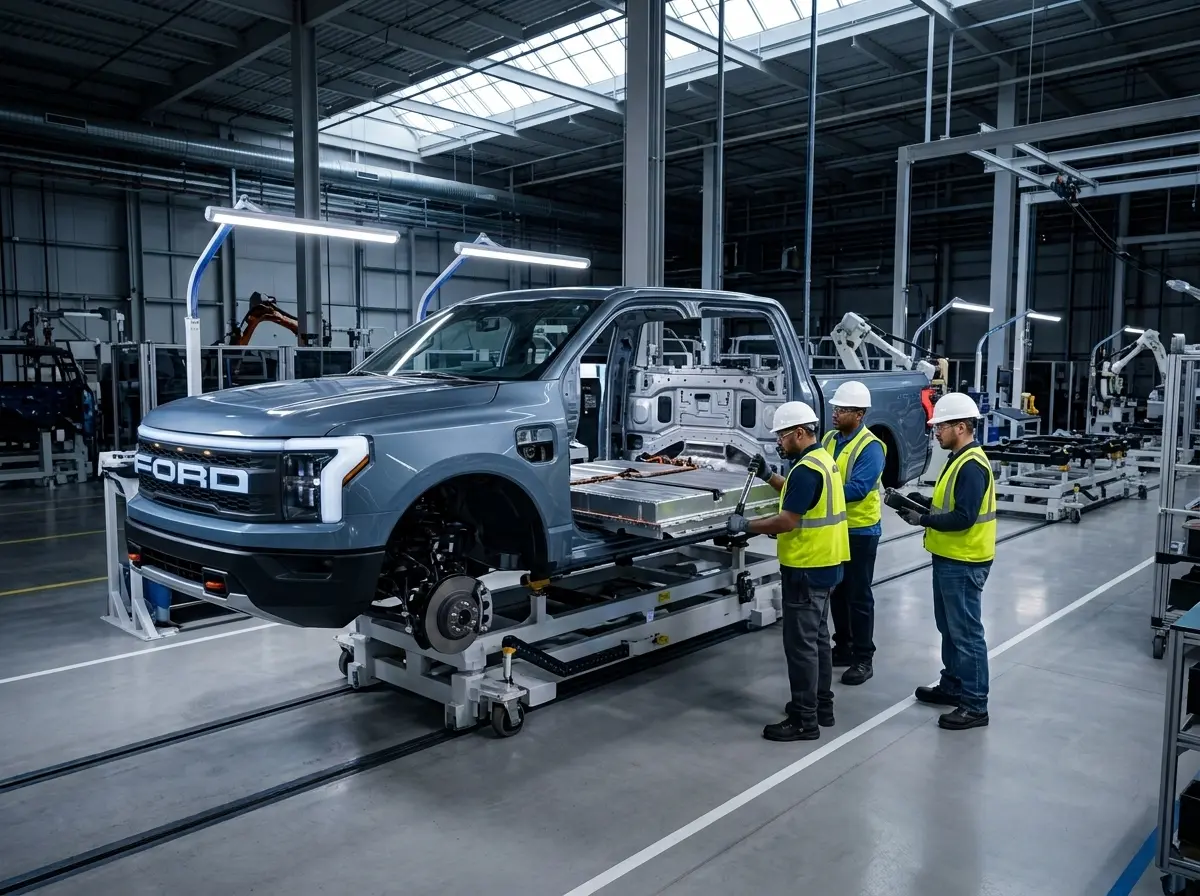
Ford invested roughly $5 billion across Louisville Assembly and BlueOval Battery Park Michigan to support the Universal EV effort and create or secure nearly 4,000 jobs. The manufacturing change is more radical than the vehicle itself.
The platform reduces parts by 20% and fasteners by 25% versus a typical vehicle. Workstations drop 40% dock-to-dock and assembly time improves about 15%. Large aluminum unicastings replace dozens of stamped pieces. Interior components mount directly to the structural battery pack. The plant shifts from a traditional moving line to what Ford calls an assembly tree that brings three major sub-assemblies together.
These changes exist to hit Chinese cost levels with American labor and a domestic supply chain. If the Fathom launches on time, at the promised price, with acceptable quality and margins, the same process can underpin future crossovers and other high-volume segments where Ford actually needs a home-run product. That is the bet. The truck is the first test article.
This is a huge moment in the UEV journey, with so much more to come!
Chris, an OTA product manager at Ford posting under @christooma, shared the name and price reveal to more than 40,000 views, underscoring internal confidence that the platform matters more than any single nameplate.
Name, Look and the EV Hesitation Factor
Ford spent nine months on the name. “Fathom” references both the old measure of outstretched arms and the idea of understanding something fully. Focus groups and internal engineers preferred it over archival options including Ranchero. Public reaction has been split. Some observers like the clean break from alphanumeric codes. Others find it odd for a truck.
Styling so far appears more lifestyle than trail-ready. That may help the sedan-replacement pitch and hurt among buyers who treat trucks as identity. EV hesitation remains the larger barrier. Many shoppers and some dealers still prefer gasoline. Ford can market, train dealers and later launch a rugged variant, but the base product has to convert fence-sitters on its own merits: price, space, frunk, software and ownership cost.
On X, reactions clustered around the price as the real news. One high-engagement take called it a potential huge hit precisely because it finally offers mass-market EV pricing. Practical questions about range and payload appeared just as often. Crowd skepticism focuses less on the name and more on whether early trucks will feel useful beyond city commuting.
Who Gains If the Bet Clears
Success for the Fathom looks different from a classic Ford hit. Moving 100,000-plus units a year would already outpace many EVs and validate the plant. Hitting Maverick-like volume while holding price and quality would be a clear win. The larger prize is a proven low-cost EV architecture that can scale into SUVs, where the real volume lives, and blunt Chinese pressure in markets Ford still controls.
Ford dealers gain an affordable EV that does not require the same discounting as earlier electric models. Louisville workers gain volume and a modern process. Competitors in the nascent low-cost EV truck space, including Slate’s simpler offering, face a full-featured Blue Oval alternative with dealer coverage and brand recognition. Traditional full-size truck buyers are largely unaffected; the F-Series remains the volume engine.
The company is also advancing Ford’s broader push into custom and aftermarket ownership with other nameplates, suggesting the Fathom could later support accessories and personalization that deepen ownership beyond the base sale.
Failure modes are straightforward: delayed launch, higher-than-planned costs, quality issues that erode the price advantage, or range/payload figures that leave the truck feeling compromised. Any of those would damage confidence in the entire Universal EV roadmap.
For now the numbers on the window sticker and the factory floor are public. Pre-orders open early next year. The first Fathoms will tell whether Farley’s manufacturing wager can produce more than a well-priced niche truck.


iPhone 18 Pro Price Hike Hands Wins to Memory Makers

Apple Lifts Trade-In Credits Ahead of Costly iPhone 18 Cycle

Hisense Ships Dolby Vision 2 First and the Brightness Catch

Quake Gets 19 Free Maps From MachineGames Quake Club

SpaceX Moon Factories Aim to Break Earth’s AI Limits

OpenAI Bets $300 Donut Speaker Can Beat Smart Home Economics

Marantz Cinema Series 2 Puts Dirac and FreeSync on Midrange Boxes

AirPods Pro 3 Hit $190 as Camera Models Loom Pricier

Ford Places Its $30K Fathom Bet on a New Production Era

Seiko Wraps Its Speedtimer in Edo Purple for 145 Years

Doom Studio id Software Cuts Half Its Staff in Xbox Layoffs

Nintendo Switch Online Adds Four Classics and One Japan-Only Title

Meta’s Muse Image Lets Anyone Use Your Instagram Photos in AI

Pink Bearista Cup Returns July 13 as Starbucks Pink Vibes Drops

Samsung Sets Galaxy Unpacked for July 22 in London With a Wider Fold

Marine Cloud Brightening Could Weaken Super El Niños, Study Says

US Trade Deficit Jumps to 14-Month High as AI Spending Lifts Imports

Micron Stock Just Entered a Bear Market. Is It Time to Buy?

Samsung’s $1,230 Galaxy Unpacked Deal: How It Stacks Up

Meta Tests ‘Super Sensing’ AI Glasses That Record Every Moment
-

 TECHNOLOGY3 years ago
How to Adjust a Bulova Watch Band – An Easy Guide
-

 News3 years ago
Fred Pentland: Athletic Bilbao’s English mentor who changed the essence of Spanish football
-

 FINANCE3 years ago
Tax Planning for Every Season: Guide to Maximizing Your Tax Benefits
-

 Education3 years ago
African Ministers New Education Plan
-

 BUSINESS3 years ago
What is Entrepreneurial Operating System? A Comprehensive Guide to EOS
-

 Education3 years ago
Innovate Your Learning Journey with Technology and Enhance Education
-

 News3 years ago
Russians formally out of World Athletics Championships
-

 BUSINESS3 years ago
Top 9 Most Expensive American Cities to Rent an Apartment