
FINANCE
Topsports Stock Crashes as Nike Revives a Failed US Playbook
Topsports stock crashed 20% as Nike’s China notice mirrors a 2017 US distributor cut that cost Nike market share for years.

Topsports shares crashed more than 20% in Hong Kong trading Wednesday after Nike confirmed it will cut the retailer off from online sales of Nike products starting in 2027. The notice ends the most lucrative digital arm of a 27-year partnership almost overnight.
It also reopens a wound Nike gave itself once before, in a different country. Nike tried stripping wholesale and online partners out of its distribution network starting in 2017. That decision cost it shelf space, market share, and eventually a $2 billion restructuring. Now it is running a close version of the same play in China, its most important market outside North America, and the analysts who watched the first attempt fail are already saying so out loud.
Topsports Loses a Fifth of Its Value in a Single Session
Hong Kong-listed shares of Topsports opened down 14.7% Wednesday before the slide deepened past 20% as trading continued. The company had just disclosed that Nike sent formal notice terminating its online distribution rights in mainland China, effective from 2027.
“The short term negative impact of the termination on the Group’s business would be significant,” Topsports said in a filing, noting that online sales of Nike’s products made up around 22% of its total revenue for the fiscal year ended February 2026.
Topsports CEO Yu Wu tried to soften the blow for shareholders. The company will keep working with Nike on “offline retail operations, local consumer service, and deep market development across city tiers,” he said, adding that “Topsports has worked with Nike for 27 years based on the principle of mutual benefit and shared growth.”
Twenty-seven years of shared growth just lost its fastest-growing channel.
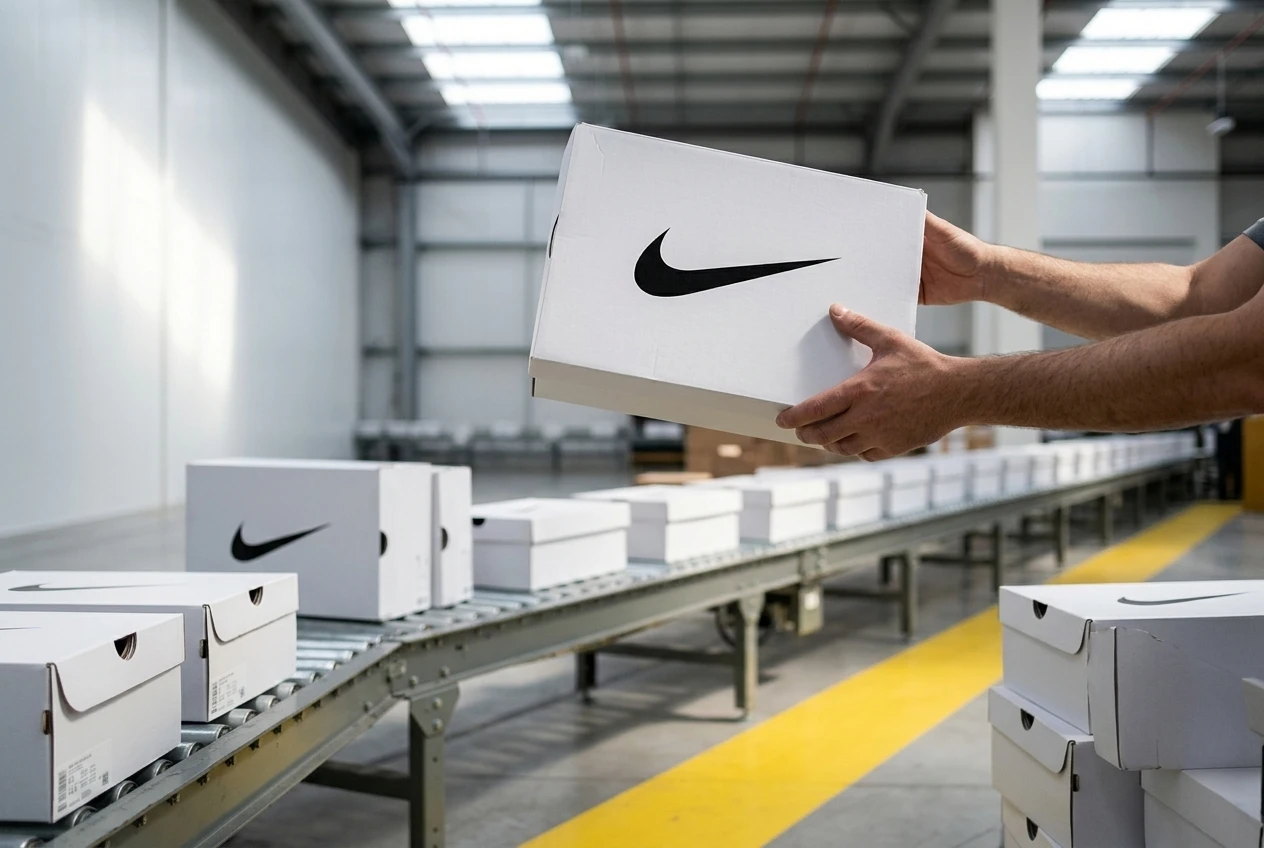
Nike Already Ran This Play, in America
In 2017, Nike began pushing hard into direct-to-consumer sales in North America, pulling product out of stores like Dick’s Sporting Goods and Foot Locker to funnel shoppers toward its own stores and Nike.com. Nike expanded that approach in June 2020 under its Consumer Direct Acceleration program.
It did not go cleanly. By December 2023, Nike had to unwind pieces of the strategy with a $2 billion cost-savings restructuring, after the consumer-direct push added complexity and inefficiency the company had not planned for. Nike quietly added back some of the wholesale partners it had cut loose years earlier, and in 2024 new president and CEO Elliott Hill restored more of those ties as part of an ongoing turnaround.
Nike has described this exact tension in its own regulatory filings before. In a securities filing from a decade ago, the company told investors it was still seeing its strategy to reset the marketplace pay off in Greater China, with quarterly revenue growth in the double digits. A later filing touted full-year China growth of 19% and direct-to-consumer growth of 52% in a single year. The playbook has worked for Nike before. It has also broken for Nike before.
| Detail | North America, Starting 2017 | China, Starting 2027 |
|---|---|---|
| The move | Pulled inventory from wholesalers like Foot Locker and Dick’s Sporting Goods to push shoppers toward Nike-owned stores and Nike.com | Terminates distributors’ rights to sell Nike products online, funneling shoppers to Nike’s own app and flagship site |
| Stated goal | A more premium, consistent brand experience and direct pricing control | Pricing control and a more consistent digital consumer experience |
| What followed | Rivals gained shelf space; market share slipped; a $2 billion restructuring followed by late 2023 | Not yet known; BNP Paribas already holds an underperform rating citing the same risk |
| Reversal | New CEO Elliott Hill restored wholesale ties starting in 2024 | Not applicable yet; effective date is January 1, 2027 |
Laid side by side, the two moves share a rationale, a mechanism, and now a warning label from Wall Street.
Why China, Why Now
Nike’s own numbers explain the urgency. The company’s fiscal 2026 full year revenue came in at $46.4 billion, flat on a reported basis and down 2% on a currency-neutral basis, with Nike Brand revenue held back specifically by declines in Greater China and EMEA. Fourth-quarter sales in Greater China fell 12% year over year, part of a business that has shrunk roughly 30% over the last five years.
There is a wrinkle in Nike’s own logic. NIKE Direct revenue, the channel Nike controls entirely, fell 7% on a reported basis last quarter, dragged down by a 12% drop in NIKE Brand Digital sales. The company pushing Chinese shoppers toward its own app is watching that exact channel shrink everywhere else too.
“We continue to face top-line headwinds,” Elliott Hill said in the statement accompanying those results. Nike’s outgoing chief financial officer, Matthew Friend, was blunter about the timeline, telling investors that sell-through conditions were unlikely to improve before at least the first half of fiscal 2027, the same window in which the China distribution change takes hold.
Analysts Already Called This One
The China plan leaked before Nike confirmed it. A Chinese media report last month first described Nike’s intention to cut off online distributors, prompting BNP Paribas equity analyst Laurent Vasilescu to draw the parallel to 2017 in a research note, and the firm has kept an underperform rating on Nike stock since.
This strategy opened up shelf space for competitors and the strategy ended poorly for Nike. We believe the same could happen if it takes the same approach in China.
Vasilescu wrote that note weeks before Topsports received its formal notice. Deutsche Bank took a similarly guarded position ahead of Nike’s June earnings call, citing a potential sharper-than-expected pullback from wholesale partners in China as one reason for its cautious stance.
A Rumor in June, a Notice in July
This week’s crash is the second leg of a trade that started a month earlier. Topsports shares were already halted and rattled once, before Nike ever confirmed anything.
- 2017: Nike launches its consumer-direct push in North America, pulling product from Foot Locker and Dick’s Sporting Goods.
- June 2020: Nike expands the approach through its Consumer Direct Acceleration program.
- December 2023: Nike unwinds part of the strategy with a $2 billion cost-cutting restructuring.
- 2024: New CEO Elliott Hill restores ties with wholesale partners as part of a turnaround plan.
- Late June 2026: A Chinese media report claims Nike will end distributors’ online sales rights from January 2027. Topsports and fellow distributor Pou Sheng together shed close to 30% of their share value over seven trading sessions before Topsports halted trading to clarify it had received no formal notice.
- July 21 to 22, 2026: Topsports confirms the formal notice has arrived. Shares fall more than 20% in a single session.
- January 1, 2027: The termination takes effect.
A rumor did most of the damage in June. Confirmation just finished the job in July.
Topsports Carries More Brands Than Just Nike’s
Nike is the headline, but it is not the whole company. Topsports is Nike’s largest distributor in mainland China and carries long-term partnerships with more than 20 leading sports brands, according to its own website.
- Nike, the brand at the center of this week’s notice and roughly 22% of last fiscal year’s total revenue through online sales alone
- Adidas, another core partner in Topsports’ mainland China retail network
- Puma, Converse and The North Face, additional global brands under the same retail umbrella
- Pou Sheng, a separate Hong Kong-listed Nike distributor that fell alongside Topsports on the same June rumor
That diversification is Topsports’ cushion and its exposure at once. Losing 22% of revenue from one channel is survivable for a company this size. Losing it while offline sales momentum is already soft, which Topsports has separately disclosed in past operating updates, is a tighter squeeze.
What Else Moved Wall Street This Week
Stock futures were already easing before the Topsports filing landed, as investors braced for a heavy earnings day. Dow futures slipped 51 points, with S&P 500 and Nasdaq-100 futures down 0.12% and 0.36%, ahead of results from ServiceNow, IBM, Tesla, Texas Instruments, Alphabet and AT&T.
Tuesday’s session had gone the other way. The major U.S. averages snapped a three-day losing streak on stronger-than-expected earnings from 3M and General Motors, while chipmakers rallied hard enough to push the VanEck Semiconductor ETF up 4% as investors rotated back into artificial intelligence names, a move that echoes the AI chip demand forecast that lifted futures across the sector earlier this year.
“Q2 earnings season is ramping up, but with most hyperscalers yet to report, the market is still waiting for the definitive read on how AI investment is being monetized and translated into future capital spending,” said Julia Hermann, global market strategist at New York Life Investment Management.
- Oil: Brent crude climbed 2% to $91.01 a barrel and WTI gained 2% to $84.91, as fresh U.S. strikes on Iranian military targets raised fears of supply disruption
- Caution from the top: JPMorgan Chase CEO Jamie Dimon said he would not buy stocks or long-dated Treasurys at current prices, citing geopolitical and fiscal risks he believes markets are underpricing
- Another earnings echo: IBM reports Wednesday too, days after its own stock swing revived a turnaround playbook from 1993, a reminder that Nike is not the only household name being measured against its own history this week
That does not change the arithmetic sitting in front of Topsports shareholders. For now, the stock crash is the only clean scoreboard anyone has. The real test starts January 1, 2027, when the distributor’s online shelves go dark for good.


Walmart’s $50 Million Opioid Settlement Closes Case Without Admission

California Sues Over $120 Million Morro Bay Wind Lease Buyout

Gilead Bixlenvo FDA Nod Opens Single Pill Path for Complex HIV Cases

Meta’s $18B Kids Deal Forever Shields Data Used to Spot Under-13s

Lettuce Outbreak Drove Record Cyclospora Spike Across 20 States

Amazon Shaves $20 Off M6 Mac Mini Before It Even Ships

SpaceX Louisiana Port Tests Debt Markets on Orbital AI Scale

Microsoft High Lifts Indexes as Small Caps Crack Support

Apple Replays 2015 Saturday Midnight Preorder for iPhone 18 Pro

Updated COVID Shots Clear FDA but Access Friction Hits High-Risk Groups

Take-Two CEO Pushes Netflix Subs for GTA 6 Extended Look

Destiny 2 Fans Unlock Vaulted Maps After Live Service Ends

Wildlands Free Update Hands Players the Tools They Already Invented

Quake Gets 19 Free Maps From MachineGames Quake Club

Quordle Monday Delivers Gavel Crush Speed Ethos Cleanly

Stripe Bid Shows PayPal Moat Cracked After Years of Slide

Tyson’s Five-Year Utah Plant Falls to Cattle Shortage Reckoning

Silver Lake Workday Talks Signal Private Floor for Software

Kennedy Lewis Takes Majority Control of The Greenbrier in $500M Deal

Best Buy Marks 60 Years With Sale That Echoes Its Audio Shop Roots
-

 TECHNOLOGY3 years ago
How to Adjust a Bulova Watch Band – An Easy Guide
-

 News3 years ago
Fred Pentland: Athletic Bilbao’s English mentor who changed the essence of Spanish football
-

 FINANCE3 years ago
Tax Planning for Every Season: Guide to Maximizing Your Tax Benefits
-

 Education3 years ago
African Ministers New Education Plan
-

 BUSINESS3 years ago
What is Entrepreneurial Operating System? A Comprehensive Guide to EOS
-

 Education3 years ago
Innovate Your Learning Journey with Technology and Enhance Education
-

 News3 years ago
Russians formally out of World Athletics Championships
-

 BUSINESS3 years ago
Top 9 Most Expensive American Cities to Rent an Apartment