
News
How the Parker Solar Probe’s 4.5-Inch Carbon Foam Shield Works
Parker Solar Probe hit 430,000 mph 3.8 million miles from the Sun on Christmas Eve 2024. The 4.5-inch carbon foam shield kept its instruments at 85°F.

At 6:53 a.m. Eastern on Christmas Eve 2024, while most of the United States was finishing holiday cooking and opening gifts, NASA’s Parker Solar Probe passed within 3.8 million miles of the Sun’s surface, closer than any human-made object had ever come, moving at 430,000 miles per hour. A beacon tone two days later confirmed the spacecraft had survived the flyby.
The record was the public story. The engineering that made it possible is an 11.4-centimetre carbon foam disc bolted to the front of the spacecraft that absorbs the Sun’s heat so the instruments behind it don’t have to.
The Christmas Eve Pass
On Dec. 24, 2024, the Parker Solar Probe reached its closest distance to the Sun, 3.8 million miles above the visible surface, in an encounter designed and operated by the NASA mission team and APL flight controllers. The spacecraft’s speed at that moment reached 430,000 miles per hour, or roughly 690,000 kilometres per hour, faster than any human-made object has ever moved, and close to three times the record previously held by the Helios 2 probe from 1976.
The spacecraft had spent six years getting there. Launched on Aug. 12, 2018, aboard a Delta IV Heavy rocket from Cape Canaveral, Parker used seven Venus flybys to bend its orbit closer to the Sun in stages. The final gravity assist, on Nov. 6, 2024, settled the spacecraft into the orbit it would keep for the remainder of its primary mission.
A beacon tone received late on Dec. 26, two days after closest approach, told the operations team at the Johns Hopkins Applied Physics Laboratory (APL) in Laurel, Maryland that the spacecraft had made it through. Detailed telemetry arrived on Jan. 1, 2025. Nicky Fox, NASA’s Associate Administrator for the Science Mission Directorate, called the flyby “a historic moment in humanity’s first mission to a star.”
We now understand the solar wind and its acceleration away from the Sun.
The 4.5-Inch Wall
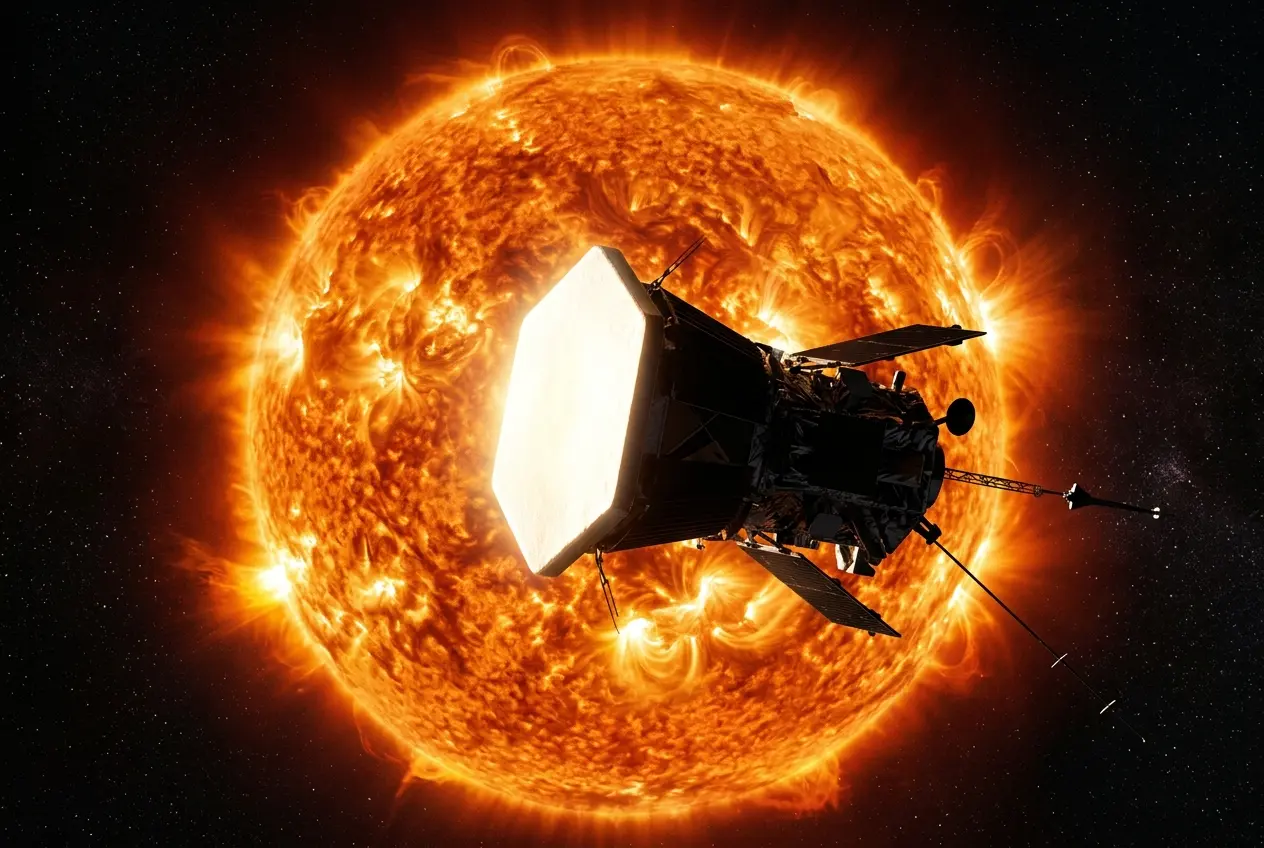
The thermal protection system is the engineering on which everything else rests. Per NASA, it is a 4.5-inch-thick (11.43 cm) carbon-composite shield designed to withstand temperatures reaching nearly 2,500 degrees Fahrenheit (1,377 Celsius) while keeping the spacecraft’s instruments at roughly 85 degrees Fahrenheit.
The shield is hexagonal, 2.3 metres in diameter, weighing about 73 kilograms, or roughly 160 pounds. It connects to the spacecraft’s custom-welded truss at six points to minimise heat conduction. Without the shield between the spacecraft and the Sun, the probe would be damaged and become inoperative within tens of seconds.
The idea for a probe that close to the Sun is not new. John Wirzburger, the mission systems engineer at APL, said it was “a challenge the space science community has wanted to tackle since 1958 and had spent decades advancing the technology to make it possible.” The current spacecraft cost NASA US$1.5 billion.
The mission plan involves 24 orbits in all, each one bringing the perihelion closer through successive Venus gravity assists. NASA describes the result as an oval-shaped orbit that brings the spacecraft back to the right distance every three months.
| Specification | Figure |
|---|---|
| Diameter | 2.3 m (7 ft 7 in) |
| Thickness | 11.4 cm (4.5 in) |
| Weight | 73 kg (160 lb) |
| Outer panels | Reinforced carbon-carbon composite |
| Core | Carbon foam (97% air by volume) |
| Sun-facing coating | White alumina (reflective) |
| Designed maximum temperature | ~1,370°C (~2,500°F) |
| Instruments behind shield | ~29°C (~85°F) |
| Truss connection points | Six |
The Core That’s 97 Percent Air
The 4.5-inch thickness is not solid material. Per NASA’s documentation of the shield installation on June 27, 2018, at Astrotech Space Operations in Titusville, Florida, the core is a carbon foam that is, by volume, 97 percent air. The structure is a three-layer sandwich: two thin outer panels of reinforced carbon-carbon composite, a material originally developed for Space Shuttle leading-edge heat shields, enclose the foam core. The Sun-facing surface is then sprayed with a specially formulated white coating to reflect as much of the Sun’s energy away from the spacecraft as possible.
The lightness is the engineering, not an accident. Per the same NASA documentation, the 160-pound shield and the spacecraft have to be light “to achieve the needed orbit.” Mass mattered because the spacecraft had to climb out of Earth’s gravity, perform seven Venus gravity assists, and arrive at the right velocity for the closest approach. A heavier shield would have eaten directly into the propellant budget for those manoeuvres.
Keeping It Pointed
The shield does no good if it is not pointing at the Sun. Per the mission’s published design, Parker Solar Probe uses four light sensors to detect the first traces of direct sunlight coming from the shield limits, then engages its reaction wheels to reposition the spacecraft back into the shadow if it has drifted.
The system has to be autonomous. The spacecraft is out of radio contact with Earth for the closest approach, so it has to make those adjustments without instructions from the ground. Radio round-trip to the spacecraft takes about eight minutes.
The mission’s project scientist at the time once described Parker as “the most autonomous spacecraft that has ever flown.” The autonomy is forced by the round-trip to the spacecraft, longer than the probe would survive without the shield’s protection.
What the Instruments Saw
The instruments behind the shield are the reason the mission exists. Four instrument suites, all designed to operate at approximately room temperature, sit in the shadow the shield casts. Per NASA’s Parker Solar Probe mission overview, the suites are:
- FIELDS – measures electric and magnetic field structures in the corona
- SWEAP – Solar Wind Electrons Alphas and Protons, counts and characterises solar wind particles
- IS☉IS – Integrated Science Investigation of the Sun, detects energetic particles
- WISPR – Wide-field Imager for Solar Probe, images the corona and inner solar wind
The early returns were significant before the December 2024 record approach. On Dec. 14, 2021, NASA announced that Parker had become the first spacecraft to fly into the Sun’s upper atmosphere, the corona, and to sample particles and magnetic fields there. The probe also pinpointed the origin of “switchbacks,” S-shaped magnetic field reversals in the solar wind that had been theoretically predicted but never directly observed.
The Dec. 2024 flyby was conducted during an active phase of the Sun’s 11-year cycle, giving scientists their first up-close measurements of coronal mass ejections and flare aftermaths from inside the corona. Adam Szabo, the mission scientist at NASA Goddard, framed the early takeaway in those terms.
The Mission Continues
The December 2024 approach was not a one-off. Per NASA’s December 2025 status update, Parker Solar Probe completed its 26th close approach on Dec. 13, 2025, again matching the record 3.8 million miles and 430,000 miles per hour set the year before. NASA confirmed the spacecraft’s status via beacon tone on Dec. 18, 2025.
The spacecraft has now equalled its own record five times in just over a year, on the schedule of the oval orbit set by the final Venus gravity assist:
- Dec. 24, 2024 – first close approach at record distance and speed
- March 22, 2025 – second match
- June 19, 2025 – third match
- Sept. 16, 2025 – fourth match
- Dec. 13, 2025 – fifth match, 26th overall close approach
NASA stated in December 2025 that the next steps for the mission in late 2026 and beyond are formally under review.
Frequently Asked Questions
How close did Parker Solar Probe get to the Sun?
Parker Solar Probe made its closest approach at 11:53 UTC on December 24, 2024, passing 3.8 million miles (6.1 million km) above the visible surface of the Sun. No human-made object has come closer.
What is the Parker Solar Probe heat shield made of?
Two thin outer panels of reinforced carbon-carbon composite enclose a 4.5-inch carbon foam core, finished with a white reflective coating on the Sun-facing side. The carbon foam inside is 97 percent air by volume, which is what gives the shield its low mass.
How does Parker Solar Probe keep its instruments cool?
The shield, kept pointed at the Sun by the spacecraft’s autonomous reaction wheels, blocks enough solar radiation that the instruments in its shadow operate at roughly room temperature. The Sun-facing side was designed for nearly 2,500°F (1,370°C).
What is the fastest Parker Solar Probe has traveled?
At closest approach, Parker hit 430,000 mph (about 690,000 km/h, or 191 km per second). That makes it the fastest human-made object ever built, almost three times the previous record held by Helios 2.
How long will the Parker Solar Probe mission last?
The primary mission was designed to operate through at least 2026. Per NASA in December 2025, the next steps for the mission in late 2026 and beyond are formally under review. The mission is funded through NASA’s Living With a Star program, which NASA Goddard manages for the agency’s Science Mission Directorate in Washington.
What has Parker Solar Probe discovered?
In 2021 Parker became the first spacecraft to enter the Sun’s corona, crossing the Alfvén critical surface. It has pinpointed the origin of “switchbacks,” S-shaped magnetic field reversals in the solar wind predicted but never directly observed before. The December 2024 record flyby is providing data from inside the corona during an active phase of the solar cycle.
Who built the Parker Solar Probe?
APL managed the heat shield and spacecraft through separate testing and evaluation at NASA’s Goddard Space Flight Center before shipping both to Astrotech Space Operations in Titusville, Florida, for final integration. The spacecraft launched on August 12, 2018, aboard a Delta IV Heavy rocket from Cape Canaveral.






Spotify Running Mode hits Android and revives its old tempo experiment

Galaxy Tab S12 Ultra Renders Keep the Notch Fans Hate

Novato Spinning Round House Sells With Six Neighbors for $3.3 Million

Crop Tour Finds Indiana and Nebraska Corn Yields Lagging 2025

Best Buy 60th sale brings Android deals back to its roots

American Airlines reverses seatback screen bet years too late

Iran Hormuz Strikes Force Gulf Oil Onto Costlier Paths

Plague Tale Prequel Day One Joins Game Pass Wave 2 as Witcher Exits

NBA 2K27 opens The City to everyone and rewrites career eras

iOS 26.6.1 Patches 29 Flaws as AI Forces Faster Apple Updates

Double Fine Cuts 23 Jobs Weeks After Xbox Independence

John Hight Exits Wizards After Digital Reckoning Hits

Day-One Big Walk Lifts PS Plus August Beyond Recycled AAA

Curtis Mead’s Red Sox Debut Ends With Fractured Wrist

Red Sox Squander Hot Streak Chance in 4-3 Loss to Athletics

Moesch and Dressel Rewrite Night One at 2026 U.S. Nationals

Boutte’s Quiet Camp Takeover Forces Patriots Receiver Choices

Take-Two CEO Pushes Netflix Subs for GTA 6 Extended Look

Halo Campaign Evolved Skulls Meet Death Barriers That Kill the Hunt

Wildlands Free Update Hands Players the Tools They Already Invented
-

 TECHNOLOGY3 years ago
How to Adjust a Bulova Watch Band – An Easy Guide
-

 News3 years ago
Fred Pentland: Athletic Bilbao’s English mentor who changed the essence of Spanish football
-

 FINANCE3 years ago
Tax Planning for Every Season: Guide to Maximizing Your Tax Benefits
-

 Education3 years ago
African Ministers New Education Plan
-

 BUSINESS3 years ago
What is Entrepreneurial Operating System? A Comprehensive Guide to EOS
-

 Education3 years ago
Innovate Your Learning Journey with Technology and Enhance Education
-

 BUSINESS3 years ago
Top 9 Most Expensive American Cities to Rent an Apartment
-

 News3 years ago
Russians formally out of World Athletics Championships