
News
Humans Have a Counterclockwise Walking Bias, and It Spans Cultures
A Nature Communications study finds that across Spain and Japan, most people veer counterclockwise, with handedness, sex, and culture making no difference.

When people are set loose to wander without a goal, they tend to curve to the left. That is the upshot of a new study, which pooled 33 trials of pedestrians in Spain and Japan and found a counterclockwise walking bias so consistent it survived tests against handedness, sex, culture, and even eye-patching.
The work, published June 10, 2026 in Nature Communications, is led by applied physicist Iñaki Echeverría-Huarte of the University of Navarra in Spain and includes Project Associate Professor Claudio Feliciani of the University of Tokyo. The two researchers first noticed the pattern while reviewing video from a social-distancing experiment conducted during the COVID-19 pandemic, and the follow-up study was designed to test whether the bias was real and to chase down its cause.
The 32 Trials That Started the Puzzle
The surprise showed up in 32 out of 33 trials of a Spanish crowd-walking experiment, Feliciani said. In every run, the group drifted counterclockwise. The pattern was sharp enough that the team could not write it off as random.
The original experiments were carried out by the Department of Physics and Mathematics at the University of Navarra in Spain. The researchers had been measuring how people kept their distance from one another in public spaces, not how they turned. When the left-turning pattern kept appearing in the video data, the team reached out to Feliciani, who was then at the University of Tokyo’s Department of Aeronautics and Astronautics, to run a parallel study in Japan. Cross-cultural replication, the logic went, would help separate a real biological signal from a local custom.
This was completely unexpected as, at least instinctively, when people walk around randomly, you imagine people turn as their needs suit them with little sign of an overall preference. But there was a definite, measurable tendency for people to turn counterclockwise over clockwise, all things being equal.
Feliciani, the Project Associate Professor who worked on the follow-up, gave the quote in the full press release on the experimental work.
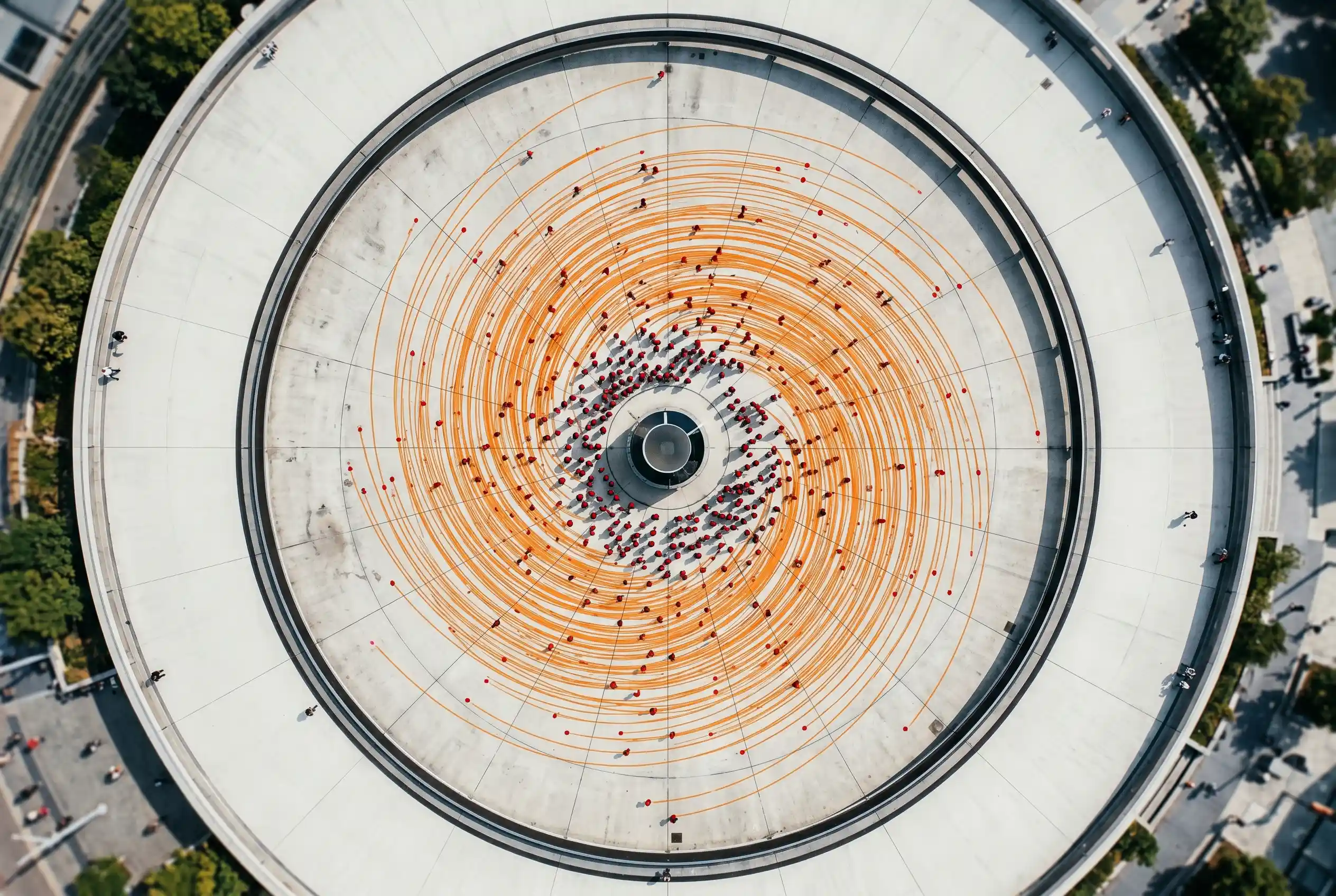
Five Experimental Campaigns Across Two Continents
The full study pulled together five experimental campaigns in Spain and Japan, run in both enclosed arenas and open spaces, and is now available as the full paper on the counterclockwise bias. In the Spanish circular-arena tests, groups of 16, 24, or 32 people were asked to roam freely for three 40-second intervals inside a 5-metre radius enclosure. In every configuration tested, the time-averaged rotation of the crowd, a measure the team calls polarization, came in positive, which by their convention means counterclockwise. The pattern held even when the researchers loaded a group with right-turners or with left-handers, two groups that should have pushed the average the other way.
The team also tested people one at a time. In one experiment, 209 people walked alone inside a hexagonal enclosure built out of chairs and tables, removing any chance of their being nudged by a crowd. The individual walkers drifted counterclockwise too, with the effect modest but statistically significant. An open-space test in a Spanish schoolyard, plus a parallel set in Japan that included free play at a Japanese nursery, ruled out a role for the arena walls.
Japan gave the team a second, more pointed test. In Spain, pedestrians who pass each other in a corridor tend to sort themselves into lanes on the right. In Japan, they tend to sort into lanes on the left, a real, observable difference in collective motion. The counterclockwise walking bias showed up in both countries, even though the lane-formation behaviour ran in opposite directions. That detail matters: a left-side social norm cannot be what is producing a left-turning crowd in a country where the prevailing norm is the other way.
- 5-metre radius circular arena for the Spanish group tests
- 3 group sizes tested: 16, 24, and 32 walkers
- 209 individuals walked alone inside a hexagonal enclosure
- Open-space tests in a Spanish schoolyard
- Parallel tests in Japan, including a nursery free-play session
What the Researchers Ruled Out
The list of factors the team tested and discarded is long. Handedness, footedness, and sex all failed to move the needle. So did which side of a corridor a person was used to walking on, since the bias appeared with equal strength in Spain and Japan, where that social default is reversed. In one direct test, the researchers patched either the left or the right eye of participants to see whether a visual asymmetry could be driving the turns; the counterclockwise bias stayed. In a separate test, they confined groups that were made up entirely of left-handed and left-footed pedestrians; the bias still appeared, with the time-averaged polarization coming in close to the value seen in mixed groups.
Large-scale physical explanations got ruled out too. “It likely does not come from the eyes,” Feliciani said, referring to the eye-patching test. He added that “some people asked us if it might be large-scale phenomena like the Coriolis force or Earth’s magnetic field, but this seems unlikely given what we have managed to point to so far.” Open-space tests in schoolyards and nurseries, where boundary effects could be reduced, ruled out walls and crowd pressure as drivers.
Younger People Lean Hardest to the Left
Of everything the team tested, only one factor shifted the strength of the effect: age. Younger people in the study showed a stronger counterclockwise preference than older participants did. The difference was small but real, and it cut across both countries.
The study did not include anyone older than their mid-30s, so the team cannot yet say whether the bias fades further with age, plateaus, or disappears entirely. Feliciani’s read is that the trend is a genuine hint. “Of all these things, the only thing that stood out was that kids tend to have a stronger bias for the counterclockwise direction,” he said, “so probably age plays a role in making the effect weaker or stronger.” That makes the next round of experiments, with older adults and with people whose mobility differs from the young and able-bodied participants tested so far, a high priority.
The fact that the bias intensifies in children, and persists in adults, is one reason the researchers suspect a biological rather than a learned cause. “Our results may appear as a minor insignificant discovery,” he said, “but in nature, most phenomena related to locomotion show that animals mostly walk without directional preference.” The counterclockwise bias in people, he added, “hints to some asymmetry at the biomechanical level.”
The biomechanical framing is a constraint, not an answer. The team has ruled out a long list of plausible individual asymmetries, but they have not yet located the actual cause. The data they have collected so far, including the eye-patching test and the individual-walker tests, point inward, toward something about how the human body is wired, rather than outward, toward social convention or environmental geometry. The team plans more detailed single-walker experiments to try to narrow it down, with virtual-reality tests on the list as a way to control sensory input more precisely. The hunt for the mechanism is open.
Where Architects and Planners Should Be Watching
The bias is more than a curiosity. The authors of the study say it has “potential implications for urban planning and crowd management,” and they single out the public spaces where the pattern could matter most:
- Airport terminals and concourses
- Museums and exhibition halls
- Train and metro stations
- Shopping centres and malls
- Stadium forecourts and arenas
- Emergency evacuation routes generally
Emergency egress is the most consequential application. If most people are going to curve left at a doorway or around a column, evacuation-route design that already accounts for that bias could shorten exit times in a fire, a stampede, or a structural failure. The effect is subtle, but in a crowd of thousands, subtle asymmetries decide which side of a corridor jams up first.
That is the tension the paper leaves on the table. Feliciani has been careful to call the finding modest because animal locomotion in general does not lean one way or the other. Modest findings with strong cross-cultural replication and clear downstream uses are not the same thing as small findings, however, and the practical stakes are not abstract. Architects, transit planners, and stadium designers are the practitioners whose work the bias is most likely to feed into, and they are the ones with the most practical use for a finding the paper’s own authors call modest.
An Open Question About the Cause
The cause of the counterclockwise bias is the headline question the paper cannot answer. The team has cleared the obvious candidates, including handedness, sex, cultural norms, eye dominance, and large-scale geophysical forces, but the actual mechanism is still missing. The paper frames this as an invitation to keep digging rather than a puzzle solved.
Several lines of further work are on the table. The team wants to extend the age range past the mid-30s and to test people with mobility differences, two populations the current data does not cover. Virtual-reality experiments are planned, with the goal of stripping out real-world sensory cues one at a time to see which ones the bias depends on. Feliciani has also flagged a separate, longer-running mystery: some running and motorsport courses are run counterclockwise for no clear reason, and whether the same biomechanical asymmetry might explain that as well is, in his words, “an investigation for another time.” A few prior studies have found a counterclockwise pattern in ants exploring unknown nests, suggesting the phenomenon, if real, may not be uniquely human.
Frequently Asked Questions
Why do most people turn counterclockwise when walking?
Researchers have not pinned it down. The new Nature Communications study, by Echeverría-Huarte, Feliciani, and colleagues, found the bias across its original Spanish data and in independent experiments in Japan, and tested it against handedness, footedness, sex, cultural background, and even eye-patching. Every one of those factors left the counterclockwise pattern intact. Whatever is producing it, the authors say, appears to be biological, possibly a biomechanical asymmetry in how the body moves.
Is the counterclockwise walking bias the same in every country tested?
Yes, in the two countries tested so far. The counterclockwise drift appeared in Spain, where opposite-direction walkers drift to the right side of a corridor, and in Japan, where they drift to the left. The fact that the same left-turning crowd pattern showed up in a country with the opposite lane-formation default is part of what rules out a social-norm explanation.
What factors don’t affect the bias?
Handedness, footedness, sex, and cultural background all failed to shift it. The team also tested eye dominance directly by covering one eye at a time; the left-turning pattern did not budge. They ran separate sessions with walkers who were all left-handed and left-footed; the rotation still went counterclockwise.
How could this affect the design of public spaces?
The authors describe the bias as relevant to pedestrian design and crowd management, since most people curve left at a doorway or around a column. They point to airports, museums, train stations, shopping centres, and stadium forecourts as places where a left-turning majority could subtly shape how crowds move. Emergency evacuation routes are the highest-stakes application: a small directional bias can decide which side of a corridor jams up first, and knowing the crowd leans one way lets engineers design around it.
What are the next steps in the research?
More detailed individual-walker experiments, with virtual-reality setups that can hold visual and auditory cues steady while turning one variable at a time. The team also wants to extend the age range past the mid-30s ceiling of the current study, test people with mobility differences, and look for similar biases in other animals. A few prior studies have found a counterclockwise pattern in ants exploring unknown nests, and Feliciani has flagged the long-standing counterclockwise direction of some running and motorsport courses as a possible future line of inquiry.






Stripe Bid Shows PayPal Moat Cracked After Years of Slide

FDA Class I Tag Hits Finished Egg Recall Weeks Later

Berkshire’s Alphabet Surge Marks Abel’s Cash Deployment Shift

Aston Martin Bets 150 Valen V12s Will Print the Cash

Walmart Took Most of the Recalled Lettuce Behind Cyclospora Wave

Silver Lake Workday Talks Signal Private Floor for Software

Zuckerberg’s AI Letter Joins a Wave of Tech Manifestos

Pixel 11 Takes Battery Edge as Galaxy S26 Keeps the Power Lead

Trump Economy Faces Reckoning as Sentiment and Sales Slide

Apple’s 15% External Cut Still Faces Its Own Zero Admission

ZA/UM Lays Off 32 Staff as Zero Parades Wins Reviews, Not Players

EA’s New In-Game Ad Platform Skips the Games That Need It Most

Mortgage Rates Climb to 6.55%, the Highest Level in Nearly a Year

Colby Covington Stuns Tsarukyan as Askren Retires in Tears at RAF 11

Spain’s Diaspora-Rooted Squad Wins Over New York Ahead of the Final

NHL’s Monday Matinee Push Puts Capitals Fans on the Clock

DeChambeau’s Two-Shot Penalty Rewrites the Open’s Weekend Draw

Guardians Rout Twins With Seven Homers, Leave Joe Ryan One Shy of Record

England Beats France 6-4 to Claim World Cup Bronze Medal

Rainout Gives Red Sox Two Shots at a Franchise-Record Win Streak
-

 TECHNOLOGY3 years ago
How to Adjust a Bulova Watch Band – An Easy Guide
-

 News3 years ago
Fred Pentland: Athletic Bilbao’s English mentor who changed the essence of Spanish football
-

 FINANCE3 years ago
Tax Planning for Every Season: Guide to Maximizing Your Tax Benefits
-

 Education3 years ago
African Ministers New Education Plan
-

 BUSINESS3 years ago
What is Entrepreneurial Operating System? A Comprehensive Guide to EOS
-

 Education3 years ago
Innovate Your Learning Journey with Technology and Enhance Education
-

 News3 years ago
Russians formally out of World Athletics Championships
-

 BUSINESS3 years ago
Top 9 Most Expensive American Cities to Rent an Apartment