
FINANCE
Chip Stocks Trim Losses as Kimi K3 Revives DeepSeek-Style Fears
Chip stocks clawed back Friday losses after a brutal 9% weekly drop, as Moonshot’s giant new open-source model revives memories of DeepSeek’s 2025 shock.

Semiconductor stocks trimmed some of a brutal week’s losses on Friday as dip buyers stepped in, even though the PHLX Semiconductor Index fell more than 9% for the week. Nvidia dropped 2%; Marvell and Qualcomm finished in the green. Chipmakers have shed $3.3 trillion in combined value since the sector’s June 22 peak.
The bounce followed Thursday’s release of Kimi K3, a Chinese open-source AI model that Beijing-based Moonshot AI calls the largest ever built. It is reviving memories of DeepSeek’s shock to this same trade eighteen months ago, arriving just as Wall Street was already second-guessing the industry’s spending.
Nvidia and AMD Claw Back Friday’s Ground
Applied Materials fell more than 5% and Lam Research dropped over 2%, the steepest declines among chip-equipment makers. Micron Technology and Sandisk, two of this year’s best-performing chip stocks, flipped between gains and losses for most of the session before settling mixed.
| Company | Friday’s Move | Context |
|---|---|---|
| Nvidia (NVDA) | Down 2% | AI chip bellwether |
| AMD, Broadcom (AVGO), Intel (INTC) | Closed lower | Well off session lows |
| Marvell (MRVL), Qualcomm (QCOM) | Closed higher | Finished above the flatline |
| Micron (MU), Sandisk (SNDK) | Mixed | Flipped between gains and losses |
| Applied Materials (AMAT) | Down more than 5% | Chip-equipment maker |
| Lam Research (LRCX) | Down more than 2% | Chip-equipment maker |
Every one of Friday’s numbers came off a lower base than the morning. Session lows earlier in the day were considerably worse across the board, and the late buying was not enough to turn the week positive.
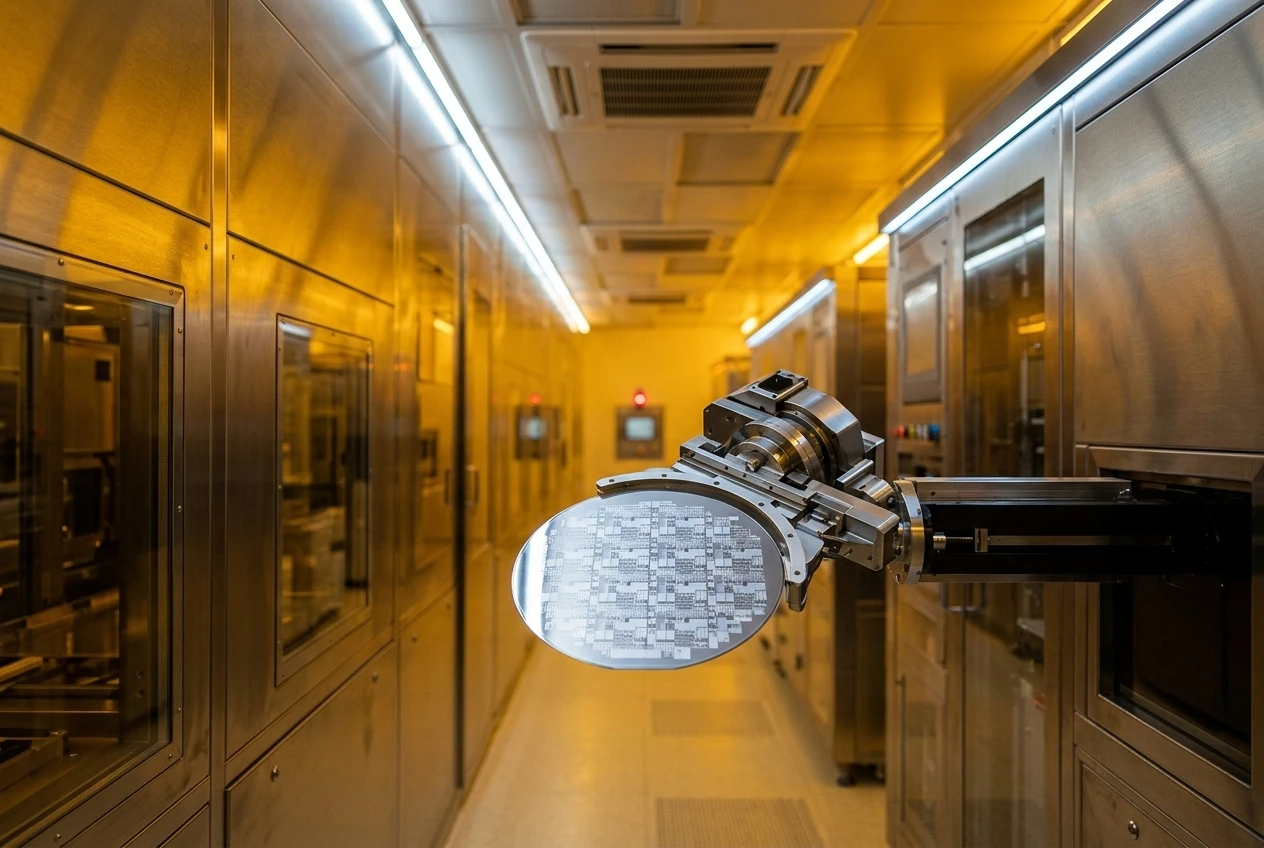
A Six-Week Rout Erases $3.3 Trillion
A week earlier, Yahoo Finance’s own tracking of a nearly 60-stock semiconductor basket put the toll since June 22 at $2.1 trillion, with the median stock down 21%. By Friday, the global count had grown to $3.3 trillion, a sign the bleeding had slowed but not stopped.
Chart watchers have pegged roughly 11,950 on the index and about 535 on the iShares Semiconductor ETF as the levels bulls need to hold on a closing basis. Break below those lines and the index could slide toward 11,000; hold them and the bounce could extend toward 13,000, with 14,000 the bigger wall above that. The Roundhill Memory ETF, which tracks DRAM chipmakers, has already fallen into its own bear market.
The reversal is a sharp turn from just weeks earlier, when ASML’s upbeat forecast for AI chip demand had helped power the rally that is now unwinding.
TSMC’s Bigger Spending Plan Spooks Its Own Investors
Taiwan Semiconductor Manufacturing Company, the world’s largest contract chipmaker, delivered part of the answer on Thursday. It posted second-quarter net income of NT$706.56 billion, roughly $21.8 billion, up 77.4% from a year earlier, on revenue of $40.2 billion, up 36%.
Then came the figure that mattered most for Friday’s mood: TSMC raised its 2026 capital-spending forecast to a range of $60 billion to $64 billion, up from $52 billion to $56 billion, an increase of roughly 15% at the top end and another record for the company. Chief Financial Officer Wendell Huang said 70% to 80% of that budget will go toward advanced process technology, with the rest split between specialty processes and packaging.
Chief Executive C.C. Wei also added to TSMC’s total committed spending in Arizona, pushing it to $265 billion. Yet TSMC’s own stock fell in premarket trading Thursday despite beating estimates on every line, as investors weighed rising equipment costs against the promise of future growth. It was a preview of Friday: even the sector’s strongest company could not escape doubts about whether all this spending will pay off.
Why Do Hyperscalers Need to Keep Spending?
Because nearly all chip demand now traces back to a handful of technology giants building AI data centers, and any hint those companies might slow down ripples through chip stocks within hours. Wall Street has said for months that hyperscaler capital budgets, not chip company earnings alone, will decide whether this rally holds. Goldman Sachs projects cumulative AI capital spending will reach $7.6 trillion through 2031, a number that only works if the underlying returns show up in hyperscaler results.
What we definitely need to see continue, though, is hyperscalers’ capex. Their earnings need to be strong.
Seema Shah, chief global strategist at Principal Asset Management, made that case to Yahoo Finance earlier this week. “They are really the foundation for the entire AI ecosystem,” she added.
Moonshot’s Kimi K3 Claims the World’s Biggest Open Model
Moonshot AI, a Beijing-based startup backed by Alibaba, unveiled Kimi K3 on Thursday, calling it the largest open-source AI model ever released at 2.8 trillion parameters, roughly 75% bigger than DeepSeek’s V4 Pro. The release landed just before the World Artificial Intelligence Conference opened in Shanghai, where Moonshot showed the model off at its exhibition stand.
K3 features a native one-million-token context window and an always-on reasoning mode, and it works with the OpenAI SDK, making it simple for developers already building on rival platforms to switch over. It is live now through Moonshot’s hosted service and API. The open weights that would let developers download and run the model themselves are not due until July 27.
The launch marks a turnaround for Moonshot, whose market position had slipped over the past eighteen months as DeepSeek’s own models drew the spotlight. On benchmarks the company published, K3 trails only Anthropic’s Claude Fable 5 Max and OpenAI’s GPT-5.6 Sol Max, and it beats Anthropic’s Claude Opus 4.8.
Beijing Has Spooked This Market Before
This is not the first time a Chinese open-source model has rattled this exact trade. On January 27, 2025, DeepSeek’s R1 model triggered the biggest one-day market-cap loss in US history, wiping nearly $600 billion off Nvidia in a single session and dragging Broadcom down 17% alongside it.
The two episodes share a root cause and differ in the details.
- Cost versus scale: DeepSeek’s shock came from a claimed $5.6 million training bill; Kimi K3 makes no such claim and instead leans on raw size, 2.8 trillion parameters against DeepSeek V4’s 1.6 trillion.
- Speed of impact: Nvidia lost 17% of its value in one trading session after DeepSeek’s release; this year’s decline built up gradually across six weeks instead of one afternoon.
- Who got hit: DeepSeek mainly punished Nvidia and Broadcom; this selloff has spread evenly across chipmakers, equipment suppliers and memory producers alike.
Fundamentals have mattered just as little this time around. Samsung’s record quarter that still triggered a selloff made the same point weeks earlier: operating profit jumped more than 1,800% from a year ago, and the stock fell anyway.
Anthropic’s Pullback and Google’s Delay Add New Static
Two other data points widened the unease this week. The United States withdrew Anthropic’s Fable and Mythos models over security concerns a month before Kimi K3 launched, according to Yahoo Finance. And on Thursday, Bloomberg reported that Alphabet was behind schedule delivering Gemini 3.5 Pro, its most powerful model.
Neither event moves chip demand by itself. Together with a bigger, faster Chinese open model, they read as evidence that the AI race is getting more crowded and less predictable, right as investors are asking whether the hardware spending behind it can still be justified.
Nvidia, AMD, Qualcomm and a run of hyperscalers report earnings over the next several weeks. TSMC already showed that beating Wall Street’s numbers is no longer enough by itself; investors want proof the capital spending is paying off, not just another promise that it eventually will.
Frequently Asked Questions
What Is the PHLX Semiconductor Index (SOX)?
The SOX is a modified market-capitalization-weighted index of companies that design, make or sell semiconductors. It launched in December 1993 at a base value of 200 and split two-for-one in July 1995. Options on the index have traded since September 1994, and it remains Wall Street’s main gauge of chip-sector health.
Is Moonshot AI a Publicly Traded Company?
No. Moonshot AI is a private, Beijing-based startup backed by Alibaba, Tencent, Meituan and HSG. It raised $2 billion in funding in May at a valuation above $20 billion, and its financial advisers say annual recurring revenue has already passed $200 million.
How Is Kimi K3 Priced Compared With Rival Models?
Kimi K3 uses flat, non-tiered billing and charges $15 per million output tokens. That is far above DeepSeek V4’s $0.87 and z.ai’s GLM-5.2 at $4.40, but still well under Anthropic’s Fable, which charges $50 for the same amount of output.
Did Nvidia Recover From the 2025 DeepSeek Selloff?
Partially, and quickly. After losing $589 billion in market value on January 27, 2025, Nvidia rebounded by roughly $260 billion the very next trading day, then dropped another $130 billion on January 29 as the whipsaw continued through the week.
Disclaimer: This article is for informational purposes only and is not investment advice. Semiconductor and AI stocks remain highly volatile, and all figures reflect reporting available as of publication.


NFL Three-Strike Safety Fouls Now Pull Coaches and Clubs In

Browns Fans Tape Protest Signs to Jim Brown Statue Over Watson

Amazon Pixel 11 Deal Erases the $100 Hike for One More Day

Elden Ring on Switch 2 Turns Its Own Worst Label Into a Portable Win

Ternus Takes the Stage With Apple’s Foldable Debut

Ikea Xbox Yxstaby Turns Controller Thumbstick Into Home Furniture

Pokémon Center Turns Past Worlds Wins Into Bundles and a Pikachu Coin

NFL Scraps Pro Bowl Game to Restore Pure Player Honor

New Twitter.now Bets the Brand Musk Left Behind

Bella Mir’s Famous First Loss Meets the Accountant Who Won

Curtis Mead’s Red Sox Debut Ends With Fractured Wrist

Moesch and Dressel Rewrite Night One at 2026 U.S. Nationals

Red Sox Squander Hot Streak Chance in 4-3 Loss to Athletics

Boutte’s Quiet Camp Takeover Forces Patriots Receiver Choices

Take-Two CEO Pushes Netflix Subs for GTA 6 Extended Look

Halo Campaign Evolved Skulls Meet Death Barriers That Kill the Hunt

Wildlands Free Update Hands Players the Tools They Already Invented

Quake Gets 19 Free Maps From MachineGames Quake Club

Destiny 2 Fans Unlock Vaulted Maps After Live Service Ends

Quordle Monday Delivers Gavel Crush Speed Ethos Cleanly
-

 TECHNOLOGY3 years ago
How to Adjust a Bulova Watch Band – An Easy Guide
-

 News3 years ago
Fred Pentland: Athletic Bilbao’s English mentor who changed the essence of Spanish football
-

 FINANCE3 years ago
Tax Planning for Every Season: Guide to Maximizing Your Tax Benefits
-

 Education3 years ago
African Ministers New Education Plan
-

 BUSINESS3 years ago
What is Entrepreneurial Operating System? A Comprehensive Guide to EOS
-

 Education3 years ago
Innovate Your Learning Journey with Technology and Enhance Education
-

 News3 years ago
Russians formally out of World Athletics Championships
-

 BUSINESS3 years ago
Top 9 Most Expensive American Cities to Rent an Apartment