
FINANCE
ECB’s September Rate Hike Bet Comes With a Growth Cost
The ECB held rates at 2.25%, but futures now price a 93% chance of a September hike landing on a eurozone economy already downgraded to 0.8% growth.

The European Central Bank left its deposit rate untouched at 2.25% on Thursday, a decision so widely expected that more than 99% of traders had already priced it in before Christine Lagarde walked to the podium. The real number came from what happens next. Futures markets now put a 93% probability on a quarter-point hike to 2.50% at the ECB’s September 10 meeting, a bet built entirely on a Middle East oil shock the central bank cannot fix at the source.
Lagarde, the ECB’s president, spent Thursday’s press conference explaining why she is willing to let that bet stand. The eurozone’s own growth forecast, cut earlier this summer, and Italy’s climbing borrowing costs suggest the bet already has a price tag, even before the Governing Council raises anything.
A Hold That Traders Had Already Priced In
Money markets treated Thursday’s decision as background noise. Analysts had been calling it a foregone conclusion for days, describing it as a hawkish-leaning hold: stand still in July, leave the door open for September.
That September move is no longer speculative chatter. Futures tracked by the market pricing tool showing 93% odds of a hike point to a quarter-point increase lifting the deposit rate to 2.50% at the next meeting, with further decisions scheduled for October 29 and December 17.
“Inflation expectations remain elevated and if sustained further, even tighter policy may well be needed,” said Ed Hutchings, head of developed market rates at Aviva Investors.
Richard Carter, head of fixed interest research at Quilter Cheviot, framed the hold as a pause rather than a pivot. “Despite its ability to hold rates today, the market still expects the ECB to be in a rate raising mood for the rest of the year,” he said.
| ECB Policy Rate | Held Through Early 2026 | Since June 11, 2026 |
|---|---|---|
| Deposit Facility | 2.00% | 2.25% |
| Main Refinancing Operations | 2.15% | 2.40% |
| Marginal Lending Facility | 2.40% | 2.65% |
The ECB left its three key rates unchanged at 2.25%, 2.40% and 2.65% on Thursday, holding the line it had drawn a month earlier.
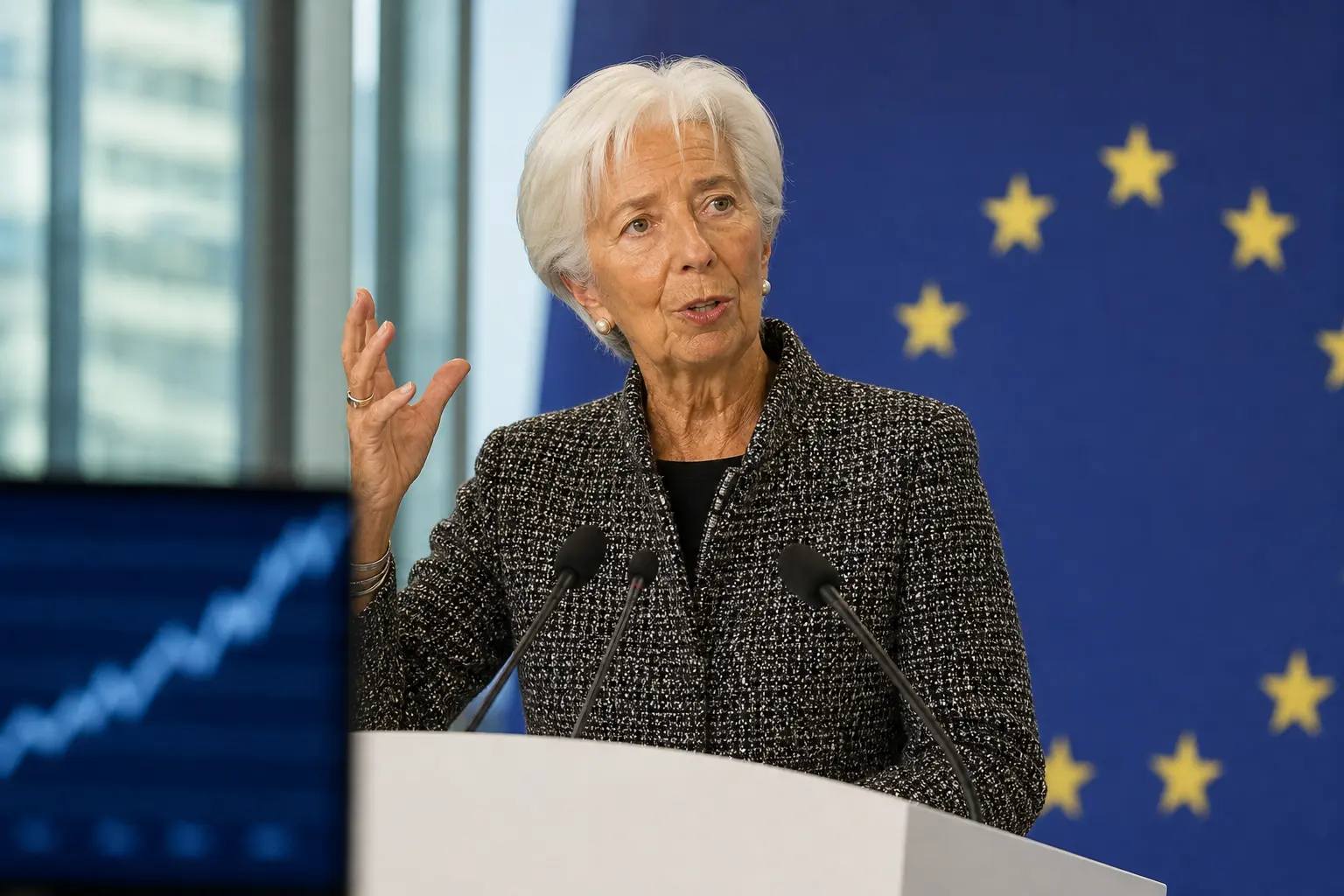
Lagarde Points the Blame at the Middle East
Renewed fighting tied to the Iran war has pushed oil prices higher again, and Lagarde said that risk now dominates the inflation outlook. “Renewed disruption of energy supplies could increase energy prices further and for longer than expected,” she told reporters.
She went further on the transmission mechanism. “The longer energy prices stay high, the more likely they are to drive up broader inflation through indirect and second-round effects,” Lagarde said, adding that she expects inflation to stay “well above target” until the first half of 2027.
The numbers back up her caution, even if they point in two different directions at once. Eurozone inflation eased to 2.8% last month from 3.2% in May, a genuine cooling. Yet the ECB’s own staff projections, updated at the June meeting that delivered the bank’s first rate rise since 2023, put the full-year 2026 average at 3.0%, revised up from an earlier estimate near 2.6%. Core inflation, stripped of energy and food, was also lifted to 2.5% for both 2026 and 2027.
The Growth Bill Behind the Inflation Fight
Raising rates does not lower the price of a barrel of oil. It raises the cost of every mortgage, business loan and government bond in the currency bloc instead, and the ECB’s own staff already expect that to show up in growth.
At the same June meeting that produced the rate hike, the ECB trimmed its 2026 eurozone growth forecast to 0.8% from 0.9%, and its 2027 forecast to 1.2% from 1.3%. Staff attributed the downgrade to the war’s toll on commodity markets, real incomes and confidence.
It still remains to be seen whether a more restrictive monetary policy can truly help curb inflationary pressures without further hurting an economy that is already showing signs of weakness.
Roger Rüegg, head of multi-asset solutions at Swisscanto, the asset management arm of Swiss bank ZKB, made that argument the same day the ECB delivered its June hike, and it has only gotten more relevant since.
- 0.8% eurozone growth forecast for 2026, cut from 0.9% at the ECB’s prior projection round.
- 2.8% annual inflation reading last month, down from 3.2% in May but still above target.
- 93% probability futures markets assign to a quarter-point hike at the September 10 meeting.
- 4.68% yield on Italy’s 30-year government bond as of mid-July, its highest level in over a year.
Kevin Thozet, a member of the investment committee at French asset manager Carmignac, said in June that his firm’s baseline already assumed two additional hikes before summer’s end. Markets have since caught up to that view.
Rome Pays More for Debt It Already Fixed
Italy offers the clearest look at who absorbs the cost of a rate hike aimed at a war overseas. The country’s fiscal story has genuinely improved. Its 10-year risk premium over Germany, the BTP-Bund spread that traders watch as a gauge of confidence in Rome’s finances, narrowed from 251 to 59 basis points between September 2022 and January 2026, according to Italy’s Ministry of Economy and Finance. Credit rating upgrades from Moody’s and Fitch followed.
That has not stopped Italy’s absolute borrowing costs from climbing. The 10-year BTP yield spiked to 4.1% in March, its highest since November 2023, as the Iran war and ECB hike bets moved together. By mid-July, the 30-year yield held at 4.68%, up roughly a fifth of a point over the past month alone.
This is not the fragmentation panic that gripped the eurozone in 2022, when Italy’s spread over Germany was the story. It is a simpler mechanic: when the ECB moves its floor, the entire curve moves with it, regardless of how much a government has cleaned up its own books. The same dynamic that forced the ECB’s first rate rise since the 2023 tightening cycle ended is now the one raising Rome’s interest bill.
Oil’s Year of Whiplash
The case for a September hike rests on the assumption that energy prices stay elevated. That assumption has already reversed itself several times in 2026.
- April 6, 2026: Brent crude surges past $109 a barrel, its highest in nearly four years, as the Strait of Hormuz effectively closes and Saudi Arabia’s flagship crude hits a record premium.
- April 8, 2026: Washington and Tehran agree to a conditional two-week ceasefire, and Brent craters more than 15% in a single session.
- June 17, 2026: The US and Iran sign a 60-day ceasefire framework and agree to reopen the Strait of Hormuz, sending Brent sliding toward $70.
- Early July 2026: ECB policymakers strike a dovish tone at the Sintra forum, signaling no urgency for further tightening.
- July 8, 2026: Renewed US strikes on Iran send Brent back above $76, erasing the ceasefire dividend within weeks.
- July 23, 2026: The ECB holds rates again, and Lagarde flags fresh energy risk as traders lock in September hike bets.
Stocks had rallied earlier this year on hopes that the conflict was cooling, in the same run that followed President Trump’s decision to cancel planned Iran strikes, even though no lasting deal was ever signed. Prediction markets have moved just as fast in the other direction, with traders pricing gas above $4 a gallon once strikes resumed. Whatever the ECB assumes about energy in September has a short shelf life.
Why September Is Not Yet Locked In
The Governing Council has been careful not to promise anything. Its July statement repeated that policy remains data-dependent and meeting-by-meeting, and officials have explicitly said they are not pre-committing to a rate path in either direction.
That caution matters given how fast the Sintra tone flipped. Policymakers signaled less urgency for tightening in early July, only to watch renewed strikes on Iran push market pricing for a September hike from around 70% to 93% within about two weeks. A ceasefire holding through August could just as easily flip it back.
The Governing Council meets next on September 10. Markets already expect it to move.
Frequently Asked Questions
What Are the ECB’s Three Key Interest Rates?
The ECB steers policy through three separate rates: the deposit facility, which pays banks for overnight deposits and currently sits at 2.25%; the main refinancing rate, at 2.40%, which banks pay to borrow weekly against collateral; and the marginal lending facility, at 2.65%, an overnight backstop rate for banks needing emergency credit.
When Is the ECB’s Next Rate Decision?
The Governing Council meets next on September 10, 2026, followed by meetings on October 29 and December 17. Futures markets currently assign a 93% probability to a quarter-point hike at the September meeting.
How Does an ECB Rate Hike Reach Household Mortgages?
Banks across the eurozone price variable-rate loans and mortgages off benchmarks that move with ECB policy, most directly the Euribor. Countries where variable-rate mortgages are common, including Spain and Portugal, tend to see loan payments adjust within months of a Governing Council decision.
Could the ECB Skip the September Hike Entirely?
Yes. The Governing Council has repeatedly said it is not pre-committing to any rate path, and its own policymakers struck a dovish tone at the Sintra forum just weeks before oil prices reversed again. A sustained ceasefire in the Iran war could remove the case for a hike as quickly as renewed strikes built it.


Walmart’s $50 Million Opioid Settlement Closes Case Without Admission

California Sues Over $120 Million Morro Bay Wind Lease Buyout

Gilead Bixlenvo FDA Nod Opens Single Pill Path for Complex HIV Cases

Meta’s $18B Kids Deal Forever Shields Data Used to Spot Under-13s

Lettuce Outbreak Drove Record Cyclospora Spike Across 20 States

Amazon Shaves $20 Off M6 Mac Mini Before It Even Ships

SpaceX Louisiana Port Tests Debt Markets on Orbital AI Scale

Microsoft High Lifts Indexes as Small Caps Crack Support

Apple Replays 2015 Saturday Midnight Preorder for iPhone 18 Pro

Updated COVID Shots Clear FDA but Access Friction Hits High-Risk Groups

Take-Two CEO Pushes Netflix Subs for GTA 6 Extended Look

Wildlands Free Update Hands Players the Tools They Already Invented

Destiny 2 Fans Unlock Vaulted Maps After Live Service Ends

Quake Gets 19 Free Maps From MachineGames Quake Club

Quordle Monday Delivers Gavel Crush Speed Ethos Cleanly

Stripe Bid Shows PayPal Moat Cracked After Years of Slide

Tyson’s Five-Year Utah Plant Falls to Cattle Shortage Reckoning

Silver Lake Workday Talks Signal Private Floor for Software

Kennedy Lewis Takes Majority Control of The Greenbrier in $500M Deal

Best Buy Marks 60 Years With Sale That Echoes Its Audio Shop Roots
-

 TECHNOLOGY3 years ago
How to Adjust a Bulova Watch Band – An Easy Guide
-

 News3 years ago
Fred Pentland: Athletic Bilbao’s English mentor who changed the essence of Spanish football
-

 FINANCE3 years ago
Tax Planning for Every Season: Guide to Maximizing Your Tax Benefits
-

 Education3 years ago
African Ministers New Education Plan
-

 BUSINESS3 years ago
What is Entrepreneurial Operating System? A Comprehensive Guide to EOS
-

 Education3 years ago
Innovate Your Learning Journey with Technology and Enhance Education
-

 News3 years ago
Russians formally out of World Athletics Championships
-

 BUSINESS3 years ago
Top 9 Most Expensive American Cities to Rent an Apartment