
BUSINESS
China Recapitalizes State Banks With Tobacco Cash and Bonds
Beijing is putting 360 billion yuan into eight state banks and insurers, with special treasury bonds and China National Tobacco writing the checks.

China’s finance ministry said on Sept. 7 it will soon sell 300 billion yuan in special treasury bonds to refill core capital at eight state financial firms.
A day earlier those firms set out plans worth 360 billion yuan (US$54 billion). The ministry covers 300 billion yuan of that total, and China National Tobacco plus its units put up 60 billion yuan to buy new shares in Agricultural Bank of China and Industrial and Commercial Bank of China, walking onto ICBC’s ordinary-share register for the first time.
The Ministry and the Tobacco Monopoly Write the Checks
Sunday’s notices look like a bank story because Agricultural Bank and ICBC take 260 billion yuan of the total. Read the payers, and it is a fiscal story. The ministry is funding 300 billion yuan with special treasury bonds. The tobacco group is putting 60 billion yuan of monopoly cash into the two listed banks. Together that is the full 360 billion yuan envelope.
The ministry said in a circular that the eight firms are operating steadily, with stable asset quality and major regulatory indicators still inside safe ranges, and that the top-up will follow market and legal rules. Shen Meng, an investment banker at Chanson & Co, has called capital injections into financial firms part of the fiscal toolkit Beijing has been using as growth stays soft.
WHERE THE 360 BILLION YUAN GOES
| Firm | Amount (billion yuan) | How it is paid | Who pays |
|---|---|---|---|
| Agricultural Bank of China | Up to 160 | Private A-share issue | Ministry 130, tobacco units 30 |
| Industrial and Commercial Bank of China | Up to 100 | Private A-share issue | Ministry 70, tobacco units 30 |
| Export-Import Bank of China | 30 | Direct injection | Ministry |
| China Life Insurance Group | 35 | Direct injection | Ministry |
| People’s Insurance Company of China | Up to 15 | Private A-share issue | Ministry |
| China Export & Credit Insurance Corp | 10 | Direct injection | Ministry |
| China Taiping Insurance Group | 7 | Direct injection | Ministry |
| China Reinsurance Group | 3 | Domestic-share cash buy | Ministry |
The two commercial banks, plus PICC’s share sale, account for 275 billion yuan that would land as new A-shares. The other 85 billion yuan is group-level cash into China Life, Taiping, China Re, Eximbank and the export credit insurer. Dong Shaopeng, a senior research fellow at the Chongyang Institute for Financial Studies at Renmin University of China, said 360 billion yuan is not a particularly large sum and reads as a routine expansion of capital from existing state owners.
Why Agricultural Bank and ICBC Need Core Capital
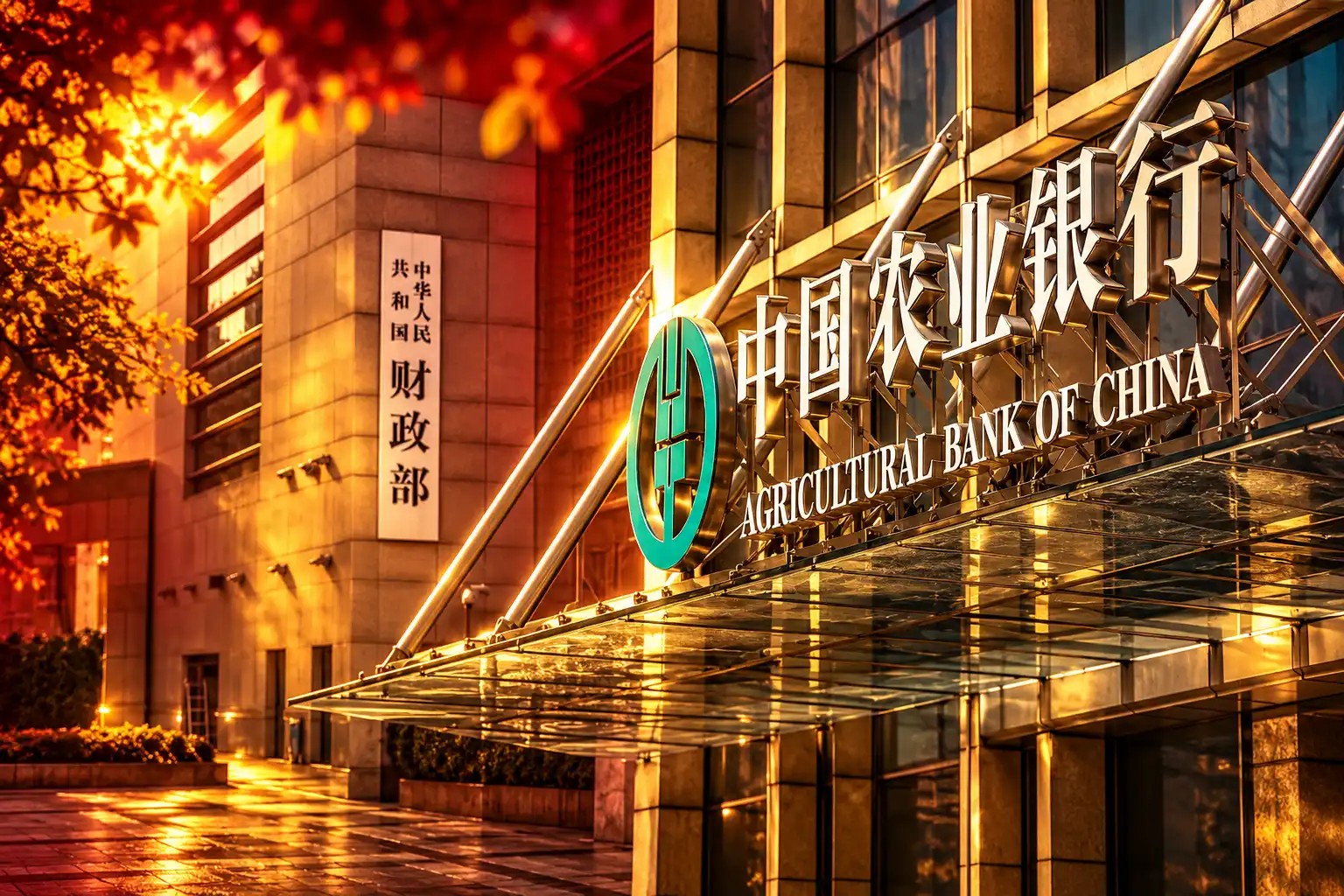
Both banks will use every yuan after fees to refill core Tier 1 capital, the loss-absorbing equity that sets how much they can lend without breaching ratios. Agricultural Bank’s filing says the extra equity is meant to serve rural clients and the real economy, to thicken the buffer against shocks, and to stay ahead of global and domestic systemically important bank rules, including total loss-absorbing capacity. The bank also flagged pressure from a possible move up a global systemic bucket.
The banks are not below the line. First-quarter reports for 2026 showed core Tier 1 ratios of 13.26% at ICBC, 14.26% at China Construction Bank, 10.8% at Agricultural Bank, 12.18% at Bank of China, 11.25% at Bank of Communications and 10.18% at Postal Savings Bank of China. ICBC and Agricultural Bank were the two that fell, by 0.63 and 0.43 percentage points from the first quarter of 2025.
WHAT THE FILINGS SAY THE CAPITAL DOES
- Agricultural Bank: Core Tier 1 is expected to reach 11.41%, 0.61 percentage points above the end of the first half of 2026.
- ICBC: Core Tier 1 is expected to reach 13.54%, 0.33 percentage points above the same date, from a first-half starting point of 13.21%.
- CICC estimate: In May, China International Capital Corp said a 300 billion yuan injection could support about 4 trillion yuan of extra assets at the two banks.
- Lending math: Wang Qing, chief macroeconomic analyst at Orient Golden Credit Rating International, said 800 billion yuan of injections across both rounds could support 6 trillion to 7 trillion yuan of new loans, about 37% to 43% of 2025 new yuan lending.
Wang said net interest margins at the big state banks have narrowed fast since 2023 because of the property slump and rate cuts, which has weakened their ability to rebuild capital from profits. That is the quiet reason the state is writing equity checks while still describing the same firms as healthy. Zeng Gang, director of the Shanghai Institution for Finance and Development, said the aim is to enlarge long-term lending capacity through leverage, not to put out a fire already visible in published ratios.
Last Year’s 500 Billion Yuan Round Stopped at Four Banks
Sunday’s package is the second use of the same special-bond tool, and it is smaller than the first. On March 31, 2025, the ministry said it would issue 500 billion yuan of special treasury bonds to refill core Tier 1 at Bank of China, China Construction Bank, Bank of Communications and Postal Savings Bank of China. Those four lenders raised a combined 520 billion yuan, and their core Tier 1 ratios rose by 0.86, 0.48, 1.28 and 1.51 percentage points.
The 300 billion yuan envelope for this second round was already in the 2026 government work report, so Sunday was the allocation, not a surprise rescue. Bank shares had room to treat the cash as a known support and still flinch at the dilution from new A-shares sold only to the state and the tobacco group.
THE SPECIAL-BOND RECAP PATH
- 1998: The ministry issues 270 billion yuan of special treasury bonds to recapitalize the big four state banks.
- March 31, 2025: The ministry says it will sell 500 billion yuan of special treasury bonds for Bank of China, China Construction Bank, Bank of Communications and Postal Savings Bank of China.
- April 24, 2025: Beijing sells the first 165 billion yuan of five-year special bonds for that bank top-up, with a 1.45% coupon.
- March 2026: The government work report proposes 300 billion yuan of special treasury bonds for another round of core capital at major state lenders.
- Sept. 6, 2026: Eight central financial firms post plans totaling 360 billion yuan, pulling in insurers and two policy institutions.
- Sept. 7, 2026: The ministry says it will soon issue 300 billion yuan of special treasury bonds to fund its share of those plans.
The 1998 round came when bad loans were the public problem. This cycle is being sold as spare capacity. The circular on Sept. 7 said a thicker core Tier 1 buffer gives banks more room to expand lending while keeping ratios intact, which is a polite way of saying the state wants more credit from firms whose own profits no longer build that buffer at the old pace.
State Insurers Join the Recap for the First Time
Last year’s special bonds stopped at four commercial banks. This round adds China Life Group, PICC, China Taiping and China Re, plus the export credit insurer. The insurance book is 70 billion yuan, a fifth of the 360 billion yuan total, and it is the piece that was not in the 2025 design.
China Life Group, the country’s largest life insurer, will take 35 billion yuan from the ministry to strengthen operating resilience and risk-bearing capacity, and to support its core businesses and governance, the group said. China Taiping will take 7 billion yuan and said the cash would help keep solvency ratios stable. China Re will raise 3 billion yuan by selling domestic shares in cash to the ministry. PICC plans to sell up to 15 billion yuan of A-shares to the ministry alone, with net proceeds going into capital.
The capital replenishment will help PICC further strengthen its capital base, enhance operational resilience and ability to withstand risks, and better leverage the insurance sector’s role as an economic shock absorber and social stabilizer.
People’s Insurance Company (Group) of China, Sept. 6 statement
Life insurers have been earning less on their portfolios while guarantees on old policies still sit on the books, and smaller firms have already shown weaker solvency. Putting ministry cash into the four big groups gives those balance sheets more room to hold bonds, stocks and, if Beijing asks, weaker peers. The official language is resilience. The balance-sheet reading is that investment yield no longer funds the buffer on its own, just as net interest income no longer funds it at the two banks.
China National Tobacco Buys a Seat at ICBC
The ministry still writes most of the checks. The tobacco monopoly is the co-investor that changes the shareholder map. Agricultural Bank will take 30 billion yuan from China National Tobacco and five related names. ICBC will take another 30 billion yuan from the parent and four provincial units. None of that 60 billion yuan is coming from the special-bond sale; it is cash from the tobacco system, locked into bank equity.
ICBC’s board on Sept. 6 approved a strategic cooperation deal with tobacco units covering Shanghai Tobacco, Yunnan China Tobacco, Hunan China Tobacco and Hunan Tobacco, alongside the parent. Agricultural Bank signed a matching deal the same day. The tobacco names are labelled strategic investors. They are also the state’s most reliable cash machine, routing cigarette profits into the two lenders that Beijing still uses as the main pipes for cheap credit.
TOBACCO CASH IN THE TWO BANK DEALS
- China National Tobacco parent: 10 billion yuan in Agricultural Bank and 10 billion yuan in ICBC.
- Jiangsu, Zhejiang and Hubei tobacco: 5 billion yuan each into Agricultural Bank.
- Beijing tobacco and Shuangwei Investment: 3 billion yuan and 2 billion yuan into Agricultural Bank.
- Shanghai Tobacco, Yunnan China Tobacco, Hunan China Tobacco and Hunan Tobacco: 5 billion yuan each into ICBC.
This is not the group’s first bank holding. As of June 30, 2026, Industrial Bank’s register still showed China National Tobacco’s 5.25% Industrial Bank stake, with the Fujian provincial tobacco company holding another 2.71%. Agricultural Bank’s own filing points back to a 2018 private A-share issue, a earlier top-up that already ran through the same playbook. What is new is ICBC. The tobacco group does not currently hold ICBC ordinary shares, so the 30 billion yuan buy is an entry, not an add-on.
Eximbank will take 30 billion yuan of ministry cash to support policy lending and opening-up, and China Export & Credit Insurance Corp will take 10 billion yuan. Those two sit outside the listed-bank story, but they sit inside the same circular. Export credit and policy lending are being thickened in the same weekend as life-insurance solvency and big-bank CET1.
The New Shares Still Need Votes and Approvals
Agricultural Bank’s Hong Kong filing sets out a 160 billion yuan A-share plan sold to seven named buyers, with a face value of 1 yuan a share and a hard cap of 15% of the pre-issue share capital. The issue price is due to be set off the first day of the offering period, and it cannot sit below 80% of the 20-session average. The ministry already holds 123,515,185,240 Agricultural Bank shares, or 35.29%, and has promised not to sell the new stock for five years, a pledge that lets it skip a mandatory offer. The same filing says the issue still needs a shareholder vote, a nod from the National Financial Regulatory Administration, Shanghai Stock Exchange review, and registration with the China Securities Regulatory Commission.
WHAT WE KNOW
- The ceiling: Eight firms have posted plans that add up to 360 billion yuan, of which the ministry intends to fund 300 billion yuan with special treasury bonds.
- The use: Listed-bank proceeds after fees go entirely into core Tier 1 capital; insurer cash is described as capital, solvency and risk resilience.
- The lock: The ministry has pledged a five-year hold on the new Agricultural Bank shares it is buying.
WHAT IS UNCONFIRMED
- Final size: Each plan is an upper limit that can shrink once regulators approve a final scheme.
- The price: No issue price is set, because the benchmark is the first day of the offering window.
- The calendar: The ministry said it will soon sell the 300 billion yuan of bonds; it did not give an auction date in the Sept. 7 circular.
Until those votes and stamps arrive, the 360 billion yuan is an allocated ceiling, not cash sitting in core Tier 1. The ministry has already named the eight firms and the tool. The tobacco group has already signed the cooperation papers. What has not happened is the conversion of special bonds and cigarette profits into permanent equity that can support the next wave of loans, underwriting and, if the ratios slip again, another round of the same trade.
Disclaimer: This article is news reporting and analysis of announced capital plans at Chinese state banks and insurers, and it is for information only. It is not investment advice, a solicitation to buy or sell any share, bond or other security, and it is not a recommendation on bank or insurance stocks in Shanghai, Hong Kong or elsewhere. Readers who may act on capital-raising, dilution or bond-supply effects should consult a licensed financial adviser or securities professional who can assess their own position. The amounts, ratios and approval steps described here reflect company filings and ministry statements as published on Sept. 6 and Sept. 7, 2026, and final proceeds, pricing and timing can change once regulators rule.

Final Fantasy Resonance Turns a Dead Gacha Into HD-2D

PHP2Shell Forced Sites Offline While Exploits Stalled

Kindle+ Folds AI Audiobooks Into the Page-Read Fund

Chip Stocks Fall as the Bond Rally Cheapens AI Spend

Comcast’s Record Odyssey Quarter Doubles as the Exit

Microsoft 365 Auth Fault Took Down Exchange and Teams

Xbox Caps Game Pass Cloud Gaming at 15 Hours

OpenClaw 2.0 Ships a Team Workplace With Host-Trust Defaults

OpenAI Unveils GPT-6 Astra With a Critical Cyber Label

Diesel Breaks Its Record as the White House Claims Credit
-
 NEWS2 months ago
Microsoft 365 Auth Fault Took Down Exchange and Teams
-
 GAMING2 months ago
Xbox Caps Game Pass Cloud Gaming at 15 Hours
-
 NEWS2 months ago
OpenAI Unveils GPT-6 Astra With a Critical Cyber Label
-
 NEWS2 months ago
OpenClaw 2.0 Ships a Team Workplace With Host-Trust Defaults
-
 BUSINESS2 months ago
Diesel Breaks Its Record as the White House Claims Credit
-

 LIFESTYLE2 months ago
Squishy Dumpling Toys Recalled After Hiding Illegal Water Beads
-
 BUSINESS2 months ago
ChargePoint Stock Rally Prices Wilmer’s Three-Year Cash Plan
-

 AUTO2 months ago
Tesla Puts Its Wheel-Free Cybercab on Austin Streets