
BUSINESS
ChargePoint Stock Rally Prices Wilmer’s Three-Year Cash Plan
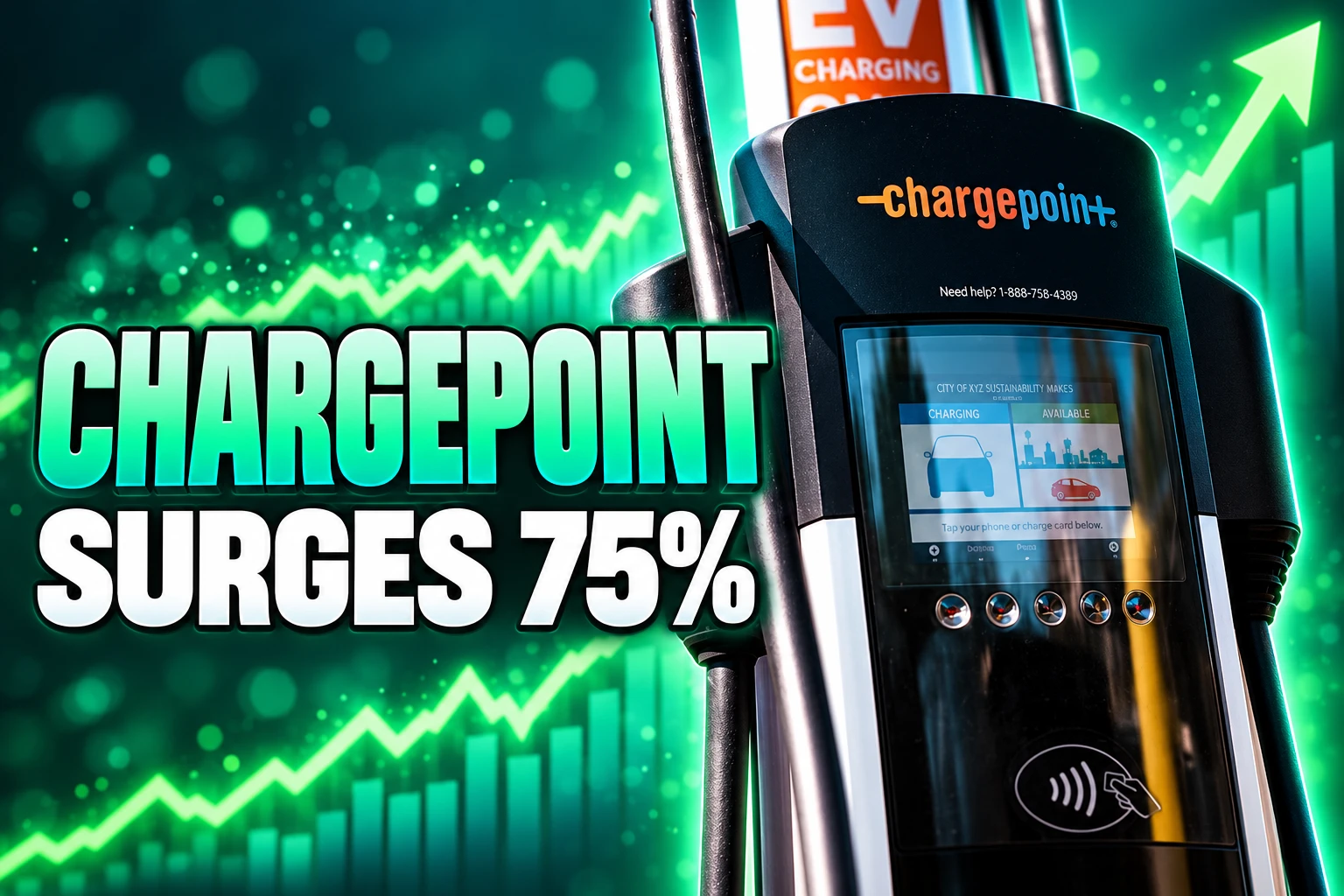
ChargePoint stock jumped 74.95% after a guidance beat, as CEO Rick Wilmer’s three-year push to cut cash burn finally got a market price.

ChargePoint stock closed at $9.08 on Thursday, a 74.95% jump after the charging company beat its own guidance. CEO Rick Wilmer called the move “the beginning of the momentum,” and said growth is starting to accelerate on new products and technology.
Wilmer has spent almost three years cutting ChargePoint’s losses and cash use. Thursday priced that bet, even as the firm guided to slower sequential sales and still withheld a date for GAAP profit.
ChargePoint Closed Thursday at $9.08
The regular session finished at $9.08, up $3.89 from Wednesday’s $5.19 close, according to ChargePoint’s investor stock tape. Shares opened at $6.90, traded as high as $9.35, and never printed below $6.71. About 27 million shares were outstanding at quarter end, which puts the close near a $245 million market value.
THURSDAY’S TAPE IN FOUR FIGURES
- The close: $9.08, up 74.95% from $5.19.
- The range: $6.71 to $9.35, after a $6.90 open.
- The volume: 43,920,352 shares, a flood against quiet summer sessions.
- The year: 52-week range $4.44 to $12.61, so the close is still well under the high.
Wednesday’s after-hours bounce, from $5.19 to about $6.18, was only the first tick. The cash session did the rest, and a 44 million share day in a name that had been trading in the low hundreds of thousands is how a still-unprofitable print becomes a 74.95% close. Traders treated the tape as a squeeze as much as a re-rating, which is a shaky foundation if the next quarter is merely in line.
Wilmer’s Three-Year Cash-Burn Plan Is What Got Priced
Wilmer joined ChargePoint in July 2022 to run operations and became president and CEO on November 16, 2023, succeeding Pasquale Romano. The three-year plan he has described since then is built on capital-light hardware, software, driver tools, and tighter operations, not on ChargePoint owning a highway network.
The hole he inherited was ugly. In the quarter ended July 31, 2023, a few months before he took the CEO job, GAAP net loss was $125.3 million. The latest quarter’s GAAP net loss was $35.6 million. Adjusted EBITDA loss shrank to $4.8 million from $22.1 million a year earlier, and Wilmer said on the call that the company effectively burned zero cash.
HOW WILMER’S CASH BET GOT TO THURSDAY
- July 2022: Wilmer joins to run product, engineering, manufacturing, and customer operations.
- July 31, 2023: ChargePoint posts a $125.3 million GAAP net loss for the quarter.
- November 16, 2023: The board names Wilmer president and CEO.
- February 19, 2025: The NYSE flags the stock for a 30-day average close under $1.
- July 28, 2025: A 1-for-20 reverse split takes effect to hold the listing.
- September 30, 2025: The federal new-EV purchase credit of up to $7,500 ends for vehicles acquired after that date.
- June 30, 2026: The last federal charger installation credit expires.
- July 31, 2026: The second quarter of fiscal 2027 closes with a $4.8 million EBITDA loss and $95.7 million of cash.
- September 2, 2026: Results go out after the close, and the stock jumps in after-hours.
- September 3, 2026: CHPT settles at $9.08.
Wilmer has not said when ChargePoint will report a GAAP profit. He said Thursday the company is approaching profit on an earnings before interest, taxes, depreciation, and amortization basis and “want[s] to get there ASAP.”
The second quarter was an exceptional quarter for ChargePoint as we exceeded the high end of our guidance, delivered record non-GAAP gross margin, and managed our cash with extreme rigor through continued operational discipline.
Rick Wilmer, President and CEO, ChargePoint second-quarter release
That is the wager the tape just marked to market: a smaller, tighter ChargePoint that can live on hardware and software sales while EV demand is no longer subsidized. It is not a return to the 2021 charging gold rush.
What ChargePoint Reported for the Quarter
Fiscal Q2 ended July 31. ChargePoint’s own release put revenue of $116.1 million, up 18% from $98.6 million a year earlier, above the company’s $100 million to $110 million guide and above the $105.2 million LSEG consensus. Management told analysts the beat came mainly from stronger hardware shipments, especially home chargers. It was the fourth straight quarter of year-over-year growth.
CHARGEPOINT Q2 FY2027 AGAINST THE YEAR-EARLIER QUARTER
| Metric | Q2 FY2027 | Year-earlier quarter |
|---|---|---|
| Total revenue | $116.1 million | $98.6 million |
| Networked charging systems | $62.9 million | $50.4 million |
| Subscriptions | $43.7 million | $39.9 million |
| GAAP gross margin | 36% | 31% |
| Non-GAAP gross margin | 38% | 33% |
| GAAP operating expenses | $76.4 million | $89.7 million |
| GAAP net loss | $35.6 million | $66.2 million |
| Non-GAAP net loss | $9.2 million | $33.0 million |
| Non-GAAP adjusted EBITDA loss | $4.8 million | $22.1 million |
LSEG’s street book had a 35 cent loss per share against an 85 cent loss. That 35 cent figure lines up with the $9.2 million non-GAAP net loss on about 27 million shares. GAAP loss is still the $35.6 million line, which is 46% narrower than a year earlier and a long way from the $125.3 million quarter in 2023.
Gross margin needs a caveat. Both the 36% GAAP and 38% non-GAAP rates include a 4 percentage point lift from tariff refunds. Strip that out and the non-GAAP rate is closer to the mid-30s, which is still better than last year’s 33%, just not the blowout the headline 38% suggests. Cash, cash equivalents, and restricted cash ended July 31 at $95.7 million, essentially unchanged from the first quarter, which is the “zero burn” Wilmer is selling.
Hardware was 54% of sales. Subscriptions were 38%. GAAP operating expenses fell 15% to $76.4 million, and non-GAAP operating expenses fell 11% to $52.3 million. The cost plan is visible in those lines. So is the fact that ChargePoint still lost money on every major profit measure it reported.
The Reverse Split That Kept ChargePoint on the NYSE
None of Thursday’s percentage math exists without last year’s split. On February 19, 2025, the NYSE told ChargePoint its average close had sat under $1 for 30 trading days. Shareholders later authorized a split in a 1-for-2 to 1-for-30 range, and the board picked 20.
The 1-for-20 reverse split on July 28 converted every 20 shares into one, cut the count from about 467.1 million to about 23.4 million, and let the stock open that Monday on a split-adjusted basis under the same CHPT ticker. The exchange confirmed by July 31, 2025, that the $1 test had been met. About 27 million shares were outstanding a year later, so the company has issued stock since the split.
Reverse splits do not add customers, ports, or cash. They keep a listing alive so a later rally can trade on the Big Board. Thursday was the first session since that maneuver that looked like a genuine re-rating, and it still left the stock below the $12.61 52-week high.
How ChargePoint Makes Money Without Owning Chargers
ChargePoint sells hardware, software, and services to the businesses that actually own the plugs: workplaces, retailers, fleets, airports, and travel plazas. Drivers use the network. The host writes the check. That is why a weak year for new EV sales does not automatically kill this P&L the way it can punish a company that bought the land, poured the pads, and needs high utilization to earn its cost of capital.
WHAT CHARGEPOINT SELLS AND WHAT IT DOES NOT
- The stations: Networked charging systems, $62.9 million in the quarter, up 25%, sold to site hosts rather than held on ChargePoint’s balance sheet.
- The software: Subscriptions of $43.7 million, up 10%, the stickier slice that bills after the pedestal is in the ground.
- The network: The company says drivers can reach 1.5 million public and private ports worldwide, a figure that includes roaming partners, and that it has powered more than 25 billion electric miles since 2007.
- The hosts: New deals in the quarter included Mercedes-Benz fleet charging in the UK and Germany, Optimus Energy Solutions and Onvo in the eastern U.S., and an overhead fast-charge setup at Portland International Airport, plus a deeper Eaton tie-up.
The Energy Department charging network inventory counted 90,019 ChargePoint locations in the United States and Canada, against 40,965 Tesla Supercharger entries on the same list. Most of ChargePoint’s installed base is slower workplace and destination power, not highway DC. Tesla still owns the road-trip fast-charge map. ChargePoint owns the software relationship with the company that put a charger in the parking garage.
Wilmer leaned on that distinction Thursday. “I think, altogether, the down cycle, or the doom and gloom, has been a bit overstated,” he said. “I think there’s a lot more positivity at the ground level.” He also said better products can win. Ground level, for ChargePoint, is a facilities manager, not a family shopping for a new car.
Federal Credits Are Gone and the Guide Is Modest
The demand backdrop is colder than the stock chart. Congress ended the federal new-EV purchase aid of up to $7,500 for vehicles acquired after September 30, 2025. Cox Automotive found U.S. new EV sales fell 27% year over year in the first quarter of 2026. Wilmer still argues U.S. automakers are selling EVs and that the used market is firm when gas is expensive, but the industry is well below the path many forecasts used when ChargePoint went public.
The last federal help for the charger itself is gone too. The IRS refueling property credit through June 30 paid individuals 30% of cost, up to $1,000 per item, for home gear placed in service from January 1, 2023, through that cutoff. Businesses could claim 6%, or 30% if they met wage and apprenticeship rules, up to $100,000 per item. Any pedestal installed after June 30, 2026, does not get that check.
ChargePoint’s own third-quarter outlook already assumes a slower sequential pace. For the quarter ending October 31, 2026, it expects revenue of $105 million to $115 million, a midpoint of $110 million that the company framed as roughly 4% higher than a year earlier. The top of that range is still $1.1 million below the $116.1 million just posted. A lumpy hardware quarter can do that. So can a market that just lost its last federal charger subsidy.
Wilmer said the growth will be “driven substantially by the new products and technology we’re putting into the market,” including faster Level 3 units in Europe and next-generation Level 2 and Level 3 hardware in the U.S., with AI used to shorten charge times, speed software work, and trim costs. That is a product story layered on top of a cost story. The guide is the product story speaking in a quieter voice than Thursday’s close.
Express Solo Has to Carry the Next Leg
The hardware Wilmer is pointing at is Express Solo, a DC platform that began early-access shipments in the quarter. He called it the first product on what ChargePoint considers its most advanced DC architecture, and the company has been staffing Europe around that push, naming John Saffrett executive vice president and managing director for the continent.
If Solo ramps, the capital-light model gets a higher-power catalog without ChargePoint buying highway real estate. If it slips, Thursday’s multiple sits on a $4.8 million EBITDA loss, $95.7 million of cash, and a third quarter that is guided no higher than $115 million. The company has now posted four quarters of year-over-year growth. It has not posted a profit, and it has not promised one on a calendar.
Wilmer told viewers the 74.95% session was only the start. The print that caused it was a real beat, a real margin step, and a real flattening of cash use after a reverse split that was about survival. The next test is whether Express Solo and a $105 million to $115 million quarter keep that cash line flat once the one-day squeeze is a memory.
Disclaimer: This article is news reporting and analysis of ChargePoint’s second-quarter results and share-price move, and it is for information only. It is not investment advice, a recommendation to buy or sell CHPT or any other security, or a forecast of future returns. Readers should consult a licensed financial advisor or broker who can review their own holdings, risk tolerance, and tax situation before making any investment decision. Revenue, loss, cash, share-count, and market figures reflect company releases, exchange tape, and the data sources named above as of the dates given, and those figures can change with later filings, restatements, or trading.

The Salary Cap Fight That Can Freeze Baseball’s TV Payday

The 2027 Mercedes GLE and GLS Keep Alabama Busy

Margaret Hamilton Dies at 90 With a Harder Fight Unfinished

Unity Parks Its Engine Inside Google’s Prompt Games

The Hidden Vendor Cut in 403(b) vs 401(k) Plans

Microsoft 365 Auth Fault Took Down Exchange and Teams

IFA 2026’s Weird Gadgets Are Building a Sensor Home

Tesla Puts Its Wheel-Free Cybercab on Austin Streets

OpenClaw 2.0 Ships a Team Workplace With Host-Trust Defaults

Xbox Caps Game Pass Cloud Gaming at 15 Hours
-
 NEWS1 month ago
Microsoft 365 Auth Fault Took Down Exchange and Teams
-
 AUTO1 month ago
Tesla Puts Its Wheel-Free Cybercab on Austin Streets
-
 GAMING1 month ago
Xbox Caps Game Pass Cloud Gaming at 15 Hours
-
 NEWS1 month ago
OpenClaw 2.0 Ships a Team Workplace With Host-Trust Defaults
-
 NEWS1 month ago
IFA 2026’s Weird Gadgets Are Building a Sensor Home
-

 NEWS1 month ago
Sony and Warner Sue Anthropic Over Torrented Song Lyrics
-

 LIFESTYLE1 month ago
Squishy Dumpling Toys Recalled After Hiding Illegal Water Beads
-

 BUSINESS1 month ago
Diesel Breaks Its Record as the White House Claims Credit