
GAMING
Dawn of the Delta Rewrites How Anno 117 Uses Land
Dawn of the Delta splits Aegyptus into three land jobs and a Nile irrigation fork, while Echoes of Kassandra arrives first on September 17.

Ubisoft Mainz will ship Dawn of the Delta, Anno 117: Pax Romana’s Egypt expansion, with update 3.0 on November 5. The studio calls it the biggest add-on of the year. Every buildable strip in Aegyptus is cut into three zones, and a regular Nile flood can stall the production you parked on it.
Echoes of Kassandra, an Assassin’s Creed Odyssey looks pack, arrives with update 2.1 on September 17, ahead of that map. The recap from Gamescom spends more time on water wheels and resident forks than on sphinx postcards, which is the part the announcement still undersells.
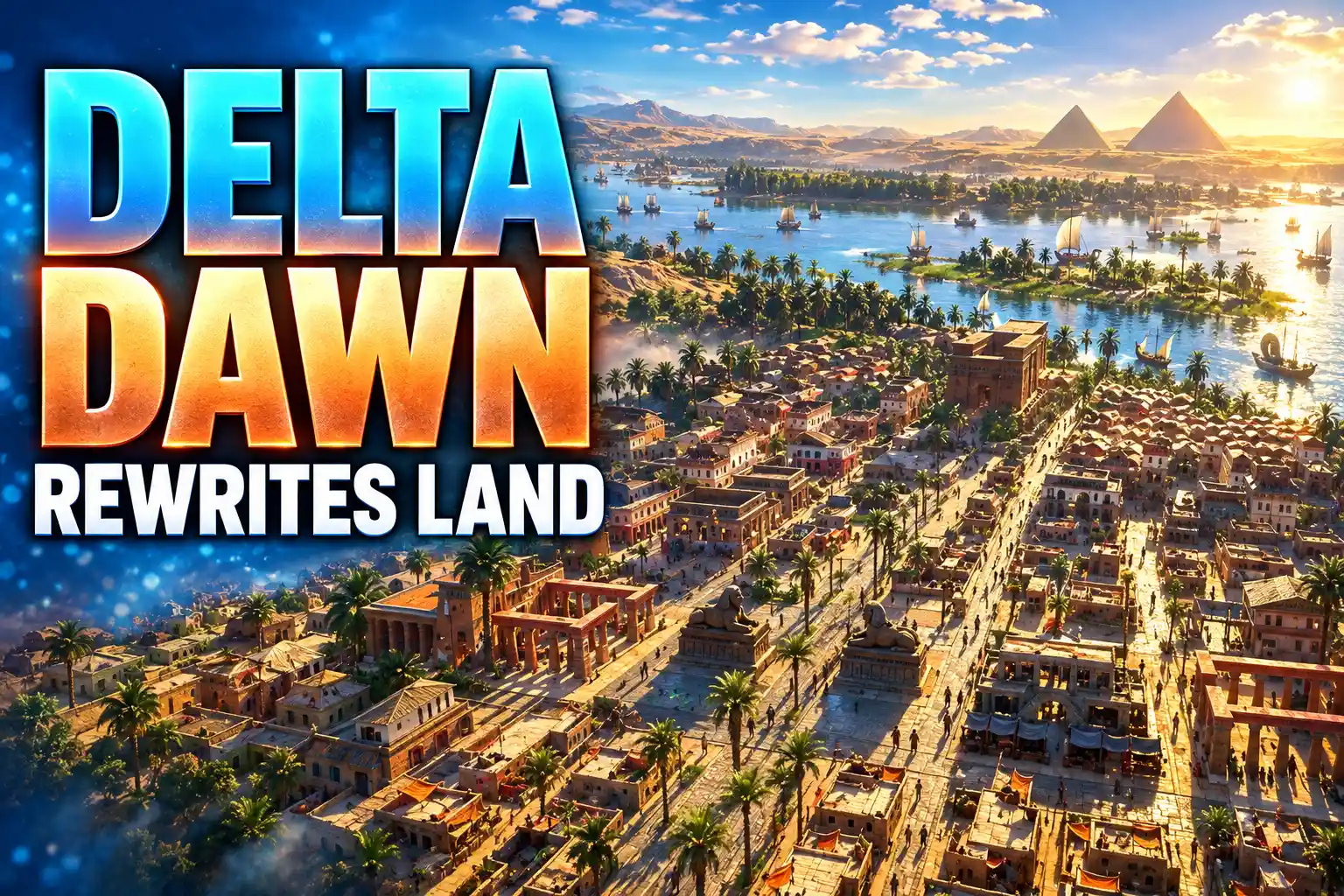
Every Tile in Aegyptus Does Three Different Jobs
Aegyptus sits in the south-eastern corner of the empire, a desert and a floodplain pressed against a large river, far from the look of Latium or Albion. The studio’s Gamescom recap is blunt about the grid: each buildable area is split in three, and those three jobs do not stack on the same tile.
THE THREE ZONES IN AEGYPTUS
| Zone | What grows | What you put there | Water |
|---|---|---|---|
| Arid Zone | Nothing, for now | Cities, open lots | Dry ground |
| Farmlands | Crops and trees | Farms and forestry | Fertile belt by the river |
| Floodplains | Output that the flood hits | Buildings on the river edge | Regular inundation |
The parenthetical “for now” on the arid belt is doing real work. Desert lots are the city sponge, and the recap already points at later greening once you move water inland. Farmland is scarce on purpose. Floodplain is the gamble strip, close enough to the river that the calendar itself becomes a production modifier.
Hands-on scenes at the show treated that flood as a trade, not a cutscene. Water can break a chain, then leave richer soil when it pulls back, a risk-reward beat in the same family as eruptions on Cinis from Prophecies of Ash. Fertility is the province’s whole argument, and a lot of the new tech is just plumbing.
Basins, Norias and a Crocodile God
After you meet the first resident tier, the Threshers, who carry Aegyptus’s farming habits, the map repeats the Albion fork. You can push a Graeco-Roman mix and upgrade into Scribes, or keep local custom and upgrade into Potters. Potters want goods such as stuffed geese. Scribes want papyrus and writing kit. Public buildings split too, and the streets change colour with the choice.
Gamescom presentations described five new resident tiers in total, with the Romanize-or-not fork meaning a single save will not see every one of them. The recap only names the first step and the two second-tier paths, so the later jobs are still in the October blogs.
Whichever path you pick, irrigation is the next wall. To squeeze the river and that thin farm belt, you can basins and connect them with canals to make fertile ground. If you Romanize, a noria lifts water into aqueducts and soaks the land around a cistern. That is not flavour text. It is two hardware kits tied to the culture switch, so the “look” of the city and the way you feed it are the same decision.
HOW WATER GETS INLAND
- Local path: Basins linked by canals, spreading fertile ground from the river without a noria.
- Roman path: A noria feeding aqueducts, then a cistern that waters the inland ring.
- Sobek’s cut: One of three new gods, tied to the delta, boosting irrigation kit and farms if you lean into his cult.
Dawn of the Delta adds three new deities. The one the studio is willing to name is Sobek, god of the river delta. His worshippers, the recap says, devote greater attention to managing and channelling the region’s waters. Religion here is a production stance, not a statue you plop for splendour and forget.
The recap page also hosts a pyramid teaser and then refuses to explain it. Pyramids will matter. How they matter is still locked.
Echoes of Kassandra Lands on September 17
The Nile map is the headline. The dated SKU is a Greek mercenary from another Ubisoft game. Update 2.1 on September 17 turns on Echoes of Kassandra and also tweaks some “heroic” specialists, plus a pile of bug fixes whose notes are still pending.
The studio account posted the Gamescom recap on September 3.
At gamescom last week we shared a bunch of news on the upcoming "Echoes of Kassandra" cosmetic pack and our big "Dawn of the Delta" expansion for November 🌴
Get an overview of all news in today's blog: https://t.co/Tw0C4vU41E pic.twitter.com/uhxVEGNCzz
— Anno (@ANNO_EN) September 3, 2026
Ubisoft is billing the pack as a collaboration with Assassin’s Creed Odyssey, built around Kassandra, the Spartan lead from that 2018 game. It is ornaments, skins, portraits, and a new audio toy, not a campaign. The Hall of Echoes music building lets you switch on Odyssey tracks while you lay roads. That is the crossover’s actual new object, a room that plays someone else’s score inside a Roman city builder.
WHAT THE PACK PUTS IN THE MENU
- Harbour ornaments: A giant Zeus that sits in harbour lots, a new ornament class for that waterfront strip.
- Mountain statues: A huge Sisyphus rock carving on mountain slots, plus a giant Athena and other Odyssey-inspired city statues.
- Skins: First-tier residences in every province, Mykonos-inspired emergency services, and a flagship skin after Kassandra’s ship Adrestia.
- Portraits and marks: Kassandra or a Cult of Kosmos face, and five player sigils drawn from Odyssey’s world.
The loudest public argument about this drop is not the Hall of Echoes. It is that Kassandra is, again, the face Ubisoft reaches for when it wants a classical cameo. That complaint misses the calendar. A looks pack on September 17 is easy to ship. A three-zone irrigation province is not, and the studio is not pretending otherwise.
Art Director Reiko spent Gamescom panels sculpting a skull-medusa and a grumpy horned cyclops head with the crowd. The studio wants those in the game after a polish pass and has not picked the delivery method. A dedicated Kassandra DevBlog was promised in the wake of the recap.
What Year 1 Already Spent Before Egypt
Year 1 was sold as three gameplay expansions and a stack of cosmetics, not as a surprise Egypt season. Dawn of the Delta is the third gameplay pack in that pass, and the studio has been calling it the largest of the three since the pass page went up. Prophecies of Ash dropped a volcano island into Latium. The Hippodrome dropped a chariot monument. Aegyptus drops a province.
YEAR 1 ON THE CALENDAR
- February 19, 2026: Marvellous Mosaic Pack ships at 7 euro, tiles and building skins, no new systems.
- April 30, 2026: Prophecies of Ash opens Cinis, the series’ largest island, under a volcano that can wreck a city and a harvest.
- June 18, 2026: Update 1.6 turns on the Blooming Cities garden pack and free landscaping brushes for everyone.
- August 20, 2026: The Hippodrome and update 2.0 land at 8 euro, with photo mode, notes, and guest features in the free patch.
- September 17, 2026: Update 2.1 and Echoes of Kassandra.
- November 5, 2026: Update 3.0 and Dawn of the Delta.
The Year 1 Pass at $34.99 on Steam bundles those three gameplay packs and five cosmetics that unlocked on day one, including sigils, a golden flagship skin, and the Pool of Tranquility ornament. Echoes of Kassandra sits outside that list in the recap, in the same extra-charge lane as Mosaic and Blooming Cities. Ubisoft has not posted its price.
Hippodrome had been out only days when Gamescom opened the Nile footage. That cadence is the point of the pass: a monument in August, a statue pack in September, a province in November. Creative Director Manuel Reinher told the show floor the studio wants to keep expansions going as long as it can, and that Ubisoft Mainz wants to keep working on this game past the current slate.
Aegyptus Can Feed the Rest of the Empire
You can start a new game in Aegyptus, or you can open an old save with the add-on turned on. The recap’s economic pitch is not tourism. Turn the delta into a breadbasket, then pull luxury goods back from Latium. Grain one way, finery the other. That is why a three-zone farm map changes cities you already built in Italy and Albion, even if you never make Egypt your capital.
The military sheet is thinner than the farm sheet, and players on the studio blog noticed. Two researchable units are on the card, plus two local hulls that run the river faster than Roman ships.
NEW TEETH ON THE NILE
- Kushite archers: Elite, more expensive, long range, high accuracy.
- Dromedarii cavalry: Hits morale on enemy cavalry and infantry.
- Local ships: Two new types, built for the river, faster there than the Roman equivalents.
War elephants are not on that list. Comments under the recap keep asking for them, as a wall-breaker and as an amphitheatre spectacle in Latium. The roster as shown is a range specialist and a morale camel troop. If elephants exist, they are in the part the studio is still holding for October.
Inter-province trade is the sleeper loop. Aegyptus is allowed to be the grain tank while Latium stays the luxury shop. That only works if the flood calendar does not empty the tank the week your Italian patricians get hungry. The noria-versus-basin fork decides how much of the desert you can turn into a second farm belt, which is how a “new map” becomes a multiplier on old islands.
The November Patch Ships Layout Stamps Too
Dawn of the Delta rides with update 3.0. The free patch is not a light loader. The studio’s 2026 roadmap, last updated August 31, puts layout stamps in update 3.0 so you can save a plan and paste it later, then expands the statistics menu with an item list and a warehouse list. Attribute and diplomacy balancing sit in the same drop, with more Hall of Fame content. Full patch notes come closer to launch.
UPDATE 3.0 ON NOVEMBER 5
- DLC hook: Turns on Dawn of the Delta for owners.
- Stamps: Save layouts and reuse them, a quality-of-life tool city-planner players have wanted since launch.
- Stats: Item overview and storage overview added to the statistics menu.
- Rules: Attribute and diplomacy tuning, plus extra Hall of Fame material.
One item did not make 2026. An in-game mod browser and manager, planned for late this year, slipped to next year. The largest map add-on of Year 1 therefore ships while the PC mod pipeline still lives outside the client. October is when the team says it will run full DevBlogs and livestreams with live play, the first long look at flood timing, noria math, and whatever the pyramid teaser is hiding.
Generally, we are on the right track in all aspects.
Manuel Reinher, Creative Director, Ubisoft Mainz, at Gamescom
Reinher also said the Egypt pack will have a major impact on the game, and Ubisoft has called Anno 117 the fastest-selling title in the series. He wants the DLC run to continue past this one. That is a studio still selling Year 1 while it argues for Year 2 in the same breath.
WHAT WE KNOW
- Dated drops: Kassandra pack and update 2.1 on September 17, Dawn of the Delta and update 3.0 on November 5.
- Save rule: Aegyptus works as a start region or as an add-on inside an existing save.
- Culture kit: Threshers into Potters or Scribes, with irrigation hardware that changes with that choice.
WHAT IS UNCONFIRMED
- Pyramid job: A teaser exists; the building rules do not.
- Pack price: Mosaic was 7 euro and Hippodrome was 8 euro; Kassandra has no number yet.
- Later tiers: Five resident tiers were described at the show, and only the first fork is named.
- Reiko’s heads: Skull-medusa and cyclops are wanted in-game, delivery method unset.
October’s DevBlogs are where the flood timer, the noria radius, and the unnamed resident tiers have to show up if November 5 is going to play like a province instead of a postcard. Until then the recap already gave away the real change: Aegyptus is not a new coat of paint on the old grid. It is a grid that refuses to let a city, a farm, and a flood sit on the same tile.

The Salary Cap Fight That Can Freeze Baseball’s TV Payday

The 2027 Mercedes GLE and GLS Keep Alabama Busy

Margaret Hamilton Dies at 90 With a Harder Fight Unfinished

Unity Parks Its Engine Inside Google’s Prompt Games

The Hidden Vendor Cut in 403(b) vs 401(k) Plans

Microsoft 365 Auth Fault Took Down Exchange and Teams

IFA 2026’s Weird Gadgets Are Building a Sensor Home

Xbox Caps Game Pass Cloud Gaming at 15 Hours

Squishy Dumpling Toys Recalled After Hiding Illegal Water Beads

Tesla Puts Its Wheel-Free Cybercab on Austin Streets
-
 NEWS2 months ago
Microsoft 365 Auth Fault Took Down Exchange and Teams
-
 GAMING1 month ago
Xbox Caps Game Pass Cloud Gaming at 15 Hours
-
 NEWS1 month ago
IFA 2026’s Weird Gadgets Are Building a Sensor Home
-

 NEWS1 month ago
OpenAI Unveils GPT-6 Astra With a Critical Cyber Label
-
 AUTO1 month ago
Tesla Puts Its Wheel-Free Cybercab on Austin Streets
-
 NEWS2 months ago
OpenClaw 2.0 Ships a Team Workplace With Host-Trust Defaults
-

 NEWS2 months ago
Sony and Warner Sue Anthropic Over Torrented Song Lyrics
-
 LIFESTYLE1 month ago
Squishy Dumpling Toys Recalled After Hiding Illegal Water Beads