
AUTO
Volkswagen Cuts 50,000 More Jobs to Shrink Its Lineup
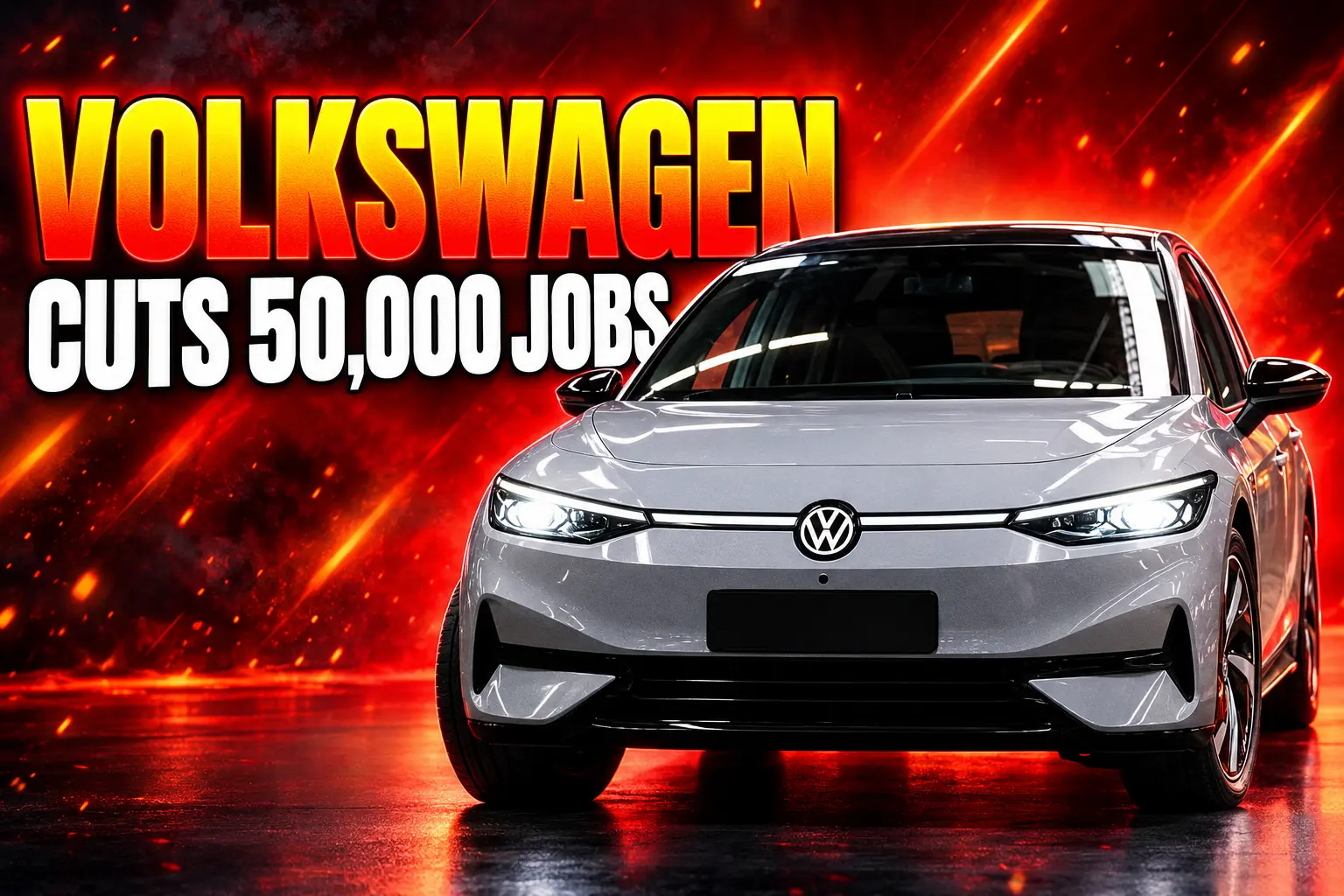
Volkswagen approved 50,000 more job cuts while halving its models and leaving four German plants without a competitive follow-on car.

Volkswagen’s supervisory board on September 3, 2026, approved a plan to cut about 50,000 more jobs and shrink the group’s model range by half. The vote also set the company on a path to about nine million cars a year and left four German plants without a competitive next model from 2031 to 2034.
Those extra roles sit on top of programs already aimed at 50,000 jobs, taking planned cuts to 100,000 by 2030 in a group that employed 662,942 people at the end of 2025. The headcount is the labor math of a smaller product company, not a separate round of trimming.
VW Will Build Fewer Cars on Purpose
The board’s Future Plan 2030 puts the core car business on a demand figure of about nine million vehicles a year. Before the pandemic the group had tooled up for about 12 million, and it says it has already taken two million units of capacity out. Further cuts are due in China and Europe, where the board says capacity still exceeds demand by more than 500,000 cars.
By 2035 the group will cut its model portfolio by about 50 percent and cut offering complexity by about 75 percent. Higher volume per remaining model is the cost lever. Chief financial officer Arno Antlitz said the savings already agreed with unions are not enough in the present market, and that the company has to cut complexity in products, platforms, and decision layers.
The concrete example the company published is seats. It will replace more than 2,300 seat variations with about 100 packaged choices, dropping low-demand extras and scaling the ones buyers actually tick. Platforms, electronics, and software are supposed to split into western and eastern versions rather than run in parallel.
FUTURE PLAN 2030 TARGETS
- Yearly volume: About nine million vehicles, down from capacity once set near 12 million.
- Model range: About 50 percent fewer models by 2035, with higher output on the cars that stay.
- Complexity: About 75 percent fewer equipment options, including the seat-choice cut.
- Margin: A nine percent operating return by 2030, equal to about €31 billion of operating profit, against €8.9 billion in 2025.
- Holdings: About one-third of the shareholding and business portfolio to be sold or recast.
Capital spending and research for 2027 to 2031 is set at €135 billion, with overhead costs aimed at €37 billion. Chief executive Oliver Blume said the group will invest a three-figure billion sum in brands and products over the coming years. The payroll cut is how a nine-million-car company pays for that while chasing a margin more than three times last year’s 2.8 percent.
Half the Lineup and Far Fewer Options
Fewer models only save money if the leftover cars run hard through fewer factories. The board’s own production finding is that a competitive follow-on cannot currently be secured, on a staggered basis from 2031 to 2034, for Emden, Zwickau, Hanover, and Neckarsulm. Alternative uses are being assessed in parallel. A full concept for the European plant network is due by the end of June 2027.
Two of those four sites were converted into all-electric plants. Zwickau, the first factory in the group to go fully electric, cost €1.2 billion ($1.37 billion) to convert after the last combustion car left in June 2020. Emden has built only ID-series electrics since the end of 2024. Both still assemble cars that sit among the group’s better-selling battery models, including the ID.4, ID.3, ID.7, Cupra Born, and Audi Q4 e-tron. The board still cannot name a competitive next car for either hall in the 2030s.
German factory costs at the Volkswagen brand fell by an average of 20 percent last year, the company said, and the gap to other European sites remains. That is why successor volume can move even when a German EV hall is not empty today. Halving the lineup is how you idle a plant without hanging a closed sign on it before 2030.
THE FOUR PLANTS ON THE 2031 TO 2034 CLOCK
| Plant | Workers | What it builds now | Board finding |
|---|---|---|---|
| Emden | More than 7,700 | ID.4, ID.7, ID.7 Tourer | No competitive follow-on, 2031-2034 |
| Zwickau | About 8,000 | ID.3, ID.4, ID.5, Q4 e-tron, Cupra Born, Bentley and Lamborghini bodies | No competitive follow-on, 2031-2034 |
| Hanover | About 14,000 | ID. Buzz and T-series vans | No competitive follow-on, 2031-2034 |
| Neckarsulm (Audi) | About 15,500 | A5, A6, A8, e-tron GT | No competitive follow-on, 2031-2034 |
Together the four sites employ about 45,000 people. Emden built about 147,000 vehicles in 2025 in a city of about 50,000. Zwickau turned out 212,000 vehicles and 10,800 bodies. Hanover has made the Bulli since 1956. Neckarsulm is Audi Sport’s home and the birthplace of the e-tron GT. The September 3 text does not order those halls shut. It says the group cannot presently book a competitive next car there, which is how a factory empties once current models run out.
Emden, Zwickau, Hanover and Neckarsulm
The China hole is what made a nine-million-car plan look generous. In the first half of 2026 the group delivered 4.13 million vehicles worldwide, 6.3 percent fewer than 4.41 million a year earlier. China accounted for almost all of the damage: 973,000 deliveries against 1,313,800, a 25.9 percent drop. Sales chief Marco Schubert said the group grew about two percent outside China and still could not outrun a Chinese market that was down about 20 percent overall.
Battery-car deliveries worldwide were 438,500 in the same half, down 5.8 percent. Europe was the exception, with battery deliveries up 8.4 percent and the European battery order book up more than 50 percent from the end of 2025. The United States went the other way. Battery deliveries there fell 68.8 percent after subsidies ended and tariffs rose. Group deliveries in North America were down 3.1 percent in the half, with U.S. volume off 7.4 percent.
The 2025 annual report shows how expensive that mix already was. Operating profit fell to €8.9 billion from €19.1 billion, a 53 percent drop, and the operating return on sales slid to 2.8 percent from 5.9 percent. Revenue was €321.9 billion. The accounts include €2.9 billion of costs from U.S. import tariffs introduced in April 2025, and €4.7 billion of impairments and other charges tied to Porsche’s revised product plan. First-half 2026 operating profit was €5.9 billion, down 11.6 percent, for a 3.8 percent return on €158.1 billion of sales.
A company that just printed 2.8 percent, and 3.8 percent at the half, has told its board the 2030 target is nine percent, or about €31 billion of operating profit. That gap is why the model cull and the plant clock showed up in the same vote as the jobs.
China Cut a Quarter of Group Deliveries
The first big cut was supposed to be the last. On December 20, 2024, Volkswagen and IG Metall ended more than 70 hours of talks with a German deal that dropped more than 35,000 jobs by 2030 through retirement and attrition, cut German capacity by 734,000 vehicles, and claimed about €15 billion a year of savings. Compulsory redundancies and plant closures were ruled out through the end of 2030. Works council leader Daniela Cavallo said then that no site would be closed and no one would be laid off for operational reasons.
Group-wide programs around that deal, including Audi and the software unit, were later counted as about 50,000 roles. The Future Plan 2030 is explicit that the new 50,000 come on top of those existing programs. Headcount was already falling: 652,200 people were on the books on June 30, 2026, 10,700 fewer than at the end of 2025, when 284,032 of the 662,942 jobs were in Germany.
The 2030 expiry is doing real work. A closure before that date would break the 2024 bargain. A finding that no competitive follow-on exists from 2031 to 2034 does not. That is the structure of the September vote, and it is why the four plants can be emptied after the guarantee lapses without the board using the word closure.
FROM THE 2024 DEAL TO THE SEPTEMBER VOTE
- December 20, 2024: Volkswagen and IG Metall agree more than 35,000 German job cuts, a 734,000-unit capacity cut, and a ban on plant closures and compulsory redundancies through 2030.
- June 26, 2026: Internal planning for a second 50,000-job round and a wind-down at four German plants becomes public. Works council, union, and Lower Saxony say they will fight closures.
- July 13, 2026: After a supervisory board session that does not settle the jobs question, Blume tells staff the group carries about a 20 percent overhead-cost gap and that a theoretical further 50,000 roles follow from it. He says he still cannot confirm competitive uses for Emden, Hanover, Zwickau, and Neckarsulm in the 2030s.
- September 3, 2026: The supervisory board unanimously approves Future Plan 2030, including about 50,000 further jobs and the 2031-2034 finding on the four plants.
- End of June 2027: A concept for a competitive European production structure is due, including alternative uses for the four sites.
Worker representatives had already restated red lines against German plant closures in 2026, pointing back to the 2024 contract. The September text does not repeal that contract. It schedules the empty-out for the years after it ends.
The 2024 Bargain Expires in 2030
The surprise on September 3 was not the content. It was the vote. The same board that had stalled in July unanimously approved the Future Plan 2030, including labor members and Lower Saxony, which holds a stake and sits at the table. Hans Dieter Pötsch, the supervisory board chair, said the board was convinced the plan would secure the group’s viability. Olaf Lies, Lower Saxony’s minister-president, called the challenges enormous and said politics still has to set a competitive trade framework.
The Supervisory Board has unanimously approved the Executive Board’s Future Plan presented today. This is a strong signal for the future of the Volkswagen Group. We are taking responsibility for our entire workforce, for our partners and for industrial jobs worldwide.
Oliver Blume, CEO, Volkswagen Group statement, September 3, 2026
Christiane Benner, IG Metall’s first chair and deputy chair of the supervisory board, had taken the opposite tone two days earlier. On September 1 she said the four plants would not close with IG Metall, called further cuts a big mistake, and argued that about 30,000 jobs hang on Emden alone. After the vote she said the labor side had fought hard for good solutions in a crisis and that the plan includes developing future scenarios for all plants.
Cavallo said the plan was a necessity for the next decade and that the burden should not fall solely on employees, with job security and economic viability treated as shared goals. The executive board now has to negotiate the extra 50,000 roles, including management jobs, with works councils brand by brand. Talks start where agreements are required. The 50,000 is an analysis the board accepted, not a signed social plan.
Why Labor Voted for the Cuts?
A nine percent operating margin on a nine-million-car company is the number that makes the rest move. Last year’s 2.8 percent, even after the Porsche charges and the tariff bill, is nowhere near it. First-half 2026 at 3.8 percent is still less than half the target. Blume’s July arithmetic was blunt: overheads about 20 percent above comparable firms, personnel about half of those overheads, hence a theoretical 50,000 more jobs worldwide.
One hundred thousand roles would be about 15 percent of the 662,942 people on the books at the end of 2025. That is a smaller Volkswagen in labor as well as in metal. The plan also asks the board to limit its own reserved approval rights to material group measures, and to design a leaner group structure, so decisions on what gets built, and where, move faster than they did on the way into this overcapacity.
The four plants will not get a verdict on September 3’s paper. They get a date. By the end of June 2027 the executive board has to bring back a production-structure concept for Europe, including other uses for Emden, Zwickau, Hanover, and Neckarsulm. Until that document lands, the Future Plan’s plant line is a clock, not a padlock, and the extra 50,000 jobs remain a target the works councils have yet to sign.

The Salary Cap Fight That Can Freeze Baseball’s TV Payday

The 2027 Mercedes GLE and GLS Keep Alabama Busy

Margaret Hamilton Dies at 90 With a Harder Fight Unfinished

Unity Parks Its Engine Inside Google’s Prompt Games

The Hidden Vendor Cut in 403(b) vs 401(k) Plans

Microsoft 365 Auth Fault Took Down Exchange and Teams

IFA 2026’s Weird Gadgets Are Building a Sensor Home

Xbox Caps Game Pass Cloud Gaming at 15 Hours

Squishy Dumpling Toys Recalled After Hiding Illegal Water Beads

Tesla Puts Its Wheel-Free Cybercab on Austin Streets
-
 NEWS2 months ago
Microsoft 365 Auth Fault Took Down Exchange and Teams
-
 GAMING1 month ago
Xbox Caps Game Pass Cloud Gaming at 15 Hours
-
 NEWS1 month ago
IFA 2026’s Weird Gadgets Are Building a Sensor Home
-

 NEWS1 month ago
OpenAI Unveils GPT-6 Astra With a Critical Cyber Label
-
 AUTO1 month ago
Tesla Puts Its Wheel-Free Cybercab on Austin Streets
-

 NEWS2 months ago
OpenClaw 2.0 Ships a Team Workplace With Host-Trust Defaults
-

 NEWS1 month ago
Sony and Warner Sue Anthropic Over Torrented Song Lyrics
-
 LIFESTYLE1 month ago
Squishy Dumpling Toys Recalled After Hiding Illegal Water Beads