
NEWS
The AI Prize to Talk With Animals Hides the Human
The Coller Dolittle grand prize for AI animal communication pays only if the animal never realizes a human is speaking, the same trick ethicists call a privacy harm.

A $10 million prize for AI animal communication pays out only if the animal never realizes a human is speaking. The Jeremy Coller Foundation and Tel Aviv University wrote that test into the Coller Dolittle Challenge, a contest modeled on the Turing test. Philosophers and field biologists now treat the same hiding move as the harm, not a clever scoring rule.
Machine learning already sorts calls that people cannot hear and writes replies in the animal’s own voice. The scientific win, as the prize defines it, is a reply from a creature that still thinks it is talking to its own kind.
The $10 Million Prize Hides the Human
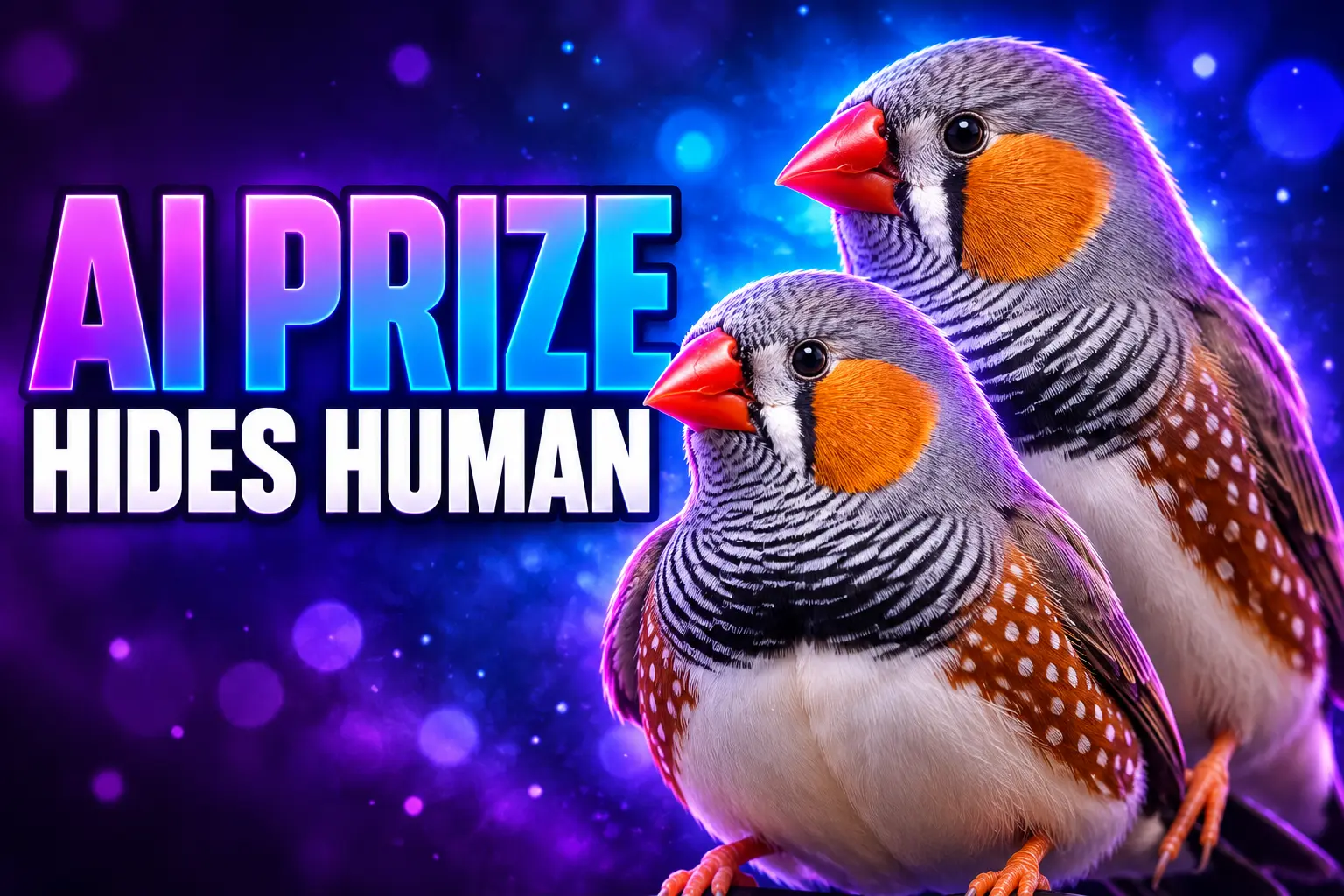
On 26 June 2026, in London, the foundation and the university named Dr. Julie E. Elie, an associate project scientist in Frédéric Theunissen’s lab at the University of California, Berkeley, as winner of the annual $100,000 purse. Elie spent more than 15 years on zebra finches and built a dictionary of 11 call-types with meanings such as aggression, hunger, and bonding. Then she asked the birds whether her labels matched theirs.
She trained finches to press buttons that played those categorized calls, and each day she rewarded only one call-type with seeds. The birds learned which playback paid. When they erred, they mixed long-distance and short-distance contact calls that sound different but share meaning, and they did not mix a short contact call with a short alarm that sound alike and mean different things. Elie said the mistakes showed that a call raises a mental image of meaning, not a reflex to a noise.
Our research shows that exciting scientific discoveries come from mistakes. It’s been a fascinating collaborative exercise to ask the zebra finches questions about their vocalizations.
Julie E. Elie, associate project scientist, Coller Dolittle Prize event
She also wants robots that copy posture and movement, because sound without the body is only half a conversation. Professor Yossi Yovel of Tel Aviv University, who chairs the judging panel, said the 2026 finalists had moved from animal “words” to “sentences,” and that Elie’s study asked whether patterns found by scientists are actually meaningful to the birds. The other shortlisted teams worked on African striped mice, chimpanzees, and bonobos. The committee also gave a lifetime award to Dr. Irene Pepperberg for her work on grey parrot communication.
THE COLLER DOLITTLE PURSE
| Award | Payout | What triggers it |
|---|---|---|
| Annual prize | $100,000 | Most promising work toward an algorithm for communication with animals |
| Grand prize | $10 million equity, or $500,000 cash | The animal talks on its own and does not know a human is the partner |
Annual entries must stay non-invasive, show communication in more than one context using the animal’s own signals, and produce a measurable response to signals broadcast to it. That last rule is playback by another name. The grand prize is paid when the animal communicates independently without recognizing humans. The challenge runs on an open-access basis, with data shared for other labs. Submissions for the 2027 round closed on 30 August 2026. The big check is still unclaimed.
Most Crow Talk Stays Inside the Family
Vittorio Baglione, a biologist at the University of León, has followed carrion crows for 30 years. He says the birds do not like people and do not like their company. With his research partner Dr. Daniela Canestrari, he fitted wild crows in northern Spain with mini-biologgers, including packs on tail feathers, because the families they study share chick care across the group, not just between a mother and father.
Canestrari said each microphone lasted six to seven days, and the pair soon had more audio than they could score by ear. Since 2024 they have worked with the Earth Species Project, a U.S. nonprofit that builds animal-language models. ESP’s detector, Voxaboxen, labeled 127,750 adult crow vocalizations from 52 mini-biologgers, plus calls from chicks and from great spotted cuckoos that share the nest.
The loud caw that people know is the thin end of the file. Intermediate and low-amplitude calls were common, which ESP reads as private, close-range talk inside the family, the kind of murmur traditional mics on a pole miss. Quiet calls may even flag a bird arriving at the nest so relatives can time chick care. The biologgers, the team reported, did not show a statistically significant hit to crow welfare.
📄 New paper in @SpringerANCO covering our carrion crow project at @unileon.
🐦⬛ 52 mini-biologgers were deployed on wild carrion crows in Spain — capturing 127K+ vocalizations.
(1/4) pic.twitter.com/yXKETnKAhS
— Earth Species Project (ESP) (@earthspecies) December 17, 2025
Baglione’s favorite find was a soft burst when a buzzard hit the nest, after which other crows arrived to defend it. He glossed the call as “Hey! Come help!” That is a useful sentence for a scientist. It is also a sentence a hunter can steal.
Rosie, Sunshine and a Zoo Speaker
Playback is old fieldcraft. You record a call, you pour it back into the air, and you watch who comes, who flees, and who answers. The Coller rules demand a measurable response to a broadcast, so the method is not a side issue. It is how a team proves the decoder works. It is also how you borrow an animal’s trust in a sound and spend it.
PLAYBACK DATES THAT STILL SHAPE THE FIGHT
- 2007: Acoustic biologist Katy Payne describes, in an On Being interview first aired on 1 February, a test at the Oregon Zoo. She played calls of Rosie, an old matriarch who had been dead for years, to the remaining herd. Rosie’s granddaughter Sunshine was still there. Payne said the elephants went into paroxysms of groaning and roaring.
- 2018 onward: Baglione and Canestrari move from watching crow families to putting mics on the birds themselves, building the audio pile that later needed machine help.
- 11 November 2024: Earth Species Project introduces NatureLM-audio, later open-sourced, as a large audio-language model trained across speech, music, and animal sound.
- 19 November 2025: NYU’s More-Than-Human Life program publishes Listening to Our Animal Kin and the PEPP rules for these tools.
- 4 April 2026: Topoi publishes Marriah Alcantara and Kristin Andrews on the ethics of machine-learning translation of animal signals.
- 25-26 June 2026: Elie’s finch dictionary takes the annual $100,000 prize. The 2025 purse had gone to a Woods Hole team led by Laela Sayigh for dolphin work that found possible language-like, shared, context-specific meaning.
Christian Rutz and colleagues warned in Science that broadcasting to wild humpback whales could change singing across an ocean basin, because those songs already travel like hit singles. César Rodríguez-Garavito, director of the MOTH program at New York University School of Law, has said playback uses an animal’s trust in a known sound to make it act as the user wants. Once a model can mint new calls on the fly, that lever no longer needs a field recording of a specific bird or whale. It needs a speaker and a prompt.
What Counts as Animal Privacy?
Alcantara and Andrews, writing in Topoi, argue that labs still skip a live risk: violating the privacy of animals by collecting data on their vocalizations and movements. They note a growing view in animal ethics that many species have an interest in, or a right to, privacy. Classic playback already risks distress, damaged signals, and broken relationships. AI translation, they write, keeps those three problems, then adds new ones.
An underlying assumption in much of this research is that animals will want to talk to us, but that might not be true. By translating animal communication, we would undermine the expectations animals have by inviting ourselves into their social groups unannounced.
Marriah Alcantara and Kristin Andrews, Topoi, April 2026
That sentence lands harder next to the Spanish crows. If most of their talk is quiet and close, a decoder is not only a dictionary. It is a way into conversations the birds keep inside the group. Alcantara and Andrews also point at projects such as DolphinGemma, a model tied to a wearable that would turn dolphin sounds into human language for the person wearing it. A successful two-way system, they argue, would mean animals are rational beings who live in normative communities, which would both reveal moral duties and create new ones.
MOTH’s answer is not a ban. It is a first attempt at rules for a field that still has almost none. On 19 November 2025 the program put out a PEPP ethical and legal framework, co-authored by Rodríguez-Garavito, Jacqueline Gallant, and Emma Crowe, after a November 2024 workshop with Project CETI, the sperm-whale translation group.
THE PEPP PILLARS AND THE HARMS THEY NAME
- Prepare: Get ready for deployment before the tools leave the lab, including ethics and data rules, not after the first viral demo.
- Engage: Bring in human and nonhuman stakeholders, including Indigenous communities, instead of treating wild sound as free raw material.
- Prevent: Run risk analysis, keep the 3Rs of animal research (replace, reduce, refine), and apply a precautionary brake on talking back when meaning is still guesswork.
- Protect: Put the animals’ interests first, respect non-coerced participation, and fix harm fast when a broadcast or a tag goes wrong.
The same report groups four kinds of damage: physical harm and exploitation; mental harm including distress, confusion, and privacy loss; relational harm to social structure; and ecological harm if a fake call spreads through a habitat. It warns that well-meant tools have been co-opted and weaponized before, and that generative models can speed that up. It also flags near-constant surveillance that can deny animals the chance to be left alone. Rodríguez-Garavito has described a future in which the same stack exposes animals to crowds that want a chat, or is turned into a weapon.
Open Recordings and the Hunter’s Playback Kit
Baglione is not an outside critic of the crow work. He is the person who collected it, and he is already on the record about who else can use a decoded “come help” or a fake “come, it’s safe.”
You can stress the animals. You can disrupt their social environment. You can pose conflicts between them, especially if you don’t really understand the meaning of the call.
Vittorio Baglione, University of León
Hunters and trappers already loop recorded bird calls to pull birds in. A model that can mint the quiet family murmur, not just the public caw, makes that trick cheaper and harder to spot. Tour boats can do the same with whales, drawing animals toward engines and crowds. A synthetic voice played often enough can also burn the original: if a group learns that a certain cry is spam, it may stop answering the real animal that still needs a reply. That is not a science-fiction add-on. It is the old playback harm called “impairing signal function,” scaled to a generator.
The first public appetite around these models is not a careful listening brief. It is the wish to ask a dog what it is shouting, or to get a cat to say a name. That hunger is the product. A decoder that works in the wild, paired with a cheap speaker, is a chat booth bolted onto a habitat. MOTH’s crowd-of-humans warning is already visible in how people talk about the tech, before any grand prize is paid.
Open data, which the Coller rules treat as a scientific good, cuts both ways. Shared files help a second lab check a claim. They also travel farther than the lab. ESP’s NatureLM-audio is built to detect and classify thousands of species and call types, and to transfer tricks from human speech into animal sound. In 2025 the group published 14 papers, co-ran the first NeurIPS workshop on the topic with Google DeepMind and others, and, with the Collective Intelligence Project, surveyed more than 1,000 people in 67 countries on how the public feels about AI-enabled interspecies understanding. The tools are being generalized on purpose. So are the ways they can be pointed.
Coller Bets the Code Breaks by 2030
Jeremy Coller, whose foundation funds the contest and also runs animal-welfare and sentience work, did not hedge at the June event. He congratulated Elie, said genuine two-way talk is still out of reach, and then put a date on the table.
AI is accelerating so fast, I have absolute conviction we’ll crack the code by 2030.
Jeremy Coller, founder, Coller Dolittle Challenge
Jonathan Birch, a professor of philosophy at the London School of Economics and a prize judge, called Elie’s work a rare pass from recording thousands of calls to testing whether the birds accept the meanings. The 2025 dolphin result and the 2026 finch dictionary are the two public rungs on that ladder so far.
THE TWO ANNUAL WINS SO FAR
| Year | Lead | Species | What the judges bought |
|---|---|---|---|
| 2025 | Laela Sayigh, Woods Hole Oceanographic Institution, with partners including the Sarasota Dolphin Research Program | Dolphins | Possible language-like system with shared, context-specific meanings |
| 2026 | Julie E. Elie, Theunissen Lab, UC Berkeley | Zebra finches | 11 call-types sorted by meaning, then checked against the birds’ own errors |
Coller’s date is four years out. The ethics papers are already on the shelf. PEPP is a voluntary frame, not a statute. The grand prize still requires the animal not to notice the human, and the annual rules still require a broadcast that gets a measurable reply. If the code does break on that timetable, the first working system will have been trained, scored, and paid under a test that treats concealment as the proof of success. The quiet crow files suggest many animals already draw that line for themselves. They keep the long talk close, and they do not like our company.

The Salary Cap Fight That Can Freeze Baseball’s TV Payday

The 2027 Mercedes GLE and GLS Keep Alabama Busy

Margaret Hamilton Dies at 90 With a Harder Fight Unfinished

Unity Parks Its Engine Inside Google’s Prompt Games

The Hidden Vendor Cut in 403(b) vs 401(k) Plans

Microsoft 365 Auth Fault Took Down Exchange and Teams

IFA 2026’s Weird Gadgets Are Building a Sensor Home

Xbox Caps Game Pass Cloud Gaming at 15 Hours

Squishy Dumpling Toys Recalled After Hiding Illegal Water Beads

Tesla Puts Its Wheel-Free Cybercab on Austin Streets
-
 NEWS2 months ago
Microsoft 365 Auth Fault Took Down Exchange and Teams
-
 GAMING1 month ago
Xbox Caps Game Pass Cloud Gaming at 15 Hours
-
 NEWS1 month ago
IFA 2026’s Weird Gadgets Are Building a Sensor Home
-

 NEWS1 month ago
OpenAI Unveils GPT-6 Astra With a Critical Cyber Label
-
 AUTO1 month ago
Tesla Puts Its Wheel-Free Cybercab on Austin Streets
-
 NEWS2 months ago
OpenClaw 2.0 Ships a Team Workplace With Host-Trust Defaults
-
 NEWS2 months ago
Sony and Warner Sue Anthropic Over Torrented Song Lyrics
-
 LIFESTYLE1 month ago
Squishy Dumpling Toys Recalled After Hiding Illegal Water Beads