
AUTO
Tesla Puts Its Wheel-Free Cybercab on Austin Streets
Tesla’s Cybercab is carrying riders in Austin without a federal no-controls waiver, while NHTSA evaluates a two-seat robotaxi no human can drive.

Tesla began offering public rides in its two-seat Cybercab in Austin on September 3, a gold robotaxi with no steering wheel, pedals, or mirrors. The National Highway Traffic Safety Administration said it is in contact with Tesla and is evaluating the rollout. Nobody inside the car can take over. Texas let it carry passengers because Tesla certified that it could.
The private show at ACL Live lasted about 15 minutes, Elon Musk did not appear, and the federal brake-pedal rewrite Tesla is betting on is still a proposal. The cars are already in the app.
A Two-Seat Taxi With No Way to Take Over
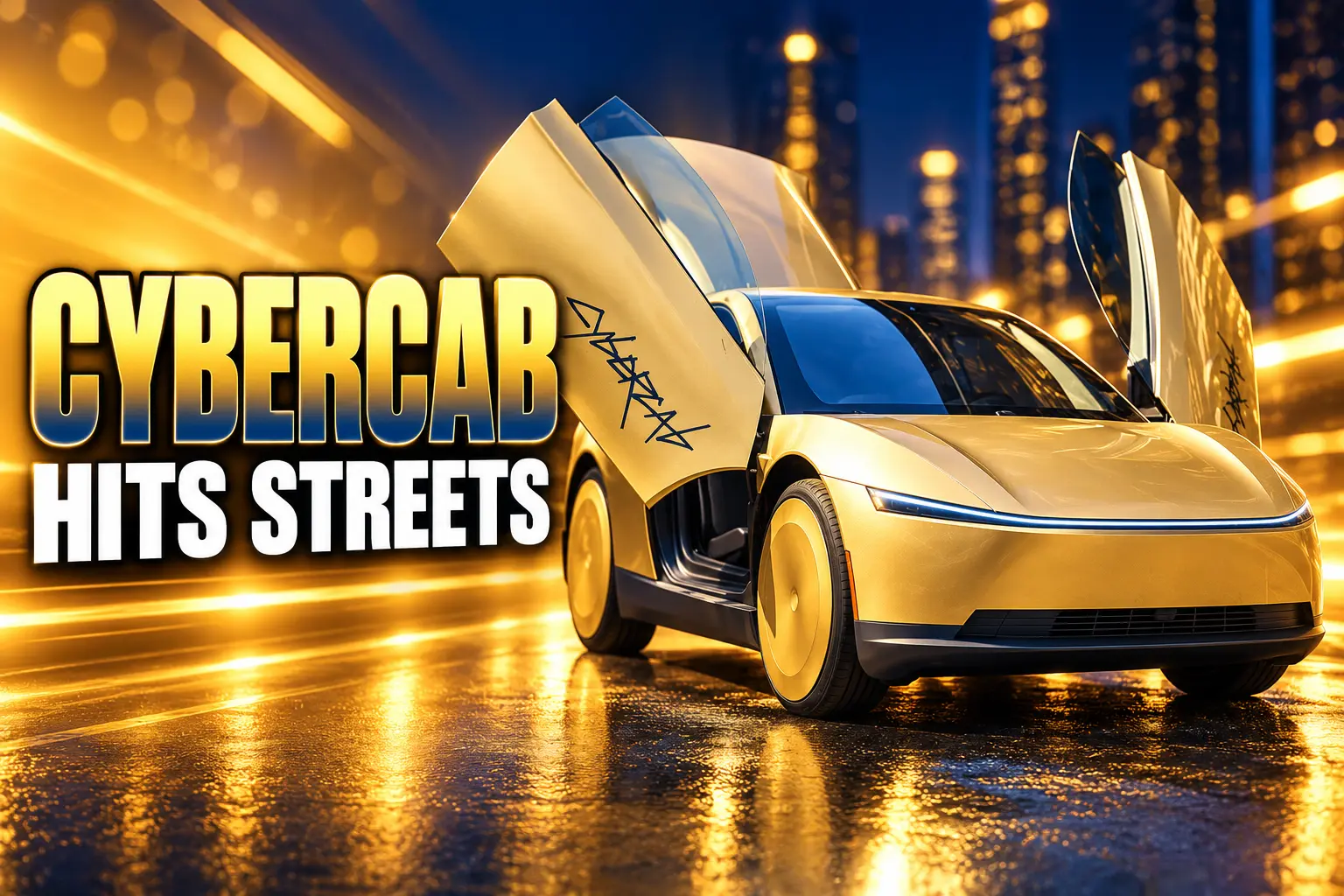
Cybercab is a golden two-seater with butterfly doors and a large cabin screen. Tesla’s rider FAQ says the trunk takes two check-in suitcases and two carry-ons, with 20.2 cubic feet of rear cargo space and 43.4 inches of leg room. There is no wheel, no pedals, and no human controls of any kind. The company says the car uses cameras to drive city streets, highways, and parking lots on its own.
Tesla updated the Robotaxi app so a rider can pick a Cybercab or a Model Y. New terms bar children under 13 from a Cybercab and children under 8 from a Model Y robotaxi, and they send disputes to arbitration. Tesla AI chief Ashok Elluswamy told the invite-only crowd, “It’s open to the entire public.” Tesla’s own site still limits those trips to limited areas of Austin.
Texas motor-vehicle records listed 45 Cybercabs in Tesla’s robotaxi fleet as of September 3, beside about 375 Robotaxi-branded Model Ys, for 420 autonomous vehicles in the state. Staff at the venue said guests would ride first and that the rest of the cars would open on September 4. Tesla enthusiast Sawyer Merritt, who filmed one of the first public trips Thursday night, said the cabin is comfortable and spacious, the suspension is soft, and the driving is “VERY smooth.”
Hugo Gonzalez of San Francisco missed an invite and came anyway. Sitting in a display car at Fareground before the doors opened, he said, “I think today is going to change the way humans use transport.” The display sat a few blocks from ACL Live, the 2,700-seat music hall Tesla used as a closed set.
Zoox Waited for Washington. Tesla Did Not
Federal Motor Vehicle Safety Standard No. 135 still tells a light vehicle to have a foot-operated service brake. Several other standards name wheels, mirrors, wipers, and defrosters that assume a person is driving. A car that deletes those parts cannot simply stamp itself as compliant. A maker either asks NHTSA for a temporary Part 555 exemption or waits for the standard to change.
Amazon-owned Zoox took the first path. NHTSA on July 31 granted Zoox an exemption capped at 2,500 vehicles a year through July 31, 2028, covering portions of eight standards, including the brake rule, rear visibility, lighting, and occupant protection. The notice calls Zoox the first passenger-carrying automated vehicle granted an exemption under that general authority, and it adds extra oversight, including operational authorizations that can tighten if the system slips.
NHTSA is in contact with Tesla and is evaluating the situation.
National Highway Traffic Safety Administration spokesperson, September 3, 2026
Tesla has not been shown to have filed that same exemption. It built Cybercab as a no-controls car and leaned on a proposed rewrite of the brake-pedal rule that NHTSA published on June 26. That notice of proposed rulemaking would split FMVSS No. 135 between vehicles with manual controls and vehicles designed never to be driven by a person. It is not a final rule. The comment window closed in late July. Until it is adopted, the written standard still names a pedal.
THE ROAD TO AUSTIN RIDES
- October 10, 2024: Unveils the Cybercab concept at the We, Robot event on the Warner Bros. lot in Burbank, promising production before 2027.
- February 2026: Rolls the first production unit off the line at Gigafactory Texas.
- April 2026: Starts volume production. Musk warns the early rate “will be very slow.”
- May 28, 2026: Texas Senate Bill 2807 takes effect. Tesla self-certifies Level 4 the same day.
- June 26, 2026: NHTSA proposes amending FMVSS No. 135 so a pedal is not required on a vehicle with no manual controls.
- July 31, 2026: Grants Zoox a two-year commercial exemption, 2,500 vehicles per 12-month period.
- September 3, 2026: Opens Cybercab rides in limited Austin zones after a private event at ACL Live.
NHTSA already has other Tesla files open, including a camera-only Full Self-Driving probe tied to reduced visibility (fog, glare, dust) and at least nine documented crashes, one of them a fatal pedestrian collision. Those inquiries sit beside the new Cybercab question. They do not answer it.
How Texas Law Put Cybercab on the Street
Texas does not wait for a federal waiver to let a driverless car carry people. Texas automated-vehicle operating rules, updated by Senate Bill 2807 in 2025 and enforceable on May 28, 2026, allow a motor vehicle with an automated driving system to run with or without a human in the seat. Commercial passenger service needs TxDMV authorization, an emergency-responder plan, a recording device, insurance, and an attestation that the system is SAE Level 4 or 5.
The statute is self-certification. The Texas Department of Motor Vehicles does not put the software on a test track and then stamp it safe. Operators file, they answer to the agency and to state courts if the attestation is wrong, and TxDMV can restrict or suspend driverless operations that endanger the public. Tesla filed the day the law took effect, covering both the Model Y robotaxi fleet and Cybercab.
That is the legal seam. Federal standards still describe equipment Cybercab does not have. Texas treats the automated system as the legal operator once it is engaged and lets the maker put the car on state roads on the maker’s word. NHTSA’s line on Thursday was that it is in contact and evaluating, not that it has cleared the design.
45 Gold Cars Against Waymo’s Texas Fleet
Texas public automated-vehicle records are the hard count, and they are not kind to the “storm of Cybercabs” Musk forecast before the event. Alphabet’s Waymo still fields the largest paid robotaxi fleet in the state. Tesla’s new two-seater is a sliver of a roster that is still mostly Model Ys with steering wheels left in the cabin.
TEXAS ROBOTAXI ROSTERS ON SEPTEMBER 3
| Operator | Texas vehicles | What is on the road |
|---|---|---|
| Waymo | 988 | Jaguar I-PACE robotaxis with human controls still in the car |
| Tesla | 420 | 45 Cybercabs and about 375 Model Y robotaxis |
| Avride | 344 | Passenger rides in Dallas, still testing in Austin |
| Zoox | 44 | Purpose-built pods; paid service first tied to the new federal exemption in Las Vegas |
Tesla’s 420 Texas vehicles are less than half of Waymo’s 988 in the same state. Nationally, Waymo runs about 4,000 autonomous vehicles across 14 U.S. cities. Tesla’s Cybercab share of its own Texas list is 45 cars. Morgan Stanley analyst Andrew Percoco wrote that 25 to 50 Cybercabs across Texas could lift the stock, and that a mere unveil with a handful of cars would sell it off. Tesla registered 45, then gave the room a short talk and sent guests into a geofence.
Shares rose more than 5% in regular Thursday trading ahead of the event, then slipped after hours. The stock is down about 20% for the year. Percoco’s note is the blunt version of what the tape did once it became clear the night would not include a national fleet number.
Waymo and trucking firm Aurora have kept saying cameras alone are not enough and that lidar and radar belong in the stack. Musk has not moved. Cybercab is the production bet on that argument: a purpose-built taxi whose entire driving system is vision and software, now carrying people in a state that asked Tesla to attest, not to prove.
The Private Show Lasted Fifteen Minutes
Tesla did not livestream the ACL Live gathering, a break from its usual product nights. Attendees said Musk skipped it. Executives spoke for about a quarter of an hour on pricing, manufacturing, and tech, then the butterfly doors opened at the curb. The company had posted videos on X in the afternoon, including one in which Musk calls Cybercab “the first car that is specifically built for unsupervised full self-driving.”
Cybercab is engineered to be the safest car on the road pic.twitter.com/EQMROaMk2E
— Tesla (@Tesla) September 3, 2026
The invite-only format left a sour aftertaste among people who expected a 2024-style broadcast and got a short private set instead. That complaint misses the more useful fact: after the applause, the same cars were hailable in Tesla’s existing Austin zone. You can hail a ride in the Robotaxi app if you are inside the geofence. The show was thin. The hardware is on the street.
Attendee Kyle Conner posted technical notes from inside the hall. They line up with what Tesla has been building toward at Gigafactory Texas: a cheap, efficient two-seater meant to be made in modules and run for years as a taxi, not as a family car with the driver deleted.
BUILD CHOICES SHARED AT THE LAUNCH
- Body: Injection-molded panels, no paint shop, a high share of recycled material, color molded in.
- Factory: Unboxed module production rather than a single moving assembly line.
- Battery: Dry-cathode 4680 cells engineered for 500,000 miles of DC fast charging, vibration, and temperature swing.
- Brakes: Brake-by-wire with an actuator at each corner, no central master cylinder, no brake fluid.
- Electrics: A 48-volt low-voltage architecture in an ancillary bay, plus steer-by-wire with the rack mounted behind the drive unit.
- Drive: Front-wheel drive, a tall gear ratio, and work to keep motor noise out of the cabin.
- Computer: A unit similar to Hardware 4 with iterative updates Tesla did not detail.
- Shape: Drag coefficient under 0.2; Conner noted CdA, the figure that actually governs road load, was not given.
Tesla also pitched native Starlink hardware and called the car engineered to be the safest on the road. Beside the stage talk, the company published a robotaxi interest form for businesses that want to buy Cybercab fleets or host infrastructure. That form is a quiet turn from Musk’s older pitch that owners would send their parked cars out to earn fares. The near-term path is Tesla-owned and fleet-owned cars, not a million private Teslas clocking in as taxis.
Launch-Night Fares Land Far Above the 2024 Pitch
When Musk unveiled the concept on October 10, 2024, he said autonomous transport should feel like “individualized mass transit.” He put city-bus operating cost at about a dollar a mile, Cybercab operating cost around 20 cents a mile over time, and a retail price including taxes around 30 or 40 cents a mile. He also said people would be able to buy one, at a figure Tesla has kept under $30,000 in public remarks.
Thursday’s numbers were not 40 cents. At lunch, a Robotaxi-branded Model Y quoted $19.58 from Montopolis to ACL Live, against $12.96 for an electric Uber, with wait times of 13 minutes versus 8. Uber in Austin partners with Waymo. After the event, Tesla still did not publish a fare card. Executives described dynamic pricing that would rise with demand and promised “a first-class experience at coach price.”
One launch-night Cybercab receipt posted on X showed $8.70 for 3.9 miles, about $2.23 a mile, or roughly 5.6 times the high end of Musk’s 40-cent price. That is a single trip on opening night, not a rate card, and it is still the only hard passenger price the public has in hand. If the 20-cent operating target is real, it lives in a future fleet of thousands, not in 45 gold coupes.
Musk’s other line that night, posted from outside the hall, was simpler: “Cybercab is basically a super comfortable lounge on wheels with a great TV and epic sound.” Merritt’s ride clip matches the lounge pitch more closely than the bus-fare pitch. Soft suspension, a huge screen, two seats, no driver, a geofence. That is the product. The 30-cent mile is still a claim.
The Safety Agency Is Already Asking Questions
NHTSA’s Thursday statement was short on purpose. The agency did not say Tesla broke a rule, and it did not say the car is cleared. It said it is in contact and evaluating a two-seater with no wheel, no pedals, and no mirrors as that car begins carrying people in Texas. Federal norms typically require those features. Tesla’s position, through the Texas filing, is that the automated system is the driver.
WHAT WE KNOW
- The roster: 45 Cybercabs are registered in Texas, inside a 420-vehicle Tesla robotaxi list.
- The map: Rides are public in limited Austin zones through the existing Robotaxi app, not yet in Tesla’s other robotaxi cities.
- The waiver gap: Zoox holds a written NHTSA exemption. Tesla is operating on Texas self-certification and a brake-pedal proposal that is not final.
- The night: Musk skipped ACL Live, Tesla did not stream the 15-minute program, and guests rode after the talk.
WHAT IS UNCONFIRMED
- Fares: Tesla has not said when a standard Cybercab tariff begins, even though at least one opening-night trip was billed.
- Washington: NHTSA has not said whether it will demand a Part 555 exemption, open a new investigation, or treat the Texas service as testing.
- Output: Tesla has not given a weekly Cybercab build rate, and Musk already said the early line would be slow.
- Other cities: No date is attached to Dallas, Houston, Miami, Tampa, or the Nevada authorization for a larger robotaxi fleet.
The gold two-seater is now a taxi in a slice of Austin, with no wheel for a passenger to grab and no federal exemption of the kind Zoox just obtained. NHTSA is in the file. The app is live. The rule Tesla needs is still sitting in the proposed column.

The Salary Cap Fight That Can Freeze Baseball’s TV Payday

The 2027 Mercedes GLE and GLS Keep Alabama Busy

Margaret Hamilton Dies at 90 With a Harder Fight Unfinished

Unity Parks Its Engine Inside Google’s Prompt Games

The Hidden Vendor Cut in 403(b) vs 401(k) Plans

Microsoft 365 Auth Fault Took Down Exchange and Teams

IFA 2026’s Weird Gadgets Are Building a Sensor Home

OpenClaw 2.0 Ships a Team Workplace With Host-Trust Defaults

Xbox Caps Game Pass Cloud Gaming at 15 Hours

Squishy Dumpling Toys Recalled After Hiding Illegal Water Beads
-
 NEWS1 month ago
Microsoft 365 Auth Fault Took Down Exchange and Teams
-
 GAMING1 month ago
Xbox Caps Game Pass Cloud Gaming at 15 Hours
-
 NEWS1 month ago
OpenClaw 2.0 Ships a Team Workplace With Host-Trust Defaults
-
 NEWS1 month ago
IFA 2026’s Weird Gadgets Are Building a Sensor Home
-
 NEWS1 month ago
OpenAI Unveils GPT-6 Astra With a Critical Cyber Label
-

 NEWS1 month ago
Sony and Warner Sue Anthropic Over Torrented Song Lyrics
-
 LIFESTYLE1 month ago
Squishy Dumpling Toys Recalled After Hiding Illegal Water Beads
-
 BUSINESS1 month ago
ChargePoint Stock Rally Prices Wilmer’s Three-Year Cash Plan