
NEWS
Lenovo’s IdeaPad Vibe Turns Apple’s RAM Hike Into an Opening
Lenovo’s IdeaPad Vibe copies the MacBook Neo’s $699 price after Apple’s RAM hike, but only AMD models let you add memory later.

Lenovo priced the IdeaPad Vibe at $699.99, matching the MacBook Neo after Apple’s June RAM hike. AMD models let you add memory later. Snapdragon models do not.
The line was shown on September 3, 2026 at Lenovo Innovation World ahead of IFA in Berlin. Shipments start in October for AMD and November for Qualcomm, with Intel listed only as later.
Apple Raised the Neo $100 in June
Apple launched the MacBook Neo at $599 on March 4, 2026, with education pricing at $499. It went on sale March 11 as the cheapest Mac laptop Apple had sold.
On June 25, 2026, Apple added $100. The base 256GB Neo is now $699. The 512GB model with Touch ID is $799. Education pricing moved to $599. Apple pointed to a memory and storage squeeze driven by AI data-center demand, and said it had already absorbed earlier cost jumps.
We have never seen a component price increase this much, this quickly.
Apple, June 2026 product pricing statement
HP has told investors that memory now makes up about 35 percent of a PC’s component cost. That is the hole Lenovo is pricing into. The Neo still ships with soldered 8GB of unified memory on an A18 Pro chip, with no way to add more after you buy it.
HOW THE $699 PRICE WAS SET
- March 4, 2026: Apple announces the MacBook Neo at $599, or $499 for education.
- March 11, 2026: The Neo goes on sale with 8GB of memory and a 36.5Wh battery.
- June 25, 2026: Apple raises the Neo by $100, to $699 and $799.
- September 3, 2026: Lenovo shows the IdeaPad Vibe at $699.99, with AMD models due in October.
The $100 move also reset the comparison every Windows maker had been losing. A $599 Mac with an aluminum body and a sharp 13-inch panel had been cheaper than most Windows machines that looked finished. At $699, that gap is a configuration fight again.
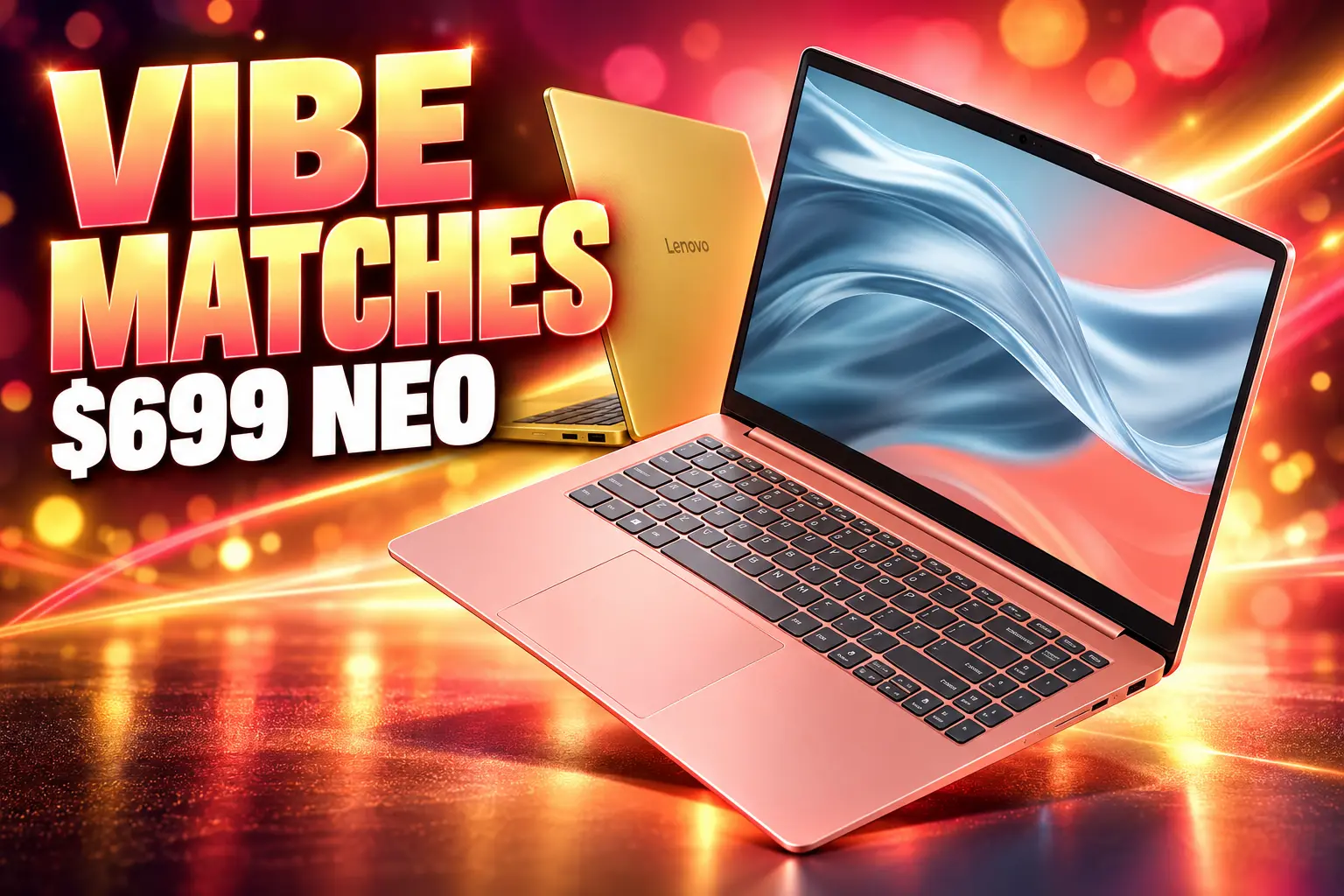
What the IdeaPad Vibe Puts on the Table
The Vibe is a 14-inch or 15-inch Windows 11 laptop, 14.9mm thick, starting at 1.3 kg (2.87 pounds). The Neo is 13mm thick and 2.7 pounds, so Lenovo is a little thicker and a little heavier, with a larger panel in both sizes.
Lenovo will sell all-metal units and mixed builds that keep a metal lid and keyboard deck over a plastic bottom. Chips are AMD Ryzen AI 400 or Qualcomm Snapdragon X at launch. An Intel version is promised without a date.
IDEAPAD VIBE VERSUS MACBOOK NEO
| Spec | IdeaPad Vibe | MacBook Neo |
|---|---|---|
| Starting price | $699.99 | $699 |
| Screen sizes | 14-inch and 15-inch | 13-inch |
| Thickness | 14.9mm | 13mm |
| Weight (from) | 2.87 pounds | 2.7 pounds |
| Memory | Up to 32GB AMD, user-upgradeable; up to 24GB Snapdragon, fixed | 8GB, soldered |
| Storage | Dual M.2, up to 1TB | 256GB or 512GB, fixed |
| Battery | 50Wh standard, 65Wh on AMD | 36.5Wh |
| Colors | 7 Pantone finishes | 4 (Silver, Blush, Citrus, Indigo) |
Both AMD and Snapdragon machines get two M.2 SSD slots and a 5MP webcam with a physical privacy cover. Keyboard backlight is optional. Touch is optional on the 15-inch size. In Europe the line starts at 799 euros.
Dell also showed a colorful 14S family at IFA aimed at the same band, so Lenovo is not the only Windows brand chasing the Neo’s new sticker. The Vibe is the one putting user RAM upgrades on the AMD side of the brochure.
Only the AMD Models Let You Add RAM
This is the split the color photos bury. AMD IdeaPad Vibe units support up to 32GB of dual-channel memory that the owner can upgrade. Snapdragon units stop at 24GB, and that memory cannot be upgraded. Storage stays expandable on both, through the second M.2 slot.
Lenovo has not published the RAM figure for the $699.99 configuration. Pre-launch specification sheets listed an 8GB option, including single-channel 8GB and 16GB layouts beside dual-channel 16GB, 24GB, and 32GB. Hands-on notes from IFA make the same inference: at current memory prices, the opening price almost certainly means 8GB.
That matters more than the chassis color. Microsoft’s Copilot+ bar is 16GB of RAM. Lenovo’s own AMD sheet uses the same cutoff. Below 16GB the Vibe is a regular Windows 11 laptop, not a Copilot+ PC, and local AI features that Lenovo is pitching under the Qira name are listed only on select configurations.
WHAT WE KNOW
- AMD path: Memory is user-upgradeable up to 32GB, with a 50Wh pack as standard and a 65Wh option on AMD, including the 15-inch model.
- Snapdragon path: Memory is fixed at up to 24GB, while the second SSD slot still works.
- Ship dates: AMD in October 2026, Snapdragon in November 2026, Intel later.
WHAT IS UNCONFIRMED
- Base RAM: Lenovo has not said whether the $699.99 box includes 8GB or 16GB.
- Module type: Pre-launch sheets described LPDDR5X at 5600 MT/s, which is an odd pairing with a user-upgrade story, and Lenovo has not shown the slots.
- Intel timing: No month, and no confirmation of which Core Series 3 chip lands in the Vibe.
Buying 8GB now and adding RAM later is the classic Windows pitch. It is a weaker pitch in 2026, because stick memory itself is expensive. The still-useful version of that pitch is simple: if you pay for 16GB or 32GB on an AMD Vibe, you are not stuck there for the life of the machine, and you are not paying Apple’s soldered 8GB ceiling a second time.
Lenovo has already sold other 2026 IdeaPads with a dual-slot RAM and SSD design around Ryzen AI 400, so the upgrade story is not a one-off slide for IFA. The Snapdragon Vibe is the one that repeats Apple’s lock-in, then asks you to like the paint.
Seven Colors, Two Chassis, and Slow Ports
Lenovo worked with Pantone on seven finishes. You can order keycaps in those colors, and you can buy extra sets to mix the keyboard against the lid. That is the part built for social photos, and it is also the part Windows makers have skipped for years while Apple sold Blush and Citrus.
Daniel Rubino spent time with the machine at IFA and put the emphasis on that menu, not on beating Apple Silicon in a benchmark.
I went hands-on with Lenovo’s new $699 IdeaPad Vibe, and it’s clearly built to take on the MacBook Neo. The design feels great for the price, the display is solid, and the overall experience punches way above its weight. The big selling point? A wide variety of colors for the shell, and you can even change out the keycaps to really make it custom. Plus, AMD, Qualcomm, or Intel chips. Customer choice is the real winner here.
Daniel Rubino, editor, on X
THE SEVEN PANTONE FINISHES
- Dreamy Violet: Muted violet that Lenovo describes as layered and calm.
- Spicy Gold: A rich golden yellow, shown on several of the metal demo units.
- Zen Green: A nature-toned green aimed at a slower, quieter look.
- Chill Blue: An icy blue Lenovo calls crisp and modern.
- Radiant Coral: Warm orange, one of the louder lids on the show floor.
- Moody Blue: Deep blue, one of the two OLED colors.
- Lowkey Grey: Neutral grey, the other OLED color.
The port list is long next to the Neo. You get two USB-A, two USB-C, HDMI 1.4, a 3.5mm jack, and a microSD reader. The Neo has one USB-C port at 10Gbps, one USB-C port at USB 2.0, and a headphone jack, with no HDMI and no card reader.
Every USB port on the Vibe is capped at 5Gbps. HDMI is the older 1.4 spec. You will plug in more things without a dongle. You will not get a fast drive, a fast dock, or a high-refresh external display out of those sockets. Pre-launch sheets also listed Wi-Fi 6, while the Neo ships with Wi-Fi 6E.
Why OLED Is Stuck on Gray and Blue
Lenovo’s own color story runs into the panel matrix. OLED is limited to Moody Blue and Lowkey Grey, the two quietest paints. Those panels are listed with full DCI-P3 coverage. The 14-inch OLED is WUXGA (1920×1200). The 15-inch OLED is a 15.2-inch 2.1K (2240×1400) sheet at 500 nits with True Black 1000.
Everyone else gets IPS. The better IPS option is 120Hz with 100% sRGB at 400 nits. Pre-launch sheets also listed a cheaper 60Hz IPS panel with 45% NTSC, which is the kind of screen that makes a $699.99 Windows laptop feel like a $699.99 Windows laptop. If you want Spicy Gold or Radiant Coral, you are on IPS, not OLED.
The Neo’s 13-inch Liquid Retina panel is 2408×1506 at 219 ppi and 500 nits, 60Hz, full sRGB, no wide P3, no True Tone. It is still a denser, brighter everyday screen than the Vibe’s base IPS, and it does not make you pick a dull color to get the good glass.
Battery is the quieter Windows advantage on paper. The Vibe’s standard pack is 50Wh, and AMD configurations can take 65Wh. The Neo uses 36.5Wh and a 20W adapter. Lenovo lists a 65W USB-C brick. Pre-launch sheets also claimed Rapid Charge Boost of 15 minutes for two hours of use. That has not been tested against the Neo’s fanless A18 Pro, which is the part of Apple’s machine Windows still has to beat after the price hike.
A Matching All-in-One for the Desk
Lenovo is wrapping the same palette around a desktop. The IdeaCentre AIO i (also written IdeaCentre AIO I) uses Intel Core Series 3 chips and the same Pantone-led finishes, including Dreamy Violet, Radiant Coral, Zen Green, and Chill Blue. It ships in November with a matching keyboard and mouse.
IDEACENTRE AIO I AT LAUNCH
- Screens: 23.8-inch or 27-inch Full HD, up to 120Hz, 350 nits, with tilt and 30mm of height travel.
- Price: $939.99 for the 24-inch model, $1,149.99 for the 27-inch.
- Memory and storage: Up to 32GB of RAM on the 27-inch, plus dual SSD slots.
- AI rating: Up to 40 TOPS on the Core Series 3 platform.
That desktop is the iMac-shaped half of the same bet: color as the reason to look, expandable storage as the reason to stay. It does not inherit the Vibe’s AMD upgrade path. It does inherit the idea that a $939.99 home PC should not look like a black office box.
October Will Test the $699 Sticker
AMD IdeaPad Vibe laptops are due in October 2026. Snapdragon follows in November. Until configure-to-order pages go live, the $699.99 match is a floor, not a build. The machine that actually competes with the Neo is an AMD 14-inch with 16GB, a 120Hz IPS or gray/blue OLED, and a second SSD slot left empty for later.
The machine that repeats 2026’s worst habit is an 8GB Snapdragon with soldered memory, a 60Hz panel, and a loud lid color. That SKU will photograph well and age like every other 8GB Windows laptop from this shortage. Lenovo already knows how to leave RAM and storage open. The October boxes will show whether it did that at the price it printed in Berlin.

The Salary Cap Fight That Can Freeze Baseball’s TV Payday

The 2027 Mercedes GLE and GLS Keep Alabama Busy

Margaret Hamilton Dies at 90 With a Harder Fight Unfinished

Unity Parks Its Engine Inside Google’s Prompt Games

The Hidden Vendor Cut in 403(b) vs 401(k) Plans

Microsoft 365 Auth Fault Took Down Exchange and Teams

IFA 2026’s Weird Gadgets Are Building a Sensor Home

Xbox Caps Game Pass Cloud Gaming at 15 Hours

Squishy Dumpling Toys Recalled After Hiding Illegal Water Beads

Tesla Puts Its Wheel-Free Cybercab on Austin Streets
-
 NEWS2 months ago
Microsoft 365 Auth Fault Took Down Exchange and Teams
-
 GAMING1 month ago
Xbox Caps Game Pass Cloud Gaming at 15 Hours
-
 NEWS1 month ago
IFA 2026’s Weird Gadgets Are Building a Sensor Home
-

 NEWS1 month ago
OpenAI Unveils GPT-6 Astra With a Critical Cyber Label
-
 AUTO1 month ago
Tesla Puts Its Wheel-Free Cybercab on Austin Streets
-

 NEWS2 months ago
OpenClaw 2.0 Ships a Team Workplace With Host-Trust Defaults
-

 NEWS2 months ago
Sony and Warner Sue Anthropic Over Torrented Song Lyrics
-
 LIFESTYLE1 month ago
Squishy Dumpling Toys Recalled After Hiding Illegal Water Beads