
Health
FDA Still Points to Taylor Farms Lettuce Despite Retracted Cyclospora Test
FDA still blames Taylor Farms lettuce for a record Cyclospora outbreak, even as a retracted lab test reveals weakened surveillance and delayed traceability rules.

The Food and Drug Administration still blames Taylor Farms iceberg lettuce for a Cyclospora outbreak that has sickened more than 1,600 people, even after retracting the one lab test that had linked the company’s product to the parasite. The agency reversed itself late Sunday, calling a positive result from the weekend a false positive. It says that changes nothing about the recall or the evidence behind it.
Cyclospora is nearly impossible to catch on a lab slide in the first place. And two federal systems built to catch outbreaks like this one faster, a surveillance network and a food-traceability rule, were pulled back or delayed before this summer even started.
A Retracted Test, an Unchanged Recall
On July 17, Taylor Farms de Mexico announced it was pulling all iceberg lettuce grown in central Mexico from the U.S. market, days after investigators traced a string of illnesses back to shredded lettuce served at Taco Bell locations in Indiana, Kentucky, Michigan, Ohio and West Virginia, part of the FDA’s five-state outbreak investigation into shredded lettuce. The company said it acted “out of an abundance of caution” after the FDA shared its initial findings.
The next day, the FDA said a lettuce sample collected from the company had tested positive for Cyclospora. By Sunday, the agency had reversed itself. Laboratory experts re-reviewed the sample and “concluded that the finding does not represent true amplification and should be considered a false positive,” the agency said in a statement.
That sample never fell inside the existing recall. It came from a separate shipment collected during routine border inspections, a detail that only became clear after a positive sample found outside the recall zone had already made headlines. On social media, the FDA clarified that the false positive “does not change the basis for FDA’s ongoing outbreak investigation or the overwhelming epidemiological data” supporting the recall.
Taylor Farms framed the reversal as a vindication. “Today, we were informed that FDA made a mistake, and this was a false positive,” the company said in a statement, adding that the FDA had apologized. FDA officials disputed that characterization on a call with reporters Monday. As of Sunday, the agency said it had not found any confirmed positive sample results for product testing in this outbreak.
Why Cyclospora Rarely Shows Up on a Lab Slide
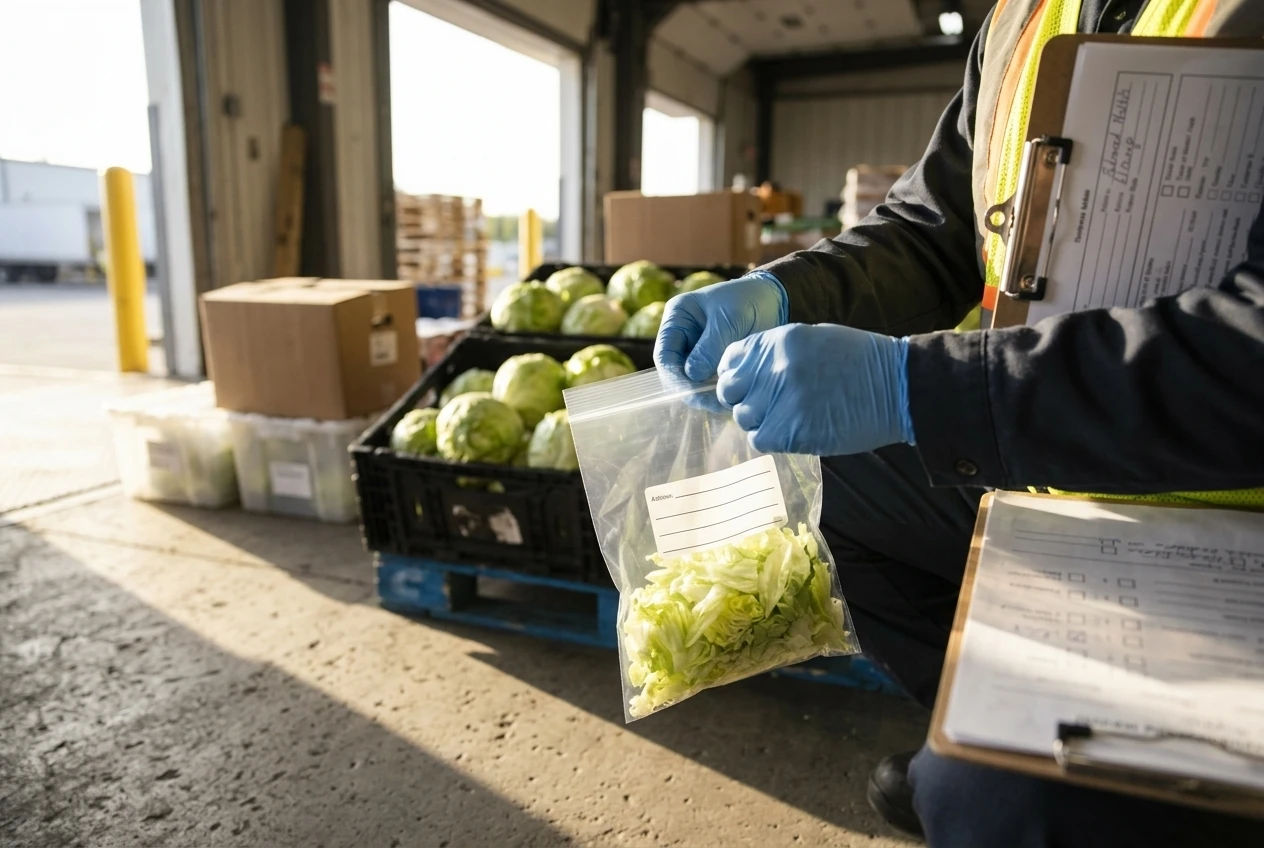
Cyclospora cayetanensis cannot be grown in a culture and has no animal model, so there is no way to multiply a sample before testing it. Detection means washing produce, pulling whatever DNA comes off, and running a PCR test that copies fragments of genetic material until there is enough signal to read.
The FDA screens imported lettuce at the southern border with this method. That speed comes with a cost. An analysis published on food safety attorney Bill Marler’s blog pointed to testing by Canadian government scientists, who found the FDA’s detection method caught the parasite in leafy greens spiked with 200 oocysts 93 percent of the time, but only 30 percent of the time when greens carried just 10 oocysts. Contamination on an actual field-grown leaf is patchy, not spread evenly across it.
“It’s really hard to grow cyclospora in the lab,” said Thomas Gremillion, director of food policy at the Consumer Federation of America, a nonprofit consumer advocacy group. A clean lab result here mostly means the test missed something that was always hard to find, not that the lettuce was truly free of the parasite.
Why Interviews Are Carrying This Investigation
Investigators never built their case on a lab result. They built it on interviews.
Acting FDA Commissioner Kyle Diamantas said the outbreak cluster tied to Taco Bell involves more than 1,600 cases, with some illnesses reported as recently as the week before. He said the agency has tracked five separate Cyclospora subclusters nationwide since the season began in May, three of which are already considered over. “We found it was important to share this actionable public health information,” Donald Prater, the FDA’s acting deputy commissioner for food, told reporters on a call.
A public health laboratory scientist, not authorized to speak publicly, told Reuters that the border test result is separate from the domestic outbreak investigation, which rests on epidemiological and traceback evidence that stands on its own.
Donald Schaffner, who chairs the food science department at Rutgers University, put it directly. “Taylor Farms is still implicated because of the epidemiology,” he wrote in an email to reporters.
“People that ate at Taco Bell, and ate Taylor Farm lettuce, are sick with the parasite,” he continued. “It’s important to realize that this is only a statistical correlation. Correlation is not causation, but it was strong enough evidence that FDA and CDC believe that this is the cause.”
Schaffner also called the recall the right move for Taylor Farms regardless of the lab result, and said the FDA showed unusual candor in admitting its test was wrong. The numbers involved depend heavily on which cluster gets counted, and the scopes rarely line up.
| Scope | Confirmed or Suspected Cases | Hospitalizations | States |
|---|---|---|---|
| Taco Bell/Taylor Farms cluster (CDC-confirmed) | 1,644 | 94 | 5 |
| Nationwide cyclosporiasis, all clusters combined | Nearly 7,000 confirmed or suspected | More than 140 | 34 |
| Michigan alone (state health department count) | 6,148 | 102 as of last week | 1 |
No deaths have been reported in any of these counts.
A Surveillance Program Went Quiet a Year Early
FoodNet is the CDC’s Foodborne Diseases Active Surveillance Network. It had required member states to report Cyclospora cases since 1997, one of eight tracked pathogens. The partnership spans the CDC, the USDA, the FDA and ten state health departments, covering 16 percent of the U.S. population.
That changed on July 1, 2025, when the network narrowed mandatory reporting to two pathogens, Salmonella and Shiga toxin-producing E. coli, and made tracking of Cyclospora, Campylobacter, Listeria, Shigella and Vibrio optional. The change came with no public announcement at the time.
Sen. Jon Ossoff, a Georgia Democrat, sent a letter last week to Health and Human Services Secretary Robert F. Kennedy Jr. demanding to know why.
Your foolish and self-indulgent demolition of critical public health programs puts Americans at risk.
Ossoff wrote, pointing to the rising case count as evidence the cut had consequences. He asked whether the CDC had restored required Cyclospora surveillance, why it was dropped in the first place, and for a status update on the source investigation.
The CDC has defended the change. Its website says other surveillance systems now monitor for infection with FoodNet pathogens, and that narrowing the reporting requirement lets staff prioritize core activities while preserving the network’s underlying infrastructure.
- Sen. Jon Ossoff and allied food safety advocates argue the FoodNet rollback left investigators slower to spot a rising outbreak until it was already the largest on record.
- The CDC maintains other surveillance systems cover the gap left by narrowing FoodNet’s mandatory pathogen list.
- Donald Schaffner of Rutgers cautions that even full surveillance would not necessarily separate this cluster from the unrelated Cyclospora cases that turn up most summers anyway.
Robert B. Shpiner, a clinical professor of medicine at UCLA’s David Geffen School of Medicine, wrote in a Guardian opinion piece that the looser FoodNet monitoring made it easier for federal officials to miss the outbreak as it built.
The Traceability Rule That Still Won’t Arrive Until 2028
A second tool remains stalled. The FDA’s Food Traceability Rule, formally Section 204 of the Food Safety Modernization Act, was supposed to take effect January 20, 2026. It would require companies handling high-risk foods, including leafy greens, to keep standardized digital records showing where a product came from and where it went, and hand that information to investigators in an electronic, sortable format within 24 hours of a request.
The rule exists specifically to speed up identification and removal of contaminated food, cutting the kind of multi-week guessing game this outbreak has produced.
That deadline never held. In March 2025, the FDA said it intended to push compliance back 30 months. A formal proposal followed that August, and by November, Congress had written a 30-month compliance delay to July 2028 into law, two years after this outbreak began.
A government watchdog wants the pace picked up regardless. The Government Accountability Office recommended in a 2026 report that the FDA build a specific timeline for the product-tracing system meant to let the agency analyze traceability data more effectively and rapidly, according to a Congressional Research Service summary of the rule’s history.
Forbes reported that Federal Election Commission filings show Taylor Fresh Foods Inc., the parent company of Taylor Farms, contributed $1 million to MAGA Inc., the pro-Trump super PAC, in March 2025, within a week of the FDA’s announcement that it intended to delay the traceability rule. The filing does not establish any connection between the donation and the delay, and Taylor Farms has not commented on the timing.
Taylor Farms Has Been Here Before
This is not the company’s first outbreak investigation. In October 2024, Taylor Farms voluntarily recalled raw onions the FDA said were likely linked to an E. coli outbreak tied to McDonald’s Quarter Pounder sandwiches. That outbreak ended in December 2024 after sickening 104 people across 14 states, hospitalizing 34 and killing one person.
The company’s pattern of repeat outbreaks now spans two federal investigations in under two years, one bacterial and one parasitic, on opposite ends of the produce supply chain.
What to Do With Lettuce Already in Your Fridge
Health officials are not waiting for a lab result before telling people what to do.
- Throw out any iceberg lettuce grown or processed by Taylor Farms in central Mexico, including bagged Marketside-brand salads sold at Walmart with best-by dates between July 18 and August 3.
- Ask restaurants where their lettuce comes from if it is not posted, particularly in the 27 states where recalled product reached distributors between June 29 and July 16.
- Cook produce to 158 degrees Fahrenheit when possible. That temperature kills the parasite; washing alone reduces risk but will not eliminate it.
- Watch for symptoms, including watery, sometimes explosive diarrhea, fatigue and nausea, which can relapse for weeks if the infection goes untreated.
The outbreak is already the worst cyclospora surge on record, and the CDC expects case counts to keep climbing through the end of August as more lab-confirmed reports work through state health departments.
Frequently Asked Questions
Is Cyclospora contagious from person to person?
No, not typically. The parasite needs to spend days to weeks outside the human body in the environment before it becomes infectious again, which makes direct person-to-person spread unlikely, unlike norovirus or the flu.
How long does cyclosporiasis last if untreated?
Symptoms can last several weeks or months without antibiotic treatment, and they may go away and then return one or more times before finally clearing.
How soon after exposure do symptoms start?
Most people who swallow the parasite start feeling sick within two days to two weeks, though exact timing depends on how much of the parasite they ingested.
Are other lettuce brands safe to eat?
Yes. The recall and FDA advisory apply specifically to iceberg lettuce grown or processed by Taylor Farms in central Mexico. Lettuce from other suppliers has not been implicated.
Why did the FDA announce a positive test before it was confirmed?
Officials said they shared the result before finishing a full quality control review because the sample fell outside the existing recall zone and they judged the public health stakes urgent enough to act on preliminary data rather than wait.


Walmart’s $50 Million Opioid Settlement Closes Case Without Admission

California Sues Over $120 Million Morro Bay Wind Lease Buyout

Gilead Bixlenvo FDA Nod Opens Single Pill Path for Complex HIV Cases

Meta’s $18B Kids Deal Forever Shields Data Used to Spot Under-13s

Lettuce Outbreak Drove Record Cyclospora Spike Across 20 States

Amazon Shaves $20 Off M6 Mac Mini Before It Even Ships

SpaceX Louisiana Port Tests Debt Markets on Orbital AI Scale

Microsoft High Lifts Indexes as Small Caps Crack Support

Apple Replays 2015 Saturday Midnight Preorder for iPhone 18 Pro

Updated COVID Shots Clear FDA but Access Friction Hits High-Risk Groups

Take-Two CEO Pushes Netflix Subs for GTA 6 Extended Look

Destiny 2 Fans Unlock Vaulted Maps After Live Service Ends

Wildlands Free Update Hands Players the Tools They Already Invented

Quake Gets 19 Free Maps From MachineGames Quake Club

Quordle Monday Delivers Gavel Crush Speed Ethos Cleanly

Stripe Bid Shows PayPal Moat Cracked After Years of Slide

Tyson’s Five-Year Utah Plant Falls to Cattle Shortage Reckoning

Silver Lake Workday Talks Signal Private Floor for Software

Kennedy Lewis Takes Majority Control of The Greenbrier in $500M Deal

Best Buy Marks 60 Years With Sale That Echoes Its Audio Shop Roots
-

 TECHNOLOGY3 years ago
How to Adjust a Bulova Watch Band – An Easy Guide
-

 News3 years ago
Fred Pentland: Athletic Bilbao’s English mentor who changed the essence of Spanish football
-

 FINANCE3 years ago
Tax Planning for Every Season: Guide to Maximizing Your Tax Benefits
-

 Education3 years ago
African Ministers New Education Plan
-

 BUSINESS3 years ago
What is Entrepreneurial Operating System? A Comprehensive Guide to EOS
-

 Education3 years ago
Innovate Your Learning Journey with Technology and Enhance Education
-

 News3 years ago
Russians formally out of World Athletics Championships
-

 BUSINESS3 years ago
Top 9 Most Expensive American Cities to Rent an Apartment