
News
SORA-Q: A Palm-Sized Ball That Explored the Moon in 108 Minutes
SORA-Q, a palm-sized ball rover co-designed by JAXA and toy maker TOMY, spent 108 minutes exploring the moon and beamed back images of the SLIM lander.

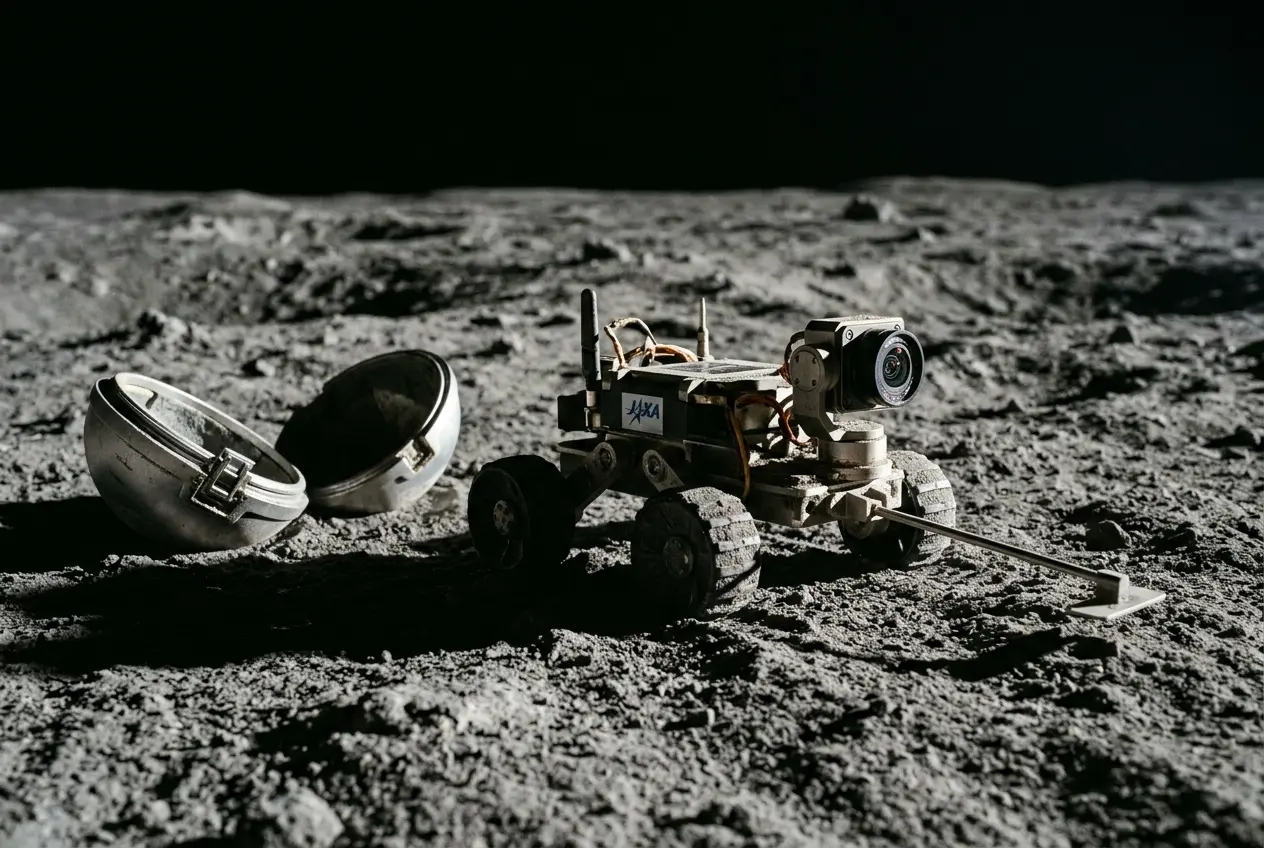
A palm-sized, ball-shaped rover called SORA-Q spent about 108 minutes exploring the moon on its own in 2024, capturing high-resolution images of Japan’s SLIM lander before falling silent. The 228-gram robot, jointly developed by the Japan Aerospace Exploration Agency and Japanese toy maker TOMY, travels to the moon as a compact sphere and unfurls two wheels, cameras, and a tail stabilizer once it touches the lunar surface. The team’s full account of the mission was published this month in the journal Science Robotics.
The shape-shifting design is borrowed from ball toys that fold out into wheeled vehicles, and the rover’s wheels turn around an axis set away from the center to keep them from sinking into powdery lunar soil. SORA-Q did not try to beam signals directly back to Earth. It used a buddy system, relaying its data to a companion rover called LEV-1, which then transmitted everything to mission control.
A Ball That Unfolds Into a Rover
Lunar rovers do not have to be car-sized. SORA-Q rode to the moon as a compact sphere about 80 millimeters across and unfurled two offset wheels, miniature cameras, and a small tail stabilizer once SLIM touched down. The two-wheeled robot is the formal Lunar Excursion Vehicle 2, and the team explains the system in the full paper on the SORA-Q mission, with the nickname drawn from the Japanese words for “space” and “sphere.”
The deployable shell is the central engineering trick. Folded up, the sphere slips into a corner of the SLIM lander alongside its larger companion LEV-1. On the surface, the two halves of the shell open outward, exposing offset wheels and a deployable tail that doubles as a stabilizer. The team reports that the shell, the offset wheel geometry, and the deployable sensor package were all sized to the constraints of a 228-gram robot.
Three design choices made the difference. They kept the rover small, kept it from sinking into the regolith, and kept it moving on minimal power.
- Ball-to-wheel transformation: a compact sphere that opens into a two-wheeled rover once on the surface
- Offset wheel axis: wheels rotate around an axis set away from the center to dig in less and grip loose soil
- Deployable sensor package: front and rear cameras plus a tail stabilizer that fold into the shell and pop out after landing
The shape-shifting body solves a problem that has tripped up earlier microrobots on the moon: their wheels get trapped in powdery regolith. Conventional wheels sit centered on their axles, and the soft lunar soil swallows them. Offsetting the axis shifts the contact point, and the team reports that the wheel design came straight from a TOMY toy innovation.
Why JAXA Asked a Toy Company for Help
The choice of TOMY as a co-developer is not a marketing stunt. JAXA needed a partner that could design and manufacture complex, moving parts at toy scale and toy cost, and the agency’s LEV-2 project page lays out the engineering case. Sony Group Corporation handled the control boards and sensors, joining the project in 2019, and Doshisha University took on mechanism design, joining in 2021. The four-party build produced a 228-gram rover small enough to ride inside the SLIM lander as a secondary payload.
TOMY’s role is mechanical, covering the ball-toy form factor and the offset wheel design that the rover carries to the lunar surface. The agency brought the science goals, the launch slot, and the integration with SLIM. The toy company brought the parts.
The paper’s authors put the conclusion in a single sentence. They describe the result as the demonstration the mission was built to deliver.
“This study demonstrated that autonomous surface operations can be realized using extremely compact robotic platforms.”
The line comes from D. Hirano and colleagues, whose Science Robotics paper was published in June 2026. The team at JAXA, TOMY, Sony, and Doshisha calls the result a proof of concept, and the design and the engineering list are both in the paper.
108 Minutes Around the SLIM Lander
SORA-Q deployed from the SLIM lander on 19 January 2024, just hours before the spacecraft itself touched down. Once on the surface, the rover operated on its own, navigating around the lander without waiting for instructions from Earth. The team reports that it sent back high-resolution images of SLIM and the surrounding terrain. Communications were lost about 108 minutes after deployment.
The paper notes that LEV-2 “accomplished autonomous lunar exploration by navigating around the SLIM lander, capturing images of both the SLIM lander and its environment, and transmitting selected images … without reliance on ground-based teleoperation.” The phrase “selected images” is a deliberate engineering choice: a palm-sized rover has a thin power budget, and choosing which shots to relay is part of the architecture. The selection protocol is what makes a 228-gram robot useful for more than a few minutes.
The mission also validated the SLIM landing site, giving the team a close-up look at the lander after touchdown.
- 108 minutes of autonomous operation
- Approximately 80mm diameter, 228g mass
- 19 January 2024 (UTC) deployment from SLIM
- Two-wheeled, ball-to-wheel configuration
108 minutes is short by the standards of car-sized Mars rovers. For a ball that fits in a child’s hand, it was long enough to drive around a real spacecraft on a real planetary body and to send the pictures home. The team frames the result as a complete demonstration of the ball-to-rover pipeline, not a partial success.
The Buddy System That Saved the Battery
SORA-Q did not communicate with Earth on its own. Every photo and every sensor reading went to a partner rover, LEV-1, which carried the heavier radio and relayed the package to mission control. The split freed SORA-Q of the need for a high-power transmitter, a large antenna, and the processing required to aim a signal across 380,000 kilometers of space. The rover could spend its saved battery and saved processor cycles on what mattered: driving, imaging, and choosing which images to send home. The team describes the architecture as a buddy system, and it is the same pattern that lets a small companion probe on future missions ride along with a larger primary lander.
LEV-1 was the data hub, the relay, and the only direct link to Earth. SORA-Q’s job was to stay small, stay low-power, and stay focused on the surface. The team reports that the rover’s 108 minutes of useful work were limited by the lunar environment, not by onboard computation.
Where the Mission Fell Short
The paper does not pretend the mission was flawless. The authors flag operational constraints and partial data loss as the two main technical challenges. Some of the imagery the rover captured did not make it back, and the team says the partial loss will inform the design of future small-scale space robots. The data and the lessons were published together, in the same paper, rather than held back for a follow-up mission.
The authors are also clear that the rover’s 108-minute run leaves questions open. A 228-gram robot with an 80-millimeter sphere cannot carry every sensor a flagship mission would want. The trade-off is built into the design, and the team is reporting what the trade-off bought and what it cost.
The paper’s closing message is that the platform held up long enough to do real science. The remaining gaps, the team says, are solvable in the next iteration.
What a Palm-Sized Robot Could Mean for Future Missions
The bigger story is what a palm-sized platform can fit into the budgets of future missions. The paper lists three specific advantages of going tiny, and each one opens a different door for mission planners. A second, a third, or a dozen small rovers can ride along on a single lander, multiplying the surface coverage without multiplying the launch cost.
- Lower development costs: toy-industry manufacturing methods can keep hardware cheap enough to risk on small missions
- Lightweight design: a 228-gram robot leaves more of the launch mass budget for scientific instruments and fuel
- Crowded-spacecraft fit: a small rover can ride along on a lander that was not designed around it, opening up secondary payload slots
The Science Robotics paper frames the result as a demonstration, not a destination. The team argues that compact platforms can carry the kinds of surface tasks that today fall to larger, more expensive rovers, and the buddy-relay architecture lets small robots operate without a full deep-space radio of their own. The next test will not be another SORA-Q. It will be the mission that sends a small, cheap, autonomous explorer somewhere the large rovers have not yet reached.
Frequently Asked Questions
How big is the SORA-Q rover?
SORA-Q is a palm-sized robot about 80 millimeters in diameter and 228 grams in mass. It rides to the moon as a compact sphere, then unfolds two wheels, a tail stabilizer, and a set of front and rear cameras after landing.
How long did SORA-Q operate on the moon?
The rover operated autonomously for about 108 minutes before communications were lost. In that window it drove around Japan’s SLIM lander and sent back high-resolution images of the spacecraft and the surrounding lunar terrain.
Who built the SORA-Q rover?
SORA-Q was co-developed by JAXA, the Japanese space agency, and TOMY, the Japanese toy manufacturer that designed the ball-to-wheel transformation. Sony Group Corporation handled control boards and sensors, and Doshisha University contributed mechanism design. The full mission results were published in the journal Science Robotics in 2026.
How did SORA-Q send data back to Earth?
SORA-Q did not try to beam signals directly to Earth. It relayed its images and sensor data to a companion rover called LEV-1, which carried the heavier radio and transmitted the package to mission control. The split saved the small rover’s battery and processing power for the surface work.






Geekbench 7 Launches and Erases Three Years of Scores

Google’s Selfie Video Sign-In Arrives as Deepfake Fraud Surges

Samsung’s New Galaxy Z Fold 8 Undercuts Its Own Ultra

Kroger and Brookshire’s Recall Over 19 Million Eggs for Salmonella

Mortgage Rates Hit an 11-Month High as Oil Fears Bite

Oil’s Price Shock Collides With Wall Street’s AI Spending Boom

Parsley and Cilantro Emerge as Cyclospora Suspects in North Carolina

Walmart Dresser Recall Reveals a Wider Furniture Safety Sweep

Apple’s iOS 27 Speed Fixes Echo Its 2018 Playbook

Cheshire Medical Center Cyclospora Cluster Exposes a Wider Outbreak

Pokémon GO Developer Niantic Rebrands as Scopely Explore

Persona 4 Revival Hands All Anime Cutscenes to Studio MAPPA

Doom Studio id Software Cuts Half Its Staff in Xbox Layoffs

Jaylen Brown Traded to 76ers for Paul George and Four Draft Picks

Nintendo Switch Online Adds Four Classics and One Japan-Only Title

Jordan Henderson Hospitalized After Wrist Injury at the Azteca

Mexico’s World Cup Run Ends at Azteca as England Hold On 3-2

Meta’s Muse Image Lets Anyone Use Your Instagram Photos in AI

Louis Vuitton Beats Molly Tea in China, Triggers Cultural Backlash

Pink Bearista Cup Returns July 13 as Starbucks Pink Vibes Drops
-

 TECHNOLOGY3 years ago
How to Adjust a Bulova Watch Band – An Easy Guide
-

 News3 years ago
Fred Pentland: Athletic Bilbao’s English mentor who changed the essence of Spanish football
-

 FINANCE3 years ago
Tax Planning for Every Season: Guide to Maximizing Your Tax Benefits
-

 Education3 years ago
African Ministers New Education Plan
-

 BUSINESS3 years ago
What is Entrepreneurial Operating System? A Comprehensive Guide to EOS
-

 Education3 years ago
Innovate Your Learning Journey with Technology and Enhance Education
-

 News3 years ago
Russians formally out of World Athletics Championships
-

 BUSINESS3 years ago
Top 9 Most Expensive American Cities to Rent an Apartment