
News
Valve Confirms Steam Frame Will Ship This Summer With Verified Program
Valve confirms Steam Frame ships this summer alongside the Steam Machine, with a Steam Frame Verified program requiring 90 FPS in standalone VR.

Valve has confirmed that Steam Frame, its first new VR headset since the 2019 Index, will ship this summer. The confirmation came in a Steamworks blog post on June 4, the same notice that formally launched the Steam Frame Verified program for games that run well on the headset in standalone mode. Steam Frame will arrive alongside the Steam Machine consolized PC, which the same post says is also shipping this summer.
The timing ends a six-month stretch of uncertainty. When Valve revealed Steam Frame in November, it pointed to “early 2026” for a launch. By February, a global memory shortage tied to AI infrastructure build-outs forced the company to “revisit” both its schedule and its pricing. Pricing for the headset is still unannounced, though Valve told UploadVR in November it was “aiming” to come in below the $1000 Index full-kit.
Valve Pins a Summer Window on Steam Frame
This month, in a Steamworks Development post titled “Steam Machine and Steam Frame Standalone Verified,” Valve’s June blog post launching Steam Frame Verified, the company wrote that it is “expanding the Verified program to include Steam Machine and Steam Frame, both of which are shipping this summer.” The notice was the first time the company has named a launch window since the February delay, and it bundles the headset with the Steam Machine, a small-form-factor desktop PC, as a single summer product pair.
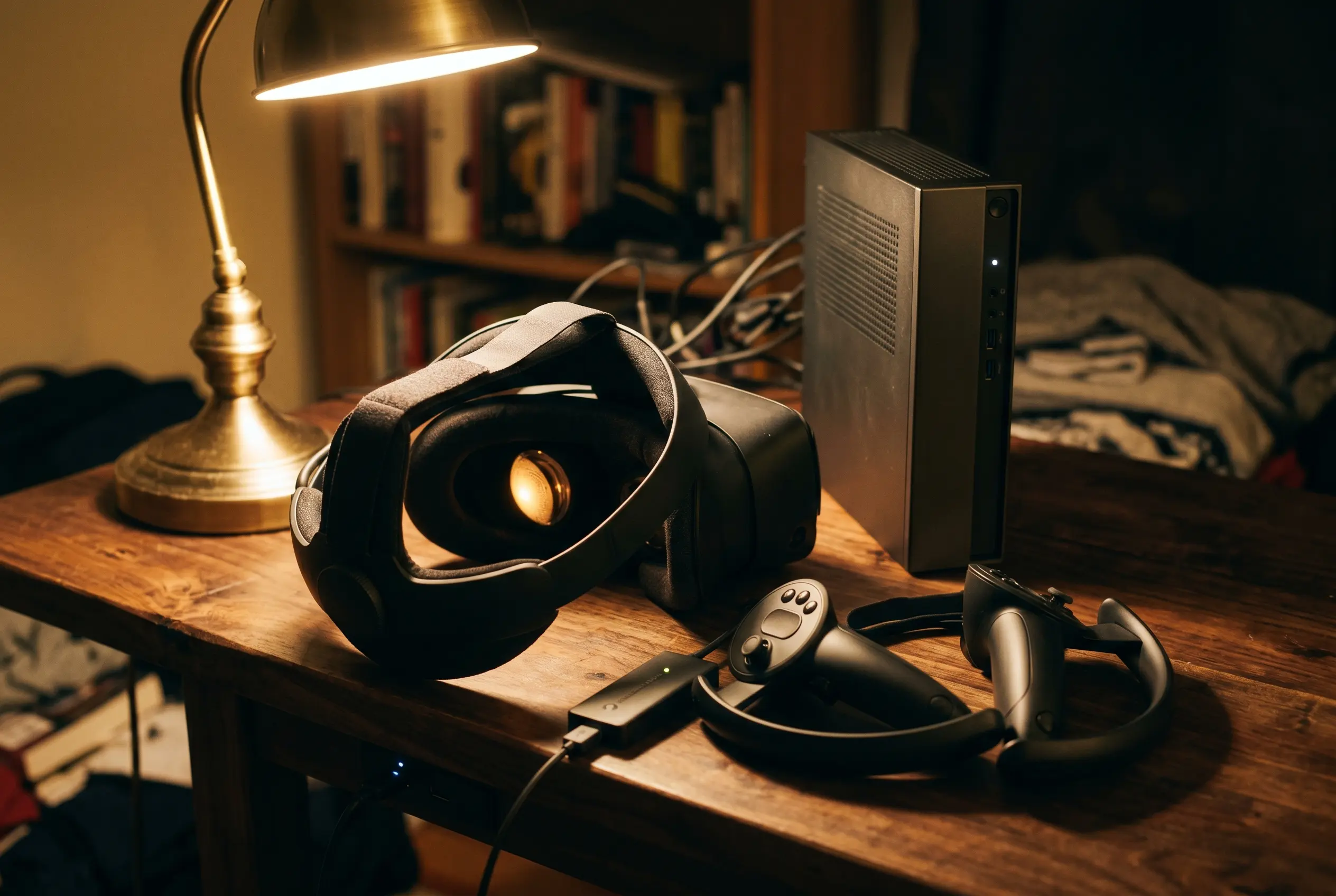
Steam Frame will replace the Valve Index on the market, and the company has already told UploadVR the Index is no longer in production. The new headset runs a VR-specific build of SteamOS and uses the same Proton compatibility layer as the Steam Deck to play Windows, Linux, and Android titles. The 6GHz Wi-Fi 6E wireless adapter in the box is the bridge to a gaming PC. Without one, Steam Frame falls back to standalone mode, where every game on the Steam store is in theory playable but most were never designed for the chip inside.
From Memory Crisis to a Confirmed Launch
The February delay was the direct result of a global shortage of DRAM and NAND flash driven by hyperscaler demand for AI training hardware. Valve said at the time that “the memory and storage shortages you’ve likely heard about across the industry have rapidly increased since then,” and that the company “must revisit” both its shipping window and pricing. Its stated goal stayed the same, “to ship all three products in the first half of the year,” but Valve stopped short of committing to specific dates.
By the June 4 update, the framing had shifted from “we are still working on it” to “this is shipping.” Valve designer Lawrence Yang, speaking to Rock Paper Shotgun, put a human voice on the stretch between February and now.
We’re obviously not thrilled about where things are at with the availability of these components. I think it is frustrating that, instead of being excited about getting ready to ship and launch these products, we’re having to deal with how we can actually build them, and think about how they’re impacted. I think… it’s not even really a silver lining, but it’s nice to know that we’re not the only ones in this boat.
The shipping window itself is open-ended. “This summer” in a Valve blog post from June 4 means a launch anytime before September 22. Tom’s Hardware and Road to VR both noted the absence of a firm date. Valve has not said what that date will be, and the company did not respond to a request for a more specific window before this article was published.
A 90 FPS Floor for Standalone VR
The other announcement in the same blog post is the Steam Frame Verified label, the headset’s version of the Steam Deck Verified badge. The criteria Valve set at GDC in March are stricter than any competing VR storefront. To earn the label in standalone mode, VR titles must run at 90 FPS, while flatscreen titles must run at 30 FPS at a minimum resolution of 720p, per the GDC 2026 Steam Frame hardware talk slides. The title must also be fully playable with the included Steam Frame Controllers, and any text or UI must remain legible on the built-in display.
The 90 FPS bar is the headline number, and it sits above what Meta, Pico, and Sony allow:
| Storefront | VR frame rate minimum for certification |
|---|---|
| Steam Frame Verified | 90 FPS native |
| Meta Horizon Store | 72 Hz (including 36 FPS reprojected to 72 Hz) |
| Pico Store | 72 Hz (including 36 FPS reprojected to 72 Hz) |
| PlayStation Store (PS VR2) | 60 FPS reprojected to 120 Hz |
Valve’s reasoning is the one the VR industry wrote down in early 2014, when both Oculus and Valve declared 90Hz the floor for high-quality VR. Below that rate, on the low-persistence displays used in headsets, many people can see a distinct flicker at the edges of the image during bright scenes. A separate study from Xi’an Jiaotong-Liverpool University, a Pimax 5K Super study on VR sickness thresholds, found 120 FPS to be the level at which nausea stopped increasing sharply, a result suggesting the original 2014 line was conservative rather than generous. Valve is choosing to hold that line rather than chase a lower one, and the cost is that fewer titles will clear it.
Running PC VR on a 10-Watt Mobile Chip
That cost is the practical problem at the heart of the headset. Steam Frame is powered by Qualcomm’s Snapdragon 8 Gen 3, a roughly 10-watt mobile chipset from late 2023 paired with 16GB of LPDDR5X RAM. On paper, the Adreno 750 GPU inside is 25% more powerful than the Adreno 740 in Meta Quest 3, a gap that widens to over 30% in practice because Valve confirmed Steam Frame does not underclock its GPU the way Quest 3 does. Even so, the chip is a fraction of what a desktop GPU can draw, and the vast majority of VR content on Steam was built for a gaming PC pulling hundreds of watts from the wall.
The headset can run almost any VR title on Steam. It just cannot run most of them well. “Visually simplistic and well-optimized titles at relatively low graphics settings will run well, and there’ll be a ‘Steam Frame Verified’ tag for such titles on Steam,” UploadVR’s November announcement explainer noted. “For high-fidelity VR gaming such as playing Half-Life: Alyx you’ll want to stream from your PC.” The Verified label is the mechanism by which Valve separates the first category from the second, and the 90 FPS requirement is the gate.
Two refresh rates bracket the display. The LCD panels run at 2160×2160 per eye, twice the Index and roughly equal to Quest 3, with a configurable range of 72Hz to 120Hz and an “experimental” 144Hz mode inherited from the Index. The pancake lens stack yields what Valve calls “very good sharpness across the full field of view,” rated “conservatively” at 110 degrees horizontal and vertical, “slightly less than Index.” The core frontbox weighs 185 grams; the full headset with strap, speakers, facial interface, and rear battery lands at 440 grams, which Valve describes as the lightest fully-featured standalone VR headset to date.
Why the Headset Has a Wireless Adapter in the Box
The included USB dongle is built for the chip problem. Steam Frame has two wireless radios. One connects to the home Wi-Fi network for the general internet connection of SteamOS; the other creates a 6GHz Wi-Fi 6E point-to-point hotspot that SteamVR on the host PC joins automatically. The dongle is the only network path the headset prefers for PC VR, and Valve designed the firmware on both sides to control the full network stack, which the company says eliminates the router-distance, wall-blockage, and ISP-supplied-modem problems that dog wireless PC VR on Quest and Pico.
Eye tracking feeds the streaming pipeline, encoding the video in higher resolution where the wearer is looking and lower resolution at the periphery. Foveated streaming has been available on Quest Pro via Steam Link VR since late 2023, but Valve says the latency is lower and the precision is higher on Steam Frame because the headset side of the software stack is its own. The same eye tracker drives foveated rendering in standalone titles, which is part of how the Adreno 750 hits 90 FPS on games that would not otherwise clear it on a 10-watt part. For owners who already have a high-end home Wi-Fi setup for PC VR, Valve says they can keep using it instead of the adapter, though the company suspects most will not.
What Developers Are Building for the Label
Since Steam Frame was announced in November, dozens of VR developers have been working to make their titles perform in standalone mode. The work has taken a few distinct shapes, and the Steam Frame Verified label is what tells buyers which ones succeeded. Developers can read the full criteria on the Steamworks documentation page for Steam Frame.
- Repurposing Quest or Pico builds: because Steam Frame can run Android APKs natively, some studios are shipping their existing Meta Quest or Pico ports with little to no rework, since both targets share the same architecture.
- Building a lower graphics tier: studios that already ship a PC version are adding a Steam Frame-specific preset, sometimes below their current lowest setting, tuned for the 10-watt chipset and the Verified criteria.
- Adding eye-tracked foveated rendering: a small set of titles are extending their foveated pipelines, which the Snapdragon 8 Gen 3 can use to claw back GPU budget without dropping the frame rate.
Valve’s promise is that tens of thousands of Steam Deck-verified titles will get a Steam Machine Verified badge automatically, and titles that fell short on Deck because of CPU or GPU limits may now pass on the more powerful Machine. For Steam Frame, the carryover is narrower, since the headset’s mobile chip and battery constraints do not match the Deck’s x86 silicon. The public list of who has cleared the Steam Frame Verified bar does not yet exist.
A 2014 Standard the Industry Had Already Started to Drift From
What the Verified label ultimately codifies is a return to a position the VR industry adopted when modern headsets were first sold to consumers. In early 2014, both Oculus and Valve publicly committed to 90Hz as the minimum bar for high-quality VR. The arrival of standalone headsets a few years later eroded that line: Quest 2 shipped at 72Hz, most Quest titles still run at 72Hz by default, and PlayStation VR2’s 60 FPS reprojected to 120Hz is now the most common floor on a tethered headset. Valve could have set Steam Frame’s bar to match. It set it at 90 FPS native, the original commitment, and accepted that fewer titles will qualify.
The bet is that buyers who want a wireless PC VR experience, which is what Steam Frame is sold as, will treat a smaller Verified catalog as a feature rather than a limitation, and that developers with the resources to optimize will do so. The cost of the bet is the games that will never carry the badge, because no amount of optimization gets them to 90 FPS on a 10-watt chipset. The headset will still play them. The store will just not call them Verified.






Shelby’s $42.9 million Daytona Coupe cashes the bet that beat Ferrari

AI forces Apple into third security drop in three weeks

Lamborghini banks 2027 revenue with sold-out Revuelto SV

Apple’s Labor Day Habit Locks iPhone 18 Pro September Dates

Frogwares Ships Sinking City 2 After Years of Air Raids

AirTag 2 Hits Near Lows Just as Travel Season Peaks

McLaren Pop Art F1 GTR Hits $34.6 Million and Resets the Tier

Spotify Playlist Notes Bring Back Liner Notes for Streaming

AirPods Max 2 hit $429 and finally close the value gap

Star Citizen private demo of Siege of Orison still wiped the devs

Guardians Rout Twins With Seven Homers, Leave Joe Ryan One Shy of Record

Rainout Gives Red Sox Two Shots at a Franchise-Record Win Streak

Caitlin Clark Skips the WNBA 3-Point Contest for a Third Straight Year

Double Fine Cuts 23 Jobs Weeks After Xbox Independence

John Hight Exits Wizards After Digital Reckoning Hits

Day-One Big Walk Lifts PS Plus August Beyond Recycled AAA

Curtis Mead’s Red Sox Debut Ends With Fractured Wrist

Moesch and Dressel Rewrite Night One at 2026 U.S. Nationals

Red Sox Squander Hot Streak Chance in 4-3 Loss to Athletics

Boutte’s Quiet Camp Takeover Forces Patriots Receiver Choices
-

 TECHNOLOGY3 years ago
How to Adjust a Bulova Watch Band – An Easy Guide
-

 News3 years ago
Fred Pentland: Athletic Bilbao’s English mentor who changed the essence of Spanish football
-

 FINANCE3 years ago
Tax Planning for Every Season: Guide to Maximizing Your Tax Benefits
-

 Education3 years ago
African Ministers New Education Plan
-

 BUSINESS3 years ago
What is Entrepreneurial Operating System? A Comprehensive Guide to EOS
-

 Education3 years ago
Innovate Your Learning Journey with Technology and Enhance Education
-

 News3 years ago
Russians formally out of World Athletics Championships
-

 BUSINESS3 years ago
Top 9 Most Expensive American Cities to Rent an Apartment