
FINANCE
Three Nuclear ETFs, Three Bets on the AI Power Race

Three exchange-traded funds now sell the same story: own the electricity source that will keep AI data centers running. The Range Nuclear Renaissance Index ETF (NUKZ), the Global X Uranium ETF (URA) and the VanEck Uranium and Nuclear ETF (NLR) each ride that thesis, but each one buys a different slice of the nuclear chain, and their one-year returns have already spread from 37% to 62%.
The headline read is simple. AI needs round-the-clock power, reactors deliver it, so buy nuclear. What that read papers over is which link tightens first, the reactors, the fuel, or the grid, because that question decides which of these three funds leads and which one lags for the next several years.
Why Nuclear Became the Default AI Power Answer
Start with the demand curve, because it is the only part of this trade nobody disputes. According to the Department of Energy’s report on data center power use, prepared by Lawrence Berkeley National Laboratory, data centers consumed about 4.4% of total US electricity in 2023 and could reach somewhere between 6.7% and 12% by 2028. A single hyperscale facility can pull more than a gigawatt, roughly the draw of 750,000 homes, and it runs that load around the clock.
That steady, always-on profile is exactly what nuclear is built to serve, and it is why the demand math keeps pointing back to reactors. S&P Global’s 451 Research forecast on data center grid demand projects the load will rise by nearly three times by 2030. Goldman Sachs Asset Management has named power grids, energy storage and renewables among its megatrends for 2026, and nuclear sits at the crossing point of all three.
The deals are already on paper. Microsoft contracted to take the full output of the restarting Three Mile Island Unit 1 over a 20-year term, with Constellation Energy securing a federal loan to fund the restart. Amazon expanded its arrangement with Talen Energy at the Susquehanna plant in Pennsylvania, locking in up to 1,920 megawatts of carbon-free nuclear power through 2042, as detailed in Talen Energy’s filing on the expanded Amazon agreement.
The bill is landing on households at the same time. The Energy Information Administration’s outlook for residential power prices sees the average residential rate near 18.2 cents per kilowatt-hour in 2026, a rise of close to 5%, and regulators in load-heavy regions are leaning toward firm, dispatchable generation. That tension is showing up locally, with state utilities now under scrutiny over record customer complaints over soaring electricity bills in Indiana.
- 4.4% to as much as 12%: data center share of US electricity, 2023 to 2028 (DOE and Lawrence Berkeley)
- Nearly three times: projected growth in data center grid demand by 2030 (S&P Global 451 Research)
- 1,920 MW: nuclear capacity Talen will supply Amazon through 2042
- About 5%: expected rise in US residential power prices in 2026 (EIA)
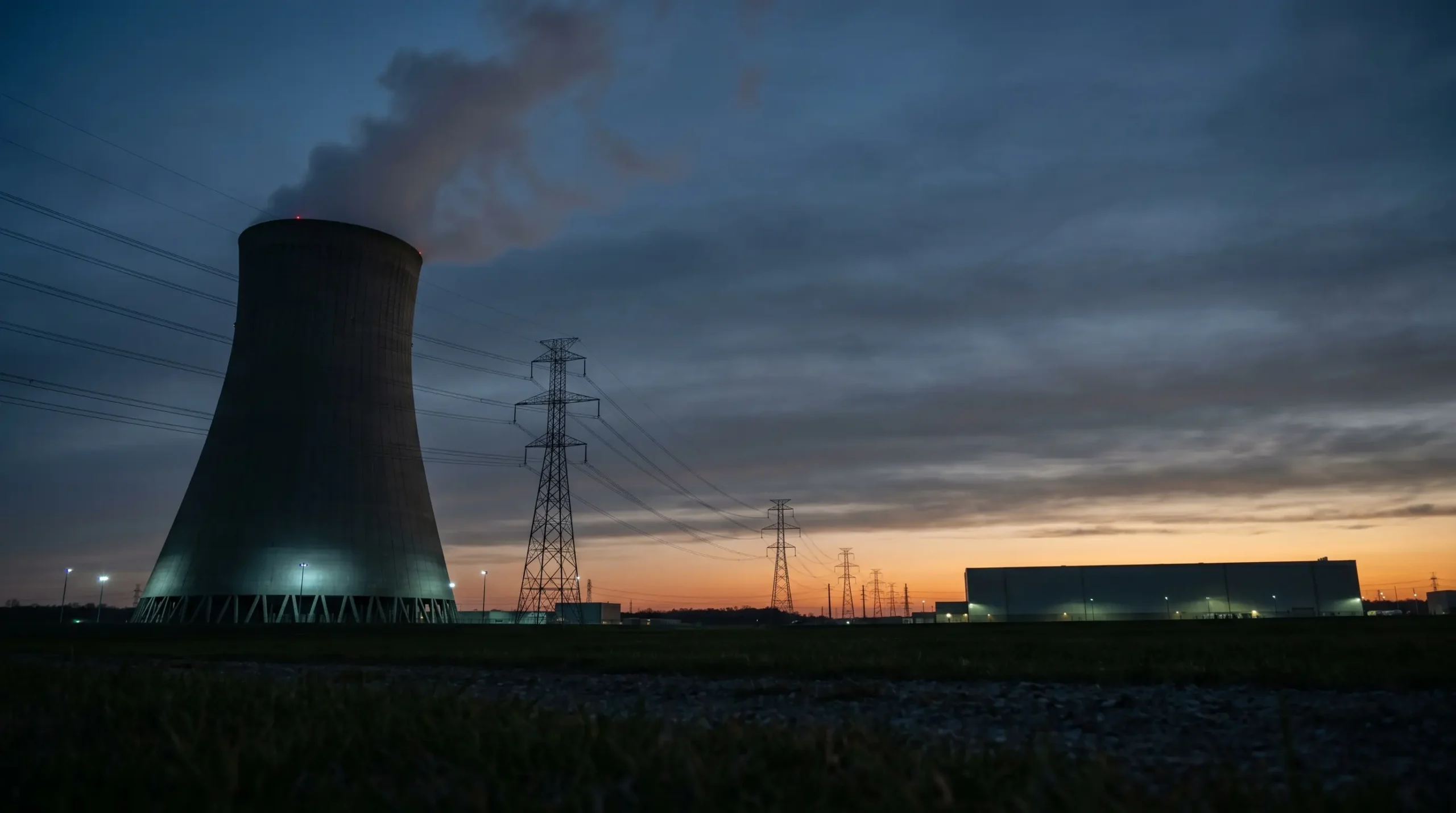
NUKZ Targets the Reactor and SMR Builders
NUKZ is the youngest of the three and the most directly pointed at the build-out. The Range Nuclear Renaissance Index screens for companies whose revenue ties to constructing, operating and servicing reactors, including small modular reactor (SMR, a factory-built reactor designed to ship in standardized units) developers, fuel fabricators and engineering firms. Top weights cluster around Cameco, GE Vernova, Talen Energy, Constellation Energy and BWX Technologies, per the Range Nuclear Renaissance Index ETF fund page, putting fuel supplier, equipment maker and operator in one basket.
The fund trades near $72, with a roughly 14% gain year to date and about 42% over the past 12 months. That trails the uranium fund on the year while beating the utility fund, which is the right outcome for a vehicle weighted toward infrastructure rather than commodity or regulated cash flow. If SMR timelines slip, the operators and large engineering names still earn from restart contracts and license extensions; if SMRs scale, the manufacturers are already in the portfolio. The cost of that targeting is concentration, since a short holdings list means one weak quarter from a top name can drag the whole fund.
URA Bets on the Uranium Chokepoint
URA owns the upstream end of the chain. The fund tracks the Solactive Global Uranium & Nuclear Components index, with weight concentrated in pure-play miners and physical-uranium holdings.
A Fuel Pipeline That Cannot Ramp Fast
Leading positions run heavily toward Cameco, with NexGen Energy, Oklo, Uranium Energy Corp and Sprott Physical Uranium Trust filling out the book, according to the Global X Uranium ETF prospectus filing. The expense ratio is 0.69%, in line with thematic peers.
Western utilities spent the 2010s drawing down strategic uranium stockpiles, and Kazakh, Canadian and Australian production cannot scale up quickly. Every reactor restart and every new contract pulls demand forward against a supply pipeline that takes years to expand, which is the squeeze URA is built to capture.
Why Miners Fall Harder Than Utilities
The numbers reflect both the spot move and the contract repricing flowing into miner economics. URA is up about 19% year to date and 62% over 12 months, with a 184% return over five years and 416% over ten, the strongest long record of the three.
That leverage cuts both ways. When uranium spot prices correct, miners typically fall further than utilities, and URA recently showed that asymmetry with a 6% one-month decline even while the broader thesis held intact. This is the volatile, high-beta way to own the theme.
NLR Anchors the Trade in Regulated Utilities
NLR is the conservative way to play the same idea. The fund blends regulated nuclear utilities with miners and a smaller slice of SMR developers across roughly 28 holdings, giving it a cash-flow profile closer to a utility fund than a commodity vehicle. Top names center on Constellation Energy, Cameco, BWX Technologies, Public Service Enterprise Group and Oklo.
It trades near $133, up about 7% year to date and 37% over 12 months, with a ten-year return near 270%. The returns are lower than its peers because regulated utilities cannot rerate as aggressively as miners or pure-play developers, but they carry rate-base earnings and steadier dividends.
The appeal is durability. Utilities that sign power purchase agreements directly with hyperscalers capture margin every time a data center plugs in, whether or not new reactors come online on schedule. If the trade compresses back into established operators, NLR holds up better than either alternative.
How the Three Funds Stack Up
Laid side by side, the funds map cleanly onto three parts of the same chain, and their returns track how far the market has rewarded each link so far.
| ETF | Slice of the chain | Year to date | 1-year | Longer record |
|---|---|---|---|---|
| NUKZ | Reactor and SMR builders | ~14% | ~42% | Newest, no 10-year history |
| URA | Uranium miners and fuel | ~19% | ~62% | ~416% over 10 years |
| NLR | Utilities and grid | ~7% | ~37% | ~270% over 10 years |
The choice comes down to which part of the thesis a reader finds most credible, and the three views do not have to be mutually exclusive.
- NUKZ for the reactor and SMR build-out, the most concentrated way to bet that hyperscaler contracts and modular reactors drive the next leg, with concentration risk as the price of that focus.
- URA for the fuel-cycle squeeze, the highest-beta route, tied tightly to uranium spot pricing and prone to sharper swings in both directions.
- NLR for the utility and grid leg, the most defensive option, anchored in regulated cash flows and the deepest track record.
Pairing them adds breadth without much overlap. NUKZ and URA together cover infrastructure and fuel while underweighting regulated utilities; NLR and URA capture utilities and miners but skip most of the SMR and engineering names NUKZ holds. The funds were built to complement, not duplicate.
Where the Nuclear Trade Could Break
None of this is a clean ride, and the same features that make each fund attractive also mark where it can crack. The demand thesis is durable; the path to monetizing it through any one fund is not.
Several pressure points sit under the trade right now:
- Concentration in NUKZ. A short holdings list means a single bad quarter from a top operator or component maker can pull the fund down further than a broader basket would.
- Spot-price whipsaw in URA. The fund’s 6% one-month drop, against an intact thesis, shows how quickly miners reprice when uranium spot softens.
- SMR timelines. Commercialization schedules can slip from permitting to grid connection, and local approvals remain slow, as seen in proposals to expand nuclear energy options in Colorado’s Garfield County.
- Lag risk in NLR. Regulated utilities cannot rerate as fast as miners, so if uranium spot doubles again, the utility fund will trail.
The honest read is that no single fund covers the whole thesis, and the one that wins depends on whether reactors, fuel or the grid proves the binding constraint. The year-to-date spread already hints at the market’s current vote, with the fuel chokepoint leading and the regulated utilities trailing, but that ranking can flip with one move in uranium spot. That is the part worth watching as the data center build-out runs through 2028.
Frequently Asked Questions
What is the difference between NUKZ, URA and NLR?
Each fund targets a different part of the nuclear supply chain. NUKZ holds reactor builders, SMR developers and engineering firms; URA concentrates in uranium miners and physical-uranium holdings; NLR leans toward regulated nuclear utilities and grid operators with a smaller miner and SMR allocation.
Which nuclear ETF has performed best in 2026?
Among the three, URA has led year to date with a gain near 19%, ahead of NUKZ at about 14% and NLR at roughly 7%. URA also leads over 12 months and over the past five and ten years, reflecting how strongly uranium miners reprice when spot prices and contract terms move higher.
Can you own more than one nuclear ETF without too much overlap?
Yes. The funds were designed to complement each other. NUKZ and URA together cover infrastructure and fuel while keeping utility weight low, and NLR and URA together capture utilities and miners but underweight the SMR and engineering names NUKZ holds. Check each fund’s top holdings before pairing, since names like Cameco and Constellation appear in more than one.
What is the expense ratio of the Global X Uranium ETF?
URA carries a total annual expense ratio of 0.69%, which is in line with other thematic energy and commodity funds. That fee is deducted from fund assets over the year rather than charged directly to investors.
Why is AI driving demand for nuclear power?
AI data centers draw large, steady, around-the-clock loads, and a single hyperscale site can use more than a gigawatt. Nuclear provides firm, carbon-free generation that matches that profile, which is why operators like Microsoft and Amazon have signed long-term power deals tied to reactors at Three Mile Island and Susquehanna.
Are nuclear ETFs a safe investment?
No thematic ETF is low-risk. These funds carry concentration risk, sensitivity to uranium spot prices, and exposure to project and permitting delays for new reactors. The utility-weighted NLR tends to be the least volatile of the three, while the miner-heavy URA tends to swing the most in both directions.
Disclaimer: This article is for informational purposes only and is not investment advice. Exchange-traded funds focused on nuclear power, uranium and utilities carry market, concentration and commodity-price risk, and past performance does not guarantee future results. Consult a qualified financial professional before making investment decisions. Figures, fund holdings and prices are accurate as of publication and can change.





Geekbench 7 Launches and Erases Three Years of Scores

Google’s Selfie Video Sign-In Arrives as Deepfake Fraud Surges

Samsung’s New Galaxy Z Fold 8 Undercuts Its Own Ultra

Kroger and Brookshire’s Recall Over 19 Million Eggs for Salmonella

Mortgage Rates Hit an 11-Month High as Oil Fears Bite

Oil’s Price Shock Collides With Wall Street’s AI Spending Boom

Parsley and Cilantro Emerge as Cyclospora Suspects in North Carolina

Walmart Dresser Recall Reveals a Wider Furniture Safety Sweep

Apple’s iOS 27 Speed Fixes Echo Its 2018 Playbook

Cheshire Medical Center Cyclospora Cluster Exposes a Wider Outbreak

Pokémon GO Developer Niantic Rebrands as Scopely Explore

Persona 4 Revival Hands All Anime Cutscenes to Studio MAPPA

Doom Studio id Software Cuts Half Its Staff in Xbox Layoffs

Jaylen Brown Traded to 76ers for Paul George and Four Draft Picks

Nintendo Switch Online Adds Four Classics and One Japan-Only Title

Jordan Henderson Hospitalized After Wrist Injury at the Azteca

Mexico’s World Cup Run Ends at Azteca as England Hold On 3-2

Meta’s Muse Image Lets Anyone Use Your Instagram Photos in AI

Louis Vuitton Beats Molly Tea in China, Triggers Cultural Backlash

Pink Bearista Cup Returns July 13 as Starbucks Pink Vibes Drops
-

 TECHNOLOGY3 years ago
How to Adjust a Bulova Watch Band – An Easy Guide
-

 News3 years ago
Fred Pentland: Athletic Bilbao’s English mentor who changed the essence of Spanish football
-

 FINANCE3 years ago
Tax Planning for Every Season: Guide to Maximizing Your Tax Benefits
-

 Education3 years ago
African Ministers New Education Plan
-

 BUSINESS3 years ago
What is Entrepreneurial Operating System? A Comprehensive Guide to EOS
-

 Education3 years ago
Innovate Your Learning Journey with Technology and Enhance Education
-

 News3 years ago
Russians formally out of World Athletics Championships
-

 BUSINESS3 years ago
Top 9 Most Expensive American Cities to Rent an Apartment