
News
Custom Mini-ITX Steam Machine Outpaces Valve’s Box by 81%, $200 Less
ETA Prime’s custom Mini-ITX Steam Machine outperforms Valve’s $1,049 box by up to 81% in gaming benchmarks, costs $200 less, and leaves room to grow.

A custom Mini-ITX Steam Machine built by YouTuber ETA Prime outperforms Valve’s newly launched $1,049 Steam Machine by up to 81% in gaming benchmarks while costing $200 less. The build trades Valve’s first-party polish for raw component value, and lands at a price that puts the official hardware’s premium in sharp relief just days after the console-shaped PC went on sale June 30, 2026.
ETA Prime’s walkthrough leans on an AMD Radeon RX 9600 XT GPU, an Intel Core Ultra 5 250K Plus CPU, and 32 GB of DDR5 RAM inside a ThermalTake TR100 Mini-ITX case. The result, per the video, hits 1.5 times the performance of Valve’s console-shaped PC across a slate of demanding games at 1440p and 4K. Valve says its own box is “over six times the horsepower of Steam Deck”; the YouTuber’s numbers show what that headroom looks like when an off-the-shelf GPU replaces the integrated RDNA 3 block.
The 81% Margin Over Valve’s First-Party Box
ETA Prime’s custom Steam Machine delivers 1.5 times the performance of Valve’s official model, per the build video. The figure is a smoothed average across the games tested; the peak gap lands at 81% on the most demanding titles. The build also costs $200 less than Valve’s $1,049 base model, a margin the YouTuber flags in the opening minutes.
Valve’s 2 TB Steam Machine costs $1,349, and the controller bundle on the 2 TB tier carries a $1,428 sticker, per the company’s Steam Machine product page. ETA Prime’s earlier $600 SteamOS build from late 2025 already showed what off-the-shelf parts could do against Valve’s silicon; the current build is the bigger, more deliberate swing at the new $1,049 box. The saving is the headline number Valve doesn’t print, and the one every buyer is now weighing against the official hardware’s out-of-box experience.
- 1.5 times the performance of Valve’s Steam Machine in ETA Prime’s benchmarks
- 81% peak gap on the most demanding titles
- $200 less than Valve’s $1,049 base model
- 18 cores on the Intel Core Ultra 5 250K Plus CPU
- 32 GB of Kingston Fury DDR5 memory at 6,000 MT/s
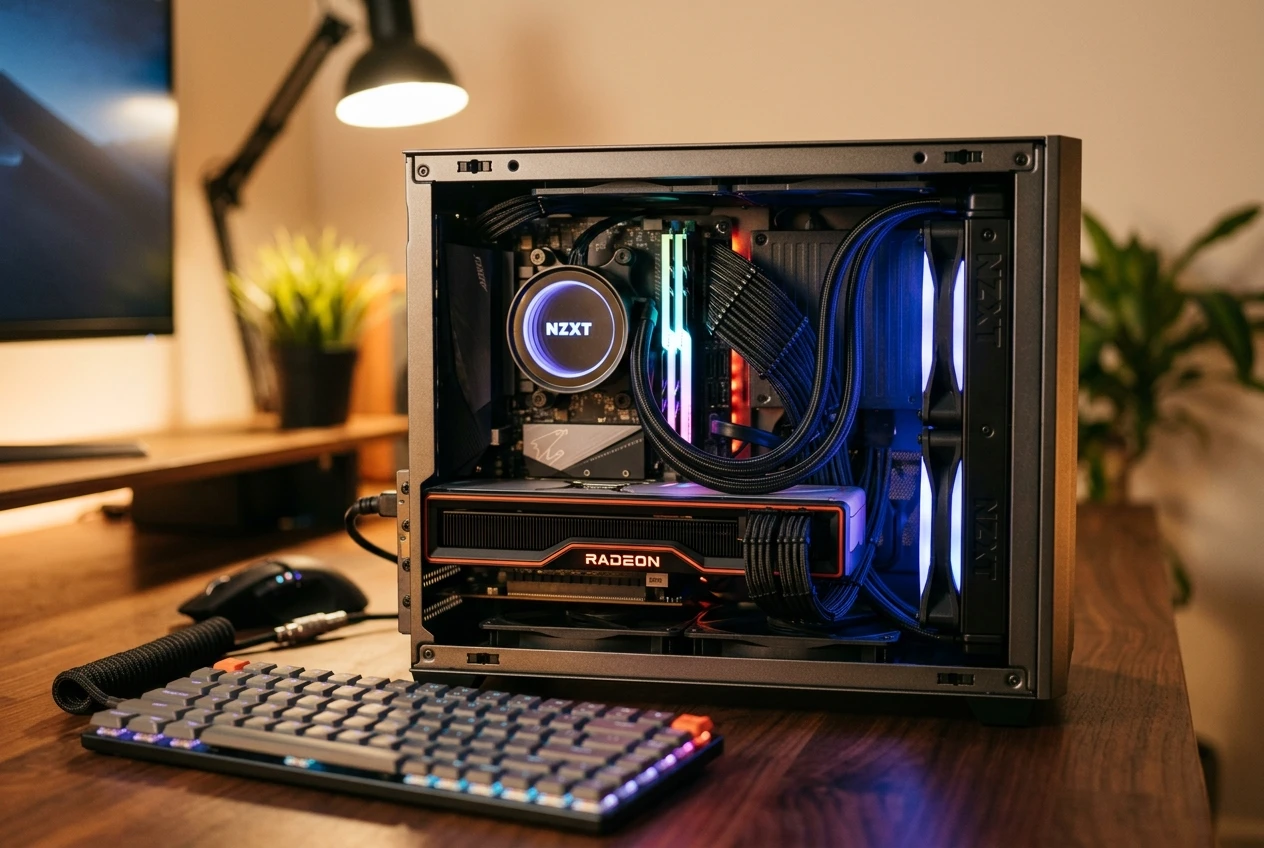
The Mini-ITX Parts List
The build runs an Intel Core Ultra 5 250K Plus with 18 cores and a 5.4 GHz max clock. It is paired with 32 GB of Kingston Fury DDR5 memory running at 6,000 MT/s, enough bandwidth to keep the GPU fed at 1440p and 4K on the tested titles. Valve’s APU is 6 cores at 4.8 GHz; the build video walks through how the parts were chosen and what the desktop-class chip adds to the kinds of frame rates the YouTuber shows.
The GPU is an AMD Radeon RX 9600 XT with 16 GB of VRAM. Storage is a 1 TB Kingston PCIe 3.0 NVMe SSD, picked for its price-to-gigabyte ratio rather than peak throughput. The 16 GB of VRAM is twice what Valve ships on the integrated RDNA 3 block, and the 32 GB of system RAM is twice Valve’s 16 GB, both of which line up with texture-heavy 4K packs and the next few years of asset-heavy releases.
The motherboard is an ROG Strix B860I Gaming Wi-Fi in Mini-ITX. The case is a ThermalTake TR100 that supports 280 mm AIO coolers. The power supply is a Cooler Master 750V SFX fully modular unit. Cooling is handled by a Thermalright FW240 AIO cooler at 240 mm, and the case is slightly larger than Valve’s compact console-shaped design. The Mini-ITX form factor keeps the footprint manageable, and the modular PSU leaves the cable runs clean enough to add a faster GPU later.
The build runs SteamOS via the official Steam Deck recovery image, the same image Valve uses on its own hardware. That keeps the software experience on the Steam side of the fence: same console-style UI, same library, same controller support. The hardware is the part ETA Prime departs from Valve on, and the parts list is the part the buyer has to assemble.
| Component | Custom Mini-ITX Build | Valve’s Steam Machine |
|---|---|---|
| CPU | Intel Core Ultra 5 250K Plus, 18 cores, 5.4 GHz | Semi-custom AMD Zen 4 6-core/12-thread, up to 4.8 GHz, 30W TDP |
| GPU | AMD Radeon RX 9600 XT, 16 GB VRAM | Semi-custom AMD RDNA 3, 28 CUs, 2.45 GHz, 8 GB GDDR6 |
| RAM | 32 GB Kingston Fury DDR5, 6,000 MT/s | 16 GB DDR5 |
| Storage | 1 TB Kingston PCIe 3.0 NVMe SSD | 512 GB or 2 TB NVMe SSD |
| Form factor | Mini-ITX, ThermalTake TR100 | Compact cube, 152 mm tall, 2.6 kg |
| Price (per source) | $200 less than Valve’s $1,049 base | $1,049 (512 GB), $1,349 (2 TB) |
What Valve’s $1,049 Box Brings to the Table
Valve’s first-party Steam Machine is built around a semi-custom AMD Zen 4 APU with 6 cores, 12 threads, a 4.8 GHz peak clock, and a 30W TDP. The integrated GPU is a semi-custom RDNA 3 block with 28 compute units, a 2.45 GHz sustained clock, and 8 GB of dedicated GDDR6 VRAM, all capped at 110W. System memory is 16 GB of DDR5. The chip targets 4K gaming with upscaling, per Valve’s own pitch, and the company’s product page says the box delivers “over six times the horsepower of Steam Deck.”
Storage runs to 512 GB or 2 TB on NVMe, with a high-speed microSD slot for expansion. Connectivity covers WiFi 6E, Bluetooth 5.3, and a dedicated 2.4 GHz wireless link for the new Steam Controller. The case is a 2.6 kg cube at 152 mm tall, 162.4 mm deep, and 156 mm wide, with 17 individually addressable RGB LEDs along the front. It runs SteamOS 3 on a KDE Plasma desktop, and Valve’s store explicitly calls it a PC. The same launch covers Valve’s parallel summer launch for the Steam Frame VR headset.
Smooth 1440p and 4K With Sub-57°C Thermals
ETA Prime’s Mini-ITX build held up across Cyberpunk 2077, Spider-Man 2, and Horizon Zero Dawn Remastered at 1440p and 4K. The YouTuber’s video shows high and ultra settings without dips, and the Thermalright FW240 AIO cooler kept CPU temperatures below 57°C through extended sessions. The thermals matter: a sustained 4K load is where integrated RDNA 3 silicon starts to thermal-throttle in a tight case, and the Mini-ITX build’s AIO removes that ceiling.
Forza Horizon 6 and Mortal Kombat 1 also ran at ultra settings without noticeable frame drops, per the write-up. The 16 GB of VRAM on the RX 9600 XT gives the card headroom for texture-heavy 4K packs that the 8 GB frame buffer on Valve’s RDNA 3 block can’t match. The 32 GB of system RAM is twice what Valve ships, which carries into mod-heavy titles and the next few years of asset-heavy releases.
The Mini-ITX form factor is the only place ETA Prime’s build loses ground to Valve’s box. The TR100 is a touch larger than the 152 mm Steam Machine cube, and the 240 mm AIO push-pull leaves a small footprint tax. The trade is acceptable, per the video: a slightly bigger box, an off-the-shelf GPU, and a real liquid cooler inside. Valve’s box fits under a TV; ETA Prime’s fits next to one.
- Cyberpunk 2077: 1440p and 4K, high and ultra settings
- Spider-Man 2: 1440p and 4K, high and ultra settings
- Horizon Zero Dawn Remastered: 1440p and 4K
- Forza Horizon 6: ultra, no noticeable frame drops
- Mortal Kombat 1: ultra, no noticeable frame drops
Cheaper Routes to the Same Goal
ETA Prime’s build is the high-water mark, not the floor. The YouTuber’s write-up walks through a lower-cost path: drop the CPU to an AMD Zen 3 chip, swap the DDR5 for DDR4, and trade the 16 GB RX 9600 XT for an AMD Radeon RX 7600 or an Nvidia RTX 3060. The trade-off is real, but the saving is also real, and the resulting rig still runs SteamOS and the same library of AAA games at 1440p with FSR. For a builder who values first-party polish less than the dollar, the path is clear.
The build’s upgrade path runs the other way. The TR100 case supports a 280 mm AIO, the modular PSU leaves room for a future flagship GPU, and the B860I board can take a faster NVMe SSD down the line. The custom box can grow; Valve’s first-party hardware is what it ships. A reader who wants the same starting point and a real upgrade runway lands on ETA Prime’s parts list, and the same dollar that buys the 2 TB Steam Machine buys the Mini-ITX build plus a Steam Controller and a faster SSD.
The Gap Between Custom and First-Party
Valve’s $1,049 Steam Machine ships a finished product: a tuned APU, a closed case, a SteamOS image that boots into a console-style UI, and a controller option in the box. ETA Prime’s Mini-ITX rig is a parts list and a how-to video. The two aren’t the same product, and the price gap reflects that. What the custom build offers, per the video, is a starting price that puts Valve’s premium on the table and a chassis that can grow into a faster GPU when prices fall.
The 81% benchmark lead isn’t a straight swap. The custom build’s GPU draws more power, the case is bigger, and the buyer needs a screwdriver, thermal paste, and a couple of hours. Whether that trade is worth it is the question every buyer now has to ask, and Valve’s product page is the place to weigh the polish against the price. The same dollar that buys the base Steam Machine buys the Mini-ITX build, the Steam Controller, and a faster SSD, with a controller still in the box.
Valve’s product page still anchors the official pitch. ETA Prime’s Mini-ITX Steam Machine build video anchors the counter-pitch, and the same memory crunch that drove Valve’s recent Steam Deck OLED price hike is what pushed the official box to $1,049 in the first place. The two stories are running in parallel, and the gap between them is what the launch price is actually buying.
Frequently Asked Questions
What is the ETA Prime custom Steam Machine, and what makes it faster than Valve’s official hardware?
The build is a custom Mini-ITX gaming PC assembled by YouTuber ETA Prime to run SteamOS and beat Valve’s first-party hardware on price and gaming performance. It uses an AMD Radeon RX 9600 XT with 16 GB of VRAM, an Intel Core Ultra 5 250K Plus CPU, and 32 GB of DDR5 RAM, hitting 1.5 times the performance of Valve’s $1,049 box with a peak gap of up to 81% in some games.
How much does the custom build cost, and where does the $200 saving come from?
Per the video, the build lands $200 below Valve’s $1,049 base Steam Machine. The saving comes from the AMD Radeon RX 9600 XT GPU and a 1 TB Kingston PCIe 3.0 NVMe SSD, both chosen for their price-to-performance ratio over Valve’s semi-custom RDNA 3 APU and 512 GB NVMe drive.
Will the custom Mini-ITX build run SteamOS the same way Valve’s box does?
Yes. ETA Prime’s video installs SteamOS using the official Steam Deck recovery image, the same image Valve uses on its own hardware. The custom build boots into the same console-style UI and runs the same Steam library, with controller support and Big Picture mode out of the box.
Can I cut the price further with cheaper parts, or push the GPU higher later?
The video walks through both routes. Cheaper options include an AMD Zen 3 CPU, DDR4 instead of DDR5, and an AMD Radeon RX 7600 or Nvidia RTX 3060 GPU. For upgrades, the TR100 case supports a 280 mm AIO, the modular PSU leaves room for a flagship GPU, and the B860I board can take a faster NVMe SSD down the line.
Is the custom build as small as the official Steam Machine, and does it matter?
No. The ThermalTake TR100 Mini-ITX case is slightly larger than Valve’s 152 mm Steam Machine cube, and the 240 mm AIO adds a small footprint tax. The trade is acceptable for the parts list and the upgrade room it unlocks, per the video, and the case still fits next to a TV.






Shelby’s $42.9 million Daytona Coupe cashes the bet that beat Ferrari

AI forces Apple into third security drop in three weeks

Lamborghini banks 2027 revenue with sold-out Revuelto SV

Apple’s Labor Day Habit Locks iPhone 18 Pro September Dates

Frogwares Ships Sinking City 2 After Years of Air Raids

AirTag 2 Hits Near Lows Just as Travel Season Peaks

McLaren Pop Art F1 GTR Hits $34.6 Million and Resets the Tier

Spotify Playlist Notes Bring Back Liner Notes for Streaming

AirPods Max 2 hit $429 and finally close the value gap

Star Citizen private demo of Siege of Orison still wiped the devs

Guardians Rout Twins With Seven Homers, Leave Joe Ryan One Shy of Record

Rainout Gives Red Sox Two Shots at a Franchise-Record Win Streak

Caitlin Clark Skips the WNBA 3-Point Contest for a Third Straight Year

Double Fine Cuts 23 Jobs Weeks After Xbox Independence

John Hight Exits Wizards After Digital Reckoning Hits

Day-One Big Walk Lifts PS Plus August Beyond Recycled AAA

Curtis Mead’s Red Sox Debut Ends With Fractured Wrist

Moesch and Dressel Rewrite Night One at 2026 U.S. Nationals

Red Sox Squander Hot Streak Chance in 4-3 Loss to Athletics

Boutte’s Quiet Camp Takeover Forces Patriots Receiver Choices
-

 TECHNOLOGY3 years ago
How to Adjust a Bulova Watch Band – An Easy Guide
-

 News3 years ago
Fred Pentland: Athletic Bilbao’s English mentor who changed the essence of Spanish football
-

 FINANCE3 years ago
Tax Planning for Every Season: Guide to Maximizing Your Tax Benefits
-

 Education3 years ago
African Ministers New Education Plan
-

 BUSINESS3 years ago
What is Entrepreneurial Operating System? A Comprehensive Guide to EOS
-

 Education3 years ago
Innovate Your Learning Journey with Technology and Enhance Education
-

 News3 years ago
Russians formally out of World Athletics Championships
-

 BUSINESS3 years ago
Top 9 Most Expensive American Cities to Rent an Apartment