
NEWS
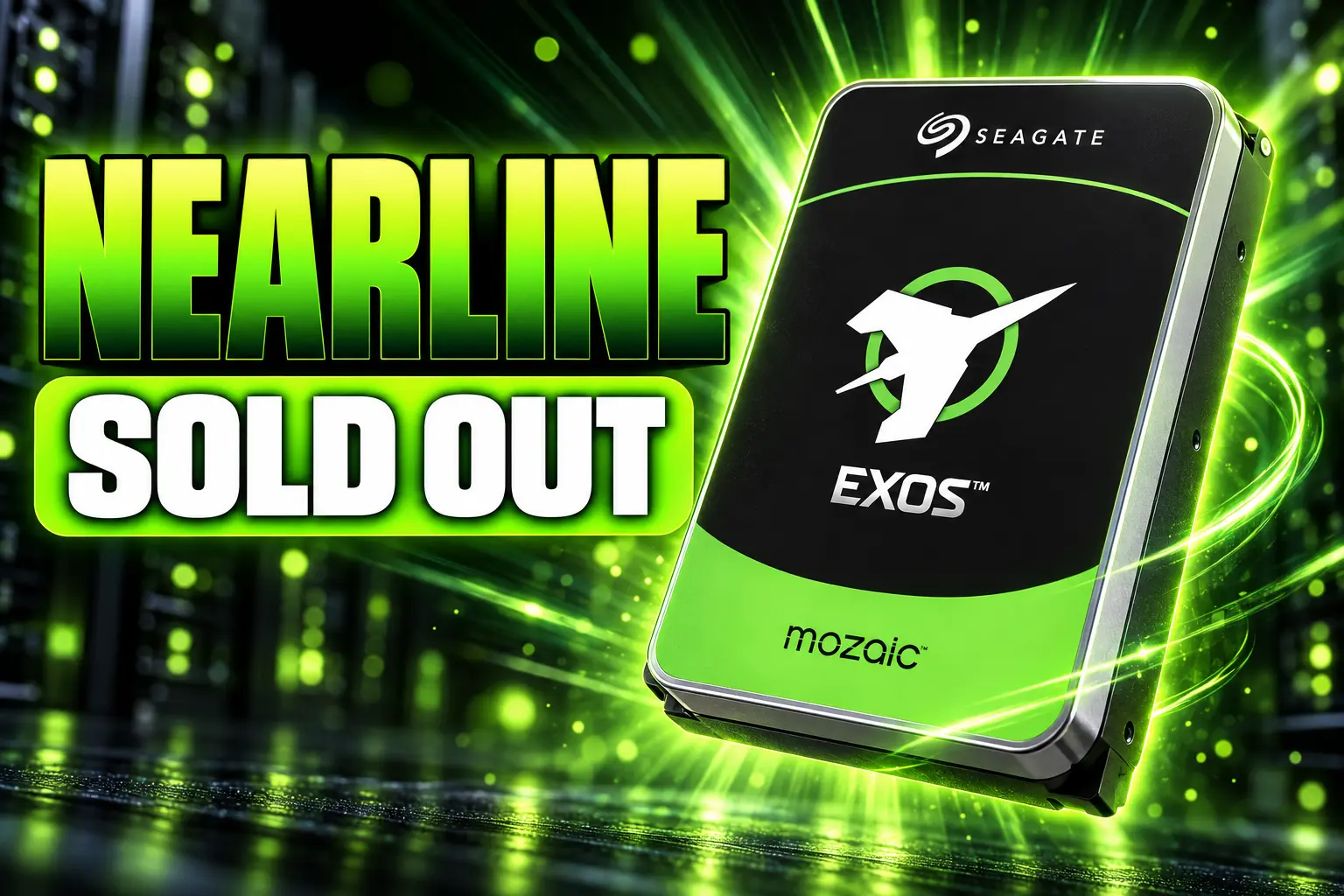
Seagate Has Already Sold Its Nearline Output Into 2028
Seagate has booked most nearline output into 2028, so AI storage gains now hinge on Mozaic HAMR yields, mix, and extra exabytes above contract.

Seagate has already booked the vast majority of its nearline hard-drive output into calendar 2028 for cloud buyers building AI data centers.
Build-to-order contracts also fix product mix and prices for all of calendar 2027, and the company is not adding drive factories. Extra exabytes now have to come from Mozaic HAMR yields on the same lines.
Nearline Output Is Booked Into 2028
Chair and chief executive Dave Mosley told analysts on the July 28 earnings call that data center demand is about 90% of exabyte shipments, and that long-term supply deals have filled almost all nearline output into 2028. Many of those customers are already talking about 2029 and later, he said, and they are not shortening their plans.
Based on the long-term supply agreements in place today, the vast majority of our nearline exabytes are now allocated into calendar 2028.
Dave Mosley, Chair and Chief Executive Officer, July 28 earnings call
That book is why the June quarter, the fiscal fourth quarter ended July 3, 2026, read like a company shipping against orders already in hand. The June quarter supplemental financial tables put the print above guidance on both sales and non-GAAP earnings.
JUNE QUARTER AT A GLANCE
| Measure | Q4 FY26 | Change |
|---|---|---|
| Revenue | $3.629 billion | +48% year over year |
| Data center revenue | $2.933 billion | +57%; 81% of sales |
| Nearline exabytes | 195 | +43% year over year |
| Non-GAAP gross margin | 52.7% | +14.8 points from 37.9% |
| Non-GAAP diluted EPS | $5.71 | +121% from $2.59 |
| Free cash flow | $1.118 billion | 31% of sales |
Full-year revenue was $12.2 billion, up 34%. Non-GAAP EPS was $15.58, up 92%, and free cash flow was $3.1 billion. Cash from operations was $3.7 billion, and Seagate sent $810 million back to holders through dividends and buybacks while cutting $1.4 billion of debt.
Guidance for the quarter ending October 2, 2026, sits at $4.1 billion of sales, plus or minus $100 million, about 50% operating margin, and $7.30 of non-GAAP EPS, plus or minus $0.20. Against $2.629 billion in the year-ago quarter, the midpoint implies about 56% growth on work that is largely already contracted.
Yield, Not New Factories, Sets the Exabyte Count
Mosley has been blunt about how Seagate will fill that book. Areal density is the plan. HAMR writes smaller magnetic bits by heating a tiny spot on the disk with a laser, so each platter holds more data and each shipped drive carries more exabytes without a new plant.
The company is putting money into HAMR tools so unit output can stay roughly flat while customers mix up to bigger drives and cycle times stretch. Fiscal 2026 capex was 4.7% of sales, inside a 4% to 6% band, and the June quarter alone spent $187 million. Seagate also makes the lasers in house; Mosley said the photonics line turned out tens of millions of edge-emitting lasers in the June quarter, which is how it keeps yield and supply on the HAMR head under its own roof.
That is the second-order bind. Demand is not the open question through 2028. The open question is whether Mozaic 4 yields, scrap, and tool time give Seagate more exabytes than the contracts already claim, because any extra can still be sold into a tight market, and any miss hits customers who thought they were covered.
WHAT THE 2028 BOOK LOCKS IN
- Volume: Most nearline exabytes are assigned into calendar 2028, with planning talks running into 2029.
- Price and mix: Build-to-order deals set configuration and pricing for all of calendar 2027 before a drive is started.
- Factories: Drive unit output stays roughly flat; growth is supposed to come from bits per disk, not new boxes.
- The leftover: Exabytes produced above the contracted amount can still be sold into the same shortage at whatever the then-current price is.
NAND tightness is shoving more cold and archive data back onto disk, which is why that leftover keeps mattering. Cloud buyers still want flash next to the GPU. They do not want to pay flash prices for training sets, checkpoints, and long-lived video that they may reopen months later.
The Mix Shift Onto Mozaic 4
HAMR products were about 40% of Seagate’s nearline exabyte run rate as fiscal 2026 ended, the first milestone on a path toward about 70% by June 2027. Mozaic 3+ is qualified and running in production at all major cloud customers, at up to 36TB per drive. Mozaic 4, at up to 44 terabytes on a 10-platter stack and more than 4TB per disk, is the node that has to carry the next step.
In March, Seagate announced production qualifications at two hyperscalers for those 44TB drives, calling Mozaic the only HAMR platform then shipping at scale. Revenue shipments started in late March. By July the two largest global cloud providers were ramping, more sign-offs were under way, and management still aimed to have 50% of HAMR exabytes on Mozaic 4 by the end of calendar 2026.
MOZAIC CAPACITY STEPS
| Platform | Per disk | Drive | Status |
|---|---|---|---|
| Mozaic 3+ | About 3TB | Up to 36TB | In production at all major cloud customers |
| Mozaic 4+ | 4TB-plus | Up to 44TB | Ramping at the two largest CSPs since March |
| Mozaic 5 | 5TB-plus | About 50TB | Qualification shipments late calendar 2027 |
| Later HAMR | Toward 10TB | Up to 100TB | Lab target around the end of the decade |
Mosley has said the 4TB-per-disk node is where yields still have to rise, and that it was early in its life when the ramp began. Seagate’s own one-exabyte comparison versus a 30TB fleet claims about 47% better infrastructure efficiency, about 100 square feet less floor, and about 0.8 million kilowatt-hours less power per year. Those are the numbers hyperscalers use when they decide whether a new platform is worth a painful qualification.
The mid-20% nearline exabyte growth target is not a demand ceiling. It is what management thinks it can ship while units stay flat and the 3TB-to-4TB changeover still burns tool time. Beat the yield plan and there is more to sell. Miss it and the 2028 book is a promise the plants cannot fully keep.
How the 2028 Notes Came Off the Books
The same week the allocation story hardened, Seagate finished cleaning up a leftover piece of the last cycle’s balance sheet. On June 11 it posted a redemption notice for outstanding notes covering the remaining about $150.7 million of Seagate HDD Cayman’s 3.50% Exchangeable Senior Notes due 2028.
Holders had until 5 p.m. New York time on September 3 to exchange. On September 8 the company paid about $150.97 million in cash and delivered 1,647,862 ordinary shares to settle what was left, after $150.51 million of principal was exchanged with cash for the face amount and shares for the in-the-money remainder. Ordinary shares closed at $904.38 that session, against an exchange price of $82.39 as of July 3, which is why so much of the settlement came out in stock.
THE 2028 NOTES WIND-DOWN
- February 19, 2026: Exchanges $600 million of the notes for $600 million cash plus about 6 million shares.
- June 11, 2026: Issues a full provisional redemption notice on the remaining about $150.7 million.
- September 3, 2026: Closes the exchange window at 5 p.m. New York time.
- September 8, 2026: Pays about $150.97 million cash and delivers 1,647,862 shares; the tranche is gone.
Gross debt was already down to $3.565 billion at fiscal year end, with $1.704 billion of cash and net leverage at 0.4 times. The June-quarter pack said Seagate had put out $1 billion of high-yield notes in July and planned to retire the convertible balance in September, aiming near $2.4 billion of debt by the end of the October quarter. Taking the 2028 notes off the indenture does free cash for tools, dividends, and buybacks. It also added shares after a move that took the stock from a 52-week low of $188.00 to a high of $1,145.00, with a market value around $205 billion on that $904.38 close.
Western Digital Is Still Qualifying Its 44TB HAMR Drive
Western Digital is not short of demand. It is short of a shipping HAMR drive at 44TB. In the June quarter it reported $3.747 billion of sales and $12.919 billion for the fiscal year, with 231 exabytes shipped, 209 of them nearline, and a 54.4% non-GAAP gross margin. Those are slightly bigger top-line and bit figures than Seagate’s. The product gap sits underneath them.
SEAGATE AND WESTERN DIGITAL, JUNE QUARTER
| Item | Seagate | Western Digital |
|---|---|---|
| Quarterly revenue | $3.629 billion | $3.747 billion |
| Fiscal-year revenue | $12.2 billion | $12.919 billion |
| Exabytes shipped | 218 | 231 |
| Data center / nearline exabytes | 195 | 209 |
| Non-GAAP gross margin | 52.7% | 54.4% |
| Highest-capacity drive shipping | 44TB HAMR (Mozaic 4) | 40TB ePMR UltraSMR |
| 44TB HAMR | In hyperscale production since March | Volume targeted first half of 2027 |
Western Digital is shipping 40TB energy-assisted PMR drives with UltraSMR and has 44TB HAMR in customer sign-off, with volume aimed at the first half of calendar 2027. That is roughly a year behind Seagate’s 44TB HAMR, which has been in hyperscale production since March. WD is also selling a high-bandwidth drive story, more sequential throughput per watt, for object stores and training pipes that care about how fast a disk streams, not only how many terabytes sit in the rack.
Toshiba remains the third name in the warehouse, with a smaller high-capacity program and no matching HAMR volume claim in the same window. For a buyer who needs density in calendar 2026, Seagate is the vendor that can put a 44TB HAMR drive on the floor now. For a buyer who can wait, WD’s 2027 HAMR and its extra platter count are the second source that keeps Seagate from owning the whole shortage.
Inference Workloads Are Filling Cheap Disk
The AI storage argument used to stop at training sets. Mosley is now selling a second pile of bits: inference context. As sessions get longer and agent tools retry steps, models keep a key-value cache of what they have already computed. That cache used to live in GPU memory. At fleet scale it spills into SSDs, then onto hard drives, because regenerating the same tokens on a GPU is the expensive option.
Seagate and SK hynix published work on hybrid storage for KV cache that keeps long context on a mix of flash and disk. The paper’s authors, Kyung Soo Lee and Jin Na Yang at SK hynix and Thomas Prohofsky at Seagate, tested SK hynix PS1010 3.84TB SSDs beside Seagate Exos 30TB Mozaic drives over RDMA. Seagate’s own follow-up note said the hybrid path cut time-to-first-token about 95% versus regenerating the cache, and that the design only works if storage sits in the inference stack rather than off to the side of it.
Jason Feist, Seagate’s senior vice president for cloud, has described the same split in plain terms: hot context stays in memory, SSDs buffer what the GPU may need next, and disk holds days or weeks of context at a fraction of all-flash cost. Bob O’Donnell, president of TECHnalysis Research, said in Seagate’s March Mozaic 4 release that high-capacity HAMR drives have become part of how labs keep training and fine-tuning moving as synthetic and real data piles up.
Physical AI is the next claimed step, robotics and vehicles trained on millions of hours of video, but Mosley still calls both KV cache and physical AI early. The near-term fill is simpler. Video, object stores, and long-lived training data already need cheap terabytes, and flash is busy and dear. That is the workload sitting under a 2028 nearline book.
Two Directors Leave as the Board Shrinks to Nine
On September 2, director Shankar Arumugavelu told the board he would not stand at the 2026 annual meeting. He has been a director since 2021, sits on the audit and finance committee, and was executive vice president and president of global services at Verizon until February 2026. Seagate said the choice did not come from a dispute over operations, policy, or practice, and that he will serve through the meeting.
The definitive proxy dated September 8 adds a second departure. Michael R. Cannon is also coming off at the end of his term. The meeting is set for October 24, 2026, as a virtual AGM, with nine nominees and the board cut from eleven seats to nine when the gavel falls. None of that rewrites the HAMR ramp. It does leave a smaller group watching a company whose next two years of output are, in large part, already sold.
Shares that closed at $904.38 on September 8 are pricing a factory that has to hit Mozaic 4 yields, keep HAMR mix climbing toward 70% of nearline exabytes by June 2027, and still find a few extra bits above the contracts. The notes are gone. The 2028 book is not. On October 24 a smaller board inherits both.
Disclaimer: This article is news reporting and analysis of Seagate’s public filings, earnings materials, and product papers, and it is for information only. It is not investment advice, a recommendation to buy or sell STX or any other security, or a forecast of future prices, margins, or shipments. Readers should consult a licensed financial adviser or other qualified professional who can weigh their own objectives, time horizon, and risk before acting on any figure here. Revenue, margin, allocation, share count, and guidance figures reflect the company documents and market data cited as of the dates in this piece and can change with later filings, guidance, or trading.

The Salary Cap Fight That Can Freeze Baseball’s TV Payday

The 2027 Mercedes GLE and GLS Keep Alabama Busy

Margaret Hamilton Dies at 90 With a Harder Fight Unfinished

Unity Parks Its Engine Inside Google’s Prompt Games

The Hidden Vendor Cut in 403(b) vs 401(k) Plans

Microsoft 365 Auth Fault Took Down Exchange and Teams

IFA 2026’s Weird Gadgets Are Building a Sensor Home

Xbox Caps Game Pass Cloud Gaming at 15 Hours

Squishy Dumpling Toys Recalled After Hiding Illegal Water Beads

Tesla Puts Its Wheel-Free Cybercab on Austin Streets
-
 NEWS1 month ago
Microsoft 365 Auth Fault Took Down Exchange and Teams
-
 GAMING1 month ago
Xbox Caps Game Pass Cloud Gaming at 15 Hours
-
 NEWS1 month ago
IFA 2026’s Weird Gadgets Are Building a Sensor Home
-

 NEWS1 month ago
OpenAI Unveils GPT-6 Astra With a Critical Cyber Label
-
 AUTO1 month ago
Tesla Puts Its Wheel-Free Cybercab on Austin Streets
-
 NEWS1 month ago
OpenClaw 2.0 Ships a Team Workplace With Host-Trust Defaults
-

 NEWS1 month ago
Sony and Warner Sue Anthropic Over Torrented Song Lyrics
-
 LIFESTYLE1 month ago
Squishy Dumpling Toys Recalled After Hiding Illegal Water Beads