
AUTO
Colorado’s Record EV Quarter Unwound After Credits Ended
Colorado EV sales led the U.S. in Q3 2025, then battery-electric share fell to 9.0% after the $7,500 credit ended.

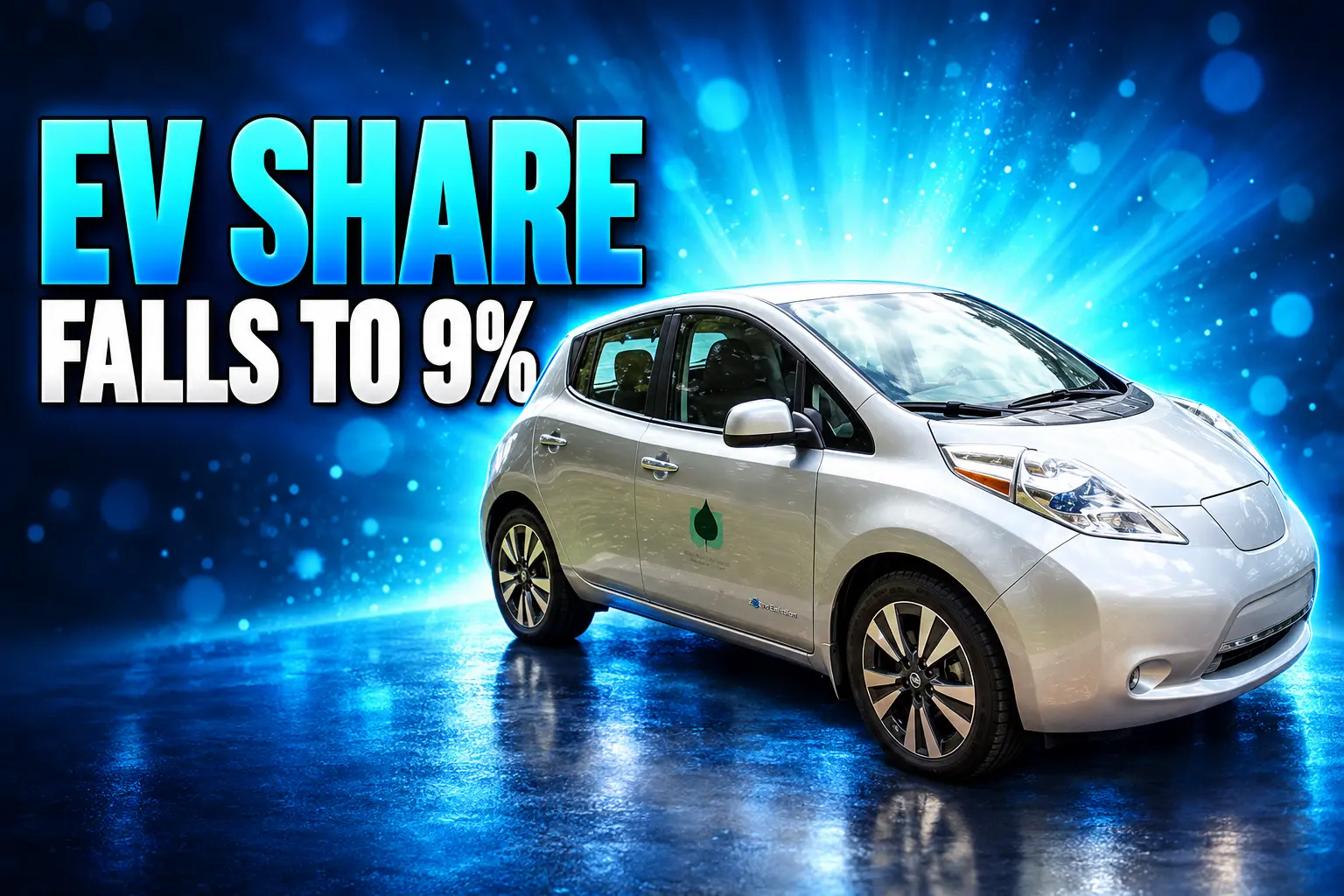
Colorado’s battery-electric share of new-vehicle registrations fell to 9.0% in the first quarter of 2026. A year earlier it was 20.1%, according to Colorado Auto Outlook, the Colorado Automobile Dealers Association report that uses Experian Automotive figures.
The hangover follows the state’s record electric-vehicle quarter in 2025, when shoppers raced to claim a federal credit that ended on Sept. 30. Dealers who posted the country’s highest EV sales share then took most of a statewide registration slump, even as Colorado kept writing rebate checks and adding fast chargers.
Battery-Electric Share Is Down to 9 Percent
The 9.0% reading did not arrive in one jump. Battery-electric share was already 12.6% in the fourth quarter of 2025, once the federal credit was gone. Plug-in hybrids fell with them. Hybrids, which do not need a plug, moved the other way.
COLORADO NEW-VEHICLE POWERTRAIN SHARE
| Powertrain | Q1 2025 | Q1 2026 |
|---|---|---|
| Battery-electric | 20.1% | 9.0% |
| Plug-in hybrid | 5.9% | 2.0% |
| Hybrid (non-plug-in) | 12.4% | 16.8% |
Those figures are statewide retail registrations in the dealers’ outlook, not a poll of showroom traffic. Battery-electric volume in the first quarter was down 63.6% from a year earlier, and plug-in hybrids were down 72.5%. Combined registrations of gasoline cars and ordinary hybrids slipped only 1.9%, less than the 3.4% drop for that mix nationwide.
Through June 2026, new battery-electric registrations were still down 55% from the same stretch of 2025, the dealers association found. Anyone who treated the 2025 spike as a new normal was reading a deadline, not a plateau.
The Sept. 30 Deadline That Pulled Sales Forward
From July 1 to Sept. 30, 2025, nearly 1 in 3 new vehicles sold in Colorado were electric, a state release said, the highest quarterly share any state had posted. Electric vehicles made up 27.3% of sales so far into 2025 when that ranking went out in October. Registrations had already passed 210,000.
The rush had a date on it. Congress ended the federal credit of up to $7,500 on Sept. 30, 2025, years earlier than the 2032 sunset buyers had been told to expect. Dealers had been writing cheap leases into that deadline. When the credit stopped, the price of the same car jumped by as much as a year’s insurance, and a lot of shoppers who were going to buy in 2026 simply bought in September instead.
THE CREDIT AND REBATE CALENDAR
- July 1 to Sept. 30, 2025: Colorado posts the country’s highest quarterly EV sales share, nearly 1 in 3 new vehicles.
- Sept. 30, 2025: The federal Clean Vehicle Credit of up to $7,500 ends.
- Nov. 3, 2025: Vehicle Exchange Colorado raises income-qualified rebates to $9,000 on new EVs and $6,000 on used ones.
- January 2026: The state’s own tax credit, worth as much as $6,000 in 2025, falls to $750.
- January to March 2026: Battery-electric share lands at 9.0% in the first quarter; battery-electric volume is down 63.6%.
- January to June 2026: Battery-electric registrations are down 55% from 2025.
- April to June 2026: California leads U.S. EV registration share; Colorado is only above 10%.
Will Toor, then executive director of the Colorado Energy Office, greeted the 2025 ranking as proof the cars sold on their own merits, not only on the subsidy.
The transportation sector has long been the hardest to decarbonize so we are grateful that so many Coloradans are making the transition to EVs, but these numbers shouldn’t be surprising, as EVs represent great value and are just plain fun to drive.
Will Toor, Executive Director, Colorado Energy Office, October 2025
He also said he was confident the trend would continue despite federal headwinds, as charging spread through cities and rural counties. The registration file for 2026 is the test of that call.
Why Colorado Raised New-EV Rebates to $9,000
State officials did not wait to see whether the federal cliff would stick. On Nov. 3, 2025, the Polis administration raised new-vehicle rebates to $9,000 for income-qualified buyers in Vehicle Exchange Colorado, and used-EV rebates from $4,000 to $6,000. The program is a cash-for-clunker style rebate, not an open check for every shopper.
Everyone else lost ground. Colorado taxpayers could still claim as much as $6,000 in state EV tax credit through the end of 2025. That base credit fell to $750 in January 2026 after general-fund shortfalls. A buyer who could stack the federal $7,500, a four-figure state credit, and a VXC rebate in 2025 was shopping in a different market than a buyer facing $750 and a maybe-$9,000 income-qualified check in 2026.
WHAT A COLORADO BUYER CAN STILL STACK
- Income-qualified rebate: Vehicle Exchange Colorado pays $9,000 on a new EV and $6,000 on a used one after the Nov. 3, 2025 increase.
- State tax credit: The standard credit is $750 in 2026, down from as much as $6,000 in 2025.
- Federal credit: The $7,500 Clean Vehicle Credit is closed for purchases after Sept. 30, 2025.
Travis Madsen, director of transportation programs at the Southwest Energy Efficiency Project, expects the rebate fight to return when legislators meet in January 2027. He also argued that driving an EV still costs less than running a gasoline car, even without the old federal check, and that cheaper electric pickups on the way could pull volume back. Those are bets on 2027 and 2028. They do not rewrite the 2026 registration print.
The 18.4% Drop Was a Plug-In Event
Colorado registered 43,514 new retail light vehicles in the first quarter of 2026, down 18.4% from 53,355 a year earlier. The U.S. market was down 8.5% in the same window. Auto Outlook’s editor, Jeffrey A. Foltz, put the extra state decline on plunging battery-electric and plug-in hybrid sales. Take those out, and Colorado’s gasoline and hybrid book barely moved.
That is a dealer problem as much as a climate one. Franchise stores had staffed, stocked, and advertised for a market in which electric vehicles were approaching a third of the floor. They then spent the winter sitting on cars priced for a $7,500 credit that no longer existed. Among the top 25 brands in the state, only Toyota and Ram added registrations in the first quarter.
The rest of the lot was not healthy either. Auto Outlook flagged high loan rates, transaction prices around $50,000, and tariffs as weights on every powertrain, and forecast 213,300 new retail registrations for 2026, down 5.3% from 225,265 in 2025. A separate tally through mid-2026 put Colorado’s overall new-car sales about 15% below 2025. The plug-in collapse is the piece that made Colorado’s slump deeper than the country’s.
Hybrids are the quiet winner in that mix. Their share rose from 12.4% to 16.8% in the first quarter, the only major powertrain that gained. Some households that would have signed for a battery car in September 2025 appear to have bought a hybrid once the federal credit, and a large piece of the state credit, came off the hood.
Fast-Charge Coverage Now Reaches 83% of Highways
The sales file and the charging map are no longer telling the same story. As of a Sept. 24, 2026 accounting, 83% of Colorado’s state highway network sat within 30 miles of a DC fast-charging station, up from 40% six years earlier. The state had nearly 500 fast-charging stations, against about 2,350 gasoline and diesel stations. In October 2025 the public network already listed more than 5,000 Level 2 ports and more than 1,400 fast-charging ports.
Shoshana Lew, executive director of the Colorado Department of Transportation, has been selling that map as the point when a statewide network becomes usable rather than a Front Range convenience.
Public investment has helped make it possible to establish charging in locations that are essential to a truly statewide network.
Shoshana Lew, Executive Director, Colorado Department of Transportation
Federal National Electric Vehicle Infrastructure money is the backbone of the rural sites. Colorado received approval in October 2025 for the last $12 million of a $56.5 million NEVI award and had already granted about $25.6 million toward 246 fast-charging ports. By late September 2026, 17 NEVI-supported locations were open and 33 were in development, including fills at Eads and Kit Carson on the Eastern Plains and at Cortez on the Durango-to-Four Corners run. A ninth round, the Direct Current Fast-Charging Plazas Grant, was expected to put about $14 million to work, with a $174,000 “gap incentive” per port for stubborn holes such as Gunnison, Ignacio, and Saguache.
HIGHWAY CHARGING AT A GLANCE
- Highway reach: 83% of the state highway network is within 30 miles of a DC fast charger, up from 40% six years earlier.
- Station count: Nearly 500 fast-charging stations, compared with about 2,350 gasoline and diesel stations.
- NEVI build: $56.5 million in federal support, with 17 sites open and 33 in development as of late September 2026.
- Next-round cash: About $14 million in plaza grants, plus $174,000 per port for high-priority gaps.
The International Council on Clean Transportation, in an April 2026 study, said Colorado still needs on the order of 55,000 non-home Level 2 chargers and about 4,200 non-home fast chargers by 2035 if it is serious about its fleet targets. Cumulative investment in that build would run about $1.6 billion by 2030 and $3.8 billion by 2035. Existing state, federal, and utility money could cover about 84% of non-home fast-charger needs through 2035 if those dollars actually land. The study was written as a charging plan, not as a sales forecast, and it shows the mismatch: the plugs are being planned for hundreds of thousands more cars than dealers are currently registering.
California Reclaimed the National Sales-Share Lead
The Alliance for Automotive Innovation’s second-quarter 2026 report, released Sept. 23, put the national ranking back where older habits would have it. California led with 21.2 percent EV share, then Washington at 17.5% and Nevada at 15.4%. Oregon, Colorado, and the District of Columbia were the other names above 10%. Colorado was in the second group, not the first.
That Alliance series is not identical to the dealers’ battery-electric-only print, and it covers a later quarter, which is why “above 10%” can sit next to a 9.0% first-quarter battery-electric share without either figure being wrong. Both say the same directional thing. The state that ran at nearly 1 in 3 in the third quarter of 2025 is no longer the national leader.
The country as a whole is still below the 2025 peak. Automakers sold 556,477 EVs in the first half of 2026, 7.1% of new light-duty sales, down 26.8% (about 204,250 vehicles) from the first half of 2025, when share was 9.5%. Second-quarter share ticked up to 7.9%, the first sequential gain since the third quarter of 2025, while volume was still down 15% from a year earlier. Hybrids took 22.2% of U.S. sales in the second quarter. Gasoline’s long decline resumed after a one-quarter bounce.
Inside Colorado’s thinner electric book, the model mix did not flip. Atlas Public Policy’s EValuateCO dashboard, built with Colorado Energy Office funding from Department of Motor Vehicles records, logged 2,976 new battery-electric and plug-in hybrid registrations in August 2026. The Tesla Model Y led with 546, then the Model 3 at 228, the Hyundai Ioniq 5 at 175, and the Rivian R2 at 136. The cars that sold when the credit was alive are the cars that still sell, just in smaller numbers.
217,000 Plug-Ins on the Road, 940,000 Wanted by 2030
Share of new sales was always a flow number. The stock is smaller than the 2025 ranking made it sound. The Alliance counted 217,000 registered electric vehicles and plug-in hybrids in Colorado among 5.54 million cars, pickups, and vans, about 3.9% of the light-duty fleet. Colorado’s statutory targets are 940,000 EVs on the road by 2030 and 2.1 million by 2035. Getting to the 2030 mark from 217,000 means more than quadrupling the current stock in four years, during a stretch when new battery-electric volume is running about half of last year’s pace.
Madsen is already pointing at the 2027 legislative session for richer incentives, and at a possible change in Washington in 2028 for a new federal credit. Lew is pointing at the remaining highway gaps. Toor, in October 2025, pointed at fun and charging. The dealers’ Experian file is pointing at 9.0% battery-electric share, a 55% year-to-date volume hole, and a 5.3% down-year for the whole market.
The chargers going into Gunnison and Ignacio will still be there if sales recover. They will also be there if the 2025 crown turns out to have been the high-water mark that a $7,500 check bought, and that a $750 credit plus a means-tested rebate could not keep.

macOS 27.2 Adds Touch Gestures 15 Years After Jobs

Seiko Turns the 2024 Panda Concept Into 5,000 Watches

FAO Food Price Index Rises Despite a Near-Record Harvest

Iran Threat Sends America’s B-1 Bombers Home From Fairford

D&D World of Warcraft Rebuilds Seven Dungeons as Tools

Microsoft 365 Auth Fault Took Down Exchange and Teams

Xbox Caps Game Pass Cloud Gaming at 15 Hours

IFA 2026’s Weird Gadgets Are Building a Sensor Home

Tesla Puts Its Wheel-Free Cybercab on Austin Streets

ChargePoint Stock Rally Prices Wilmer’s Three-Year Cash Plan
-
 NEWS1 month ago
Microsoft 365 Auth Fault Took Down Exchange and Teams
-
 GAMING1 month ago
Xbox Caps Game Pass Cloud Gaming at 15 Hours
-
 AUTO1 month ago
Tesla Puts Its Wheel-Free Cybercab on Austin Streets
-
 BUSINESS1 month ago
ChargePoint Stock Rally Prices Wilmer’s Three-Year Cash Plan
-
 NEWS1 month ago
IFA 2026’s Weird Gadgets Are Building a Sensor Home
-

 BUSINESS1 month ago
Diesel Breaks Its Record as the White House Claims Credit
-

 NEWS1 month ago
OpenAI Unveils GPT-6 Astra With a Critical Cyber Label
-

 NEWS1 month ago
OpenClaw 2.0 Ships a Team Workplace With Host-Trust Defaults