
BUSINESS
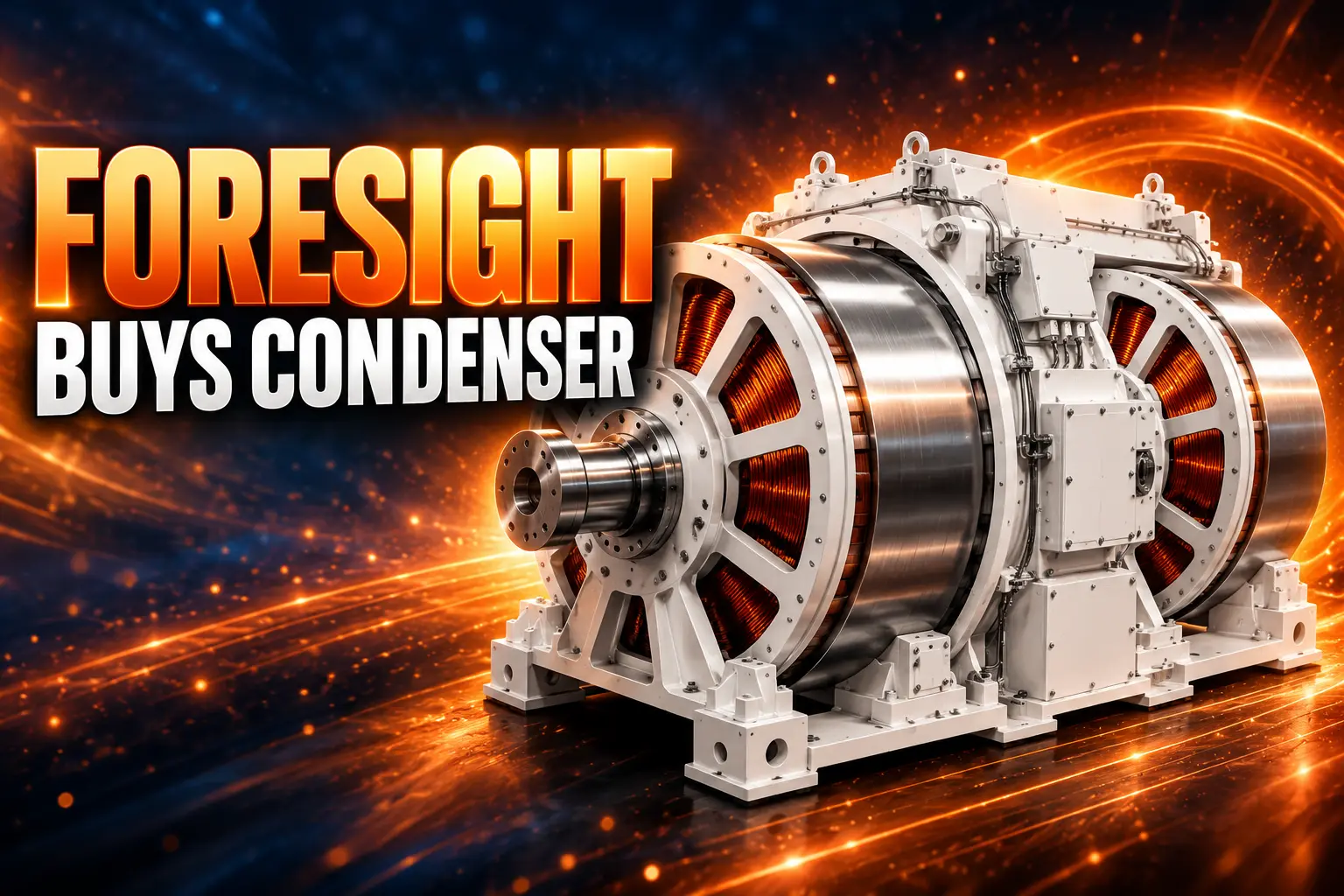
Foresight Buys a Rare Scottish Grid Stability Machine
Foresight has bought the Blackhillock synchronous condenser from GIP, stacking a Pathfinder contract to 2034 onto the batteries it already took private.

A Foresight fund has bought the Blackhillock Synchronous Condenser in North-East Scotland from funds managed by Global Infrastructure Partners, part of BlackRock. The machine has been running since July 2025 under a National Energy System Operator contract that pays inflation-linked, availability-based fees through 2034.
Foresight Group Holdings, the London-listed manager, described Blackhillock as a rare grid stability asset in a high-priority area and one of only two synchronous condensers in the region. Financial terms were not disclosed. The manager said the purchase is its entry into the grid stability market, after it already took a large UK battery trust private.
What a Synchronous Condenser Does for the Grid
A synchronous condenser is a spinning machine that feeds no megawatt-hours onto the wires. The rotor is kept turning with a small draw of grid power, so the plant looks electrically like an old power station even though it sells no energy. NESO pays it to be available, not to generate.
Wind and solar connect through inverters. They do not store kinetic energy in a heavy shaft the way a coal, gas or nuclear set does. When a large plant trips, that missing spin used to slow the fall in frequency. Scotland has been adding offshore wind at the same time as thermal and nuclear plant have been leaving the system, which is why NESO ran a dedicated Scottish tender for these services.
WHAT THE MACHINE IS PAID TO PROVIDE
- Inertia: Stored spin that slows frequency swings after a sudden loss of generation, holding the system nearer 50 Hz.
- Short circuit level: Extra current during a fault, so protection kit can see the problem and isolate it.
- No energy sale: The plant is paid on availability under Pathfinder II, with the fee linked to inflation through 2034.
Foresight’s investment director, Anouska Morjaria, put the same physics in commercial language: more intermittent generation raises the need for assets that can hold the grid still. The buy, she said, diversifies a portfolio of critical infrastructure while funding the kit the UK transition requires.
Pathfinder II Pays Through 2034
The cheque attached to Blackhillock comes from Stability Pathfinder Phase 2, the Scottish round NESO (then National Grid ESO) awarded in April 2022. The operator chose ten contracts worth £323 million from 225 proposals submitted by 21 companies, locking in 11.55 GVA of short circuit level in Scotland and 6.75 GVA seconds of inertia for Great Britain.
Five of those contracts went to synchronous condensers. Five went to grid-forming batteries, which try to mimic a spinning set through inverter controls. The 10-year deals were due to start in April 2024. NESO later put the cost-saving benefits of about £500 million on the same 10-year book, against the cost of holding inertia on fossil plant. From 2035 the sites can bid into ordinary stability markets.
THE PATHFINDER II WINNERS
| Company | Location | Technology |
|---|---|---|
| Statkraft | Coylton | Grid-forming battery |
| Statkraft | Neilston | Grid-forming battery |
| TINZ Programme 1 ProjectCo 3 | Beatrice | Synchronous condenser |
| Zenobe Energy | Blackhillock | Grid-forming battery |
| Zenobe Energy | Kilmarnock South | Grid-forming battery |
| Zenobe Energy | Eccles | Grid-forming battery |
| WP Grid Services 3 | Gretna | Synchronous condenser |
| WP Grid Services 8 | Rothienorman | Synchronous condenser |
| WP Grid Services 1 | Thurso South | Synchronous condenser |
| WP Grid Services 9 | Neilston | Synchronous condenser |
The official Blackhillock line on that list is Zenobe’s battery, not Foresight’s condenser. Foresight still says the condenser it has bought sits near the Blackhillock transmission substation and holds a Pathfinder II NESO contract. The two plants share a node, not a name on the winner board.
Julian Leslie, then head of networks at the system operator, said the Scottish round was the first time grid-forming inverters had been used in several places across a region to fix short circuit level and inertia together. The condensers were the other half of that hedge: green motors with free-spinning flywheels, in the operator’s phrase, that boost both services without making power.
THE BUILD-OUT TO FIRST POWER
- January 2020: Pathfinder Phase 1 secures 12.5 GVA seconds of inertia over six years at a cost of £328 million.
- April 2022: Phase 2 awards the ten Scottish contracts, split evenly between condensers and grid-forming batteries.
- February 2023: Construction starts at Rothienorman, the first Phase 2 condenser to be finished.
- December 2024: Rothienorman enters commercial operation for Quinbrook and Welsh Power.
- 11 March 2025: NESO confirms the first two Phase 2 projects are live, including Great Britain’s first grid-forming battery.
- July 2025: The Blackhillock Synchronous Condenser begins operating under its NESO availability contract.
By summer 2026 most of the Phase 2 fleet was up. The remaining units were due in by year end. Foresight is not buying a development story. It is buying a machine that has already been spinning for 14 months.
Blackhillock Already Hosts Europe’s Biggest Battery
The substation sits in Moray, on the corridor that takes Moray Firth offshore wind onto the mainland grid. Zenobe’s Blackhillock battery went commercial on 3 March 2025 at 200 MW / 400 MWh, with a second phase meant to take the site to 300 MW / 600 MWh. SMA supplied 62 medium-voltage power stations there, rated for 370 MW seconds of synthetic inertia and 116 MVA of short circuit contribution.
Zenobe placed the battery between Inverness and Aberdeen to ease congestion from Viking (443 MW), Moray East (950 MW) and Beatrice (588 MW). The same node is why a condenser with a long NESO cheque is scarce. Foresight called the area high-priority. The battery next door is the public face of that priority. The condenser is the quieter plant that still sells physical spin.
Pathfinder II treated the two technologies as substitutes in the same auction. At Blackhillock they now sit as neighbours. One stores energy and fakes inertia with software. The other stores inertia in steel and sells it on availability. Foresight owns the second and, through a separate deal, a large slice of the first technology class.
Foresight Bought the Batteries in 2025
On 9 July 2025, Foresight Energy Infrastructure Partners II and Blackmead Infrastructure, a Foresight portfolio company, said they had taken Harmony Energy Income Trust private. FEIP II took 49 percent. Blackmead took 51 percent. The trust held eight operational two-hour batteries across England and Scotland, about 400 MW / 800 MWh in all, which Foresight called the UK’s largest such fleet.
The cash offer was 92.4 pence a share. JLL, which advised the trust, called the completed deal the largest operational BESS sale in Europe at the time. Richard Thompson, co-manager of Foresight Energy Infrastructure Partners, said the portfolio offered immediate scale and cash yield in a mature storage market, and that FEIP II wanted a pan-European battery platform on the back of it.
THE HARMONY FLEET FORESIGHT TOOK PRIVATE
- Capacity: About 400 MW / 800 MWh across eight grid-connected sites.
- Duration: Two-hour batteries, the largest operational fleet of that type in Great Britain at the deal.
- Price: 92.4 pence a share, with ownership split 49 percent FEIP II and 51 percent Blackmead.
- Date: Take-private announced as complete on 9 July 2025, the same month the Blackhillock condenser went live.
Blackhillock does not add more storage. It adds a different revenue line: a NESO availability contract with inflation through 2034, on a machine that does not trade wholesale power. The Harmony batteries live on spreads, balancing services and whatever stacking their operators can hold. The condenser lives on being there. Foresight now holds both books.
Rothienorman Spins at the Other North-East Node
Foresight’s “one of only two” claim points at Rothienorman in Aberdeenshire, the other Pathfinder II condenser in the north-east. Quinbrook Infrastructure Partners and Welsh Power brought that plant into commercial operation in December 2024, the first of the ten Phase 2 sites to do so. Siemens Energy supplied the kit. Construction had started in February 2023.
Welsh Power says Rothienorman is contracted for 1,357 MVA of short circuit level and 470 MW seconds of inertia. SSEN Transmission, which owns the connecting substation, announced energisation at Rothienorman substation as a step toward holding the grid with less fossil plant. Gareth Rees, Welsh Power’s head of project delivery, said the team had delivered the first operational synchronous condenser under Pathfinder round II.
Keith Gains, Quinbrook’s UK managing director, said Pathfinder II was written for Scotland because asynchronous wind was rising while nuclear and thermal plant that once supplied spin were retiring. The other Welsh Power condensers sit at Gretna, Thurso South and Neilston, outside the north-east pairing Foresight is using. Beatrice, the TINZ condenser on the Pathfinder list, connects onshore at Blackhillock, which is why that name keeps attaching to more than one stability plant.
Why the Later Auction Shut Batteries Out
Pathfinder II was a demonstration as much as a procurement. Five battery sites won 10-year cheques to prove that inverters could sell inertia and short circuit level. The follow-on market has been less kind to that proof. Modo Energy found that NESO’s Stability Market Round 2, concluded in March 2026, awarded no contracts to battery projects. Synchronous condensers and open-cycle gas turbines took 7.3 GVA seconds after battery bids failed at the technical assessment stage.
That result sits beside, rather than inside, the Pathfinder book Foresight has just bought. Blackhillock’s condenser is already contracted through 2034. It does not need to clear Round 2. The auction still matters for anyone who thought the Scottish pathfinder had settled the technology fight. Physical rotors and gas peakers still passed the test NESO set for the open market. Grid-forming batteries, on that round, did not.
Independent energy consultant Kathryn Porter has been blunt about the physics behind that caution. Voltage, she argues, is local, so the location of synchronous machines matters in a way a single national frequency number does not. She has written that she doubts grid stability can ever be guaranteed using inverter-based resources alone. Grid-forming advocates answer that the commercial gap, not the engineering, was the delay, and that Pathfinder’s paid inertia product is what gets the inverters built at scale.
Foresight is not picking a side in that argument. It already owns two-hour batteries. It has now bought a contracted rotor at a node that also hosts Europe’s largest transmission battery. The mix looks like a portfolio of how Britain actually holds the grid, not a bet on which slide will win the next conference.
GIP Hands Over a Contracted Rotor
Global Infrastructure Partners sold the plant out of funds it manages. BlackRock closed its purchase of GIP on 1 October 2024. Neither side published a price for Blackhillock. What transferred is clearer than what it cost: an operating condenser, a NESO Pathfinder II availability contract with inflation through 2034, and a site next to a substation that already takes a large share of Moray Firth wind.
As we see increasing levels of intermittent generation in our energy mix, there is a rising need for assets such as Blackhillock to stabilise the grid. This acquisition diversifies our portfolio of critical infrastructure assets, while supporting our investment into the technologies and services needed to enable the UK’s energy transition.
Anouska Morjaria, Investment Director, Foresight Group
After 2034 the Pathfinder cheque ends and the plant, like the rest of the Phase 2 fleet, can bid into the standing stability markets. Those markets are the same ones that in March 2026 still preferred spinning machines and gas. Foresight will meet that reset with a rotor that has already been paid to run for a decade, sitting beside a battery fleet it bought for a different set of spreads.
On 7 September 2026, that NESO contract changed hands.
Frequently Asked Questions
What Is a Synchronous Condenser?
It is a large rotor, often with a flywheel, that stays synchronised with the grid and supplies inertia and short circuit current without exporting energy. The machine draws a small amount of grid power to keep spinning, which is why NESO can treat it like a power station for stability while paying it only to be available.
What Did NESO’s Pathfinder Phase 2 Buy?
The Scottish round awarded ten 10-year contracts in April 2022, five for condensers and five for grid-forming batteries, to secure 11.55 GVA of short circuit level and 6.75 GVA seconds of inertia. NESO said the package was worth £323 million and would supply the combined effect of almost four coal-fired stations.
What Came Before Pathfinder Phase 2?
Stability Pathfinder Phase 1, run in January 2020, secured 12.5 GVA seconds of inertia over six years at a cost of £328 million. That earlier round was not open to grid-forming batteries in the way Phase 2 was, and it set the template for paying directly for spin as thermal plant left the system.
Who Sold the Blackhillock Condenser to Foresight?
Funds managed by Global Infrastructure Partners, which BlackRock has owned since 1 October 2024. Foresight did not name the GIP vehicles or the price, and GIP has not published a matching sale notice.
When Does the Blackhillock NESO Contract End?
Foresight says the Pathfinder II revenues run through 2034 on an inflation-linked, availability basis. NESO has said Phase 2 sites can enter specific stability markets from 2035, when the original 10-year pathfinder term is over and the plant must compete again for the same services.

The Salary Cap Fight That Can Freeze Baseball’s TV Payday

The 2027 Mercedes GLE and GLS Keep Alabama Busy

Margaret Hamilton Dies at 90 With a Harder Fight Unfinished

Unity Parks Its Engine Inside Google’s Prompt Games

The Hidden Vendor Cut in 403(b) vs 401(k) Plans

Microsoft 365 Auth Fault Took Down Exchange and Teams

IFA 2026’s Weird Gadgets Are Building a Sensor Home

Xbox Caps Game Pass Cloud Gaming at 15 Hours

Squishy Dumpling Toys Recalled After Hiding Illegal Water Beads

Tesla Puts Its Wheel-Free Cybercab on Austin Streets
-
 NEWS2 months ago
Microsoft 365 Auth Fault Took Down Exchange and Teams
-
 GAMING1 month ago
Xbox Caps Game Pass Cloud Gaming at 15 Hours
-
 NEWS1 month ago
IFA 2026’s Weird Gadgets Are Building a Sensor Home
-

 NEWS1 month ago
OpenAI Unveils GPT-6 Astra With a Critical Cyber Label
-
 AUTO1 month ago
Tesla Puts Its Wheel-Free Cybercab on Austin Streets
-
 NEWS2 months ago
OpenClaw 2.0 Ships a Team Workplace With Host-Trust Defaults
-

 NEWS2 months ago
Sony and Warner Sue Anthropic Over Torrented Song Lyrics
-
 LIFESTYLE1 month ago
Squishy Dumpling Toys Recalled After Hiding Illegal Water Beads