
NEWS
Massachusetts Puts AI Literacy on Diplomas Before Standards Exist
Massachusetts would hang AI literacy on every diploma as a career-plan milestone, before standards exist and before most districts use the host tool.

Massachusetts wants every public high school graduate to finish an AI and digital literacy module, under final recommendations for a statewide framework released June 17, 2026. The milestone would live inside a career plan, not a required computer science credit, and the Legislature has not turned the plan into law.
Voters in November 2024 killed the MCAS diploma rule that had stood since 2003. The replacement package now on the table treats AI literacy as the easy, popular piece of a much harder rewrite.
Massachusetts Wants AI Literacy on Every Diploma
The council’s plan has four primary pieces. Students would complete MassCore college-prep coursework, take state-designed end-of-course exams in English, math, and science, keep a My Career and Academic Plan known as MyCAP, and finish a capstone project or a portfolio.
AI and digital literacy would not be a fifth pillar. It would sit as a required MyCAP milestone beside financial literacy, work-based learning, and a FAFSA or MASFA completion step that families can skip. Students could go further through a capstone or a possible Seal of Distinction, but the floor is a module, not a year-long course.
Governor Maura Healey said every student deserves an education that prepares them for college, a career, service, or another path. Secretary of Education Steve Zrike called the package a nation leading standard that matches the realities students will face after high school. Commissioner of Elementary and Secondary Education Pedro Martinez, co-chair of the 32-member council, said it was a once-in-a-generation chance, especially for students furthest from opportunity.
Healey created the council by executive order on January 17, 2025. Members met from March 2025 through May 2026. The June document is written as advice for the governor and the Legislature. House Speaker Ronald J. Mariano, a former teacher, said the House looks forward to partnering. No enacting bill has become law, and the Board of Elementary and Secondary Education would still have to write regulations after a statute lands.
Standards for the Module Do Not Exist Yet
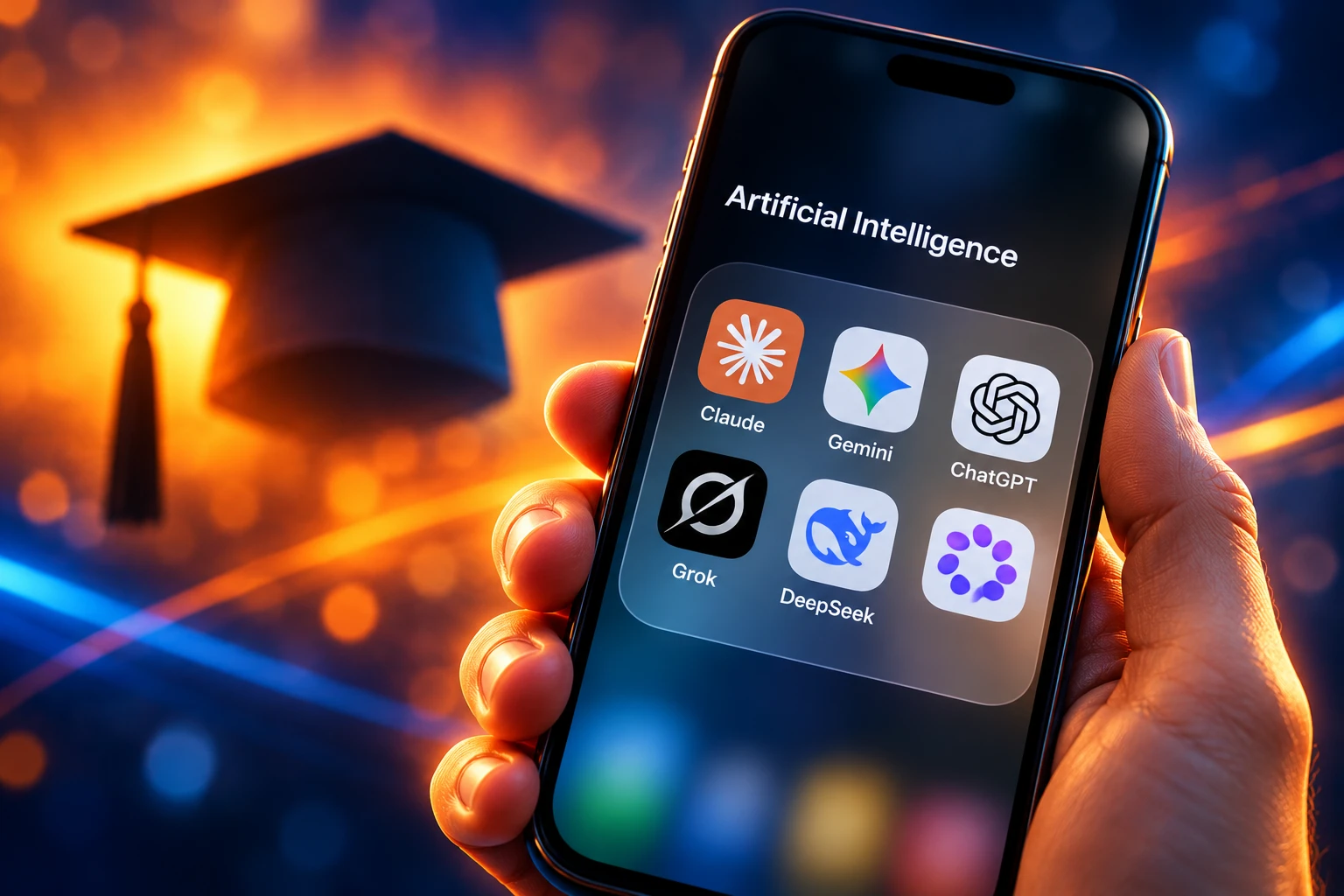
The administration’s own summary says students would build foundational knowledge about emerging technologies, responsible use of AI tools, and AI’s impact on education, work, and everyday life. Last year the state already published K-12 AI guidance and AI literacy materials for educators. That is policy for districts. It is not a graduation standard.
WHAT WE KNOW
- The vehicle: Districts may meet the milestone through local coursework or a state-developed AI and digital literacy learning module.
- The origin: AI and digital literacy was not a formal item in the December 2025 interim report; co-chairs elevated it after listening sessions, a public survey of 6,615 responses, and other input.
- The shelf life: The final report says the recommendation may need to be updated over time because the technology keeps changing.
WHAT IS UNCONFIRMED
- The standards: The Board and the Department of Elementary and Secondary Education still have to write what “AI and digital literacy” means for a diploma.
- The hours: No credit value, seat-time floor, or passing bar is set in the June document.
- The grader: The plan does not say who signs off that a student finished the milestone, or how a state virtual module would be scored against a local course.
Media Literacy Now, which backed the milestone, put the next decision in plain terms. What goes into those standards will decide whether students leave with judgment or with a box ticked. Draft language already points at credible sources, the role of algorithms, and critical reading of what AI produces. Those are media-literacy skills, and they are still a draft.
The council report leans on labor-market research to justify the add-on. As of 2023, it says, 92 percent of jobs required digital skills, workers in those jobs earned 23 percent more, and the same-job premium for AI skills was 56 percent. That is a wage argument. It is not a syllabus.
Forty Percent of Districts Run the Host Tool
MyCAP is the bucket that would hold the AI milestone. It is a multi-year college, career, and civic planning process that DESE already recommends for grades 6 through 12 and requires in Chapter 74 career technical programs, Innovation Career Pathways, and Early College. About 40 percent of Massachusetts districts use it.
THE ADOPTION GAP
- MyCAP: About 40 percent of districts now run the planning tool that would host AI literacy, financial literacy, work-based learning, and the financial-aid form.
- MassCore: About 74 percent of districts already have local rules that meet or exceed MassCore unit totals in the core academic subjects.
- State money: The administration opened $500,000 in grants last summer to help more districts reach MassCore, not to staff an AI module.
- Other states: Twenty-five states require an individual career and academic plan in high school, and seven others recommend one.
MassCore is the piece that already exists in most buildings. MyCAP is the piece that would carry AI, and most districts do not run it yet. Districts would not be forced onto a single software product. MEFA Pathways is free and recommended, and other state-approved platforms would be allowed. A free login does not invent counseling time. A milestone on a plan students never open is still a milestone on paper.
Implementation planning is slated for the 2026-27 school year. MassCore would hit incoming ninth graders in fall 2027. MyCAP, the AI module, the exams, and the capstone would wait for the ninth-grade class that enters in fall 2028.
Who Already Built the Curriculum Pipeline?
While Beacon Hill has not voted, the organizations that already train people on AI in Massachusetts are not waiting for a statute. The diploma rule, if it passes, will land on a market that already has certificates, teacher institutes, and a planning contractor.
THE PIPELINE ALREADY IN PLACE
- DESE module: The state would be allowed to ship a virtual AI and digital literacy unit, the same delivery idea already sketched for financial literacy.
- Google certificates: On February 26, 2026, Healey and Grow with Google opened no-cost AI and career certificate training to every Massachusetts resident through the Massachusetts AI Hub, with access running through December 31, 2027.
- Project Lead The Way: In June 2025 the STEM Advisory Council and the AI Hub put $135,000 into a Future Ready classroom pilot for 45 classrooms, about 1,600 students, and 30 districts, then expanded the AI curriculum work that fall.
- Public Consulting Group: PCG already coaches districts on MyCAP for DESE, which means the host tool and the vendor sitting on it are in place before the AI standards are.
- Day of AI: Jeff Riley, the former elementary and secondary commissioner and now executive director of the nonprofit Day of AI, has praised Boston’s jump on the proposed state rule and framed the job as giving educators and students knowledge and agency, not debating whether AI is coming.
The same administration that wants AI on the diploma already rolled ChatGPT out to 40,000 executive-branch employees and stood up a $100 million Massachusetts AI Hub in 2024. Technology Services and Security Secretary Jason Snyder said preparing students means they leave able to work in a digital and AI-powered world. That is a workforce pitch. It also puts the state’s own vendors and partners one step closer to the classroom than the unwritten standards are.
Zero States Require an AI Course to Graduate
Code.org and CSforALL’s 2025 State of AI and CS Education report, with data finalized December 1, 2025, found no state that requires students to earn credit in an AI and computer science course to graduate. Twelve states require a computer science course. Four (Colorado, Virginia, North Dakota, and Ohio) explicitly focus on AI inside their computer science standards. Sixty percent of U.S. public high schools offered a foundational CS course in 2024-25.
AI VERSUS COMPUTER SCIENCE ON THE DIPLOMA
| Policy | Where it stands |
|---|---|
| CS course required to graduate | 12 states |
| AI and CS course required to graduate | 0 states |
| AI named inside CS standards | 4 states |
| Massachusetts proposal | A MyCAP module, not a CS credit |
Massachusetts already lets a computer science course replace one MassCore math unit or one lab science unit if it meets Digital Literacy and Computer Science standards. The new AI item does not use that door. It does not add a CS credit. It adds a planning milestone that Code.org’s AI-plus-CS graduation test would not even count, because that test looks for course credit and named AI and CS instruction.
Idaho, by contrast, has a one-credit digital literacy course for students graduating after January 1, 2028. West Virginia’s computer science credit, starting with ninth graders in 2027-28, explicitly excludes digital literacy and keyboarding. Massachusetts is claiming a first on AI literacy while writing a lighter instrument than the CS credits other states already enforce.
Teachers Put Capstones First and State Exams Last
The loud fight is not about the AI module. It is about the exams that would sit next to it. The Massachusetts Teachers Association, which led the 2024 ballot campaign, said on June 17 that the recommendations missed the opportunity that voters provided when they passed Question 2.
The proposals that can modernize our public schools are marred by an outdated, top-down approach to policymaking driven by the state Department of Elementary and Secondary Education that does not respect the professionalism of educators.
Max Page, President, and Deb McCarthy, Vice President, Massachusetts Teachers Association
Page and McCarthy support a strong course of study, capstones, and more counseling. They oppose any state-designed, state-graded, MCAS-style test as part of a diploma, and they note those exams are not the same as a teacher’s own final. The June report says performance on the end-of-course assessments will meaningfully count toward a student’s record and path to graduation. That sentence is the fuse.
A UMass Amherst Center for Education Policy survey, released September 8, 2026, landed on the same split. Researchers emailed about 18,000 teachers between June 2 and August 24 and received 1,179 completed surveys, weighted to match the state’s teaching force, with a 2.9 percent margin of error. Most teachers put capstone projects or MassCore at the top of their diploma list. Half ranked statewide final exams last. Less than a fifth ranked those exams first.
Jack Schneider, a UMass professor who helped lead the survey, said schools still need rigorous content standards and a way to track progress, and they also need to think about what gets a student into class ready to learn. The same survey found 54 percent of teachers called student use of AI a problem. The people who would teach the new milestone already see AI as a classroom headache, not a finished skill, while the state writes it onto the diploma as a planning task.
MassCore itself is heavy: four years of English, four of math, three of lab science, three of history, two of the same world language, arts, physical education, and five additional courses. That is the piece teachers ranked high. The AI module is riding in the shadow of that list and of the exam war.
The $1 Million That Stops at Boston
Boston did not wait for Beacon Hill. On March 26, 2026, Mayor Michelle Wu, Superintendent Mary Skipper, and Kayak co-founder Paul English, a Boston Latin School graduate, announced a $1 million public-private partnership aimed at making Boston the first major U.S. city where every public high school graduate is AI literate. The gift funds teacher training with UMass Boston’s Paul English Applied Artificial Intelligence Institute, industry-informed curriculum, hackathons, internships, and career pathways. Nine founding advisory-board members come from AI, robotics, software, and consumer tech.
Boston Public Schools opened an inaugural cohort of 25 secondary AI Educator Ambassadors for the 2026-27 year. The stipended teachers take a week-long August institute at UMass Boston, complete a Demystifying AI course, deliver a foundational AI literacy lesson sequence, and help run a district hackathon. Skipper has said some students will also be able to take credit-bearing AI courses at the university. Wu said the work has to stay grounded in ethics and in keeping creativity and leadership intact, and that AI should add to learning rather than replace it.
That is a city with a donor, a university institute, and 25 paid teacher-leaders. The statewide plan offers a future DESE module and $500,000 in MassCore grants. Gateway cities in the PLTW pilot got a classroom experiment. They did not get Boston’s check. If the Legislature writes the MyCAP milestone into law without staffing, the districts that already have money and partners will look “AI literate” first, and everyone else will click through a state module.
FROM THE MCAS VOTE TO THE CLASS OF 2032
- November 2024: Voters repeal the MCAS as a diploma requirement after 21 years.
- January 17, 2025: Healey signs the executive order creating the 32-member graduation council.
- June 2025: The state launches the $135,000 Future Ready AI classroom pilot.
- December 2025: An interim report lists MassCore, exams, MyCAP, and a capstone, and leaves AI off the formal list.
- February 26, 2026: Healey and Google open free statewide AI certificate training through December 31, 2027.
- March 26, 2026: Boston announces the $1 million English gift and the ambassador cohort.
- June 17, 2026: Final recommendations add AI and digital literacy as a MyCAP milestone and keep state end-of-course exams.
- September 8, 2026: UMass Amherst releases the 1,179-teacher survey that ranks state exams last.
- Fall 2027: Incoming ninth graders would be the first MassCore cohort if the plan is adopted.
- Fall 2028: Incoming ninth graders would be the first class facing MyCAP, the AI milestone, exams, and a capstone.
- 2032: That class would be the first to graduate under the full package.
The first students who would carry every piece of the new diploma, including the AI milestone, would enter ninth grade in fall 2028 and finish in 2032. The module’s standards have not been written. The Legislature has not voted.

Liberty Parks MotoGP on Formula 1’s Austin Stage

The Salary Cap Fight That Can Freeze Baseball’s TV Payday

The 2027 Mercedes GLE and GLS Keep Alabama Busy

Margaret Hamilton Dies at 90 With a Harder Fight Unfinished

Unity Parks Its Engine Inside Google’s Prompt Games

Microsoft 365 Auth Fault Took Down Exchange and Teams

Diesel Breaks Its Record as the White House Claims Credit

Xbox Caps Game Pass Cloud Gaming at 15 Hours

Squishy Dumpling Toys Recalled After Hiding Illegal Water Beads

IFA 2026’s Weird Gadgets Are Building a Sensor Home
-
 NEWS2 months ago
Microsoft 365 Auth Fault Took Down Exchange and Teams
-
 GAMING2 months ago
Xbox Caps Game Pass Cloud Gaming at 15 Hours
-
 BUSINESS2 months ago
Diesel Breaks Its Record as the White House Claims Credit
-

 AUTO2 months ago
Tesla Puts Its Wheel-Free Cybercab on Austin Streets
-

 NEWS2 months ago
OpenClaw 2.0 Ships a Team Workplace With Host-Trust Defaults
-
 NEWS2 months ago
Sony and Warner Sue Anthropic Over Torrented Song Lyrics
-
 LIFESTYLE2 months ago
Squishy Dumpling Toys Recalled After Hiding Illegal Water Beads
-
 BUSINESS2 months ago
ChargePoint Stock Rally Prices Wilmer’s Three-Year Cash Plan