
BUSINESS
Employers Funded Life Insurers’ 33% August Premium Jump
Life insurers’ August new business premium rose 33%, but group single-premium deals and labour-code gratuity funding, not household policy growth.

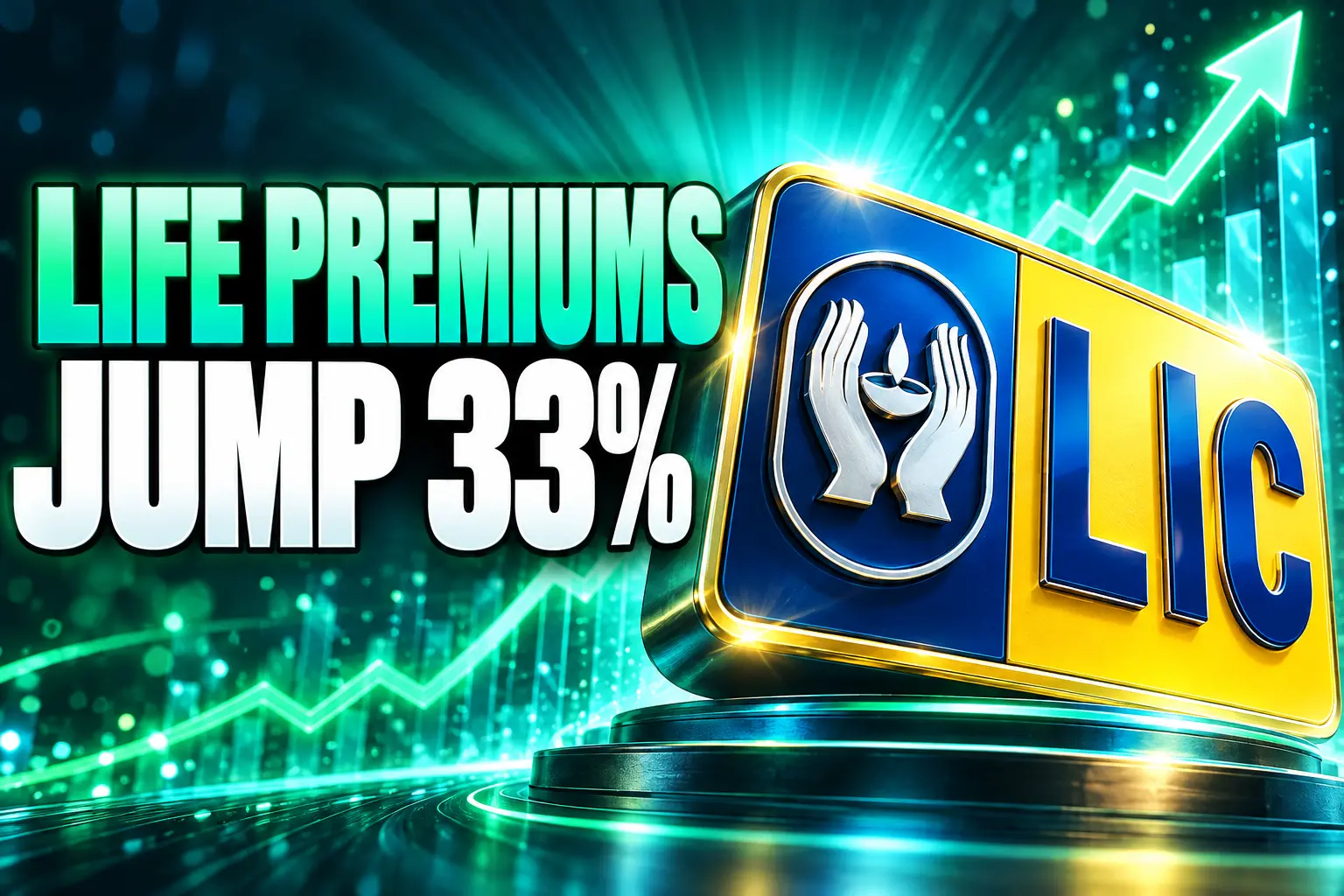
Life insurers collected Rs 41,197.78 crore of new business premium in August, 33% more than a year earlier, after group single-premium deals did most of the work. Early figures from the Life Insurance Council put year-to-date new business premium at Rs 1.97 lakh crore, up 20.41% from Rs 1.63 lakh crore.
The cheques behind that print came from company books. Retail-weighted premium, which tracks household regular-pay policies, grew about 14% in the month.
Most of the Month Came From Group Deals
Group single-premium business rose 56% to Rs 23,887 crore from Rs 15,303 crore and supplied 58% of August collections. That is the product employers use to fund gratuity trusts, leave encashment and retirement pots in one transfer, including group gratuity and superannuation plans sold as a single premium for simpler administration.
Group yearly renewable premium leapt to Rs 1,385 crore from Rs 20 crore a year earlier, a base spike rather than a new retail habit. Individual non-single premium, the recurring household line, grew 13.4% to Rs 10,349 crore. Individual single premium rose 34.7% to Rs 5,512 crore.
AUGUST PREMIUM BY PRODUCT LINE
| Product line | August 2026 (Rs crore) | Change |
|---|---|---|
| Group single premium | 23,887 | +56% |
| Individual non-single | 10,349 | +13.4% |
| Individual single | 5,512 | +34.7% |
| Group yearly renewable | 1,385 | from Rs 20 crore |
| Industry new business premium | 41,197.78 | +33% |
On a year-to-date basis, group single premiums were up 24.54% at Rs 1.17 lakh crore, while individual single and non-single premiums grew 14.82% and 13.88%. Group non-single premiums fell 35.25%.
The Labour Codes That Repriced Group Cover
Those group inflows sit on a legal change, not a sudden burst of family buying. India’s four labour codes took effect on 21 November 2025. CareEdge Ratings had already flagged enhanced gratuity rules supporting group premiums as a support for the employer book in FY26, and that support is still in the FY27 monthly prints.
WHAT THE CODES CHANGED FOR EMPLOYERS
- Wage floor: Basic pay, dearness allowance and retaining allowance must make up at least 50% of total pay, which lifts the base used for gratuity.
- Fixed-term staff: A worker on a fixed-term contract becomes eligible for gratuity after one year of the contract, against the old five-year wait.
- Start date: The labour ministry says the new wage definition and gratuity maths apply from 21 November 2025, not back through old service years.
Permanent staff still need five years for gratuity. The extra bill is concentrated on contract-heavy payrolls and on any firm that had kept basic pay thin to hold statutory costs down. Insurers take that bill as a group single-premium top-up.
Fixed Term Employee (FTE) will be eligible for gratuity if he/she renders service under the contract for a period of one year (from start of contract).
Ministry of Labour and Employment, additional FAQs on the labour codes
The ministry’s March 2026 FAQ set also confirms gratuity after one year of contract service and that the wage definition used for that calculation runs from 21 November 2025. Company treasurers, not first-time term-plan buyers, are the ones writing the larger cheques.
LIC Banked the Rupees as Private Insurers Sold Policies
Life Insurance Corporation of India took the rupee headline. Its August new business premium rose 45.3% to Rs 23,275 crore from Rs 16,023 crore, a 56.5% share of the industry month. Group single-premium business at LIC rose 71.9% to Rs 17,141 crore, which is 73.6% of LIC’s own August book.
Private insurers collected Rs 17,922 crore, up 20% from Rs 14,936 crore. They are still faster on a year-to-date basis, with premiums up 22.31% to Rs 80,005 crore from Rs 65,410 crore, against LIC’s 19.14% rise to Rs 1.17 lakh crore. That YTD gap is the opposite of the August scoreboard, where LIC’s group book overpowered the private total.
THE AUGUST SPLIT
- LIC share of the month: 56.5% of industry new business premium, built on group single-premium inflows.
- Private YTD speed: 22.31% growth through August, still ahead of LIC’s 19.14%.
- Group franchise: LIC already held 70.90% of group business in the June quarter, with 60.10% of first-year premium overall and 38.89% of individual business.
- Stock tape: LIC and HDFC Life shares rose as much as 3% on 8 September after the print.
Nuvama said LIC’s retail-weighted premium rose about 13% and outpaced private peers, while LIC’s total annualised premium equivalent slowed to 3%. The Council’s own retail-weighted series puts LIC at 12.8% for August and 15.3% for April-August. The rupee month and the quality month are different ledgers.
Why Policy Count Barely Budged
Premiums can swell when a few employers write large cheques. Lives covered do not have to follow. Policy volumes rose only 2.57% in April-August, to 94.88 lakh from 92.50 lakh. Private insurers lifted policy counts 10.08%. LIC’s policy count fell 1.67%.
Retail-weighted premium tries to strip the bulk effect out. It gives full weight to individual non-single premium and a tenth of the weight to individual single premium, and it grew about 14% in August and about 13.9% in April-August, less than half the 33% headline and well below the 20.41% year-to-date new-business figure.
That gap is the household story. More rupees moved. Hardly more people bought a policy, and the state incumbent sold fewer of them even as its group desk had its loudest month of the summer.
SBI Life Grew Retail as Its Headline Stalled
The employer-led month also explains why one large private book looked slow. SBI Life’s total new business premium rose 2.8% to Rs 3,415 crore, taking year-to-date premium to Rs 16,220 crore, up 12.73%. Group single premiums at SBI Life fell 34.3%. Individual non-single premiums grew 16.07%, and retail-weighted premium rose 21.8% in August and 16% in April-August.
HDFC Life was the more even large private. Total new business premium rose 17.8% to Rs 3,609 crore from Rs 3,064 crore, with retail-weighted premium up 17.4%. Group single premiums grew 14.1% and individual non-single premiums 16.8%. Its April-August total was up 14.43% at Rs 15,570 crore, while retail-weighted premium for that stretch was only about 6%.
ICICI Prudential Life’s August premium increased 9.9% to Rs 1,953 crore, with year-to-date premiums up 18.52% to Rs 9,120 crore. Individual non-single premium grew 10.6% and group single premium 31.2%, while group yearly renewable premium declined 13%.
LISTED AND LARGE BOOKS, AUGUST 2026
| Insurer | August NBP (Rs crore) | August growth | YTD growth |
|---|---|---|---|
| LIC | 23,275 | 45.3% | 19.14% |
| Private insurers (all) | 17,922 | 20% | 22.31% |
| HDFC Life | 3,609 | 17.8% | 14.43% |
| SBI Life | 3,415 | 2.8% | 12.73% |
| ICICI Prudential Life | 1,953 | 9.9% | 18.52% |
| Aditya Birla Sun Life | 1,313 | 137.9% | 96.68% |
Mid-size books split hard. Bajaj Life grew 31.6% in August and 41.68% year to date. Tata AIA rose 33.2% in the month and 25.92% year to date. Kotak Mahindra Life posted 16.1% monthly growth and 34.17% year to date, and PNB MetLife’s premium increased 55.5% in August and 24.90% year to date. Canara HSBC Life grew 5.2% in August and 21.03% year to date.
IndiaFirst Life’s August premium rose 20.5%, but its year-to-date premium was down 10.85%. CreditAccess Life’s year-to-date premium fell 57.74% even after a 101.5% rise in August. Edelweiss Life declined 3.39% year to date. Go Digit’s year-to-date premium rose 33.23%. IndusInd Nippon Life grew 16.9% in August and 23.31% year to date, while Star Union Dai-ichi and Shriram Life recorded year-to-date growth of 17.33% and 20.12%.
A Weak Year-Ago August Inflated the Growth Rate
August was not the fattest month of the fiscal year in rupees. Industry new business premium in July was Rs 47,005 crore, up 20.7%, so the August total of Rs 41,197.78 crore is a seasonal step down, the same pattern as last year, when July 2025 printed Rs 38,958.1 crore and August 2025 printed Rs 30,958.8 crore.
The 33% rate is a year-on-year story, and last August was a soft base. CareEdge’s monthly series shows August last year had fallen 5.2% from August 2024’s Rs 32,644.1 crore. FY27 then opened at Rs 30,550.4 crore in April, up 39.1%, before May slowed to Rs 32,030.9 crore, up 5.1%, when group single premium cooled.
FY27 MONTHLY PRINTS SO FAR
- April 2026: New business premium Rs 30,550.4 crore, up 39.1%.
- May 2026: Rs 32,030.9 crore, up 5.1%, as group single premium cooled.
- July 2026: Rs 47,005 crore, up 20.7%, still the fattest month of the year so far.
- August 2026: Rs 41,197.78 crore, up 33% on a weak year-ago base.
- 7 September 2026: Life Insurance Council releases the provisional August table.
The 33% print is real money, and most of it is employer money. Household policy count is up 2.57% this fiscal year, LIC sold fewer policies, and retail-weighted growth ran at about 14%. That is the number that will still be on the page when the group cheques stop landing in a single month.
Frequently Asked Questions
What Is Group Single Premium in Life Insurance?
It is a lump-sum premium an employer or other group master-policyholder pays to an insurer to fund a scheme, most often a gratuity trust, leave-encashment pot or superannuation fund, rather than a family buying a regular-pay policy. Insurers also use the same wrapper for some credit-linked covers. The August industry figure of Rs 23,887 crore is that wholesale ticket, which is why rupees can jump when the number of policies does not.
How Is Retail-Weighted Premium Calculated?
The Council series used around this print gives full weight to individual non-single premium and 10% weight to individual single premium, and it leaves group business out. For August that is Rs 10,349 crore plus a tenth of Rs 5,512 crore, or about Rs 10,900 crore, which is why the measure grew about 14% when headline new business premium grew 33%.
When Did India’s Labour Codes Change Gratuity Rules?
The four codes came into force on 21 November 2025. Fixed-term employees become eligible for gratuity after one year of the contract; permanent employees still qualify after five years. Wages for the calculation must be at least 50% of total pay, with excess allowances added back, which raises the funding need that group schemes are built to hold.
What Is the Difference Between NBP and APE?
New business premium counts the rupees received, so a large group single-premium cheque prints in full. Annualised premium equivalent scales single-premium income down, commonly to 10%, so that a one-time transfer does not look like a year of regular premium. CareEdge treats group yearly renewable premium as recurring when it builds APE, which is why LIC can post a 45.3% new-business month and a 3% APE reading in the same tape.
Did GST on Individual Life Cover Change Before This Print?
Yes. GST on individual life insurance policies was cut to zero in September 2025, a change CareEdge has tied to better affordability in the individual book. That tailwind was already in the base by August 2026, which is why a 13.4% rise in individual non-single premium is the household run-rate after the tax cut, not before it.
Disclaimer: This article is news reporting and analysis of industry premium figures for information only. It is not investment advice, insurance advice, or a recommendation to buy, hold or surrender any policy, share or other product. Readers should consult a licensed insurance advisor or a SEBI-registered investment adviser before acting on any figure in this piece. Premium totals, growth rates and product mixes reflect Life Insurance Council, company and research-house figures as published for August 2026 and may be revised in later disclosures.

The Salary Cap Fight That Can Freeze Baseball’s TV Payday

The 2027 Mercedes GLE and GLS Keep Alabama Busy

Margaret Hamilton Dies at 90 With a Harder Fight Unfinished

Unity Parks Its Engine Inside Google’s Prompt Games

The Hidden Vendor Cut in 403(b) vs 401(k) Plans

Microsoft 365 Auth Fault Took Down Exchange and Teams

IFA 2026’s Weird Gadgets Are Building a Sensor Home

Xbox Caps Game Pass Cloud Gaming at 15 Hours

Squishy Dumpling Toys Recalled After Hiding Illegal Water Beads

Tesla Puts Its Wheel-Free Cybercab on Austin Streets
-
 NEWS2 months ago
Microsoft 365 Auth Fault Took Down Exchange and Teams
-
 GAMING1 month ago
Xbox Caps Game Pass Cloud Gaming at 15 Hours
-
 NEWS1 month ago
IFA 2026’s Weird Gadgets Are Building a Sensor Home
-

 NEWS1 month ago
OpenAI Unveils GPT-6 Astra With a Critical Cyber Label
-
 AUTO1 month ago
Tesla Puts Its Wheel-Free Cybercab on Austin Streets
-
 NEWS2 months ago
OpenClaw 2.0 Ships a Team Workplace With Host-Trust Defaults
-

 NEWS2 months ago
Sony and Warner Sue Anthropic Over Torrented Song Lyrics
-
 LIFESTYLE1 month ago
Squishy Dumpling Toys Recalled After Hiding Illegal Water Beads