
BUSINESS
REC’s Tokenised Bond Tests Same-Day Digital Settlement
REC listed India’s first tokenised corporate bond the same day, paid in wholesale digital rupees, a ₹500 crore test of settlement rails.

REC Ltd raised ₹500 crore on September 7 through India’s first tokenised corporate bond, with pay-in, allotment and listing finished the same day. Investors paid in the Reserve Bank of India’s wholesale digital rupee for notes that carry a 7.30% coupon, run for one year and nine months, and fall due in May 2028 ($52.9 million).
The issue was a SEBI sandbox pilot, not a large funding round, and it put listed corporate debt onto rails the central bank had already tested on government securities, call-money loans and tokenised certificates of deposit.
REC Closed the Book in a Single Day
REC, the state-owned power financier under the Ministry of Power, said the sale was India’s first pilot issue of tokenised corporate bonds under SEBI’s Regulatory Sandbox Framework. Bidding ran on the National Stock Exchange’s Electronic Bidding Platform, the same screen used for ordinary private placements, and the company accepted ₹500 crore after a book of ₹796 crore. That response was around eight times the ₹100 crore base, once the ₹400 crore greenshoe is set aside.
THE REC SANDBOX TAP
| Term | Figure |
|---|---|
| Base issue | ₹100 crore |
| Greenshoe | ₹400 crore |
| Bids received | ₹796 crore |
| Amount accepted | ₹500 crore |
| Coupon | 7.30% a year |
| Tenor | 1 year 9 months, due May 2028 |
| Listing | NSE and BSE, same day |
REC posted those terms on September 8, and Director (Finance) Rajesh Kumar tied the result to SEBI’s sandbox rather than to a change in REC’s own credit.
REC Limited Successfully Issued India’s First Pilot Issue on Tokenized Corporate Bonds Under SEBI Regulatory Sandbox Framework
REC, a Maharatna Central Public Sector Enterprise (CPSE) under the Ministry of Power and a leading NBFC-IFC, has achieved a landmark milestone in… pic.twitter.com/EDQe7GoL78
— REC Limited (@RECLindia) September 8, 2026
The bonds are ordinary REC paper. Coupon and principal still sit with the issuer. What moved is the record of who owns them and the cash used to pay for them.
A Permissioned Ledger and a Second Wallet
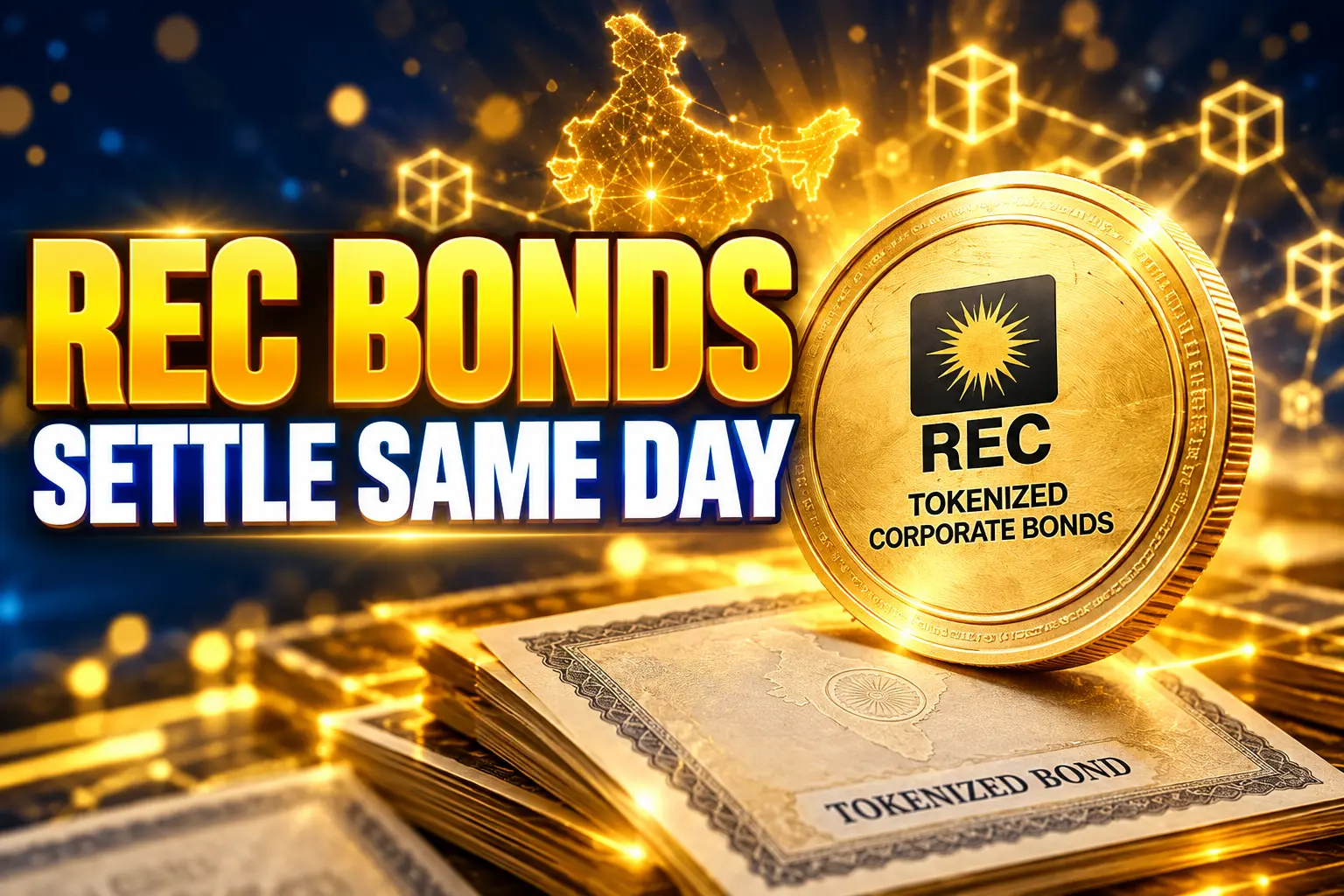
Ownership sits on Demat 2.0, a permissioned distributed ledger the depositories built for tokenised holdings, instead of the older depository register. Payment moved through a wholesale CBDC wallet, which is not the retail Digital Rupee app. Both had to match before the trade could complete, which is why allotment and listing could finish on the same day as pay-in.
REC called that link atomic delivery-versus-payment: the bond and the cash move together, or neither moves. NPCI, the depositories and the exchanges worked the pilot with SEBI and the RBI, and the ledger stays inside licensed market plumbing. Public chains, bitcoin and rupee stablecoins are not part of the design.
The cash rail is older than this bond. RBI’s Digital Rupee FAQs, updated February 4, 2026, said the wholesale e-rupee already had 16 bank and non-bank participants and three live uses, including the ability to settle government securities and call-money trades and tokenised certificates of deposit. REC is the first listed corporate bond on that cash leg, not the first rupee instrument the wholesale wallet has touched.
THE CASH RAIL INTO THE REC NOTE
- February 4, 2026: RBI’s Digital Rupee FAQs list 16 wholesale participants and three live uses, including government securities, call money and tokenised certificates of deposit.
- August 20, 2026: SEBI whole-time member Amarjeet Singh tells an ASSOCHAM bond summit that a tokenisation pilot with the RBI is expected soon, aimed at simultaneous transfer of security and money.
- September 7, 2026: REC prices the sandbox bond on NSE’s bidding platform and lists it on NSE and BSE the same day.
Houses without both wallets could not bid. Mutual funds, banks and companies that have not opened a wholesale CBDC account and a Demat 2.0 holding are still on the ordinary bond market, where money and paper still clear on separate clocks.
Why India’s Bond Market Barely Trades
India can raise a lot of corporate debt and still struggle to trade it. Amarjeet Singh told the August 20 summit that outstanding corporate bonds had grown from about ₹17.5 trillion at the end of FY2015 to over ₹60 trillion at the end of July 2026, around 12% a year, and that the market is about 16-17% of GDP, against around 79% in South Korea, around 54% in Malaysia and around 38% in China. In FY2025-26 the debt market mobilised about ₹9.11 trillion, nearly twice the amount raised in equity, while about 98% of issues were privately placed.
The secondary tape is thinner than that stock implies. Singh said that of nearly 33,000 outstanding instruments across about 7,200 issuers, only 400 to 500 bonds trade daily. Corporate-bond repo, the usual way a dealer finances inventory, is about ₹6,000 crore on a typical day and still less than 1% of the wider repo market. Online bond platforms did grow, with registered clients rising from about 0.6 million to 1.5 million in FY2025-26 and yearly value from about ₹71 billion to ₹260 billion, but that is still a small window on a ₹60 trillion book.
HOW LITTLE OF THE STOCK CHANGES HANDS
| Market | Corporate-bond ADTO as share of outstanding stock |
|---|---|
| India | 0.2% |
| China | 0.5% |
| United Kingdom | 2.4% |
| United States | 4.7% |
CareEdge, in a June 15, 2026 note, put India’s daily turnover equal to 0.2% of outstanding stock, and said government securities turn over about 10 times as fast as corporate bonds. Faster primary settlement does not, by itself, create a two-way market in the 32,500 names that sit idle on a typical day. It can cut the window in which a buyer has paid and still does not own the note, which is the risk Singh said the pilot should test.
HDFC Bank Arranged the Issue Without Confirming a Bid
People familiar with the sale named HDFC Bank and ICICI Bank among about 20 buyers that also included mutual funds and companies, and they said investors used the RBI’s digital currency to pay. HDFC Bank said it was one of the arrangers and did not comment on buying the bonds. Axis Bank, ICICI Bank, ICICI Securities Primary Dealership, REC, Trust Investment Advisors and Yes Bank did not reply to emails seeking comment at the time of that account.
WHO SHOWED UP ON THE SANDBOX BOOK
- HDFC Bank: Named as a buyer by people familiar with the sale; the bank confirmed only an arranger role.
- ICICI Bank and ICICI Securities PD: Named on the buyer list; neither replied to a request for comment.
- Axis Bank and Yes Bank: Named as private-bank buyers; both were silent on the emails.
- AK Capital Services: Confirmed it took part.
- Taurus Group: Confirmed it invested and helped arrange the offer.
- Trust Investment Advisors: Named among subscribers; no public comment.
Amar Gandhi, founder and managing director at Taurus Group, said the main gain is speed. “By connecting tokenized securities with central bank digital currency-based payment, allotment and settlement can become significantly faster,” he said, after confirming the firm both bought and arranged.
That buyer list is a closed set. The 8-times headline measures demand among houses that already hold both wallets, not among the wider bond market that still settles on the old rails. A bank that arranges the sale and then declines to say whether it owns the paper is acting like a dealer testing a new pipe, which is a narrower claim than a rush into tokenised credit.
₹500 Crore Against ₹60 Trillion Outstanding
REC did not need a sandbox to raise ₹500 crore. The company is a regular issuer in rupee bonds, and ₹500 crore is a small print against a book SEBI put above ₹60 trillion in July, and against ₹9.11 trillion of corporate-debt raising in FY2025-26. The oversubscription line is also easy to misread: ₹796 crore of bids is around eight times the ₹100 crore base and about 1.6 times the ₹500 crore REC kept.
Crypto accounts treated the print as a public-chain debut. The ledger is permissioned, the cash is central-bank money, and bidding sat on NSE’s existing platform. The constraint that will matter for the next issues is the same two-wallet gate that defined this one. Until more treasuries hold wholesale CBDC and Demat 2.0 accounts, tokenised taps will keep clearing in a small room even when the coupon looks ordinary.
Same-day listing is the part that ordinary REC paper does not offer. If those notes can later change hands on the same clock, dealers may need less cash tied up between trade and settlement, which is the liquidity argument in its honest form. That secondary window does not exist as a published rulebook yet, so the September 7 print proves issuance, not trading.
Wednesday’s Private-Sector Window at Larsen & Toubro
Merchant bankers said Larsen & Toubro, India’s largest engineering company, is inviting bids on Wednesday, September 9, for three-year tokenised notes of up to ₹500 crore at a 7.40% coupon, which would be the first such issue from a private-sector company. They said the notes would settle the same day and that only investors with active CBDC wallets could bid. L&T did not reply to questions about the plan.
WHAT WE KNOW
- The calendar: Bankers said L&T asked for bids on September 9 for a three-year tokenised tap.
- The terms on the street: Size of up to ₹500 crore and a 7.40% coupon, settled in wholesale digital rupees.
- The gate: Only investors with active CBDC wallets are being told they can bid, matching the REC design.
WHAT IS UNCONFIRMED
- Company confirmation: L&T itself has not confirmed the issue, the coupon, or the size.
- The book: Allotment, final size and the buyer list are not public.
- Secondary rules: Exchanges have not published trading, market-making or lock-in rules for the tokenised notes.
A second issuer, if the book builds, would show that the wallets can be reused, which is the only way a sandbox pipe becomes market plumbing. A quiet book would show the opposite: that the same 20 names cannot be asked to stand in every week for ₹500 crore prints that still cannot be sold on.
SEBI’s Brief for a Faster Bond Market
Singh put tokenisation fourth among SEBI’s bond-market jobs, after market making, a wider distribution channel and a Credit Risk-o-Meter for debt. He said the work with the RBI would test whether a shared ledger can move the security and the money together, cut reconciliation, and, later, automate coupons through smart contracts. He also drew a hard line around what the pilot is for.
Let me clarify that this is not about creating a separate trading market. It is about examining whether technology can make the existing bond market simpler, faster and more efficient.
Amarjeet Singh, whole-time member, SEBI, at ASSOCHAM’s corporate bond summit, August 20, 2026
Kumar, at REC, described the same design as a debt-market step that keeps the old investor protections in place.
By leveraging digital infrastructure, distributed ledger technology, and CBDC-enabled settlement while preserving existing investor protections and regulatory safeguards, SEBI is laying the foundation for the next generation of capital market infrastructure.
Rajesh Kumar, director (finance), REC, in the company’s September 8 statement
The September 7 print did what that brief asked: a listed PSU bond, paid in wholesale digital rupees, allotted and listed before the day ended. Whether those notes trade as readily as they settled is a different test, and it has not started.
Disclaimer: This article is news reporting on a completed REC bond issue and on related market plumbing, and it is for information only. It is not investment advice, a solicitation to buy or sell any bond, token, or digital-rupee product, or a judgement on REC, Larsen & Toubro, or any named bank. Readers who are considering a purchase should consult a SEBI-registered adviser or other qualified investment professional who can review their own mandate and limits. Coupons, sizes, buyer lists and settlement rules are those given by the issuer, the RBI FAQs, SEBI remarks and deal-side accounts cited above, and they can change as the sandbox and any later issues move on.

The Salary Cap Fight That Can Freeze Baseball’s TV Payday

The 2027 Mercedes GLE and GLS Keep Alabama Busy

Margaret Hamilton Dies at 90 With a Harder Fight Unfinished

Unity Parks Its Engine Inside Google’s Prompt Games

The Hidden Vendor Cut in 403(b) vs 401(k) Plans

Microsoft 365 Auth Fault Took Down Exchange and Teams

IFA 2026’s Weird Gadgets Are Building a Sensor Home

Xbox Caps Game Pass Cloud Gaming at 15 Hours

Squishy Dumpling Toys Recalled After Hiding Illegal Water Beads

Tesla Puts Its Wheel-Free Cybercab on Austin Streets
-
 NEWS2 months ago
Microsoft 365 Auth Fault Took Down Exchange and Teams
-
 GAMING1 month ago
Xbox Caps Game Pass Cloud Gaming at 15 Hours
-
 NEWS1 month ago
IFA 2026’s Weird Gadgets Are Building a Sensor Home
-

 NEWS1 month ago
OpenAI Unveils GPT-6 Astra With a Critical Cyber Label
-
 AUTO1 month ago
Tesla Puts Its Wheel-Free Cybercab on Austin Streets
-

 NEWS2 months ago
OpenClaw 2.0 Ships a Team Workplace With Host-Trust Defaults
-

 NEWS2 months ago
Sony and Warner Sue Anthropic Over Torrented Song Lyrics
-
 LIFESTYLE1 month ago
Squishy Dumpling Toys Recalled After Hiding Illegal Water Beads