
LIFESTYLE
The $400 Heat Storm Garage Heater Needs an Electrician
Home Depot’s Heat Storm 6000-watt Wi-Fi garage heater is $399.99, but a 240-volt hardwire, a permit, and a sealed garage decide if it actually heats.

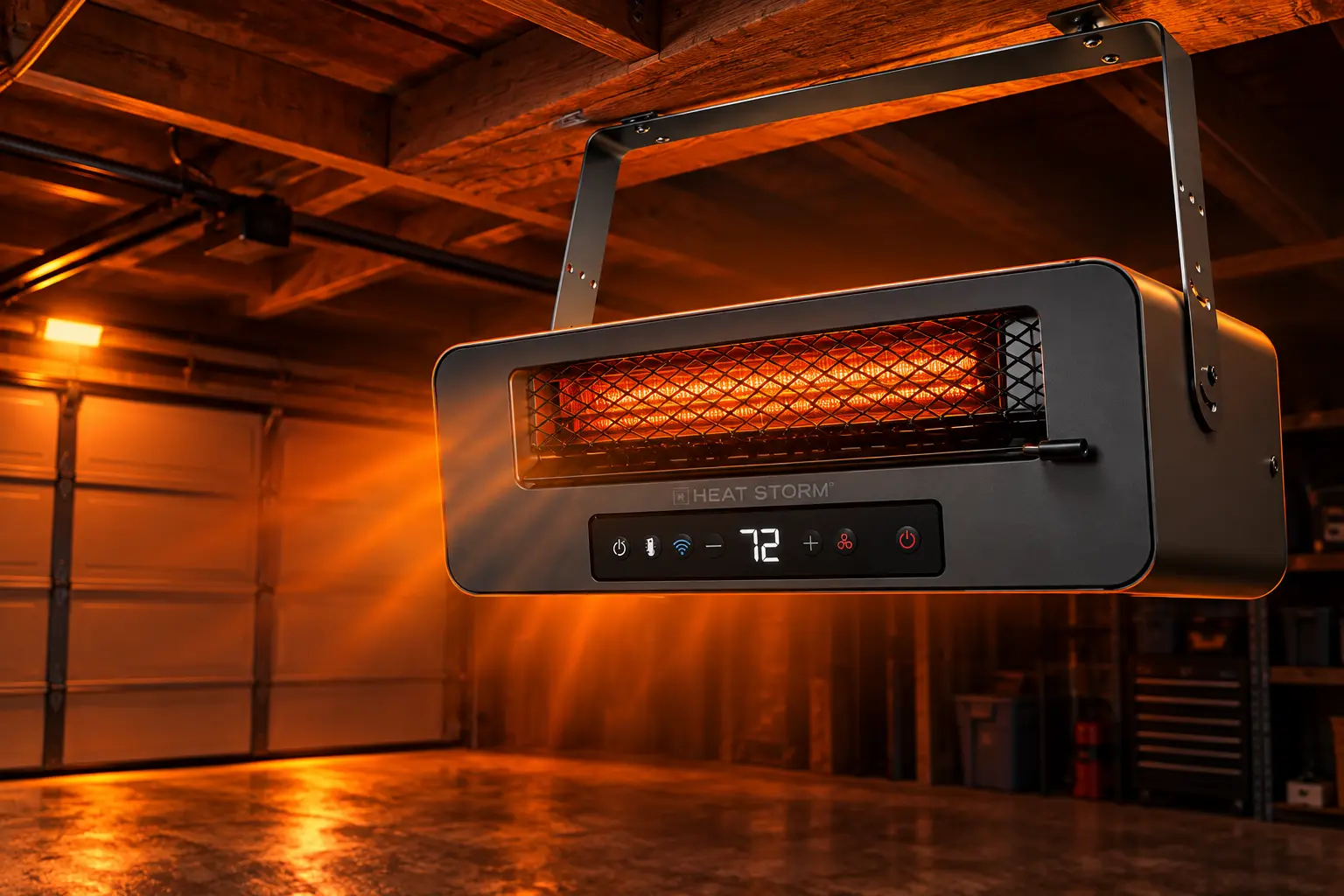
The Heat Storm A-6000-GC is selling for $399.99 at Home Depot as a Wi-Fi ceiling heater for cold garages. It ships without a plug.
The unit hangs on a wall or the ceiling, draws 6,000 watts on high, and talks to a phone app. The person who decides whether that box actually warms the bay is a licensed electrician standing at your panel, and the garage’s insulation after the breaker is on.
Home Depot Sells a Heater With No Cord
Heat Storm lists the A-6000-GC at the same $399.99 and calls for hardwiring to a 240-volt electrical system, with professional installation recommended and no wiring in the carton. Nameplate load is 25 amps on high and 12.5 amps on the 3,000-watt setting. Output is listed at 20,400 BTU, which matches the usual electric conversion of 6 kilowatts.
The steel housing is 12.75 inches deep, 17.5 inches wide, and 7 inches high, and it weighs 17 pounds. Heat Storm puts fan noise at 45 to 49 decibels. Buyers on the Home Depot card keep returning to the same points: it mounts off the floor, it comes up to temperature quickly, and the fan is quiet enough to live with. Other buyers said it was not powerful enough, or that the fan needed more push.
Those notes sit next to a coverage claim the company prints in bold. As primary heat, Heat Storm says the heater serves up to 1,000 square feet. As secondary heat, it says up to 1,800 square feet. A Walmart product card for the same 240-volt unit draws a harder line: up to 500 square feet in uninsulated space, and up to 1,000 square feet only when the area is well insulated.
The 1,000-Square-Foot Number Leaves Insulation Out
A contractor sizing page at HVACDirect puts the same warning in plainer language: square footage alone does not size a garage. Ceiling height, door leaks, R-value, and the outdoor design temperature change the load. Two 24-by-24-foot bays can share 576 square feet and still need different heaters if one is attached and sealed and the other is detached, tall, and opened all day.
A common electric rule of thumb is about 10 watts per square foot in an insulated garage with an 8-foot ceiling. At that rate, 6,000 watts covers about 600 square feet, not 1,000. Cold-climate tables that start at 15 to 20 watts per square foot for a well-insulated two-car bay push the need even higher. One Home Depot buyer said the heater would not take an 800-square-foot garage above 60 degrees after several hours, and blamed the building as much as the unit.
COVERAGE CLAIMS VERSUS A 6,000-WATT BOX
| Claim or rule | Area it implies | What it assumes |
|---|---|---|
| Heat Storm primary heat | Up to 1,000 sq ft | Manufacturer chart, space already able to hold heat |
| Heat Storm secondary heat | Up to 1,800 sq ft | Another heat source is already running |
| Walmart uninsulated note | Up to 500 sq ft | Bare walls, doors, and ceiling |
| 10 watts per square foot | About 600 sq ft | Insulated garage, modest ceiling, 6,000 W on high |
The table is why a 1,000-square-foot promise and a 60-degree complaint can both be true. The heater puts out a fixed 20,400 BTU. The garage either keeps that heat or dumps it through an uninsulated door every time a car rolls in.
What a 240-Volt Garage Circuit Costs
The carton does not include cable, a breaker, or a plug, and the English install sheet tells the electrician to land 8-gauge copper on a dedicated circuit with a maximum 30-amp fuse. Full power is 25 amps at 240 volts. That is dryer-circuit territory, not a spare 120-volt receptacle on the wall.
A 2026 contractor guide on dedicated circuits puts $300 to $600 for a 30-amp, 240-volt circuit in a typical house, with distance from the panel as the main swing. A straight run in an unfinished garage is the cheap end. A detached bay, a finished wall, or a full panel is not. If there is no spare slot, the same guide puts extra panel work at $500 to $2,000 or more. Most towns also want a permit for a new circuit.
Add the heater and a typical circuit and the project lands around $700 to $1,000 before anyone buys insulation. That is the number the app never shows.
WHAT THE ELECTRICIAN IS ACTUALLY SELLING
- A dedicated run: The heater is an appliance on its own circuit, not a share with lights or a compressor.
- The right copper: Heat Storm’s current sheet calls for 8-gauge copper and a maximum 30-amp fuse, and it wants a grounded 240-volt feed on L1, L2, and ground.
- Time on site: A simple add in an open garage is often 2 to 4 hours; fishing cable through finished walls can take a full day.
- A labeled breaker: The panel needs a double-pole space, a clear label, and a local inspection in most jurisdictions.
Some owners already have a 30-amp, 240-volt welder or dryer outlet in the shop and are tempted to add a cord. The safety sheet still says the heater is designed to be wired direct, and it tells you not to use an extension cord or a relocatable power tap. That is the electrician’s call, not a weekend adapter job.
6 Kilowatts Show Up on the Power Bill
Wi-Fi does not change the physics. On high, the element is a 6-kilowatt resistor. The U.S. Energy Information Administration put the average residential price at 18.31 cents per kilowatt-hour in July 2026, up 4.9 percent from July 2025. At that average, 6,000 watts costs about $1.10 per hour. The 3,000-watt setting costs about $0.55 per hour.
RUNNING COST AT THE JULY 2026 U.S. AVERAGE
- High, 6,000 W: About $1.10 an hour at 18.31 cents per kWh.
- Low, 3,000 W: About $0.55 an hour on the same rate.
- Your bill, not the average: State prices in that EIA table ran from under 10 cents to more than 30 cents, so the same heater is a different appliance in California than in the Dakotas.
Schedules in the app are how you stop paying the high rate on an empty floor. They do not shrink the 25-amp draw while the coils are on. If the garage cannot hold heat, the thermostat just keeps calling for $1.10 hours.
Smart Life Can Preheat an Empty Bay
Heat Storm does not ship a private app. Setup runs through the free Smart Life app, and the company’s pairing page says the phone must be on a 2.4 GHz network. Dual-band routers sometimes need a separate 2.4 GHz name before the heater will join. Once it is on, the phone can switch the unit, set a temperature, and repeat a schedule so the bay is warm before anyone opens the door.
The current carton also includes an external thermostat, which older owners used to ask for because the sensor in the housing reads the unit, not the far corner of the garage. Place that remote sensor in the occupied zone and the 45-to-60-degree split some buyers describe becomes possible.
I maintain 45 degrees when the garage is unoccupied, and 60 when i am working in the garage.
Gaston M., verified buyer who had an electrician run 240-volt power in a detached two-car garage, Heat Storm product page
That is the honest use case. The app is a timer for a 6-kilowatt load, not a substitute for a sealed door. In one filmed winter check of an insulated single-car bay of about 250 square feet, the same 6,000-watt class held 72 degrees with 32 degrees outside. That is a small, tight room. It is not a proof of 1,000 square feet.
A Sealed Door Beats a Bigger Element
Heat Storm’s own product page still leads with the 1,000-square-foot line. Buyers who live with the unit describe something smaller and more local: knock the chill off a workbench, hold 60 degrees while a project is underway, then drop back so the meter stops spinning. Several reviews called the advertised coverage too optimistic. The gap is usually the building.
Concrete floors, thin sectional doors, and unsealed top plates dump heat faster than a 17-pound ceiling box can replace it. Before a second heater goes on the card, the cheaper work is still weatherstrip, an insulated door, and ceiling batts. HVACDirect’s load note is the same idea in contractor language: measure the envelope, then pick equipment whose output matches the loss.
CHECK THE ENVELOPE BEFORE THE APP
- The big door: Perimeter seals and an insulated section stop the largest leak in most bays.
- The ceiling: Heat stacks high; a bare ceiling makes the 7-inch heater work against a cold attic.
- The floor: Bare concrete is a heat sink, so a 60-degree air target can still mean cold feet.
- The openings: Each car exit dumps the air the 20,400 BTU just paid to warm.
Home Depot’s listing is a $399.99 Wi-Fi heater that stays off the floor. The working system is a 25-amp, 240-volt circuit, a permit, and a garage that can keep the BTUs it is given. If the panel is already full, that $500 to $2,000 extra is the line that turns a ceiling gadget into a service upgrade, and it is the line the product photo never shows.
Frequently Asked Questions
Does the Heat Storm 6000-Watt Garage Heater Use a Standard 120-Volt Plug?
No. The A-6000-GC is a 240-volt hardwired indoor heater, and Heat Storm’s safety sheet says not to run it on an extension cord or a relocatable power outlet. The carton does not include the branch-circuit cable, so a licensed electrician has to land a dedicated feed that matches the nameplate and local code.
What App Controls the Heat Storm Wi-Fi Garage Heater?
Heat Storm points owners to the free Smart Life (Smart Living) app, not a brand-only program. Pairing needs a 2.4 GHz Wi-Fi signal, and some mesh or dual-band routers have to expose a separate 2.4 GHz name before the heater will join. After it is linked, the same app can set schedules, change modes, and shut the unit off from another location.
What Comes in the Box With the A-6000-GC?
Heat Storm lists the heater, mounting hardware, an external thermostat, and a remote control with batteries. Wiring, a breaker, and a plug are not in the box. The external thermostat is the piece that lets the control point sit in the occupied part of the garage instead of on the hot housing.
How Long Is the Heat Storm Garage Heater Warranty?
Heat Storm advertises a 1-year warranty and 30-day returns on its own product page. Retailer return windows can differ, and the electrical circuit the electrician installs is separate work that is not covered by the heater carton.

Final Fantasy Resonance Turns a Dead Gacha Into HD-2D

PHP2Shell Forced Sites Offline While Exploits Stalled

Kindle+ Folds AI Audiobooks Into the Page-Read Fund

Chip Stocks Fall as the Bond Rally Cheapens AI Spend

Comcast’s Record Odyssey Quarter Doubles as the Exit

Microsoft 365 Auth Fault Took Down Exchange and Teams

Xbox Caps Game Pass Cloud Gaming at 15 Hours

OpenClaw 2.0 Ships a Team Workplace With Host-Trust Defaults

OpenAI Unveils GPT-6 Astra With a Critical Cyber Label

Diesel Breaks Its Record as the White House Claims Credit
-
 NEWS2 months ago
Microsoft 365 Auth Fault Took Down Exchange and Teams
-
 GAMING2 months ago
Xbox Caps Game Pass Cloud Gaming at 15 Hours
-
 NEWS2 months ago
OpenAI Unveils GPT-6 Astra With a Critical Cyber Label
-
 NEWS2 months ago
OpenClaw 2.0 Ships a Team Workplace With Host-Trust Defaults
-
 BUSINESS2 months ago
Diesel Breaks Its Record as the White House Claims Credit
-

 LIFESTYLE2 months ago
Squishy Dumpling Toys Recalled After Hiding Illegal Water Beads
-

 BUSINESS2 months ago
ChargePoint Stock Rally Prices Wilmer’s Three-Year Cash Plan
-

 AUTO2 months ago
Tesla Puts Its Wheel-Free Cybercab on Austin Streets