
NEWS
Amtrak Cascades Airo Trains Debut After a Year Short on Seats
Amtrak Cascades Airo trains begin Sept. 30 with four daily trips, adding seats after 2025 Horizon cuts, while dual-mode versions wait for 2027.

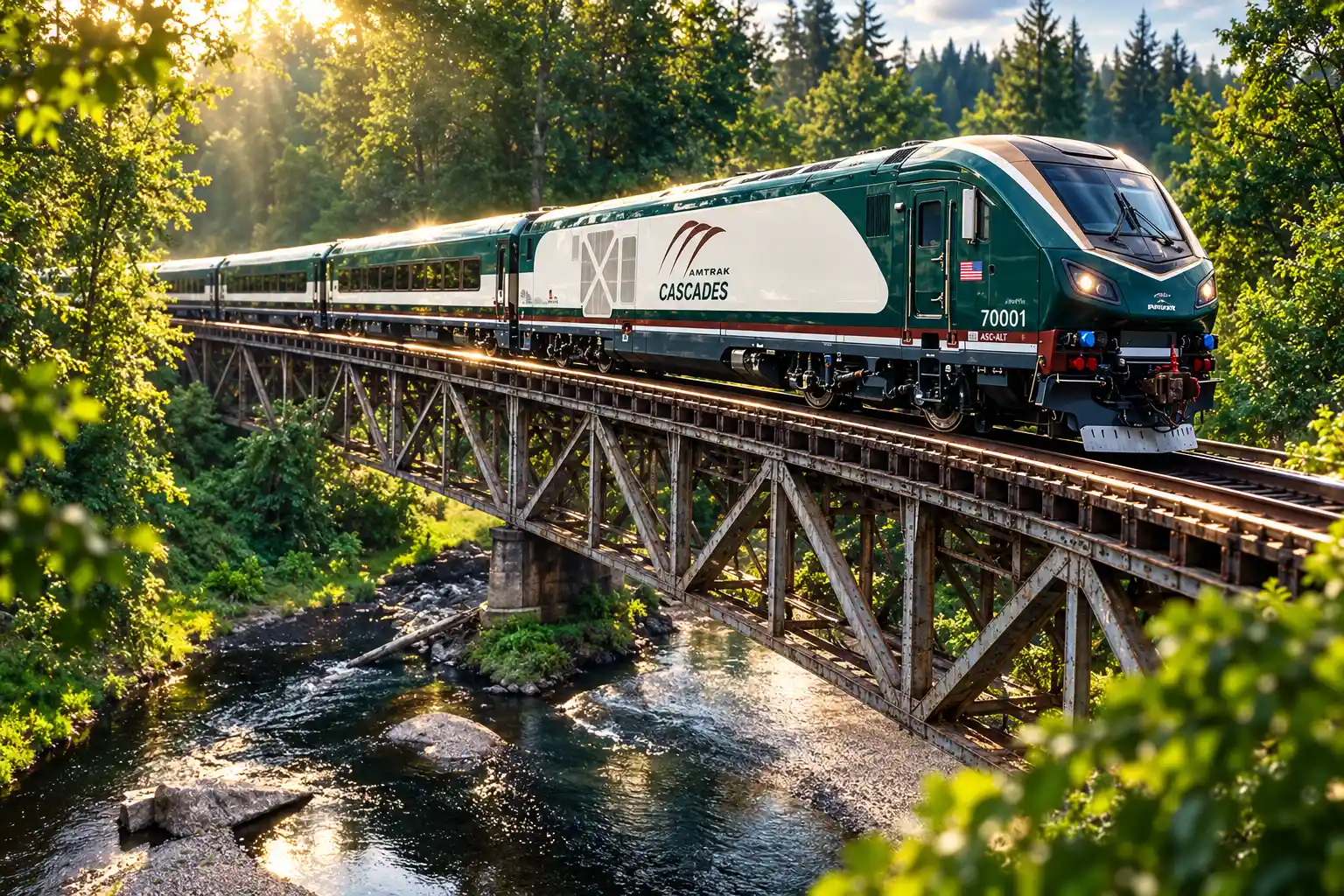
Two new Amtrak Cascades Airo trainsets begin carrying passengers on four daily trips on Sept. 30, the first Airo service in the country. They take one Seattle-Eugene round trip and one Seattle-Vancouver, B.C., round trip after a year when grounded cars, buses, and borrowed coaches did the work.
Amtrak, Washington, and Oregon are selling USB ports, a new cafe, and a first-in-the-nation label. The load the new cars actually pick up is simpler: Cascades ran short of seats after Amtrak pulled its Horizon fleet in March 2025, and these diesel sets are the first replacements that can put more than 300 seats back on a train.
Wednesday’s Four Trips Are Only the Opening Slice
Amtrak’s Sept. 17 notice assigns the launch to two trainsets operating four daily trips between Vancouver, B.C., Seattle, Portland, and Eugene, Oregon. A third accepted set stays in reserve. The railroad has ordered eight Cascades Airo sets, plus two new locomotives and a spare cab car, with the rest of that roster due through early 2027.
On Saturday, Sept. 26, one of those sets ran a Seattle-Portland preview for media and local officials. Public tour slots in Portland that Sunday morning and in Seattle that afternoon filled within 24 hours of going up for registration. The cars then sit two more days before revenue work.
WEDNESDAY’S FOUR AIRO TRIPS
| Train | Route | Times | Duration |
|---|---|---|---|
| 516 | Seattle to Vancouver, B.C. | 8:30 a.m. to 12:30 p.m. | 4 hours |
| 519 | Vancouver, B.C., to Seattle | 4:45 p.m. to 9:10 p.m. | 4 hours 25 minutes |
| 503 | Seattle to Eugene | 7:10 a.m. to 1:48 p.m. | 6 hours 38 minutes |
| 508 | Eugene to Seattle | 4:30 p.m. to 10:50 p.m. | 6 hours 20 minutes |
Cascades still runs six daily round trips between Seattle and Portland, with two trains continuing to Eugene and two running to Vancouver. Airo on day one covers 2 of 12 Seattle-Portland trains, 2 of 4 Vancouver trains, and 2 of 4 Eugene trains. The other frequencies stay on the mix of Amfleet coaches and Oregon’s Talgo Series 8 sets that held the corridor together after 2025.
Horizon Cars Left the Corridor Short 20% of Its Seats
The new paint is not arriving on a stable fleet. Cascades spent 18 months improvising after Amtrak took Horizon cars out of service for corrosion, a failure that hit this route harder than the other corridors on that roster.
HOW CASCADES RAN OUT OF CARS
- December 2017: The Point Defiance Bypass derailment starts the clock on retiring Talgo Series VI trainsets, which leave the railroad by June 2020.
- November 2024: A tree strikes the cab car of Oregon’s Mount Bachelor Talgo Series 8 set, taking that train out through the winter.
- March 26, 2025: Amtrak grounds the Horizon fleet for corrosion. Cascades loses 26 cars, and all but one of seven daily round trips is cancelled, with buses filling the holes.
- April 1, 2025: Amfleet I coaches hauled in from the East Coast restore frequencies, cutting seating capacity 20% for the rest of the year.
- May 8, 2025: Mount Bachelor returns to a Seattle-Eugene cycle beside the Mount Jefferson set.
- August 3, 2025: Both Oregon Talgo sets are pulled with condemned wheels, cancelling trains 503, 508, 516, and 519 that day.
- September 26, 2026: One of three accepted Airo sets makes the Seattle-Portland preview run.
- September 30, 2026: Two Airo sets enter revenue service on four daily trips.
Washington State Department of Transportation later tied that seat cut to an 8% ridership drop in calendar 2025, even as it said demand stayed high. Sold-out weekend trains were the visible result, not a collapse in people wanting to ride. The Airo cars are the first new capacity that is sized for that demand instead of for a salvage consist.
Chris Warner, interim director of the Oregon Department of Transportation, said Oregon continues to reach record train ridership and that Cascades lets people leave I-5 traffic for the scenery. The measured corridor peak sits in 2024, when WSDOT counted 993,000 riders, before the Horizon grounding took seats out of the market.
Why These Airos Skip the Dual-Mode Hardware
Cascades Airo sets are diesel-only Type D trainsets. They run with a Siemens Charger locomotive and six cars, without the overhead-power car Amtrak is building for Northeast Corridor Airos, because this route has no catenary and no third rail.
Amtrak’s own service plans list eight diesel Cascades sets that can pair with a new ALC-42E locomotive or with the SC-44 Chargers Washington already owns. The national Airo program is a different machine: most of the 83 trainsets are dual-mode, built so a train can run under Northeast wires and then keep going on diesel without swapping locomotives. Those B-sets use an auxiliary power vehicle with a pantograph. Cascades does not get that car.
Siemens rates the Airo platform at up to 125 mph, a figure written for electrified eastern routes. Cascades riders will not see that speed. What they get from the same order is the carbody, the cab car that lets a set reverse without looping, and the monitoring gear Federal Railroad Administration Administrator David Fink said should cut vehicle downtime and travel delays. Fink called Airo the biggest fleet replacement program in Amtrak’s 50-year history.
Northeast Regional Airo service is planned for late 2027. The first of those trainsets has already finished production and entered testing. Cascades is first because these diesel sets were the simpler configuration to finish, and because the Pacific Northwest had eight dedicated sets in the original order, not because the new cars change the freight-railroad tracks they still have to share.
Pacific Northwest Food, Six Restrooms, and a Baggage Hold
Inside, Amtrak specified a Cascades look rather than the red, white, and blue the later national sets will wear. The cars use evergreen, cream, and mocha, with graphics drawn from the Cascade Range. The cab car on these sets includes a baggage compartment, so checked bags stay part of the trip.
WHAT RIDERS GET ON THE NEW SETS
- Seats: More than 300 per trainset, with adjustable headrests, larger tray tables, and dedicated cup and tablet holders.
- Power and Wi-Fi: Complimentary Wi-Fi, individual power outlets and USB ports, and digital customer information displays.
- Access: Accessible seating through the train, automated steps, enhanced wayfinding, and six restrooms with touchless controls, plus 360-degree turning circles called out by Siemens.
- Cafe: A food-service car with Pacific Northwest food and drink, replacing the older cafe layout on Amfleet and Talgo consists.
Julie Meredith, secretary of the Washington State Department of Transportation, said the trains bring improved reliability, comfort, and amenities and that Washington is the first in the nation to put them in service. Reliability still depends on the same host railroads and the same border stop that shaped today’s 4-hour Seattle-Vancouver card. The cars do not rewrite that timetable.
An 83-Train Order With Eight Sets for Cascades
Siemens Mobility is building Airo in the United States on the Venture car and Charger locomotive platform. In July 2021 the company was awarded $3.4 billion in contracts to design, manufacture, and technically support 73 trainsets. In August 2023 Amtrak ordered 10 more, bringing the fleet to 83. The buy is backed by the Infrastructure Investment and Jobs Act.
AIRO ORDER AT THE CASCADES LAUNCH
- National fleet: 83 trainsets, with Cascades as the first revenue route.
- Cascades share: Eight six-car sets, two new locomotives, and a spare cab car.
- Supply chain: 96 U.S. suppliers providing 3,829 parts, and Amtrak cites work across 31 states.
- Plant: Production started at Siemens Mobility’s 60-acre solar-powered rail headquarters in Sacramento, with coach work also running at a newer Lexington, North Carolina, shop.
Tobias Bauer, CEO of Siemens Mobility North America, said the first passenger trips start a run that extends far beyond the Pacific Northwest. That is the honest frame. Cascades is the opening act for a fleet meant to replace Amfleet I cars that, by mid-2026, were about 49 years old on Amtrak’s inspector general’s count, more than 450 cars across the East and the state-supported map.
After extensive planning, design, manufacturing and testing, we’re just weeks away from welcoming customers aboard. This is an important milestone not only for Amtrak Cascades customers, but for Amtrak’s broader effort to modernize and expand passenger rail across the country.
Byl Herrmann, Amtrak interim president, Sept. 17 statement
Launch talk has stayed on new interiors and the first-in-the-nation tag. The live constraint is still how many seats actually move between Seattle and Portland on a given day, and four Airo trips do not yet cover that spine.
916,000 Riders Hit a Seat Ceiling in 2025
WSDOT’s 2025 performance report said Amtrak Cascades transported 916,000 riders in 2025 and took in $39,888,000 in ticket revenue. That was down 8% from 993,000 riders in 2024, the agency’s record year, after Amfleet replacements cut capacity 20% while demand stayed high.
The states pay Amtrak to operate Cascades from Eugene to Vancouver, B.C., under a Washington-Oregon partnership. In federal fiscal 2025, sponsoring partners put $25 million into operating payments. The cars are the visible change; the bill for running them still sits with the two state DOTs.
WHERE 2025 RIDERS ACTUALLY SAT
| Journey | Share of 2025 riders | Airo on Sept. 30 |
|---|---|---|
| Within Seattle-Portland | 58% | 2 of 12 daily trains |
| Within Vancouver, B.C.-Seattle | 20% | 2 of 4 daily trains |
| Within Portland-Eugene | 11% | 2 of 4 daily trains |
| Across Seattle and Eugene | 6% | Trains 503 and 508 cover the full run |
| Across Vancouver, B.C., and Portland | 5% | No launch train covers the full run |
More than half the corridor’s riders never leave the Seattle-Portland segment, and most of those trains on Wednesday will still be the old consist. The Vancouver and Eugene Airo cards matter, and they are also the thinner markets. Until more of the eight sets are in daily work, the new interiors will show up most often on the ends of the map.
Full Cascades Airo Service Waits Until Early 2027
Amtrak says more Cascades Airo sets enter service through early 2027. A preview-week count put the full eight-set roster in operation in January. Five sets are still in the pipeline behind the three already accepted, and crew training plus shop time will pace how fast those cars replace Amfleet and the two Oregon Talgos.
Later Airo deployments keep the same passenger layout and put Amtrak’s national colors on the sides. The next public date on that calendar is late 2027 on the Northeast Regional, where the dual-mode hardware finally meets the wires it was designed for. Cascades will have been running the diesel version for a year by then, which is the reliability sample Amtrak wants before that larger fleet goes to work.
On Wednesday the 8:30 a.m. Seattle train to Vancouver is scheduled as the first northbound Airo trip, with the 7:10 a.m. Seattle-Eugene run covering the south. Until the other six sets are in the rotation, Cascades still mixes those cars with Amfleet coaches and Oregon’s two Talgo Series 8 trainsets.

Final Fantasy Resonance Turns a Dead Gacha Into HD-2D

PHP2Shell Forced Sites Offline While Exploits Stalled

Kindle+ Folds AI Audiobooks Into the Page-Read Fund

Chip Stocks Fall as the Bond Rally Cheapens AI Spend

Comcast’s Record Odyssey Quarter Doubles as the Exit

Microsoft 365 Auth Fault Took Down Exchange and Teams

Xbox Caps Game Pass Cloud Gaming at 15 Hours

OpenClaw 2.0 Ships a Team Workplace With Host-Trust Defaults

OpenAI Unveils GPT-6 Astra With a Critical Cyber Label

Diesel Breaks Its Record as the White House Claims Credit
-
 NEWS2 months ago
Microsoft 365 Auth Fault Took Down Exchange and Teams
-
 GAMING2 months ago
Xbox Caps Game Pass Cloud Gaming at 15 Hours
-
 NEWS2 months ago
OpenClaw 2.0 Ships a Team Workplace With Host-Trust Defaults
-
 NEWS2 months ago
OpenAI Unveils GPT-6 Astra With a Critical Cyber Label
-
 BUSINESS2 months ago
Diesel Breaks Its Record as the White House Claims Credit
-

 LIFESTYLE2 months ago
Squishy Dumpling Toys Recalled After Hiding Illegal Water Beads
-

 BUSINESS2 months ago
ChargePoint Stock Rally Prices Wilmer’s Three-Year Cash Plan
-

 AUTO2 months ago
Tesla Puts Its Wheel-Free Cybercab on Austin Streets